
Iran shows off air defense in Kurdistan, Azerbaijan border region

While Iran has generally conducted operations against Kurdish dissidents in this area, the highlighting of air defense is interesting for shedding light on regional commanders.
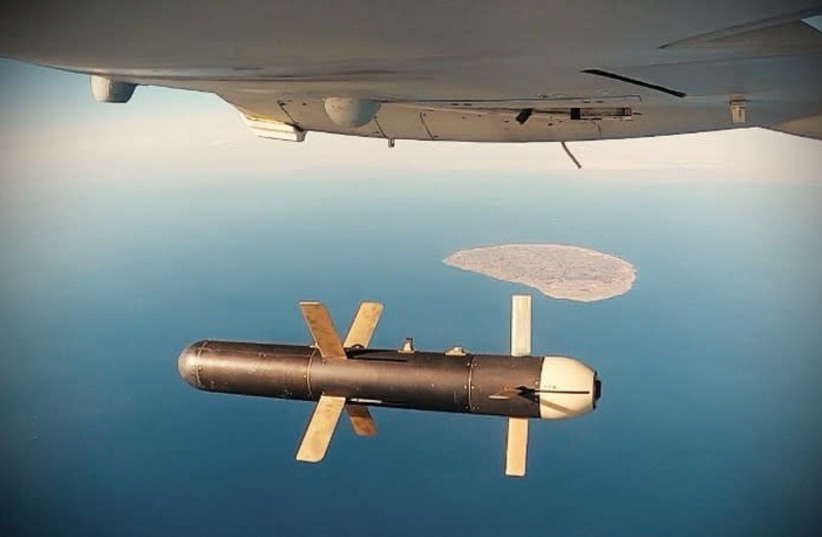
An Iranian Shahed 171 drone dropping a bomb as part of a military exercise in the Gulf, in Iran (photo credit: REUTERS)
An Iranian Shahed 171 drone dropping a bomb as part of a military exercise in the Gulf, in Iran
(photo credit: REUTERS)
Iran has granted a rare interview with one off its top air defense officials responsible for areas in five provinces that border the Kurdistan region of Iraq and also Azerbaijan. With a headquarters in Ardabil province, this is considered the “gate” to the Islamic Republic of Iran and is a sensitive area because of minority populations, simmering insurgencies and security concerns.

While Iran has generally conducted operations against Kurdish dissidents in this area, recently bragging about having defeated the PJAK group over the last decade, the highlighting of air defense is interesting because it sheds light on regional commanders responsible for a unique frontier. According to Tasnim, the commander here is named Brig.-Gen. Abbas Azimi, and he says that he has carried out his mission successfully.

The commander of this Northwest Air Defense Zone discussed the use of special UAV radars in the region. Iran has recently boasts of using new drones with precision munitions and extending its radar range. “We have detected threats at distance from the border, but they did not dare enter the border.” What were these threats? He does not specify. Turkey has been conducted a major campaign using drones against Kurdish PKK militants in northern Iraq in recent months. Turkey has urged Iran to help it fight PKK-linked groups, such as PJAK. In 2018 Iran also used drones to monitor ballistic missile strikes on a Kurdish group in Koya. A drone strike also targeted PJAK in Iraq recently.

This means Iran wants to secure this region. The air defender does not mention what countries might threaten Iran, however, last year, pro-Iranian groups in Iraq linked to the Popular Mobilization Units accused Israel of attacks on their munitions warehouses and specifically claimed Israel used drones.

Iran’s air defense for the northwest says that the country has made major advances and that 90% of systems are made locally. Iran has relied for a long time on its own technological know-how because of sanctions. It has developed local systems such as the 3rd Khordad air defense system which downed the US Global Hawk last June. It tried to send this system to Iraq in April 2018 to T-4 airbase but that shipment was reportedly destroyed in an airstrike.

In August, Iran unveiled the Bavar 373 which it said was a new locally produced system that was developed over the last decade. The Bavar 373 uses a missile that may have a 200 km range. The missile’s origins are actually long ago in a pro-1979 American missile used by the Shah’s regime. The Khordad system by contrast uses a missile with origins likely in a Russian BUK air defense missile. Overall the systems represent achievements in using phased array radar, using both S and X band for detection and guidance.

Iran declared operations S-200s in the 1990s and sought S-300s from Russia. Iran also uses the SA-15 or Tor-M1 surface-to-air missile which it acquired in the early 2000s and which it used by mistake to shoot down a Ukrainian airliner in January 2020. Iran has vast missile technology, including with origins in China, Russia, North Korea and other missile technology that it acquired or reverse-engineered over the years, experimenting with longer ranges for solid and liquid fuel.

Iran’s air defender in the article notes that there are some 20 types of systems he has access to detect enemy aircraft or drones. He says that this includes the usual mix of using frequencies, optics and sensors to cover the skies over northwest Iran. He also has the Bavar 373 long-range missile defense which is more complex. “The Commander of the Northwest Air Defense Zone announced the design and construction of advanced command and control systems in air defense.” He also says Iran is advancing in electronic warfare and that young experts are innovating to make Iran more secure.

Of particular interest he mentioned the importance of drones and UAVs being constructed in his region. “At present Iran can export UAV products.” Iran has been discussing arms exports recently as an arms embargo will be lifted in October. Iran says it maintains round-the-clock observation and using intelligence to prevent aggression. The air defender Azimi noted that air defense is not a new military endeavor but dates from the First World War.

It was not clear why Tasnim included this interview at this time. It mentions, oddly, the difficulty of land acquisition for a headquarters for the unit and the need for regulations of helicopters. Those minor details may be for internal government consumption. Iran has sought to export its air defense abilities and it may be designed to showcase competence for export needs. Overall the message may be to Turkey, Iraq, dissident groups and others that northwest Iran is not a porous airspace but that it has advanced air defense. The region is mountainous and difficult to defend.

https://www.jpost.com/middle-east/iran-shows-off-air-defense-in-kurdistan-azerbaijan-border-region-641310


i24NEWS

Hamas leader Ismail Haniyeh during a demonstration against US President Donald Trump's plan in Gaza on June 26, 2019
Hassan Jedi/Flash90Hamas leader Ismail Haniyeh during a demonstration against US President Donald Trump’s plan in Gaza on June 26, 2019
Hamas leader Ismail Haniyeh while visiting neighboring Lebanon for the next week

Hamas leader Ismail Haniyeh said on Sunday that his terrorist organization was harboring rockets capable of “hitting Tel Aviv and even beyond” during a visit to Lebanon on Sunday, according to Arab media reports.

“We tell the enemy that we will not forgive historic injustice, and that we will not forget our right of return, regardless of the sacrifices,” he added.

Haniyeh also asserted that “[Arab] normalization does not represent the peoples of the region,” referring to United Arab Emirates’ recent decision to sign a peace treaty with Israel.

The leader of the Palestinian terrorist movement’s political wing and his deputy, Saleh al-‘Aruri, are meeting Lebanese Hezbollah leader Hassan Nasrallah while they tour the country over the next week. 

During the meeting, the two terrorist leaders highlighted the solidity of their relations, based “on foundations of faith, brotherhood, Jihad and a common destiny.”

Haniyeh’s statements come against a backdrop of renewed tensions between Israel and the Gaza Strip which have escalated in recent weeks, although a Qatari-brokered ceasefire last week has at least temporarily cooled potential conflagration.


Hamas and Hezbollah seek global terror front against Israel

Haniyeh and Nasrallah were toasting success – that Hezbollah believes it is unchallenged in Lebanon.

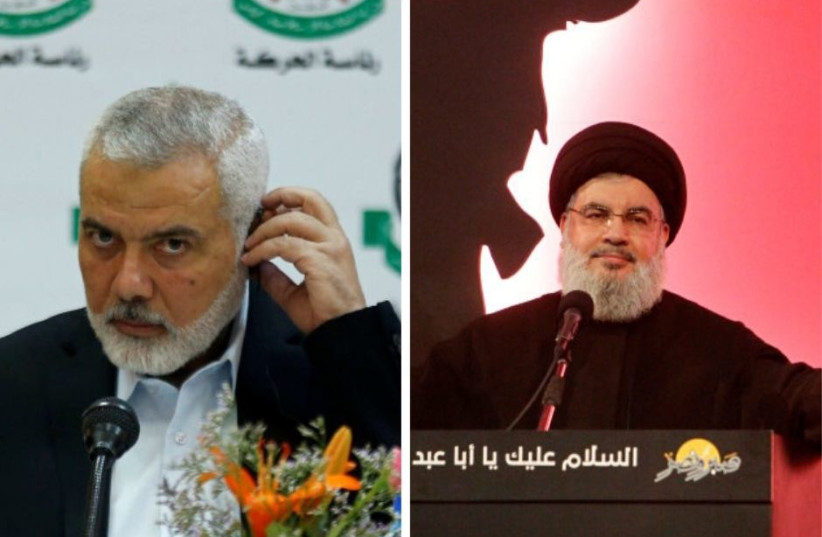
Hamas Chief Ismail Haniyeh attends a meeting with members of international media at his office in Gaza City, June 20, 2019; Hezbollah leader Sayyed Hassan Nasrallah addresses his supporters during a public appearance at a religious procession (photo credit: MOHAMMED SALEM/AZIZ TAHER/REUTERS)
Hamas Chief Ismail Haniyeh attends a meeting with members of international media at his office in Gaza City, June 20, 2019; Hezbollah leader Sayyed Hassan Nasrallah addresses his supporters during a public appearance at a religious procession
(photo credit: MOHAMMED SALEM/AZIZ TAHER/REUTERS)
Hamas leader Ismael Haniyeh recently met Hezbollah leader Hassan Nasrallah in a widely expected meeting. It was designed to showcase that the two terrorist groups can meet openly as if they are governments of two countries.

Hamas is on a regional tour after receiving red-carpet treatment in Istanbul from Turkish President Recep Tayyip Erdogan. The US condemned that meeting. Hamas then went to Lebanon to hold court with Hezbollah, despite the recent horrific explosion that decimated Beirut. While rescuers were searching with dashed hopes for survivors, Haniyeh and Nasrallah were toasting success.

What is the element of that success? Hezbollah believes it is unchallenged in Lebanon. Despite French President Emmanuel Macron seeking to pressure Beirut to form a more technocratic government, it scored a win by having the leader of its parliamentary delegation meet Macron. The terrorist group doesn’t appear to fear that questions about the ammonium-nitrate explosion in August will implicate it in illegal weapons storage throughout the country.

Haniyeh met Nasrallah to discuss developments in Lebanon and the Palestinian areas, according to Fars News in Iran. There are large numbers of Palestinians in Lebanon who live in refugee camps that have become their own neighborhoods. These Palestinians have the same political groups as in the West Bank and elsewhere, and Hamas wants to gain inroads with them.

Hezbollah vows to “resist” Israel and puts photos of al-Aqsa Mosque on its propaganda, indicating how the groups are aligned. They are also aligned with Iran, which supports them both. Hamas also receives political support from Turkey, and its members operate there.

The meeting shows how these groups – both of them extralegal terrorist groups that traffic in weapons – are eroding state institutions, since they meet without the Palestinian Authority or Lebanese officials present.

THE LEADERS complained about US President Donald Trump’s “Deal of the Century” and said they wanted the “Muslim ummah” to oppose Israel, Fars News reported. They claimed their “axis of resistance” was stable and talked about how strong their relationship is, emphasizing “brotherhood and Jihad.” They want to form a “regional alliance” against the US and “Zionists,” according to the report.

It is Haniyeh’s first known visit to Lebanon since 2003.

According to other statements by Hamas reported by Fars News, it appears the organization now realizes it needs strategic partners to confront Israel and that these partners are in Lebanon and Istanbul. This is about creating a counter to what Haniyeh says is a “strategic threat to Palestinian aspirations.”

The recent UAE-Israel deal and Israeli successes in blunting Hamas threats have led Hamas to this conclusion. It tried military means to destroy Israel in the past, including bus bombings and tunnels, but it has largely been isolated over the last 15 years.

Hezbollah also fought a war with Israel in 2006. But since then, it has focused on stockpiling weapons, including drones and precision-guided munitions. Despite tensions with Israel last August and this July over the killing of its members in Syria, a conflict has not developed.

Hezbollah is trying to swallow and digest the Lebanese government, going from being a state within a state to controlling many levers of power. This has been a long path – including the 2008 clashes, putting Michael Aoun in the presidency and intervening in Syria.

In some ways, Hezbollah and Hamas are maturing. Nasrallah was born in 1960 and Haniyeh in 1962. Their formative experiences were in the 1980s, when Hezbollah was rising in Lebanon and fighting Israel and when Hamas was beginning to grow its tentacles in Gaza and the West Bank. They both were becoming full-fledged adult terrorists when Israel appeared to be giving up territory in the West Bank after the Oslo Accords and when it left Lebanon in 2000.

With advice from Iran, Hezbollah challenged Israel after 2000. Hamas thought it could come to power through elections, while using terrorism at the same time. Both movements have had to govern over the last decade because they have grown in power.

But with power comes responsibility. Neither want the responsibility of being held to account as a state, but both appear to want to function like a state. Like Iran using the term “revolution” for an ossifying regime that is opposed by its people, these groups talk about “resistance,” when in reality it is the young generation that wants to be free of their 1980s mentality and shackles of sectarianism.

The meeting in Beirut was an attempt to prove some kind of relevance and legitimacy. Whether they can leverage support from Iran, which is starved for cash by US sanctions, remains to be seen.

https://www.jpost.com/arab-israeli-conflict/hamas-and-hezbollah-seek-global-terror-front-against-israel-641234
