
According to Abdul Rahman Al-Sudais, the imam of the Grand Mosque in Mecca, the prophet was so good to his Jewish neighbor that the latter converted to Islam.

Muslim pilgrims maintain social distancing as they circle the Kaaba at the Grand mosque during the annual Haj pilgrimage amid the coronavirus disease (COVID-19) pandemic, in the holy city of Mecca, Saudi Arabia July 29, 2020 (photo credit: SAUDI MINISTRY OF MEDIA/HANDOUT VIA REUTERS)
Muslim pilgrims maintain social distancing as they circle the Kaaba at the Grand mosque during the annual Haj pilgrimage amid the coronavirus disease (COVID-19) pandemic, in the holy city of Mecca, Saudi Arabia July 29, 2020
(photo credit: SAUDI MINISTRY OF MEDIA/HANDOUT VIA REUTERS)
Has Saudi Arabia begun preparing its people for normalization with Israel?

A sermon delivered on Friday by Abdul Rahman al-Sudais, the imam of the Grand Mosque in Mecca, has been interpreted by some Arabs and Muslims as a prelude to normalization with Israel.

In his sermon, Sudais said that Islam requires Muslims to respect non-Muslims and treat them well.

He pointed out that Prophet Mohammed “performed ablution from a polytheistic water bottle and died while his shield was mortgaged to a Jew.”

According to Sudais, the prophet was so good to his Jewish neighbor that the latter converted to Islam. Sudais also talked about the need to “correct and purify the Islamic faith from false and suspicious beliefs.”

The imam had previously called for peaceful inter-faith dialogue and preached Islam’s opposition to “explosions and terrorism.”

Saudi Arabia has agreed to allow Israeli flights into its airspace. Saudi Foreign Minister Prince Faisal bin Farhan recently said the kingdom was open to establishing relations with Israel on condition that a peace agreement is reached between Israel and the Palestinians.

Sudais’s words sparked a wave of protests on social media, where many Arabs and Muslims claimed he was paving the way for Saudi Arabia to follow suit with the United Arab Emirates and establish relations with Israel.

Egyptian Islamic scholar Mohammed al-Sagheer accused the Saudi cleric of hypocrisy. “He is paving the way for normalization and treason,” Sagheer commented.

Islamic cleric Muhammad al-Shinqiti of Mauritania accused Sudais of exploiting the podium of the Grand Mosque in Mecca to promote normalization with Israel.

Abdel Fatah Fayed, Egyptian affairs editor at Al-Jazeera, said the bottom line of the Friday sermon was that “submission, normalization and loyalty to Israel” are permitted. He added: “Al-Sudais does not have the right to tamper with Islam. Nothing can justify treason.”

Algerian Twitter user Mohamed Mestour posted a picture on the social media platform of Sudais with the caption: “I’m a rabbi, not an imam.”

Iran could become hub of arms trafficking and exports as embargo ends

Iran’s Press TV says the country produces 90% of its arms locally and that Iran is one of the leading top ten countries in the world in terms of indigenous production.

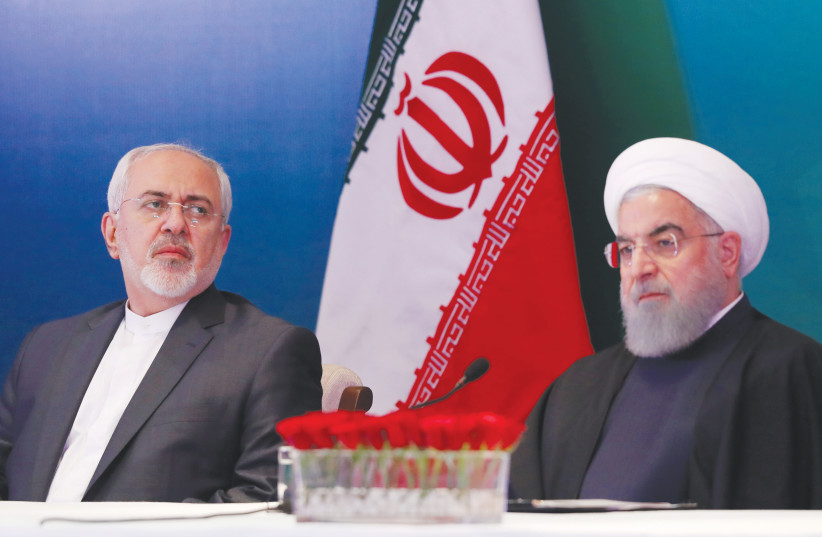
IRANIAN PRESIDENT Hassan Rouhani (right) and Foreign Minister Javad Zarif. Who wanted to pay the price of moral action to truly stop Iran? (photo credit: DANISH SIDDIQUI/ REUTERS)
IRANIAN PRESIDENT Hassan Rouhani (right) and Foreign Minister Javad Zarif. Who wanted to pay the price of moral action to truly stop Iran?
(photo credit: DANISH SIDDIQUI/ REUTERS)
Iran’s own media has bragged that the country will soon become an exporter of weapons as the arms embargo on the country ends. The arms embargoes on Iran are ending despite US calls for them to be extended. The embargo on Iran exporting arms was supposed to be in force for five years after the Iran Deal or JCPOA was adopted in October 2015.

Iran’s Press TV says the country produces 90% of its arms locally and that Iran is one of the leading top ten countries in the world in terms of indigenous production. Arms embargoes that began in the 1980s during the Iran-Iraq war led the country to “produce a wide array of hardware over the years, including its own tanks, armored personnel carriers, missiles, radars, boats, submarines, UAVs and fighter planes.” Iran boasts cruise missiles it says can go more than 1,000km.

According to Iran’s defense ministry the country is already a defense superpower, producing some 38,000 military-grade parts. “Sanctions have so far had minimal negative effects on countries and groups allied with Iran as part of the so-called ‘resistance axis’ formed against foreign and Zionist intervention,” Press TV says.

Iran today is considering not only exports of weapons but also what to do in the face of US “maximum pressure” and attempts to trigger “snap back” sanctions by the US. An article at Fars News reveals that Iran is watching the US presidential election closely. However, despite the view in the US that US presidential candidate Joe Biden might be more keen on returning to the Iran Deal, Iran is not as enthusiastic.

“Biden’s presence in the White House, if not more harmful for Iran, at least has the same consequences as Trump’s presence in this position. A look at the Democratic campaign document also confirms continuation of the same containment strategy that has been in place since the Obama administration.”

In short: Iran will move forward with provocations and weapons import and export regardless of the US election, according to this one report at least.

Iran’s goal is to isolate the US and leverage what it sees as its successes during the Trump years so far on the world stage. Iran is under crippling sanctions, but its narrative is that it can still export and develop weapons. Iran in recent months boasted about new ranges for drones, new precision weapons for drones, new missiles, a satellite, new naval weapons, and new radar.

The country’s message is that it is still full steam ahead. However foreign reports indicate that Iran suffered mysterious setbacks at Natanz and at a missile facility and that it is unable to pay its proxies in Yemen, Iraq and Lebanon due to US sanctions.

The article on the arms exports shows Iran’s plans in the coming months. It illustrates that Iran wants to legally export weapons, not just do so clandestinely as it has already done in the region.

Iran has sent ballistic missiles to Iraq in 2018 and 2019 Reuters reports and Iran has sent at least three ships laden with weapons to the Houthis in Yemen, all of which were intercepted by the US, and Iran sends air defense and other weapons to Syria and it sends precision guided munitions to Hezbollah in Lebanon.


Tehran has been breaching the 2015 nuclear deal in response to Washington’s withdrawal from the deal in 2018 and the reimposition of sanctions.

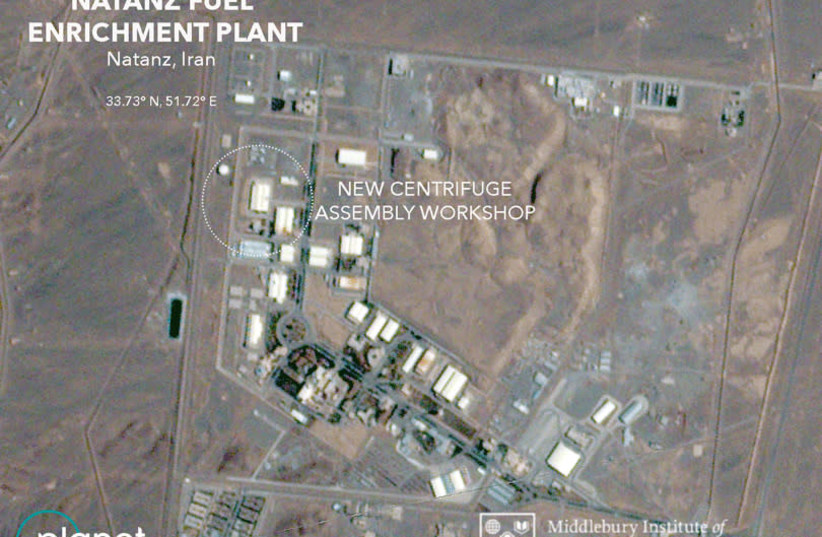
A handout satellite image shows the new centrifuge assembly workshop, according to the Middlebury Institute of International Studies at Monterey (MIIS) analysis, at the Natanz Fuel Enrichment Plant in Natanz, Iran, July 1, 2020 (photo credit: REUTERS)
A handout satellite image shows the new centrifuge assembly workshop, according to the Middlebury Institute of International Studies at Monterey (MIIS) analysis, at the Natanz Fuel Enrichment Plant in Natanz, Iran, July 1, 2020
(photo credit: REUTERS)
Iran’s stockpile of low enriched uranium is more than ten times over the limit set by the Iran deal, according to a quarterly report by the International Atomic Energy Agency released Friday.

Those documents showed that Iran had violated the terms of the 2015 Joint Comprehensive Plan of Action, known as the Iran nuclear deal, but that its stockpile of low-enriched uranium was still lower than it had been prior to the deal.

Iran had granted the UN nuclear watchdog access to inspect one of the two nuclear sites, after a protracted standoff.

During the inspection, the IAEA took environmental samples, one of the two reports obtained by Reuters said, referring to samples aimed at detecting traces of nuclear material that may have been present.

The agency’s inspectors will visit the other site “later in September 2020 on a date already agreed with Iran, to take environmental samples,” the report said.

The other report said that Iran’s stock of low-enriched uranium (LEU) rose by 534 kg. in the most recent quarter, roughly the same amount as in the previous three months, to 2,105.4 kg.

That is more than 10 times the 202.8 kg limit set by Iran’s 2015 nuclear accord with big powers, which Tehran has been breaching in response to Washington’s withdrawal from the deal in 2018 and reimposition of sanctions.

The stockpile, however, remains far below the many tons of LEU that Iran had accumulated before the 2015 deal.

Tehran is enriching up to a fissile purity of 4.5%, which while above the deal’s 3.67% limit is still far short of the 20% higher-enriched level it achieved before the deal.

Report of the violation of the JCPOA comes two weeks after the US reported to the UN that Iran was in violation of the deal. Washington then triggered a mechanism in the deal, which would restore UN sanctions against Iran lifted in 2015 under UN Security Resolution 2231.

The sanctions relief was in exchange for Iranian compliance with the deal, but any of the six signatories to the document have a right to reinstate them should Tehran violate it.

To date, the UN Security Council has dismissed America’s demand to trigger the sanctions, a move that would mark the end of the JCPOA.

The Security Council and the remaining signatories to the deal – Russia, China, France, Great Britain and Germany – want to keep the deal intact.

The US is particularly concerned that the UN arms embargo against Iran is set to expire on October 18. The snapback of UN sanctions would include an arms embargo.

https://www.jpost.com/breaking-news/iaea-inspects-one-of-two-sites-in-iran-after-long-stand-off-641096