
They did not expect to find anything this special when they began digging near what is now the Armon Hanatziv Promenade
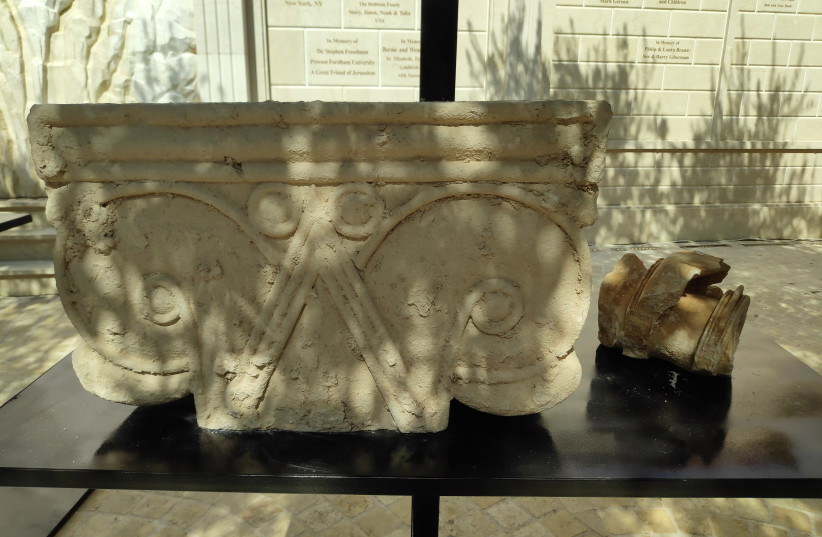
The symbol of the Davidic dynasty (photo credit: TZVI JOFFRE)
The symbol of the Davidic dynasty
(photo credit: TZVI JOFFRE)
A “once in a lifetime” find is how the City of David described three immaculately preserved 2,700-year-old decorated column heads, or capitals, from the First Temple period that indicate a connection to the Davidic Dynasty.

Archaeologists from the City of David did not expect to find anything this special when they began digging near what is now the Armon Hanatziv Promenade.

“I’m still excited,” said Yaakov Billig, an archaeologist with the City of David who began exploring the Armon Hanatziv area about 30 years ago.

He was working at the site when the sound of a spade scraping a stone slab surprised him. After a careful excavation, archaeologists at the site uncovered the capital, whose style is found in royal and official buildings in the kingdoms of Israel and Judea during the First Temple period.

“I thought, ‘Yaakov, maybe you’ve been in the sun too long.’ But I looked again, and it was still there,” Billig told The Jerusalem Post.
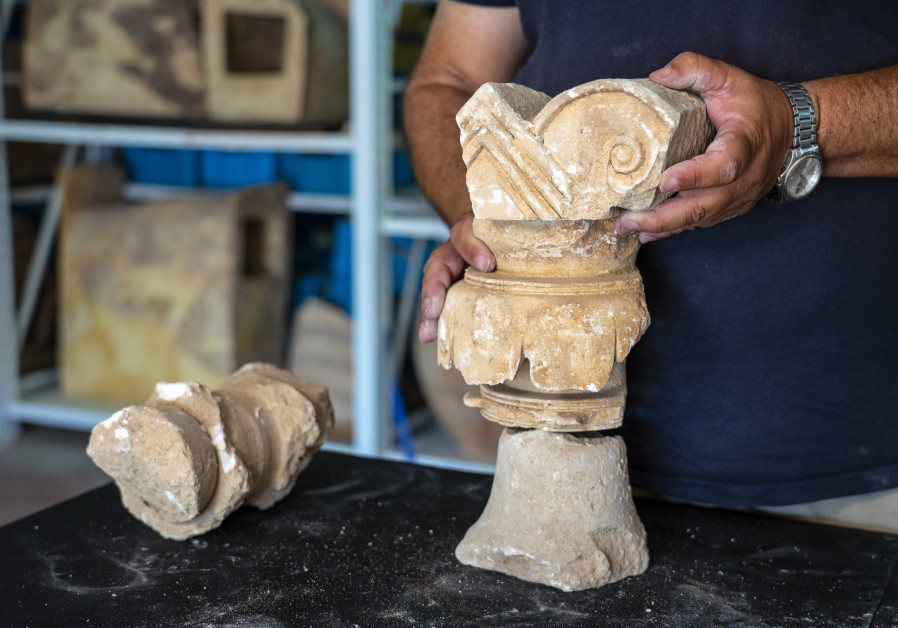
While lifting the capital out of the ground, they were stunned to find not only that the stone was decorated on both side, but that there was yet another identical capital directly underneath it. A third identical stone was found nearby.

The stones seem to have been hidden intentionally due to their seemingly careful placement. It may have been the only thing that saved them from being destroyed, as the rest of the site was “just about leveled,” with many of the surviving stones being recycled in other buildings, Billing said. Why the stones were so carefully hidden may never be known, he added.

The capitals are linked to the Davidic Dynasty because such designs from the period of the kingdoms of Israel and Judea have only been found within the areas they ruled. The design has been found from later periods in other locations throughout the Mediterranean and Middle East.

The royal design can be found today on NIS 5 coins and on signs pointing to archaeological sites in Israel.

Besides the capitals, additional artifacts found at the site indicate a royal or noble building as well, including a toilet, which was only found in the homes of the wealthy in that period, Billig said.

The findings were revealed at a press conference attended by Billig, Israel Antiquities Authority archaeologist Dr. Yuval Baruch, Culture and Sports Minister Chili Tropper and City of David Foundation chairman David Be’eri.

Using evidence from artifacts found at the site and the level at which they were found, archaeologists dated the capitals to the seventh century BCE, between the rule of King Hezekiah and the Babylonian conquest and destruction of Jerusalem.

The location of the site seems to indicate a sort of “exit from the walls” of Jerusalem, showing that the people felt more secure in their surroundings after the Assyrian siege of the city failed. The biblical story of the siege describes the defeat of the Assyrians as a miraculous event against all odds, which may explain why the residents of the city suddenly felt secure enough to settle outside the walls, Billig said.

The other archaeological sites in the area tend to be from the Second Temple period, he said, adding that if additional digs are conducted, other mansions and palaces may be found in the strategically located area.

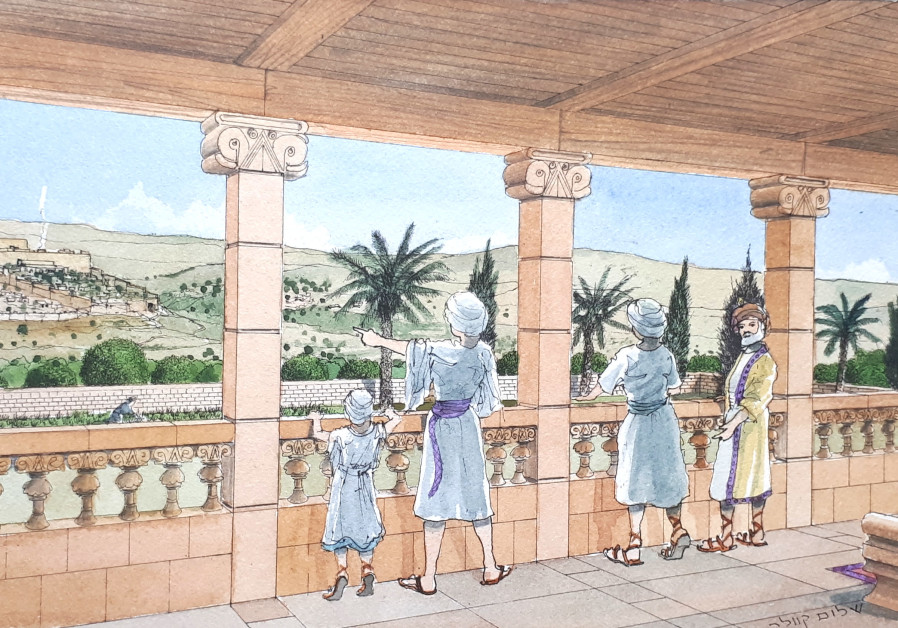
About 20 to 30 similar capitals exist, but these are generally larger and reconstructed. The ones found in Armon Hanatziv are medium-sized and smaller than the more commonly found capitals and may have been used to decorate pillars in a courtyard or patio. Smaller stones of a similar design were found at the site as well and seem to have been used in a decorative window sill.

Archaeological findings are usually revealed to the public only after a long process of research and study. But the City of David and the Israeli officials decided that these findings were too important to keep hidden. The decision to reveal the findings in such an early stage was made “based on the idea and deep belief that these archaeological remains – this built, physical legacy – are the inheritance of the entire public,” Baruch said.

“We are making every effort so that the public will see how professional, scientific and impartial Israeli archaeology is – which is relevant to everyone, no matter where they’re located, whether in Israel or anywhere else,” he said.
“This discovery is really a once-in-a-lifetime discovery,” City of David Foundation vice president Doron Spielman said. “It’s not every day that we’re able to discover something that four billion people around the world – who have some type of identity to the bible, to ancient Jerusalem, to the idea of discovering the bible and unearthing the archaeology underneath the ground and connecting it to the actual place” – can relate to.

A large number of additional artifacts from the same period were found at the site as well. But the capitals may be some of the greatest treasures, connecting the site to the stories of the Davidic kingdom in the Bible. The additional artifacts found at the site are being studied and will be revealed to the public at a later date.



The Effort to Dismantle the State of Israel

By September 6, 2020


BESA Center Perspectives Paper No. 1,732, September 6, 2020

EXECUTIVE SUMMARY: Unlike other Western democracies, Israel has had to face the coronavirus crisis at a time when its social cohesion and governability have been weakened by a chain of processes and events over recent decades that were propelled by the values of progressive liberalism. The coronavirus crisis offers an opportunity, which must not be missed, to put Israel’s existence and security back on the footing of the country’s original liberal values.

Israel’s original values are grounded in the morality of truth, freedom, mutual responsibility on the national level, and justice, with the aim of forging a strong social-national entity on that basis. Progressive liberalism, by contrast, denies the existence of objective truth and views every social structure—from the family to the nation itself—as an outcome of power and oppression. Such power and oppression, according to progressive liberalism, must be eliminated.

Adherents of this philosophy believe, accordingly, that Jewish Israel, as a nation-state whose values represent the old social order, must disappear so as to clear the path for their own values. This line of thinking is congruent with the argument made in the last century that Judaism had to disappear so as to clear the path for the values of the communist and Nazi social orders.

The campaign to dismantle Israel began in the late twentieth century when a group of Israeli academics and journalists presumptuously self-styled themselves as “the new historians.” Through “the fabrication of Israeli history” (as Efraim Karsh put it), they turned the Israeli side, which barely survived a pan-Arab attempt to annihilate it a few years after the Holocaust, into the guilty party for defeating those seeking its demise.

Despite academic and legal refutation of their “research,” the “new historians” succeeded—along with artists and writers such as Amoz Oz, who averred that “pure truth destroys everything and does not build anything”—to puncture the fervent national ethos of the establishment of the state of Israel, an ethos that united Israeli and world Jewry.

Fabricating Israeli history paved the way to fabricating the reasons for the Palestinian-Israeli conflict. This involved transforming the conflict from an existential confrontation in which one party (the Palestinians) categorically rejects the other’s right to national self-determination into a territorial real estate dispute that could be ended in a compromise-based peace.

Compromise is a supreme foundational value in Jewish culture and in Western democracy, and most of the Israeli Jewish public has consistently supported it, including during the Oslo “peace” process. Ironically, even though it was the Palestinian leadership that rejected the “Oslo compromise” (just as it had rejected the numerous compromises offered over the course of the twentieth century), many blamed Israel, not the Palestinians, for the failure of this process. This enabled the Palestinians and their liberal-progressive backers to amplify their century-long denial of the Jewish People’s right to national self-determination.

The fact that the Guardian saw fit to publish three articles in a single week questioning Israel’s right to exist, like the one penned by American Jewish journalist Peter Beinart, at a time when Britain is undergoing one of the worst health, economic, and social crises in its modern history, points to the obsessive mendacity of this campaign.

No less alarmingly, the illusion that the “era of peace” and the technological revolution obviate the need to physically control territory and defeat the enemy has driven the IDF’s top brass to scrap not only the ground army, as maintained by Gen. (res.) Yitzhak Brik, the sharpest critic of the defense establishment in recent years, but also the IDF’s most precious asset: the doctrine of rapid victory that enabled its impressive triumphs in 1948, 1956, 1967, and 1973. It was replaced by an esoteric doctrine of warfare that was concocted from the ideas of leading poststructuralist philosophers and that denied Israel the ability to end its wars with a quick, clear-cut, and overwhelming win, as seen in the failed wars in Lebanon (2006) and the Gaza Strip (2008-09, 2012, and 2014).

Meanwhile, “the constitutional revolution” dealt a severe blow to the Israeli government’s ability to function. For while this revolution helped make the moral values touted in Israel’s Declaration of Independence part of Israel’s Basic Laws, that contribution pales into insignificance compared to the damage wrought by the concomitant “cultural revolution”—especially the making of jurists into “the main agents of incorporating [progressive] liberalism into the culture of the country” (as an Israeli law professor described it). This fractured Israeli democracy and governance by frequently overturning the laws and decisions of the elected legislative and executive authorities in line with the values of progressive liberalism. Those values directly clash with the values of the state of Israel and its Basic Laws.

Thus the coronavirus, whose defeat requires the intensive use of moral acumen in every domain, offers an opportunity to go back to grounding the decision-making of the state’s three authorities, and of its operative mechanisms, in its moral values as articulated in the Basic Laws. This is a cultural-educational task of the highest order, and it must be undertaken immediately. It will require appointing a special project manager, as was done in the field of public health. Then, while the health of the country’s citizens is being protected, a vital effort will also be made to thwart the attempts to dismantle and destroy those citizens’ national home.

https://besacenter.org/perspectives-papers/israel-existence-security/?fbclid=IwAR0AxPTL-9elROaMC3Rauxp-cvYyvvoov3z2qxRZzEtT2mXACXUV8nXXZds


Washington’s Middle East allies could have little choice with 5G

Currently in ‘cold war’ with China, US deems its version of telecommunications system a security concern

Workers install 5G telecommunications equipment on a T-Mobile tower in Seabrook, Texas. May 6, 2020 (photo credit: REUTERS/ADREES LATIF)
Workers install 5G telecommunications equipment on a T-Mobile tower in Seabrook, Texas. May 6, 2020
(photo credit: REUTERS/ADREES LATIF)
The US is pressing its allies in the Middle East to join about 30 other nations in foregoing the Chinese version of 5G, the newest technology for cellular networks, claiming that a law in China can compromise their data and security.

These states will thus find themselves having to choose between Beijing, a major investor in the region, and Washington, their security guarantor, which believes its own security could be breached via allies using a Chinese system.

“It’s every country’s own decision,” US Under Secretary of State for Economic Growth, Energy and the Environment Keith Krach told The Media Line, adding, however: “We want to warn them against using Chinese 5G for their own national security.”

It’s not just a warning, though.

When asked how serious the US was in saying that it could sever ties with allies that disagree, Krach replied: “It’s very serious.”

One of those allies is Israel.

Under Prime Minister Benjamin Netanyahu, the Jewish state has made China its third-largest trading partner. The Asian giant has invested huge sums in infrastructure projects and start-ups in Israel – some of them so sensitive that they drew concern in Washington for potentially putting US military operations in the area at risk.

When Netanyahu formed a government in April after two swings and misses, the first meeting set up by US Ambassador to Israel David Friedman was not with him or his coalition partner, Alternate Prime Minister and Defense Minister Benny Gantz – it was with Yoaz Hendel, the communications minister. The goal was to pressure Hendel to stay away from China when issuing 5G tenders.

“I think Amb. Friedman’s move is highly symbolic because 5G is highly strategic to the United States, to Israel and nations around world – to their national security and sovereignty – because with the capabilities of 5G, it’s touching all your communications,” Krach told The Media Line.

“It’s the backbone for the Chinese Communist Party’s surveillance state. It extends the great China firewall when you hook up apps, microphones and cameras. We’re banging the drum on that,” he stated.

“It’s every country’s right to choose who they want to go with… but the risks are enormous,” he said.
By all indications, Israel and the US are days away from signing a memorandum of understanding according to which Israel will block the use of Chinese equipment in its 5G networks.

This shift away from China has been swift and dramatic (although there are other reasons, such as Chinese deals with Israel’s archenemy, Iran). But are the Israelis – along with other allies in the region – becoming a pawn in America’s trade war with China?

“I don’t see a trade war,” Krach said. “I see a real and urgent threat to democracies around the world. It is about Israel’s national security. I mean Israel, pound-for-pound, has the most technology in the world.”

The US is seeking to root out Chinese involvement in 5G as part of its Clean Network Initiative, announced in April. It says that China is among a group of malign actors looking to use the technology and other internet and communications infrastructure to spy on customers and siphon off sensitive military, political and economic information.

The Chinese law cited by the US allows Beijing to force any of the country’s companies, state-owned or otherwise, to provide such data to the government on demand. The US, therefore, has stated its preference 5G systems from domestic or European vendors.

Washington has made its concerns known to the Gulf states as well, but perhaps not so publicly.

Pre-pandemic, these countries supplied 28% of China’s oil imports, and the Chinese economy is now bouncing back more rapidly than that of the US and the European Union.

Yet like Israel, Gulf states are dependent on security partnerships with the US because of their common enemy, Iran.
The US boosted its 40,000-troop deployment in the Gulf following what is believed to have been a 2019 Iranian strike on Saudi oil facilities, sending soldiers to Saudi Arabia and the United Arab Emirates. The forward headquarters of its Central Command is in Qatar, and its Fifth Fleet is stationed in Bahrain.

This tug-of-war for influence is going to force US allies to pick a partner, but they are going to put off a decision for as long as they can and use as much leverage as they can in the process.

“I think it would be useful first to remind ourselves that these countries have agency and some leverage of their own,” John Calabrese, director of the Middle East Institute’s Middle East-Asia Project, told The Media Line. “So apart from the issue of how China will approach this contest is the question of its Gulf partners’ calculations.”

Gulf Cooperation Council states have been preparing for higher-profile roles on the global stage. These nations have spent the past decade pouring their oil wealth into investments in their digital infrastructure, partially with an eye toward showcasing development through events like the 2022 FIFA World Cup, to be held in Qatar; the UAE’s Dubai Expo 2020 (which was postponed until 2021 because of the coronavirus pandemic); and Saudi Arabia’s 2020 G20 presidency, with a summit in Riyadh coming up in November.

The Saudis are keen on transforming themselves into the region’s digital hub. Last year, the kingdom’s leading carrier partnered with China’s Huawei for a 20-city, 2,000-tower 5G introductory project, giving Saudi Arabia the largest 5G network in its corner of the world.

The UAE was preparing to host more than 25 million visitors to Expo 2020, and its two biggest telecoms signed 5G deployment deals with Huawei. The first end-to-end 5G call in the region took place last year courtesy of the UAE’s Etisalat telecom.

The 2022 World Cup is a massive undertaking, and Qatar wants to include 5G. One of its two main telecoms, Vodafone, partnered with Huawei to deploy 5G networks in the capital, Doha, and in scores of other locations.

So how much would a Gulf withdrawal from China on the 5G front impact Beijing’s long-term plans for the region?
“A departure point for considering Beijing’s possible approach is to recognize that Chinese interests in the Middle East are far more extensive and of greater importance than any one sector, much less any single company,” The Middle East Institute’s Calabrese noted.

“That said, it seems to me that the central battleground on which the US-China rivalry will play out is the field of advanced technology,” he went on. “The stakes are quite high in the longer term for the US and for China, given the historical evidence that technological breakthroughs and innovations can produce enormously valuable civilian-military synergies.”

For now, it seems that the US has a leg up on China in the 5G war. The United Kingdom and France announced recently that they would take America’s “clean” path, as did the three biggest telecoms in Singapore and Canada.

“There are around 30 countries that have already made the decision to go clean,” Krach told The Media Line, citing several European states. “In February, Huawei announced [it] had 91 5G contracts. They’re down to 30-something. Those deals are evaporating.”

The remaining countries, including some Gulf states, may be hanging on to see if the upcoming US election leads to a Joe Biden administration and a possible change in the aggressive US posture toward China. In the meantime, Beijing is looking to recoup its losses by turning to Iran, with the two sides recently drafting a monumental trade and security partnership, undercutting US efforts to isolate the Islamic Republic.

If there is one country that is not much interested in US threats about its telecommunications alliances, it is apparently Iran.
But the move gives the US another talking point when it comes to its allies in the Middle East: Why do business with China when it is doing business with your number-one enemy? In fact, Washington is asking its Gulf allies why America needs to be pressing them on Chinese 5G at all.