
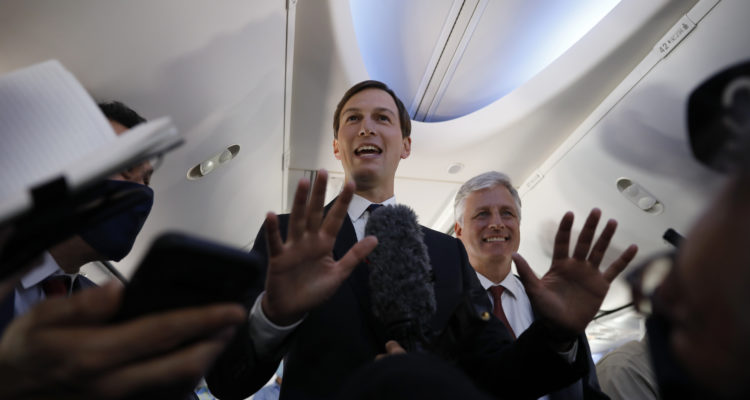
Kushner: Peace between Israel and all 22 Arab states ‘logical’

September 2, 2020

As the Israeli delegation returned to Israel after an historic visit in Abu Dhabi, President Donald Trump’s son-in-law and senior advisor Jared Kushner continued his tour of the Gulf.

Kushner visited Saudi Arabia and Bahrain, meeting with the kingdoms’ leaders. Israel’s Channel 12 News reported that Kushner may also visit Qatar in the coming days.

In Saudi Arabia, Kushner met with Crown Prince Mohammed bin Salman. Saudi-owned news agency SPA reported that the pair “discussed the peace process and its horizons, as well as the need to resume negotiations between the Palestinians and the Israelis to reach just and lasting peace.”

Saudi Arabia, which officially has no diplomatic relations with Israel, is widely thought to cooperate with the Jewish state on regional security issues.

The Gulf kingdom recently allowed the first commercial direct flight from Israel to the UAE to fly over its airspace, a move Kushner praised as “very gracious.”

Two weeks ago, Prince Faisal, the governor of the Madinah province, released a statement praising the UAE-Israel peace agreement, but stopped short of saying Saudi Arabia had plans to follow.

“Peace must be achieved between the Palestinians and Israelis based on the internationally recognized parameters,” he said. “Once that is achieved, all things are possible.”

King Hamad bin Issa al-Khalifa of Bahrain also praised the UAE-Israel peace agreement in his meeting with Kushner.

According to the Bahrain News Agency, al-Khalifa “highlighted the United Arab Emirates’ historic and continued efforts to support the interests and causes of Arab and Islamic nations, and their… endeavors to reach a just and comprehensive solution that guarantees the Palestinian people their legitimate rights and lasting peace in the region.”

When asked by the UAE’s state-run news agency WAM about the possibility of additional peace agreements with Arab nations on the horizon, Kushner responded optimistically.

He said all 22 Arab states normalizing relations with Israel was “logical” and the next agreement could happen “within months.”

“Obviously anything could happen, but the reality is that a lot of people are envious of the move that the United Arab Emirates has made. A lot of people want access to the technology, economy and the advancements that Israel has. Israel is like another Silicon Valley for the Middle East,” he said.

“We don’t solve problems by not talking to each other. So, normalizing relations and allowing people-to-people and business exchanges will only make the Middle East stronger and a more stable place,” he added.

Kushner: Peace between Israel and all 22 Arab states ‘logical’


Threading the Middle East Needle

U.S. Marines with Special Purpose Marine Air-Ground Task Force – Crisis Response – Central Command conduct a joint-security patrol in Syria, August 23, 2020. (Sergeant Brendan Custer/USMC)

Russia harasses U.S. forces in Syria as Iran grabs Iraq.

Russian forces in Syria are seeking to escalate tensions with U.S. forces there at the same time as Iranian-backed proxy groups in Iraq continue to fire rockets at U.S. facilities. This puts the White House and Pentagon in a bind. With an election looming and domestic crises on the agenda, the Trump administration has indicated it may make a decision about the U.S. mission in Syria “fairly soon” as some U.S. forces are withdrawn from Iraq. In the wake of Secretary of State Mike Pompeo’s successful trip to the region in August, it’s essential that Russia and Iran don’t come away looking like winners in Syria and Iraq. Threading this needle by maintaining a small U.S. footprint and keeping Iran and Russia deterred will be a difficult task.

Russian armored vehicles in Syria clashed with a U.S. patrol on August 25, injuring the crew of an American mine-resistant ambush-protected (MRAP) vehicle. The incident happened in northeast Syria. This is a complex landscape where the U.S. withdrew from some bases and posts in October 2019 during a Turkish invasion. That crisis saw U.S.-backed Syrian Democratic Forces (SDF), who have been fighting ISIS, withdraw while a Russia–Turkey agreement partitioned a border area. However, the U.S. remained in many parts of eastern Syria, with the White House saying soldiers would “secure” oil fields.

The Russians, backed by the Syrian regime, have sought to undermine the U.S. role in Syria. Russia, Iran, and Turkey have condemned an “illegal deal” between a U.S. oil company and the SDF in Syria. To confront American forces, the Russians use propaganda in media and incite pro-Syrian-regime locals to protest U.S. forces. Russian patrols frequently monitor American patrols, sometimes playing cat-and-mouse on local roads, with the Russians following U.S. vehicles around or harassing them. On August 25, Moscow went one step further. Backed by two helicopters, the Russians struck a U.S. vehicle with one of their own. The helicopters buzzed the U.S. patrol at low altitude, kicking up dust, which the U.S. coalition says was abnormally aggressive behavior.

The White House said the incident was “unsafe and unprofessional” and called for deconfliction. American soldiers have a right to defend themselves, the National Security Council reiterated. Joint Chiefs head General Mark Milley spoke to Russian general Valery Gerasimov, his Russian counterpart, about the incident. Clearly the White House and Pentagon are taking this seriously, because previous incidents with the Russians haven’t reached this level of condemnation and phone calls to Moscow.

As Russian patrols harass the U.S. near Derik and Qamishli in Syria, 250 miles southwest, U.S. forces and their partners are being challenged by Iran and ISIS sleeper cells near Deir Ezzor in Syria. This is a large area, spanning roughly the distance from New York City to Washington, D.C. Iran’s goal is to infiltrate tribal areas near the Euphrates River and get tribes to protest the U.S. and SDF presence. Meanwhile, across the border in Iraq, there are weekly rocket attacks by Iranian-backed militant groups on areas where Americans are present, such as the embassy in Baghdad. In the past, when U.S. forces were killed at Camp Taji by a rocket attack, U.S. Central Command responded with airstrikes. On August 23, U.S. forces left Taji and handed it over to the Iraqi army, one of half a dozen bases handed over in the last six months.

The Russians and Iranians know that the U.S. is leaving bases in Iraq, and Russia unsurprisingly sought to end an arms embargo on Iran while Tehran brags about defeating the U.S. at the United Nations. Put it all together and it looks like a full-court press to harass the U.S. across Iraq and Syria. Does Moscow think that if it ups the cost for Washington to remain in Syria, America might pull back, as the U.S. did after Turkey’s invasion in October 2019? Certainly Iran and Russia know U.S. elections are coming up and that the administration has vowed to stop fighting endless wars in “faraway places.”

https://www.nationalreview.com/2020/09/us-foreign-policy-syria-iraq-deter-russia-iran-difficult-task/


“The finds on the mountain reflect 3,000 years of Jewish activity at the site, and every pit dug in the site could shed light on thousands of years of Jewish history.”

A view of the Temple Mount from the air (photo credit: GALI TIBBON)
A view of the Temple Mount from the air
(photo credit: GALI TIBBON)
The Waqf filled in a hole that opened in the Temple Mount floor with concrete on Tuesday, raising concerns that possible archaeological findings may now be lost.

The hole opened up near the Mughrabi Gate in the southwestern section of the Temple Mount on Sunday, according to the Waqf. The Mughrabi Gate is the gate used by all non-Muslims to enter the Temple Mount plaza.

The hole was about 1 ft (30 cm) by 1.3 ft (40 cm) wide and about 2.3 ft (70 cm) deep and located about 13 ft (four meters) from the Western Wall and 39 ft (12 meters) from the southern wall.

An advisor for the Waqf stated that the hole was most likely a water conduit.
The Temple Mount Organizations demanded that a proper archaeological restoration be conducted at the site, but the hole was filled with concrete by the Waqf on Tuesday, according to Army Radio.
“The Temple Mount is the microcosm of the ancient world. Every meter on the Temple Mount has first-rate national importance,” said Asaf Fried, a spokesperson for the Temple Mount Organizations, according to Temple Mount News. “The finds on the mountain reflect 3,000 years of Jewish activity at the site, and every pit dug in the site could shed light on thousands of years of Jewish history. Whether it is a cistern from the days of Herod, or an opening of a cave from the days of King Solomon, from the escape caves he built at the bottom of the mountain, among other things to hide the Ark of the Covenant during a hostile onslaught.”

“Where are all the thousands who went out a month ago to protest against harming the holy things of Israel?” wrote the Students for the Temple Mount group on Twitter. “When it happens in reality in the most holy place for the Jewish people, is it less important than a TV show?”

The Al-Quds Foundation warned that the hole may be a sign of structural damage to the southwestern area of the site, referencing a stone that fell out of the Western Wall not far from where the hole opened. The foundation claimed that Israel is preventing a proper restoration of the site in order to place the area in structural danger and create an opening to intervene.
In July 2018, a large stone fell out of the wall above a prayer platform that is part of the egalitarian prayer section of the Western Wall, causing significant damage to the site. Repair work on the stones was completed in March.
The Waqf, an arm of the Jordanian Ministry of Sacred Properties, administers the Temple Mount site.
Visits by religious Jews to the Temple Mount are monitored by Waqf guards and Israeli police – and all Jewish prayer, including silent prayer, is forbidden, according to the Jerusalem Center for Public Affairs.
No sacred Jewish objects, such as prayer books or prayer shawls, may be brought onto the mount, according to the tourism website Tourist Israel.

The Temple Mount is open to Jewish entry Sunday through Thursday from 7:30 a.m. until 11 a.m. (10:30 a.m. in the winter) and again from 1:30 p.m. until 2:30 p.m.