Stopping sovereignty moves was “prerequisite” for normalization, UAE official says, and confirms F-35 sale was not part of the deal.
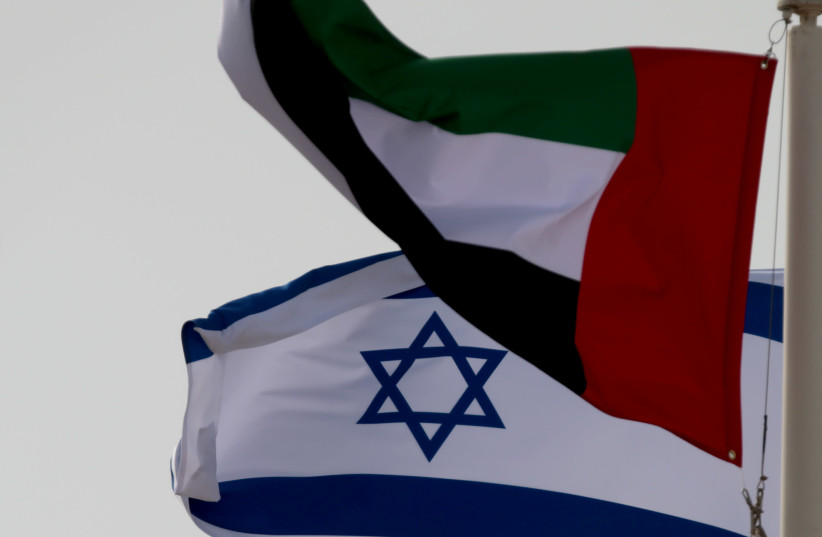
A United Arab Emirates (UAE) flag waves alongside an Israeli flag (photo credit: REUTERS/CHRISTOPHER PIKE)
A United Arab Emirates (UAE) flag waves alongside an Israeli flag
(photo credit: REUTERS/CHRISTOPHER PIKE)
Israel and the United States have promised the United Arab Emirates that Jerusalem will not annex parts of the West Bank as a guarantee for normalizing relations between the countries, UAE Foreign Ministry Director of Policy Planning Jamal al-Musharakh said on Tuesday.

Asked if annexation would threaten the ties between the countries, al-Musharakh said “it does not” and that “bilateral relations are well underway in various fields.”

However, he added, that “one of the prerequisites of the commencing of bilateral relations was the halting of annexation.”

Al-Musharakh said he has “assurances from key leaders in the US and Israel” that such a move will not happen. He used a word in Arabic that means to stop or delay to describe the agreement on the matter of sovereignty. American statements on the matter used the word “to suspend.”

The UAE “remains with the Arab consensus and resolutions pertaining to” the Palestinians, he said. “We have not backed out even an inch from our position.”

Al-Musharakh spoke with journalists at the Presidential Airport in the UAE as the first official Israeli delegation to the country, led by National Security Adviser Meir Ben-Shabbat, came to a close. A day earlier, the first-ever direct flight from an Israeli airline, El Al, landed in that airport.

Al-Musharakh argued that normalization with Israel benefits the entire region, including the Palestinians.

“There is room for innovation and education and a future for youth not to grow up in an area of conflict,” he said. “There are too many conflicts in the region and it is high time to look forward to sustainable ways forward and hope for the future.”

The Emirati official confirmed Prime Minister Benjamin Netanyahu’s account that the sale of F-35 stealth jets was not related to ties with Israel.

“It was not by any means the driver of this,” al-Musharakh said, and opposed a journalist’s characterization of the matter as an “irritant” in the normalization process.

The purchase of the F-35s is “a legitimate, longstanding request we have. We see them as legitimate.”

In response to Iranian leader Ayatollah Ali Khamenei’s remarks that normalization with Israel is a “betrayal” and “the Emiratis will be disgraced forever,” al-Musharakh said “the path to peace and prosperity is not in hate speech.”

“That kind of message runs counter to a forward-looking view for the region,” he added.

As for the normalization talks, Al-Musharakh said things are moving “at a healthy pace,” but it is hard to determine at this point when embassies will open or when a signing ceremony in the US takes place.

When there is a UAE embassy in Israel, it will be in Tel Aviv, he said.

The discussions, which took place in Abu Dhabi on Monday and Tuesday, have been “promising,” and “prove that the path towards peace and prosperity is through partnership and cooperation,” al-Musharakh added.

“There is a large demographic of youth in the region that needs hope, a way forward,” he said.

Al-Musharakh expressed hope that Israeli-Emirati cooperation, such as on fighting COVID-19, will benefit the entire world, not just the two countries.

Erdoğan believes he is restoring Turkey to greatness. Is he?

The Erdoğan vision is to recreate the period of Turkish and Ottoman greatness.

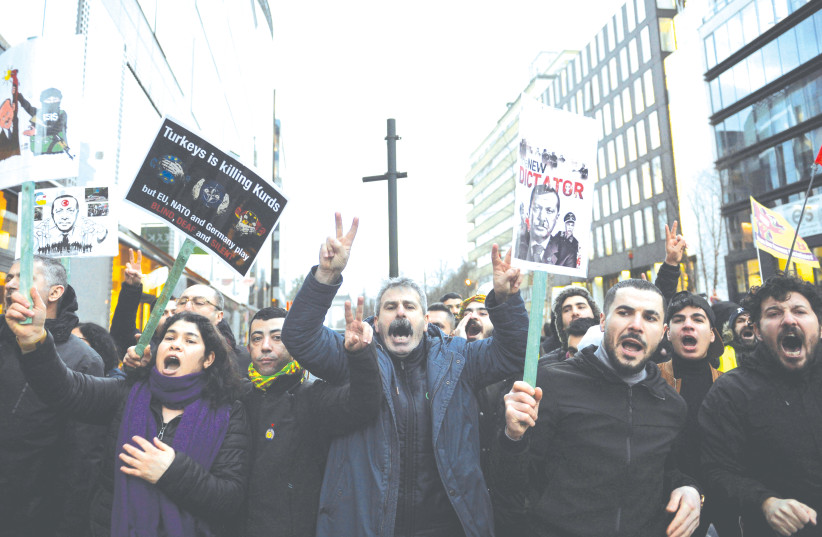
DEMONSTRATORS PROTEST a visit of Turkey’s President Recep Tayyip Erdogan in Brussels, March 2020. (photo credit: JOHANNA GERON/REUTERS)
DEMONSTRATORS PROTEST a visit of Turkey’s President Recep Tayyip Erdogan in Brussels, March 2020.
(photo credit: JOHANNA GERON/REUTERS)
Mustafa Kemal Ataturk was the founder of modern-day Turkey. Now, almost 100 years after serving as the first president of the Republic of Turkey, Ataturk is having a resurrection – of sorts.

Turkish President Recep Tayyip Erdoğan thinks he is the new Mustafa Kemal Ataturk.

Erdoğan is trying to regain lands and restore Turkey to greatness. If he has his way, he will restore his country’s heritage even further back in history. He revels at the thought of restoring Turkey’s influence to the position it held during the Ottoman Empire, and even earlier, to the period of the Seljuk Empire, the powerful Turkish-Persian Sunni ruling federation of the 11th-14th centuries.

Erdoğan is expanding Turkey. He is laying claim to territories, waters and oil rights that include the Eastern Mediterranean. The Turkish Army has invaded parts of Iraq and Syria. Some of these claims, such as the conflict with Greece, have been covered in the international media. Most others have not.

A map recently circulated on Twitter by Metin Kulunk, one of Erdoğan’s closest political associates, offers proof of Turkey’s expansive objectives and territorial claims. On the Erdoğan map, Turkey spans areas far more vast than the territory it now holds. The map includes northern Greece through to the eastern Aegean Islands, half of Bulgaria, all of Cyprus, most of Armenia and large swaths of Georgia, Iraq and Syria.

The Erdoğan vision is to recreate the period of Turkish and Ottoman greatness.

The map was originally tweeted on August 26. The date is significant. It is the anniversary of the Battle of Manzikert that took place in 1071. It was the battle that led to the eventual defeat of the Holy Roman Empire. The battle was the beginning of the fall of the Holy Roman Empire and the start of the emergence of the Ottoman Empire. The significance of this transitional period in history is best realized in the change of names. In 1453 Constantinople, the capital city of Turkey was renamed Istanbul.

In Erdoğan’s world view, an equivalent of the original Holy Roman Empire exists today, and that equivalent is none other than the United States and her ally Israel. Erdoğan is positioning himself and his country to fill what he sees as an extremely important power gap. He wants to oust today’s equivalent Holy Roman Empire and occupy that position himself.

FOR THE Turkish president, this happens in stages. He is filling power voids left by Iran. As Iran falters on the international stage, because of the COVID-19 pandemic and because of the crippling effect US-led sanctions are having on the Iranian economy, Turkey is stepping in. Erdoğan has championed the cause and is taking the place once held by Iran as leader of the bulwark against the West.

This week, for example, a gas deal was signed between a US company and the Syrian Democratic Forces, a Kurdish group that controls a section of Syria that has significant and untapped oil reserves. Turkey, along with Iran and Russia, condemned the agreement. Turkey has told the United States repeatedly to get out of Syria. Declaring that the United States is an outsider, all three condemning countries echoed his point. They did not, of course, see the irony in that each one of these countries also has a significant presence in Syria.

Recently, Erdoğan hosted the Hamas leadership in Istanbul. During their meeting, as was first reported by The Jerusalem Post, Erdoğan gifted Hamas leaders with Turkish citizenship and a prized Turkish passport. Knowingly issuing a Turkish passport, a European Union passport, to known and wanted international terrorists is nothing short of sponsoring terrorism. These coveted travel documents will be used to raise money that will unquestionably finance the planning and execution of murderous terrorist attacks against civilians in Israel.

Erdoğan is an extremely effective leader. He created an Islamic party that ousted the security and military caste that had effectively checked Islamic extremism. Over the years, Erdoğan has become increasingly Islamist and increasingly more extremist. The move is apparent in his growing disdain for the West, and especially clear in his attitude toward the United States and Israel.

Despite serious economic troubles at home, Erdoğan is a leader on the move. Invoking images of the Seljuk Empire and Ataturk, coupled with his unabashed defiance of the United States and Israel, strengthens his position within his own country. Erdoğan makes Turks proud of their heritage, proud to be Turkish and the progeny of once great heroes and warriors.

Erdoğan’s vision is in direct conflict with the West. I hope he fails. I think he will fail. His ideology, while it makes people feel good, has resulted in hard economic times. National economic success is dependent on linkage to the United States and Israel. Iran and Russia cannot – will not – pick up the slack. Thus far Erdoğan’s ideology, not his economic interests, has led his decision-making process. But it will only take him so far.

In the end, success is all about economics.

The author is a political commentator and the host of Thinking Out Loud on JBS TV.


Iran nuclear deal parties meet to try to save accord amid US pressure

Signatories to the agreement will hold talks as Tehran continues to ramp up nuclear activities


European and Iranian diplomats meet as part of closed-door nuclear talks with Iran in Vienna, Austria, February 26, 2020. (AP Photo/Roland Zak)

File: European and Iranian diplomats meet as part of closed-door nuclear talks with Iran in Vienna, Austria, February 26, 2020. (AP Photo/Roland Zak)

The signatories to the faltering Iran nuclear deal will meet in Vienna on Tuesday as the US is urging international sanctions on the Islamic republic to be reimposed and an arms embargo to be extended.

Britain, France, Germany, China and Russia are struggling to save the 2015 landmark accord with Iran, which has been progressively stepping up its nuclear activities since last year.

Tehran insists it is entitled to do so under the deal — which swapped sanctions relief for Iran’s agreement to scale back its nuclear program — following the US withdrawal from the accord in 2018 and the reimposition of sanctions.

In a boost to Tuesday’s talks, the Iranian atomic energy last week agreed for inspectors of the UN nuclear watchdog to visit two sites suspected of having hosted undeclared activity in the early 2000s.

One of the sites was reported to be in Abadeh, south of Isfahan — a location that in September 2019 was revealed by Prime Minister Benjamin Netanyahu as the site of an alleged secret nuclear facility. Netanyahu said at the time that Iran had tried to destroy the site and any evidence it had been used to develop nuclear weapons.

International Atomic Energy Agency Director General Rafael Mariano Grossi attends a meeting with head of the Atomic Energy Organization of Iran Ali Akbar Salehi, in Tehran, Iran on August 25, 2020. (Atomic Energy Organization of Iran via AP)

The International Atomic Energy Agency (IAEA) head Rafael Grossi had traveled to Iran last week on his first trip since taking up the top post last year, and after months of calling for access.

Results from any site visits are, however, expected to take three months, according to a diplomat familiar with the matter, so “it risks being a problem then with the Iranians” if anything undeclared and nuclear-related is found.

US ‘isolated’

Mikhail Ulyanov, Russia’s Ambassador to International Organisations in Vienna, noted Monday on Twitter that “nuclear deal participants have a lot of topics to discuss.”

The meeting will be chaired by EU senior official Helga-Maria Schmid with deputy foreign ministers or political directors from Britain, China, France, Germany, Iran and Russia attending.

Mark Fitzpatrick, an associate fellow of the International Institute for Strategic Studies (IISS), said last week’s agreement on access kept “Iran generally in line with the rest of the world, against an isolated United States.”

The United Nations last week blocked the US bid to reimpose international sanctions on Iran, while Washington also failed to rally enough support to extend an arms embargo set to start to lapse from October.

But Fitzpatrick pointed out that “Iran’s nuclear activities remain of deep concern to those states that are dedicated to non-proliferation.”

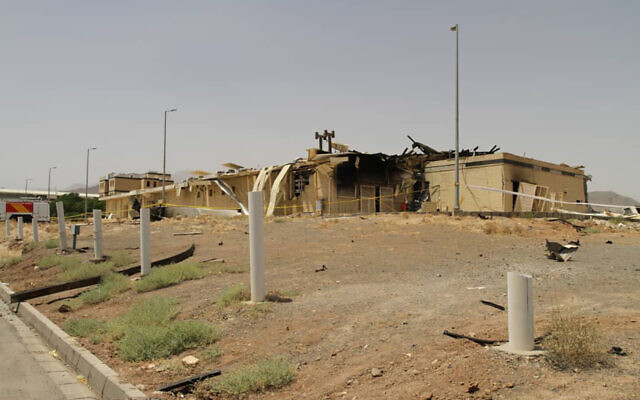
Iran reportedly recently transferred advanced centrifuges used to enrich uranium from a pilot facility into a new hall at its main Natanz nuclear fuel plant, which was hit by sabotage, allegedly by Israel, in July.

This photo released July 2, 2020, by the Atomic Energy Organization of Iran, shows a building after it was damaged by a fire, at the Natanz uranium enrichment facility some 200 miles (322 kilometers) south of the capital Tehran, Iran. (Atomic Energy Organization of Iran via AP)

An IAEA assessment published in June said Iran’s stockpile of enriched uranium was almost eight times the limit fixed in the accord.

The level of enrichment is still far below what would be needed for a nuclear weapon, but EU parties to the deal have urged Iran’s full compliance.

The IAEA, which regular updates its members on Iran’s nuclear activities, is expected to issue a fresh report ahead of a meeting of member states to discuss the dossier later this month.