Incident is first reported airstrike since July 20, when a Hezollah fighter was killed, sparking ongoing tensions on Lebanese border


The Israeli military launched a number of missiles at targets in southern Syria late Monday night, killing at least two soldiers and wounding seven others, Syrian state media reported.

The attack triggered the country’s air defenses at 10:40 p.m., according to the official SANA news outlet.

“The Israeli aggression resulted in two martyrs, seven wounded soldiers, and material damage,” SANA said.

It appeared to be the first reported Israeli airstrike on targets in Syria since a July 20 attack in which a Hezbollah fighter was killed, prompting the Lebanese terror group to vow revenge for his death and sparking as yet unresolved tensions.

The Israel Defense Forces did not comment on the reported strikes, in accordance with its policy.

Syrian media reported that Monday night’s strikes targeted sites south of Damascus and in the Daraa region, specifically in areas suspected of being Iranian and Hezbollah strongholds in the country.

“Violent explosions erupted in rural As-Suwayda and Daraa due to Israeli airstrikes targeting military sites south of Damascus, as well as Sheikh Maskin and Izraa,” the Syrian Observatory for Human Rights war monitor said.

SANA reported that the incoming missiles were fired from near Mount Hebron, on Israel’s Golan Heights.

SANA quoted a Syrian military source as saying that the country’s air defenses intercepted a number of incoming missiles. Such claims are made by Syrian media after nearly every Israeli airstrike, but defense analysts generally dismiss them as empty boasts.

Israel has launched hundreds of strikes in Syria since the start of the civil war in 2011. It has targeted government troops, allied Iranian forces and fighters from the Lebanese Shiite terror group Hezbollah.

It rarely confirms details of its operations in Syria, but says Iran’s presence in support of President Bashar Assad and Hezbollah is a threat and that it will continue its strikes.

Following the July 20 strike in which a Hezbollah fighter was killed, the Israeli military went on high alert along the Lebanese border, bracing for an attack by the group. According to the IDF, the terror group has attempted to exact its revenge against Israeli troops a number of times in the ensuing weeks, including with a failed sniper attack last Tuesday night.

Hezbollah leader Hassan Nasrallah vowed on Sunday that his group would kill an Israeli soldier in retaliation for the death of its operative in Syria the month before in order to establish “deterrence” against Israel.

https://www.timesofisrael.com/syria-says-israel-launched-missiles-at-targets-in-countrys-south/

Iran boasts of new bombs for drones in armed forces display

What has Iran achieved now? It claims it now has a retractable landing gear for the rarely seen Fotros.

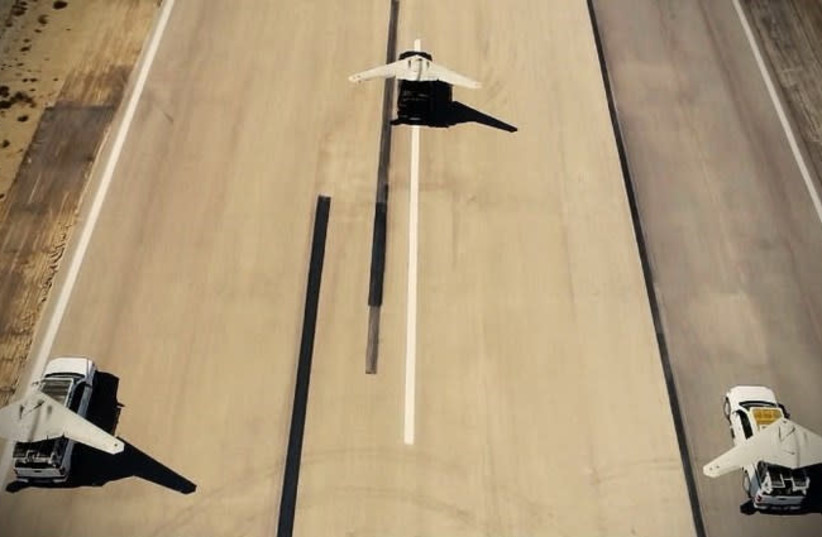
Iranian versions of the American RQ-170 drone which were used in a military exercise in the Gulf in Iran, involving dozens of drones, are seen on the a runway, in this undated handout photo. (photo credit: REUTERS/TASNIM NEWS AGENCY)
Iranian versions of the American RQ-170 drone which were used in a military exercise in the Gulf in Iran, involving dozens of drones, are seen on the a runway, in this undated handout photo.
(photo credit: REUTERS/TASNIM NEWS AGENCY)
Iran’s drone capabilities are increasing as Iran’s Ministry of Defense showcased a variety of new achievements with unmanned aerial vehicles.

An article at Fars News says that Iran is increasing its abilities to become one of the “top five countries in the world in the field of combat drones.” It is investing in precision bombs, better guidance and also other “leaps forward.”

It was not clear when the exhibition took place but Fars News devoted a large segment to looking at the new capabilities of Iran’s weapons which could threaten the US, Israel and allies in the region.

What is important in Iran is to showcase standardization and mass production of several successful and historic lines of drones, including the Ababil series, the Muhajer and now the Karar and Fotros.

The Karar is actually a kind of cruise missile or kamikaze drone whereas the Fotros looks like it was designed as a copy of Israel’s IAI Heron.

Many Iranian drone models are copies of US drones that Iran has captured, although it has also built copies of Israeli drones and weapons. Iran’s original 1980s drones were relatively innovative and unique, but Iran now realizes that US models, such as the Predator and Sentinel, or the Elbit Hermes 450 from Israel, have elements that Iran wants, either for propaganda reasons or airworthiness.

What has Iran achieved now? It claims it now has a retractable landing gear for the rarely seen Fotros.

A new prototype, based on a 2013 version, is flying. Iran displayed the new drone with a bunch of existing models as if it was part of a kind of safari of military equipment.

Oddly the Ministry left it to Fars News to speculate on the abilities of these drones. In this case the media says that Iran has achieved new types of missiles, including “vertical armor-piercing bombs.”

We’ve seen these tested before, and they are also copies of foreign munitions. Iran says it has also upgraded its Mohajer-6, part of the family of drones in this class.

The dual-take drone is also a copy of foreign models, perhaps based on the Denel Dynamics Seeker from South Africa, which itself is based on Israeli successes with similar style drones.

Iran has kitted the Mohajer 6 out with bombs under each wing now and has published video of them striking targets. Iran says it used them against Kurdish dissident groups.

Tehran also says its Karar drone, which is basically a cruise missile, can fly some 900 km now with a 250 kg warhead. Iran has invested in what it calls a Simorgh bomb.

There is some lack of clarity about this term because Simorgh is also the name of a launch vehicle Iran uses and it is supposedly a class of drones as well.

Iran says it put an MK-82 bomb on this drone with a guidance kit. Bizarrely Iran seems to have basically taken a drone whose origins go back to the V-1 and the Teledyne Ryan Firebee and lashed a bomb onto it.

This is odd because they could just use this drone as a cruise missile, because it doesn’t seem to be able to return to base anyway.

There is lack of clarity about what Iran seeks to achieve using its increasing investment in these kinds of kamikaze drones. It used them against Saudi Arabia last September, and they are effective.

However, it’s unclear why it would put more munitions on them. Iran seems to want to experiment with adding more bombs and guidance to its growing arsenal until it finds the right mix for drones and loitering munitions and cruise missiles.

The overall goal is to give the country a large number of abilities to threaten sophisticated adversaries such as the US and Israel by being able to fields maneuverable munitions that also have their own bombs attached.

Iran may sense that western air defense systems will have difficulty dealing with a complex threat like this. It is already known Iran pioneered precision guided munitions, adding these capabilities to drones seems to be what it is moving toward.


Since those threats the Saudis and Emirates have increased their abilities with the coalition in Riyadh to confront these types of drones and threats.

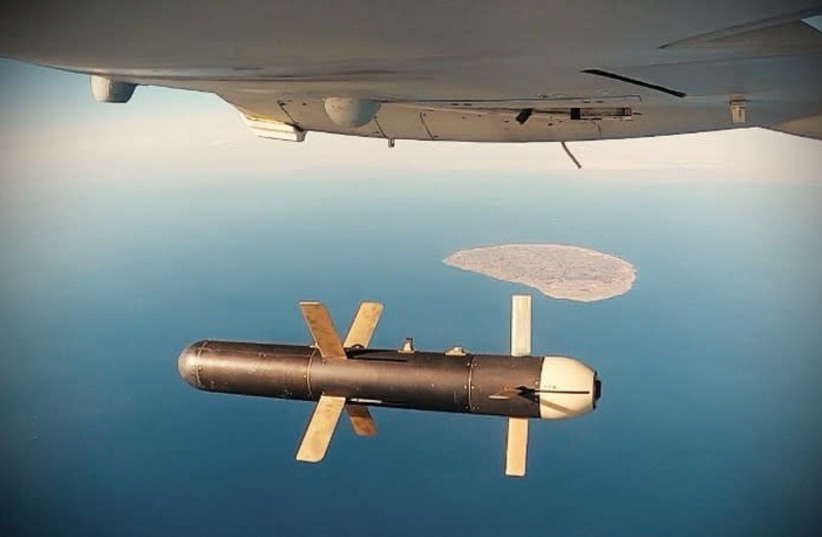
An Iranian Shahed 171 drone dropping a bomb as part of a military exercise in the Gulf, in Iran (photo credit: REUTERS)
An Iranian Shahed 171 drone dropping a bomb as part of a military exercise in the Gulf, in Iran
(photo credit: REUTERS)
The United Arab Emirates condemned an Iranian-backed Houthi attack on Saudi Arabia’s Abha airport overnight. The attack was intercepted by aircraft from Saudi Arabia. Riyadh and Abu Dhabi are allies against the Houthis who have fired missiles and drones at the Saudi Kingdom. The UAE says that its defense relations with Riyadh work to protect both the Emirates and Saudi Arabia as the security of both are indivisible, according to an article at Al-Ain media.

The recent attack involved a booby-trapped drone that sought to attack Abha airport. Houthis, using Iranian technology, have attacked this airport in southern Saudi Arabia, many times. Arab News reported that the coalition spokesman Col. Turki al-Maliki said that some shrapnel fell on the airport as the drone was destroyed. The coalition will deter the Houthis, he said. The Saudi-led coalition includes Riyadh’s allies and those fighting the Iranian-backed group. Iran has used drones and cruise missiles to attack Saudi Arabia.

In August 2019 the Houthis attacked the Shaybah oil field near the border with the UAE. The Houthis used drones in the attack that was some 1,200 kilometers from where the drones were allegedly launched from. It is not clear how the Houthis achieved this range since Iranian drones usually boast only a 1,000km range. At the time the Voice of America noted that this represented an increased Houthi threat to the UAE. In 2018 the Houthis even claimed drones had penetrated UAE airspace, which the UAE denied.

Since those threats the Saudis and Emirates have increased their abilities with the coalition in Riyadh to confront these types of drones and threats. Saudi air defense has become more proficient at stopping a plethora of threats from Yemen.

https://www.jpost.com/middle-east/saudi-arabia-downs-iranian-backed-threat-on-eve-of-israel-uae-flight-640563