
“Hezbollah in Lebanon received large deliveries of ammonium nitrate, which are closely related to the material detonated in Beirut.”
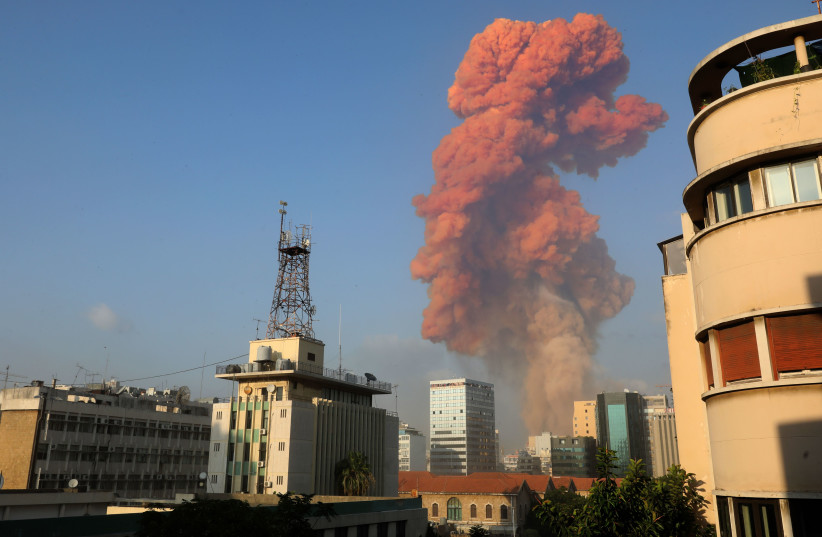
The scene of an explosion in Beirut on August 4, 2020. The blast, which rattled entire buildings and broke glass, was felt in several parts of the city.  (photo credit: ANWAR AMRO/AFP VIA GETTY IMAGES)
The scene of an explosion in Beirut on August 4, 2020. The blast, which rattled entire buildings and broke glass, was felt in several parts of the city.
(photo credit: ANWAR AMRO/AFP VIA GETTY IMAGES)
 The Lebanese terrorist organization Hezbollah had purchased a large amount of ammonium nitrate that coincided with the storage of the ammonium nitrate that was lodged at the Beirut port and led to a massive explosion in early August, according to a Wednesday report in the German daily broadsheet Die Welt.

The paper wrote that the “Welt has exclusive information from Western secret services. Accordingly, the [Hezbollah] militia bought large quantities of the dangerous substance,” adding that “After the disaster in the port of Beirut, Hezbollah was suspected of having been involved in the storage of the explosive ammonium nitrate.”
Die Welt reported that “according to information from Western secret services that are available to Welt, Hezbollah in Lebanon received large deliveries of ammonium nitrate, which are closely related to the material detonated in Beirut.”
The Welt said it is not certain if the  ammonium nitrate at the port was the same ammonum nitrate shipped around the same time to Hezbollah in 2013 and 2014. Hezbollah’s purchasing of ammonium nitrate was shipped through the port and other amounts via  airport or overland through Syria.
The Jerusalem Post could not verify the unnamed Western intelligence sources contained in Welt’s story.
The explosion of the ammonium nitrate during the first week of August killed at least 177 people and injured 6,000. The explosive material was believed to have been stored at the port since 2014.
The Welt wrote that Hezbollah had considerable quantities of ammonium nitrate delivered to Lebanon precisely at that time [late  2013 or early 2014]. The Quds unit of the Iranian Revolutionary Guard, i.e. the part of those paramilitaries responsible for foreign operations, which also have a key political position in Iran, is said to have been responsible for the transport.”

Welt said that the deliveries of ammonium nitrate to Hezbollah in 2013 must have occurred on the watch of the head of Iran’s Quds Force, Qasem Soleiman, who was assassinated by the US military in a drone strike in January.
The first delivery is believed to have taken place on July, 16, 2013 and involved 270 tons of ammonium nitrate that was sent from Iran to Lebanon. The invoice was 179.399 euro. On October, 23, 2013, a second delivery of 270 tons of ammonium nitrate was delivered for the cost of 140.693 euro. The amount of the third delivery of ammonium nitrate could not be determined.
A fourth delivery on April, 4, 2014 costed 61,248 euros and  Welt estimated that the tonnage ranged from 9o to 130 tons of ammonium nitrate. The total of three deliveries of ammonium nitrate to Hezbollah ranged from 630 to 670 tons.
Welt added that “The freight from October 2013 is said to have been transported in flexible bulk containers by plane, presumably with one of the officially private Iranian airlines, which are considered the front companies of the Revolutionary Guard.”

The paper said one of the airlines,the Iranian-based Mahan Air, “was deprived of the right to take off and landing in Germany last year, with an explicit reference to the activities of the Revolutionary Guard.” The US goverment designated the The Islamic Revolutionary Guard Corps a foreign terrorist organization.
Welt listed a number of Hezbollah and Iranian regime operatives involved in the deliveries of ammonium nitrate to the port. Mohammad Qasir, who who was sanctioned by the US goverment for financing Hezbollah. was listed as a deliverer of the explosive material.
Matthew Levitt, who serves as the director of the Washington Institute’s Reinhard Program on Counterterrorism and Intelligence told the Post that” Qasir heads Lebanese Hezbollah unit 108, responsible for facilitating transfer of weapons and tech from Iran to Lebanon via Syria. Based in Damascus, Qasir and other senior Hezbollah officials work closely with officers from Quds Force’s Unit 190—which specializes in smuggling weapons to Syria, Lebanon, Yemen, and Gaza—under the supervision of the late Qassem Soleimani.”
He said that the” purported effort to procure ammonium nitrate to the 2,750 tons of ammonium-nitrate that blew up earlier this month” are not linked to his account of Qasir’s terrorist activities outlined to the Post.
Levitt, a leading Hezbollah expert, added that “The first link in the weapons transportation chain is Qasir’s Unit 108, which is responsible for moving weapons across Syria to the Lebanese border and then, together with Unit 112, transporting weapons across the border into Lebanon. Another Hezbollah unit, Unit 100, runs a ratline in the reverse direction, from Lebanon to Syria to Iran, ferrying Hezbollah trainees to and from advanced training in the handling and use of the rockets delivered from Iran.
He continued that “Qasir, aka Hajj Fadi, is uniquely qualified to head a unit as sensitive and important as Unit 108. One of Qasir’s brothers, Hassan, is reportedly the son-in-law of Hezbollah Secretary General Hassan Nasrallah. Another brother, Ahmed Qasir, was the suicide bomber who carried out the November 1992 attack on an Israeli military headquarters in Tyre. Nasrallah referred to Ahmed as the ‘prince of martyrs’ at a Martyrs Foundation event marking the anniversary of the attack.”


The Arab world is fed up with the Palestinians

Opinion: As these nations come to conclusion that ‘Palestinian problem’ is not an asset but a burden, they will no longer entertain every Palestinian whim, leaving just Yemen and Qatar aligned with Iran and Turkey’s axis of evil

Ben-Dror Yemini|
Published: 08.18.20 , 23:30
We are facing two camps – the camp of peace and the camp of destruction. The camp of zealotry and the camp of moderateness.
The biggest surprise following Israel’s peace accord with the United Arab Emirates (UAE) is that there was no division within the Arab world about it.
פלסטינים שורפים את גדל האמירויות בהפגנה ביטא
Palestinians burning UAE flags following peace accord with Israel
In fact, almost all Arab countries have expressed their support for the agreement and hopped on the peace train.
We are left only with Yemen and Qatar who oppose the agreement and they have joined Iran and Turkey’s axis of evil. The axis of Islamic radicalism, both Sunni and Shi’ite.
So what actually happened? Well, the Arab world is fed up. It looks to the left and the right and realizes, albeit belatedly, that wherever Islamic radicalism is involved – whether Shi’ite or Sunni – the result is always destruction and ruin.
Iran, Turkey and their jihadist affiliates are involved in Syria, Yemen, Lebanon, Somalia, Iraq, Afghanistan, Gaza, northern Sinai, and northern Nigeria. Wherever they go, chaos follows.
מוחמד בן סלמאן ו סבאח אל אחמד אל ג'אבר א סבאח
Saudi Crown Prince Mohammed bin Salman
(Photo: Reuters)
The UAE or Saudi Arabia definitely did not become democracies all of a sudden, but in the Middle East, the choice is not between liberal democracy or a dictatorship. The choice is between stability or destruction.
And how are the Palestinians doing? The violence that former PLO leader Yasser Arafat instigated has been defeated. It only made the Palestinians’ problems worse. Arafat’s heir, Mahmoud Abbas, opposes violence and he still failed.
The Arab world refuses to continue entertaining every Palestinian whim. Following the near-unanimous Arab support for normalization, the Palestinian failure becomes all the more painful.
Why did the Palestinians lose the Arab world? At some point starting in the late 1990s, Arab leaders realized that the “Palestinian problem” was not an asset, but a burden.
Palestinian President Mahmoud Abbas speaking with an image of his predecessor Yasser Arafat in the background
(Photo: AFP)
After all, being hostile to Israel never benefited anyone. That is why prominent Arab states supported former U.S. president Bill Clinton’s peace outline in the 90s. They even tried to pressure Arafat to accept the agreement, but to no avail.
Although Abbas stopped the violence, he stuck to Arafat’s diplomatic policy of always saying “no,” regardless of what was on offer.
It was “no” to the 1937 Peel Commission, “no” to the 1947 UN partition plan, “no” to Israeli withdrawal for peace in 1967, “no” to then-prime minister Ehud Barak’s peace offer in 2000, “no” to Clinton’s peace offer later that year, “no” to then-prime minister Ehud Olmert’s peace offer in 2008, “no” to then-U.S. president Barack Obama’s peace offer in 2014 – and of course “no” to U.S. President Donald Trump’s peace plan.
They never wanted a state for the Palestinian people, they just didn’t want one for the Jews.
הבית הלבן פגישה בנימין נתניהו ו דונלנד טראמפ נשיא ארצות הברית
Benjamin Netanyahu and Donald Trump during the presentation of the U.S. peace plan at the White House in January
(Photo: GPO)
The Arab countries are fed up. The Arab Peace Initiative that was endorsed by the Arab League in 2002 was a farce because the original plan – i.e. the Saudi Initiative – was completely different. It was very close to the Clinton outline – two states for two peoples.
Following pressure from then-Lebanese president Émile Lahoud and senior Palestinian official Farouk Kaddoumi, it became an All-Arab initiative that offered no real peace but a Palestinian right of return to the State of Israel, with a clause stipulating that descendants of Palestinian refugees would not receive citizenship in the countries in which they live.
Now the Palestinians are paying the price for their past victories – and it is a Pyrrhic victory.
They still have the support of college campuses in the West. After all, “civil society organizations” continue with their stubbornness and the Israel Boycott, Divest and Sanctions movement (BDS) stands by Iran and Turkey in opposition to normalization.
A BDS rally in London
(Photo: citizenside.com)
But what impresses progressive professors in North America and Europe does not impress Arab leaders. They know that going even deeper into the Palestinian rabbit hole will not lead them to heavenly peace.
They supported the Palestinian cause for many years to no avail. Israel gave the Palestinians the Gaza Strip and it resulted in Hamas rule. They know that the outcome of such support leads to a takeover by the Muslim Brotherhood, Hamas’ parent organization, which hates the Arab leaders as much as or even more than Iran does.
Now, let’s imagine a scenario in which instead of Abbas calling back the Palestinian ambassador from the Emirates, he thanked Crown Prince Mohammed bin Zayed for stopping the threat of annexation, welcomed normalization and sought to join a regional peace initiative that would give Palestinians self-determination alongside Israel.
Sounds like a fantasy, right? That is exactly the problem – whoever chooses to be part of the Iranian-Turkish axis will end up inflicting destruction upon themselves. Not prosperity.

https://www.ynetnews.com/article/SJLZPWYzD?fbclid=IwAR3X5i68qGGWQ1f1JYTTf8r8OCE-t9ceCk-MBIcZdONHErVZzPZ3C3oFm0Y


DUBAI/NEW YORK (Reuters) – The fate of a fragile 2015 nuclear deal between Iran and world powers hinges on the result of the U.S. presidential election in November, not a planned U.S. bid this week to trigger a return of all U.N. sanctions on Tehran, said several Iranian officials.

Despite U.S. sanctions bid, Iran aims to keep nuclear deal alive until U.S.  election - Reuters
FILE PHOTO: A staff member removes the Iranian flag from the stage after a group picture with foreign ministers and representatives of the U.S., Iran, China, Russia, Britain, Germany, France and the European Union during the Iran nuclear talks at the Vienna International Center in Vienna, Austria July 14, 2015. REUTERS/Carlos Barria/File Photo

When Iran agreed to sanctions relief in return for curbs on its nuclear program, Tehran warned that it would no longer stick to the deal if any of the parties sparked a so-called snapback of sanctions at the U.N. Security Council, a backstop included in the accord in case Iran stopped complying.

U.S. President Donald Trump’s administration plans this week to use that snapback provision, even though it quit the deal in 2018 and the move is opposed by the remaining parties to the accord – Germany, Britain, France, Russia, China and Iran.

But despite Tehran’s declaration five years ago, three senior Iranian officials told Reuters that Iran’s leadership is determined to remain committed to the nuclear deal, hoping that a victory by Trump’s political rival Joe Biden in the Nov. 3 presidential election will salvage the pact.

“Right now the decision is to remain in the deal even if Americans make their biggest mistake of triggering the snapback mechanism,” said a senior official, on condition of anonymity, who is involved in the discussions about Iran’s nuclear policy.

“We will be still here, but Trump might not be at the White House in a few months,” the official said.

Biden has said he would rejoin the nuclear deal, but only if Iran first returned to compliance. The accord was agreed by former U.S. President Barack Obama’s administration, when Biden was vice president.

A second Iranian official – a former nuclear negotiator – said Iran was “technically and politically” ready to quit.

“But we have to be smart and not to fall in the U.S. trap which wants to push Iran out of the deal,” said the official, speaking on condition of anonymity.

‘ENORMOUS LEVERAGE’

Iranian Foreign Minister Mohammad Javad Zarif has described the next few weeks and months as critical for the nuclear deal.

To trigger a return if all U.N. sanctions on Iran the United States will submit a complaint to the 15-member Security Council about Iran’s non-compliance with the nuclear deal.

In response to what Washington calls its “maximum pressure” campaign – a bid to get Iran to negotiate a new deal – Tehran has breached several central limits of the 2015 deal, including on its stock of enriched uranium.

But diplomats say the snapback process will be tough and messy as Russia, China and other countries on the Security Council challenge the legality of the U.S. move given Washington itself is no longer complying with what Trump called “worst deal ever” and has imposed strong unilateral sanctions on Iran.

A European diplomat, speaking on condition of anonymity, said that the U.S. move to spark a return of all U.N. sanctions would risk “destroying” the nuclear deal, but “it will be a completely contested procedure so the snapback will have no effect, it will not be recognized by others.”

The United States argues it can trigger the return of the sanctions because it is still named as a participant to the nuclear deal in a 2015 U.N. Security Council resolution that enshrines the agreement.

A second European diplomat, speaking on condition of anonymity, said “the overwhelming majority of the international community” believe the United States cannot trigger snapback.

Outgoing U.S. Iran envoy Brian Hook said on Tuesday that the nuclear deal, while well intentioned, had failed to deter Iran.

“We have put in place enormous leverage for a (Trump) second term to get the kind of outcomes that we’re going to need,” he told a United Against Nuclear Iran think tank event.

Additional reporting by Sabine Siebold; Writing by Michelle Nichols; Editing by Alistair Bell


‘ENORMOUS LEVERAGE’
