Turkey dispatched a drillship to the eastern Mediterranean, where a Turkish research ship conducting seismic surveys in disputed waters stirred a row with Greece last week, Bloomberg reported on Tuesday.

The Yavuz was accompanied by three offshore supply ships and a navy escort, Bloomberg said.

The Daily Sabah reported on Monday that the Turkish drillship Kanuni will join the Yavuz and the Fatih, a similar vessel, in boosting Turkey’s seismic exploration in the eastern Mediterranean.

At the time the Daily Sabah published the report, the Kanuni was docked at a port in Taşucu, located in Turkey’s southern Mersin province, after undergoing extensive upgrades and refitting.

Greece and Turkey have long disagreed on overlapping claims to hydrocarbon resources in the region, with both sides holding conflicting views of how far their continental shelves extend.

The latest tension in the region follows a move by Ankara on Aug. 10 to send the navy-escorted Oruç Reis research ship into a disputed area of the eastern Mediterranean. Greece responded by dispatching its own military assets and conducting military exercises in the area with Cyprus and France.

Political and military tensions between NATO allies Turkey and Greece have surged in the past year after Turkey sought to explore for minerals off the coast of Cyprus. Ankara, which does not recognise Cyprus as a state, claims half of the country’s Exclusive Economic Zone (EEZ) on behalf of the breakaway Turkish Republic of Northern Cyprus and has repeatedly carried out warship-escorted offshore drilling in the territory.

On Monday, Cyprus criticised the European Union over what it said was diffidence amounting to “a policy of appeasement” in dealing with Turkey.

“Unfortunately we are observing a diffidence from the European Union in taking on a substantive role and adopting policies of deterrence,” Reuters cited Cypriot government spokesman Kyriakos Koushios as saying in remarks to reporters.

He said Cyprus welcomed expressions of support from the EU but it was not enough.

“The policy of appeasement and the messages of support are not enough to discourage Turkey from its illegal actions,” Koushios said.

https://ahvalnews-com.cdn.ampproject.org/c/s/ahvalnews.com/turkey-greece/turkey-sending-more-drillships-disputed-eastern-mediterranean-waters-reports?amp

Turke.

https://ahvalnews-com.cdn.ampproject.org/c/s/ahvalnews.com/turkey-greece/turkey-sending-more-drillships-disputed-eastern-mediterranean-waters-reports?ampy sending more drillships to disputed eastern Mediterranean waters – reports


Projectile hits open area in Israeli territory, two girls lightly injured while running to bomb shelters in Ashkelon; arson balloons spark series of fires in southern Israel


Smoke and flames rise after Israeli war planes army carried out airstrikes over Gaza City on August 18, 2020 after a rocket was fired from Gaza towards Israel (Photo by MAHMUD HAMS / AFP)

Smoke and flames rise after Israeli war planes army carried out airstrikes over Gaza City on August 18, 2020 after a rocket was fired from Gaza towards Israel (Photo by MAHMUD HAMS / AFP)

Israeli war planes carried out series of airstrikes in the Gaza Strip late Tuesday night, after Palestinians fired a rocket and sent several arson balloons into Israel, sparking a series a fires, the Israel Defense Forces said.

The overnight raids targeted Hamas sites in the Gaza Strip including a military compound belonging to an elite unite of the terror group, the army said, adding that it holds Hamas responsible for all violence emanating from the Strip.

Video footage published by the Hamas-linked Gaza news site Shebab appeared to show Israeli jets firing on targets in the Strip.

The renewed airstrikes came hours after terrorists in Gaza fired a rocket toward Israeli communities north of the enclave on Tuesday night, the IDF said.


There were no immediate reports of impact in populated areas, indicating the projectile struck an open field.

The rocket triggered sirens in the city of Ashkelon, north of Gaza, and in the nearby community of Kibbutz Zikim, sending tens of thousands of people to bomb shelters.

Two girls were lightly injured while running to bomb shelters, the Magen David Adom ambulance service said.

A 10-year-old girl sustained an injury to one of her limbs and a 7-year-old girl injured her face and one of her limbs. “Both of them received treatment and were sent by MDA teams to Barzilai hospital for further care,” medics said.

The rocket attack was the second of the week, and came amid rising tensions between Israel and terror groups in the Gaza Strip.

View of damage to a house in the southern Israeli town of Sderot that was caused by fragments of an Iron Dome interceptor missile, which was fired to shoot down incoming rocket fire from the Gaza Strip, on August 16, 2020. (Flash90)

On Sunday, terrorists in the Strip fired two rockets at southern Israel, both of which were intercepted by the Iron Dome missile defense system.

Fragments of an Iron Dome interceptor struck outside a home in the town of Sderot, causing damage to the structure and lightly injuring a 58-year-old man.

Over the past week, terrorists in the enclave have again begun launching balloon-borne incendiary and explosive devices into southern Israel, sparking dozens of fires that caused environmental and property damage in the region.

On Tuesday, Gaza officials announced that the Strip’s sole power station had run out of fuel and would stop operating. Israel last Thursday cut off fuel transfers via the Kerem Hashalom crossing as a punitive measure following the rocket ad balloon attacks.

Earlier Tuesday, Prime Minister Benjamin Netanyahu said Israel would respond to airborne arson attacks in the same manner it does rocket attacks, and warned that there could be another major flareup.

“I regret that we are also preparing, to the extent necessary, for the possibility of a round or rounds. I hope that we will not get there,” he told local leaders of Gaza-area communities.

Judah Ari Gross contributed to this report.


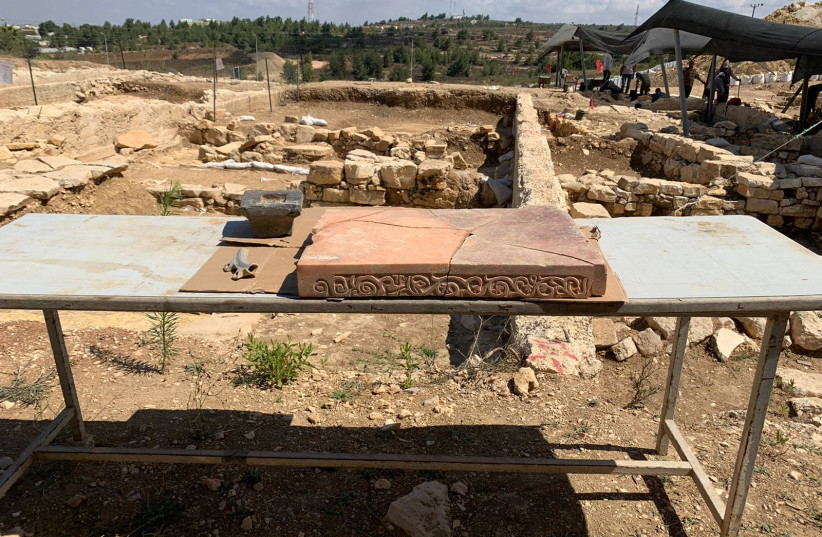
Second Temple Period stone table unearthed near Beit El

The COGAT archaeology unit is in charge of the management, preservation and access to the archaeological sites in the West Bank, and specifically in Israeli-controlled Area C.

Second Temple Period stone table unearthed in the site of Khirbet Kefar Mur near Beit El in the West Bank (photo credit: COGAT SPOKESPERSON'S OFFICE)
Second Temple Period stone table unearthed in the site of Khirbet Kefar Mur near Beit El in the West Bank
(photo credit: COGAT SPOKESPERSON’S OFFICE)
A richly decorated stone table dating back to the Second Temple period has been unearthed in the archaeological site of Khirbet Kefar Mur near Beit El in the West Bank.

The rare artifact was found in an excavation conducted by the Archaeology Unit of the Coordination of Government Activities in the Territories (COGAT). It probably belonged to a wealthy family living in the Jewish settlement that stood on the site in the last centuries of the 1st millennia BCE.

The Archaeology Unit has been working in Khirbet Kefar Mur for over a decade. As explained by the director of the excavation Yevgeni Aharonovich in a paper in a 2016 issue of the journal In the Highland’s Depth, published by the University of Ariel, the site was settled from at least the 8th century BCE up to Byzantine times, with the early Roman period marking its heyday.

The COGAT archaeology unit is in charge of the management, preservation and access to the archaeological sites in the West Bank, and specifically in Israeli-controlled Area C.

In in Khirbet Kefar Mur, the archaeologists have uncovered the remains of residential buildings, ritual baths, an oil mill and many daily objects such as pottery and coins. A massive wall dating back to the Jewish Great Revolt in the 1st century CE was also found, which seemed to have been erected very fast to prepare for the war. Moreover, the remains of a church with a mosaic floor and a bathhouse from the Byzantine period also emerged.

According to the researchers, the stone table represents a rare discovery since only very few similar items have been uncovered in the region so far.

“I welcome the discovery of this impressive artifact, which adds to the wealth of other findings that we have unearthed at the Khirbet Kefar Mur archaeological site,” Civil Administration Archaeology Staff Officer Hanina Hizami commented in a press release. “We will continue to make new discoveries that testify to the rich history that took place in the Judea and Samaria area hundreds and even thousands of years ago.”

“The new findings that we are investigating add another layer to the Jewish history of the area, and to that purpose, the Archaeology Unit in the Civil Administration has been investing many efforts and resources over the years in order to research the archaeological findings at the site,” Hizami added and continued, “We will continue to work tirelessly to preserve the archaeological sites and national heritage and cultural assets throughout Judea and Samaria.”