President’s son-in-law says PA has a chance to return to the negotiating table, US “trusts” Israel not to unilaterally apply annexation.

Arutz Sheva Staff , 17/08/20 17:06


Jared Kushner

Jared Kushner

Yonatan Sindel/Flash 90

Jared Kushner, adviser and son-in-law to US President Donald Trump addressed the peace agreement he helped broker between Israel and the United Arab Emirates Monday.

Addressing Israeli reporters, Kushner said that “Israel has made a very generous proposal for the establishment of a Palestinian state, including an exchange of territories. The understanding that this is the situation has enabled the breakthrough that led to the current agreement.”

“The president laid out his vision for peace in January this year … and this is the first map ever agreed to by one of the parties publicly put out in a peace negotiation. We got Israel to agreed to negotiate on the basis of the process of division, they agreed to the map and agreed to move forward on a Palestinian state. This was a major breakthrough that changed the view of a lot of people in the region about Israel’s seriousness to actually make concessions to resolve this longstanding conflict,” Kushner said, adding the countries in the region also questioned why the Palestinian Authority boycotted the economic conference in Bahrain.

“There is a generous offer of a state state and an exchange of territories, and we offer the Palestinians a return to the table,” he said

When asked how the US would make certain that Israel does not unilaterally annex any territory, Kushner said, “We built a very trusting relationship with Israel. President Trump is committed to holding them accountable to it, and Israel has agreed with us that they will not move forward without our consent. We do not plan to give our consent for some time, as right now the focus has to be on getting this new peace agreement implemented. We really want to get as much interchange between Israel and the United Arab Emirates as possible, and we really want Israel to focus on creating new relationships and new alliances.”

“That land is land that right now that Israel, quite frankly, controls. It’s Israelis who are living there. It’s not going anywhere. There shouldn’t be any urgency to apply Israeli law. So we believe that they will stick to their agreement,” he said.

http://www.israelnationalnews.com/News/News.aspx/285415


While Riyadh remains hesitant to publicly declare relationship with Israel, analysts expect a significant increase in behind-the-scenes cooperation


Saudi Arabia's Crown Prince Mohammed bin Salman attends a meeting with US Secretary of State Mike Pompeo in Jeddah, Saudi Arabia, on September 18, 2019. (Mandel Ngan/Pool Photo via AP)

Saudi Arabia’s Crown Prince Mohammed bin Salman attends a meeting with US Secretary of State Mike Pompeo in Jeddah, Saudi Arabia, on September 18, 2019. (Mandel Ngan/Pool Photo via AP)

RIYADH, Saudi Arabia (AFP) — The UAE’s decision to normalize ties with Israel could propel Saudi Arabia to deepen its furtive relations with the Jewish state as Riyadh seeks to entice investments to fund an ambitious economic transformation, analysts say.

The United Arab Emirates on Thursday became the first Gulf state to normalize relations with Israel, in a historic US-brokered accord that raised the prospect of similar deals with other Arab states.

Saudi Arabia, the Arab world’s biggest economy, has maintained a conspicuous silence over the deal, but local officials have hinted that Riyadh is unlikely to immediately follow in the footsteps of its principle regional ally.

However, “the UAE-Israeli normalization lends itself to expanding the realm of indirect Saudi-Israeli relations,” said Aziz Alghashian, a lecturer at Essex University specializing in the kingdom’s policy towards Israel.

“I think Saudi-Israeli interactions will increase via the UAE.”

Home to Islam’s holiest sites, Saudi Arabia would face sensitive political calculations before a formal recognition of the Jewish state.

Like the UAE’s move, such a step would be seen by Palestinians and their supporters as a betrayal of their cause.

But the kingdom has already cultivated covert ties with Israel in recent years, a shift spearheaded by Crown Prince Mohammed bin Salman even as his father King Salman has voiced steadfast support for an independent Palestinian state.
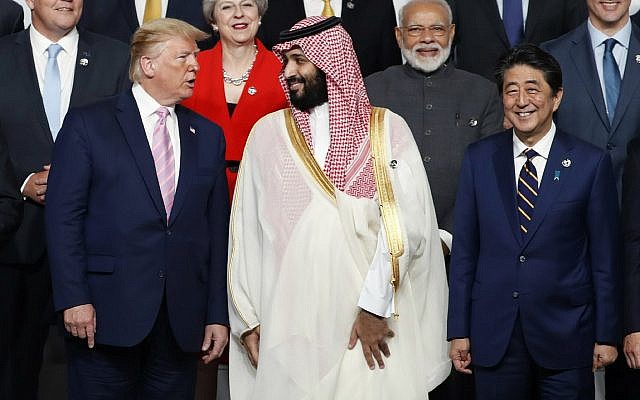
Illustrative: US President Donald Trump, left, speaks with Saudi Arabia’s Crown Prince Mohammed bin Salman at the G-20 leaders summit in Osaka, Japan, June 28, 2019. (Kim Kyung-Hoon/Pool Photo via AP)

A shared animosity toward Iran, along with Saudi attempts to attract foreign investment to fund Prince Mohammed’s ambitious Vision 2030 economic diversification plan, appear to be pushing the kingdom closer to Israel than ever.

A centerpiece of Vision 2030 is Neom, a $500 billion planned megacity on the kingdom’s west coast, for which observers say the kingdom requires Israeli expertise in areas including manufacturing, biotechnology and cybersecurity.

The creation of Neom “requires peace and coordination with Israel, especially if the city is to have a chance of becoming a tourist attraction,” said Mohammad Yaghi, a research fellow at Germany’s Konrad Adenauer Stiftung.

Neom is set to be built close to the Israeli resort town of Eilat, along the geopolitically sensitive waters of the Red Sea and the Gulf of Aqaba.

Integral part

Gulf states have increasingly sought Israeli technology for the surveillance of their own citizens and to purchase precision missiles that Western countries are unwilling to sell, Yaghi wrote in a research paper in April.

Saudi Arabia has sought to keep its outreach to Israel out of the public eye, but it has not been easy.

In June, a verified Twitter account linked to the kingdom’s embassy in Washington said the Saudi council of ministers had agreed to recruit Israeli cybersecurity firm Check Point Software in Neom.

The embassy later denied the claim and distanced itself from the account.
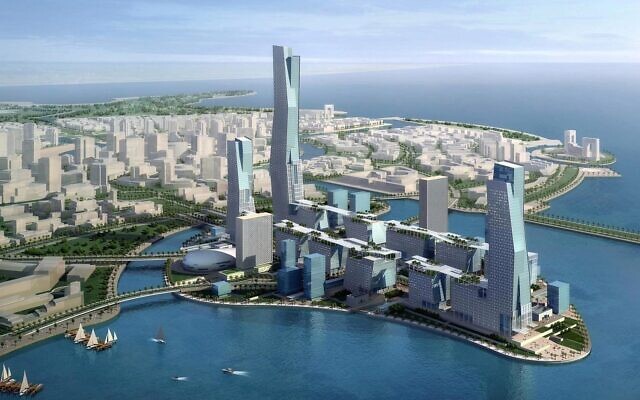
illustration of the planned Neom city (Neom.com)

Marc Schneier, an American rabbi with close ties to the Gulf, quoted Saudi Arabia’s deputy defense minister Prince Khalid bin Salman as once telling him that Israel was an “integral part” of achieving Vision 2030.

Schneier made the comment to AFP in May, and Saudi authorities did not dispute that the prince made the remark.

Despite the official silence, the pro-government Saudi media has repeatedly tested public reaction by publishing reports advocating closer ties with Israel.

“I forecast a future that entails the creation of a joint high-tech ecosystem among [Gulf Cooperation Council] countries, known as the ‘Silicon Wadi,’” Israeli consultant Nave Shachar wrote last week for the English website of Al-Arabiya, a Saudi-owned broadcaster.

Shachar, who according to his LinkedIn profile was previously employed by the Israeli defense ministry, was referring to a regional equivalent of Silicon Valley.

“Now, more than ever, it is in the best interest of Israel and the GCC to increase business cooperation,” he said.

An inevitability

Observers say US President Donald Trump, who backed Prince Mohammed following global uproar over the 2018 murder of journalist Jamal Khashoggi, holds enormous leverage to get the kingdom to formally recognize Israel.

But Saudi Arabia appears to be resisting Washington’s pressure as it has more at stake than the UAE.

“I do think it is an inevitability that Saudi Arabia and Israel will have fully normalized relations and they will be able to do a lot of great things together,” Jared Kushner, Trump’s senior adviser and son-in-law, said at the weekend.

In this Saturday, May 20, 2017, file photo, White House senior adviser Jared Kushner, right, walks with Ivanka Trump at the Royal Court Palace, in Riyadh, Saudi Arabia. (AP Photo/Evan Vucci,)

“Saudi Arabia has obviously been a great leader in [modernization] but you can’t turn a battleship around overnight,” Kushner told CNBC.

Schneier said the kingdom’s leadership held “conflicting views along generational lines.”

“This bold initiative by the Emirates will strengthen the generational forces that would like to see this happen now,” he told AFP this week.

“This announcement from the UAE will transform the current indirect relations between the Saudis and Israel to formal direct relations.”


Tensions on the rise with Greece after Ankara sends warships and research vessels into areas claimed by Athens, rejects ‘sanctions and threats’


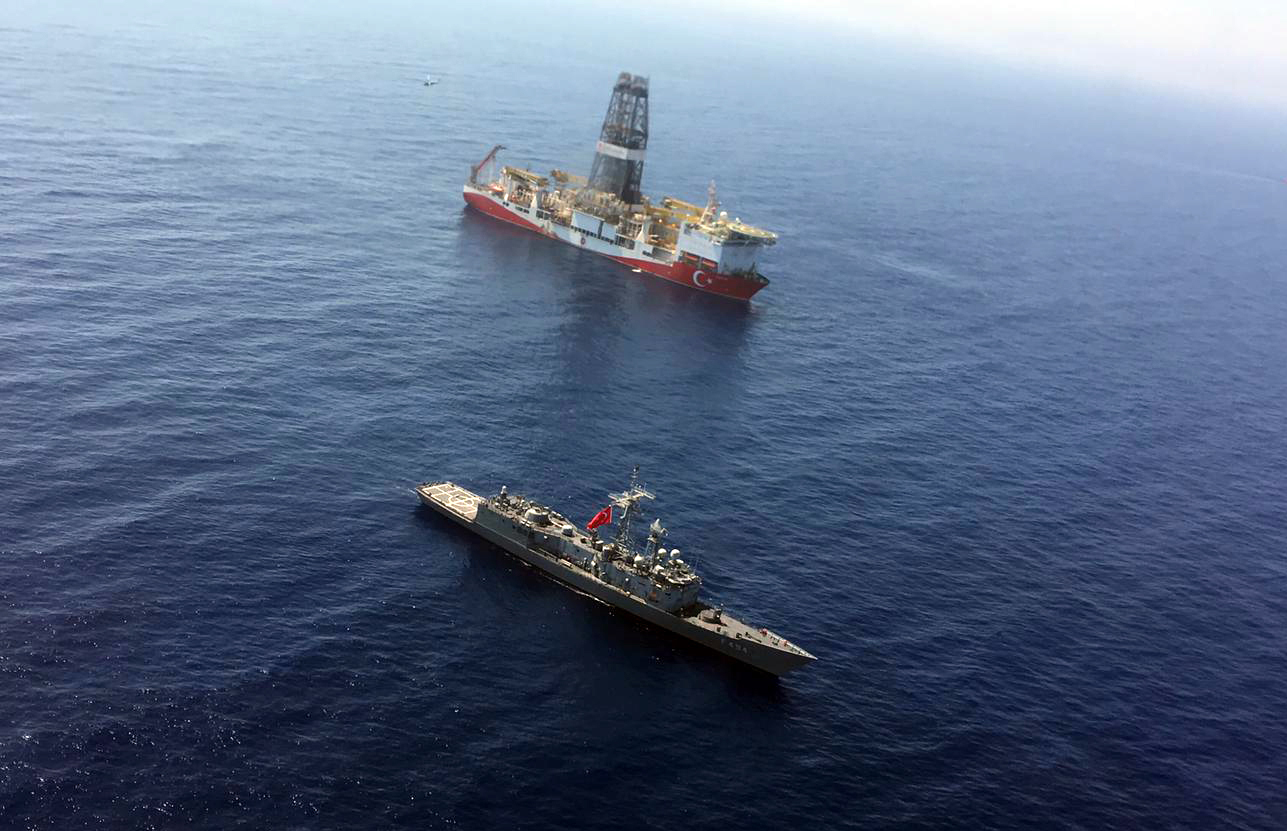
Illustrative: In this July 9, 2019 file photo, a Turkish Navy warship patrols near Turkey's drilling ship 'Fatih' that was making its way towards the eastern Mediterranean near Cyprus to begin drilling operations. (Turkish Defence Ministry via AP, Pool)

Illustrative: In this July 9, 2019 file photo, a Turkish Navy warship patrols near Turkey’s drilling ship ‘Fatih’ that was making its way towards the eastern Mediterranean near Cyprus to begin drilling operations. (Turkish Defence Ministry via AP, Pool)

BRUSSELS, Belgium — The European Union urged Turkey on Sunday to “immediately” stop exploring for gas in a disputed area of the eastern Mediterranean, as tensions rise with other countries in the region.

The call came after Ankara said it planned to extend its search by drilling off the southwestern coast of Cyprus from next week.

Turkey’s actions in the eastern Mediterranean have put it at loggerheads with its uneasy NATO ally Greece and the rest of the EU, with France announcing last week it would bolster its presence in the region in support of Athens.

Brussels has repeatedly called on Ankara to halt energy exploration off Cyprus, arguing that the drilling is illegal because it infringes on the country’s exclusive economic zone.

A helicopter flies over Turkey’s drilling ship, ‘Fatih’ dispatched towards the eastern Mediterranean, near Cyprus, July 9, 2019. (Turkish Defence Ministry via AP, Pool)

Turkey’s latest announcement “regrettably fuels further tensions and insecurity in the Eastern Mediterranean,” EU foreign policy chief Josep Borrell said in a statement.

“This action runs counter and undermines efforts to resume dialogue and negotiations, and to pursue immediate de-escalation, which is the only path towards stability and lasting solutions, as reiterated by EU foreign ministers last Friday,” he said.

“I call on the Turkish authorities to end these activities immediately and to engage fully and in good faith in a broad dialogue with the European Union.”

The issue was also at the heart of a meeting on Sunday in the Dominican Republic between US Secretary of State Mike Pompeo and his Turkish Foreign Minister Mevlut Cavusoglu.

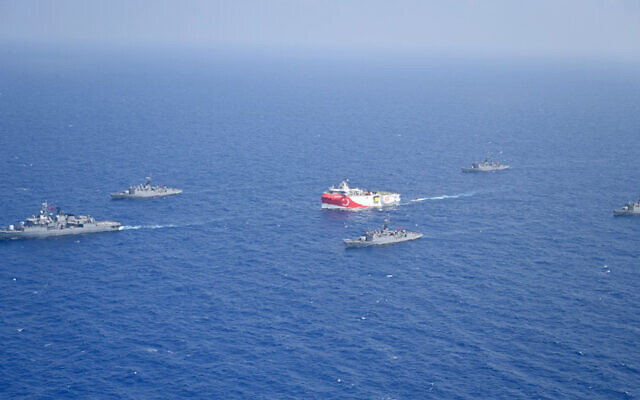
In this photo provided by the Turkish Defense Ministry, Turkey’s research vessel, Oruc Reis, in red and white, is surrounded by Turkish navy vessels as it was sailing near Antalya on the Mediterranean, Aug 10, 2020 (Turkish Defense Ministry via AP, Pool)

The two men spoke of the “urgent need to reduce tensions in the Eastern Mediterranean,” the State Department said in a statement.

At a press briefing after the meeting, Cavusoglu said Ankara would “continue to defend its interests.”

The Turkish navy said in a statement late on Saturday that the drill ship Yavuz, which has been based off Cyprus for the past few months, will explore off the southwestern coast of the island from August 18 to September 15.

Turkey has remained defiant in the face of the protests, saying it has a right to search for oil and gas in the eastern Mediterranean, where regional nations are racing for riches after the discovery of large energy deposits.

Turkish President Recep Tayyip Erdogan gestures as he speaks to members of the press after a cabinet meeting at the Presidential Complex in Ankara on August 10, 2020. (Adem ALTAN/AFP)

“We strongly advise against going to the search area,” the Turkish navy warned in its statement.

Last week, Ankara sent the seismic research vessel Oruc Reis, escorted by warships, to an area claimed by Greece, triggering the ire of Athens and the EU.

On Friday, EU foreign ministers voiced solidarity with Greece and called for a deescalation of the crisis.

Turkish President Recep Tayyip Erdogan said Saturday that Ankara was ready for dialogue but insisted: “We will not back down in the face of sanctions and threats.”

The defense ministry meanwhile published photographs of naval maneuvers in the eastern Mediterranean, showing warships escorting another seismic research vessel, the Barbaros Hayrettin Pasa.

https://www.timesofisrael.com/eu-urges-turkey-to-halt-gas-hunt-in-disputed-east-mediterranean-areas/