
The UAE Is the First Domino to Fall …

by Benjamin Weil / JNS.org

OPINION

The Tel Aviv municipality building is lit with the United Arab Emirates national flag following the announcement of a deal to normalize relations between the Israel and the United Arab Emirates, Aug. 13, 2020. Photo: Reuters / Ammar Awad.

JNS.org – For years, statesmen and diplomats from around the world have claimed that it is impossible for Israel to reach a peace agreement with any Arab state without first signing a peace agreement with the Palestinian Authority. They said Israel would have to give up land beyond the Green Line — plus evacuating settlements, splitting Jerusalem and establishing a Palestinian state.

The thought of Israel signing a peace agreement with any Arab country — let alone one of the most influential ones in the Middle East — was considered crazy up until a few years ago. This historic day, with the announcement of normalizing relations between Israel and the United Arab Emirates, has proven that this old concept is not valid and never was.

The UAE has broken the glass ceiling and the fear of recognizing Israel publicly. The two countries have much to learn from and share with each other. Israel can offer the Emiratis technology and R&D, as well as future access to Mediterranean ports, thereby bypassing the needs to send oil tankers through the Straits of Hormuz. In return, the UAE has capital, vision and influence to help Israel both economically and diplomatically. This agreement will change the face of the Middle East, or as longtime former Israeli leader Shimon Peres used to say, “a new Middle East.”

Yoseph Haddad posted a video on Twitter: A Lebanese journalist asks Nasrallah a simple question and reveals to the world the…

To the “peace activists” in Israel and abroad, I am sure you have been working hard to convince governments from around the world that Israel is not serious about peace and is preventing chances for future peace with its communities in the West Bank. This announcement shows that Israel has never stopped and will never stop the pursuit of peace. I hope the peace activists join all Israelis and Emiratis in celebrating this milestone. After all, this is what they were fighting for, too.

As a final thought, I look to the three countries Israel has secured peace with: Egypt (1979), Jordan (1994) and the United Arab Emirates (2020). Interestingly enough, two out of the three Israeli prime ministers who have reached a peace agreement with these countries were from the Likud — Menachem Begin and Benjamin Netanyahu. It is even more striking that out of the three agreements, only one of them included giving up land for peace, and that was Begin giving the Sinai Peninsula to the Egyptians. It is worth mentioning that Ariel Sharon, another right-wing premier from Likud, disengaged from Gaza to gain peace, though that effort failed. Looking at these examples, it seems that right-wing governments in Israel have been more successful in reaching peace agreements with Arab countries than the left.

I hope that this agreement between Israel and the United Arab Emirates is the first domino to fall, and that other potential Arab countries will see the benefit of establishing relations with the Jewish state. This will hopefully bring true peace and stability to the Middle East, and transform the region from an area of fighting and war to one of ingenuity, entrepreneurship and building bridges between people and cultures so that our generation can reach a new peak.

Benjamin Weil is director of the Project for Israel’s National Security for the Endowment for Middle East Truth (EMET), a pro-Israel and pro-American think tank and policy institute in Washington, DC. He formerly served as the international adviser to Yuval Steinitz, a member of Israel’s Security Cabinet.
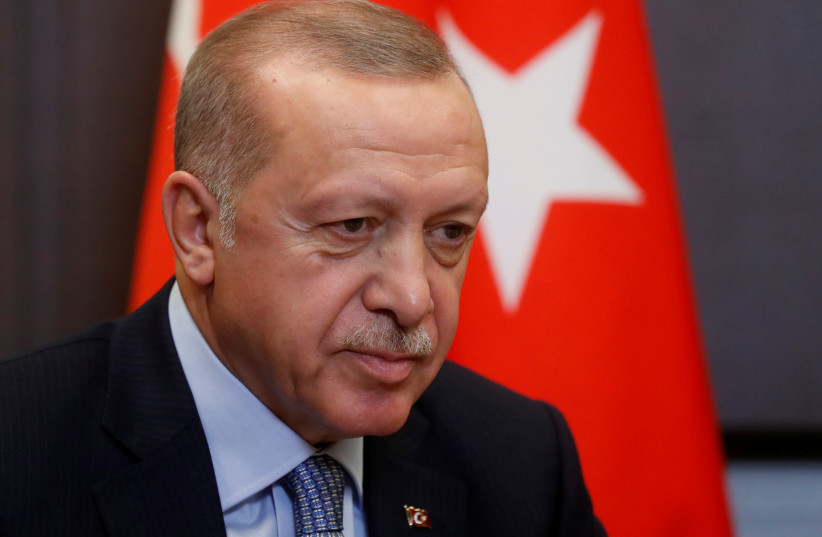

Erdogan: Turkey may suspend ties with UAE over Israel deal

The Foreign Ministry said the Palestinian people and administration were right to react strongly against the agreement.

Turkish President Recep Tayyip Erdogan attends a meeting with Russian President Vladimir Putin in the Black sea resort of Sochi, Russia, 22 October 2019 (photo credit: SERGEI CHIRIKOV/POOL VIA REUTERS)
Turkish President Recep Tayyip Erdogan attends a meeting with Russian President Vladimir Putin in the Black sea resort of Sochi, Russia, 22 October 2019
(photo credit: SERGEI CHIRIKOV/POOL VIA REUTERS)
President Tayyip Erdogan said on Friday that Turkey was considering closing its embassy in Abu Dhabi and suspending diplomatic ties with the United Arab Emirates over its accord to normalize ties with Israel.

Erdogan was speaking to reporters in Istanbul after the Turkish Foreign Ministry said history will never forgive the “hypocritical behavior” of the UAE in agreeing such a deal.

The Foreign Ministry said the Palestinian people and administration were right to react strongly against the agreement, which recasts the order of Middle East politics from the Palestinian issue to the fight against Iran.

“History and the conscience of the region’s peoples will not forget and never forgive this hypocritical behavior of the UAE, betraying the Palestinian cause for the sake of its narrow interests,” the ministry said in a statement.

“It is extremely worrying that the UAE should, with a unilateral action, try and do away with the (2002) Arab Peace Plan developed by the Arab League. It is not in the slightest credible that this three-way declaration should be presented as supporting the Palestinian cause.”

US President Donald Trump helped broker the accord.

Turkey has diplomatic and trade ties with Israel, but relations have been strained for years. In 2010 Israeli commandos killed 10 Turkish activists trying to breach a blockade on the Gaza Strip, which is ruled by the Palestinian Islamist movement Hamas.

The UAE becomes the third Arab country to establish full relations with Israel, after Egypt in 1979 and Jordan in 1994.

https://www.jpost.com/arab-israeli-conflict/turkey-history-will-not-forgive-uae-for-israel-deal-638655?fbclid=IwAR1Qjh6QGYbxkx4ZNmIvgGEFZZOwfrH9h_FtC0190ixm-vvMAkPZS2ovLTU


An IDF vehicle at the scene of a fire sparked by an incendiary balloon launched from the Gaza Strip, near Be'eri Kibbutz in southern Israel, on August 13, 2020. (Jack Guez/AFP)

An IDF vehicle at the scene of a fire sparked by an incendiary balloon launched from the Gaza Strip, near Be’eri Kibbutz in southern Israel, on August 13, 2020. (Jack Guez/AFP)

Israel launched airstrikes against Hamas targets in the Gaza Strip for the fourth night in a row late Friday in response to a spate of attacks using balloon-borne arson and explosive devices sent from the Strip into Israel in recent days.

The overnight attack on sites used by Hamas, the Islamist terror group that rules the enclave, was the fifth such operation since the start of the week.

The Israel Defense Forces said in a statement that combat helicopters and tanks hit a number of terror targets belonging to Hamas, including sites used by its naval forces, underground infrastructure and observation posts.

“The attack was carried out in response to balloons with explosives and incendiary balloons [launched] from the Gaza Strip into Israeli territory over the past week,” the IDF said.

The IDF added that it holds Hamas responsible for all acts in and emanating from the Strip.

There have been no reports of casualties in the latest bout of violence in the south.

Makeshift firebombs attached to bunches of balloons or kites ignited over 100 fires in Israel in the past week, setting alight agricultural fields and brush. Officials said most were small fires, but some caused damage.

Smoke and flames rise after Israeli aircraft carry out airstrikes near the southern Gaza Strip city of Rafah on August 12, 2020. (Said Khatib/AFP)

Friday night’s attack came a day after Israel and the United Arab Emirates agreed to normalize ties in a landmark US-brokered deal, ratcheting up tensions in the West Bank and Gaza.

The agreement infuriated the Palestinian leadership, who called it a “betrayal” of their cause, including their claim to Jerusalem as the capital of their future state.

Palestinians also held protests against the deal in Jerusalem, the West Bank and Gaza Strip. Protesters taking part in Friday prayers at the Al-Aqsa Mosque on the Temple Mount in Jerusalem trampled and then set fire to a poster of the UAE leader to protest accord.

Palestinian Authority President Mahmoud Abbas called an emergency meeting of PA leadership in response to the agreement, while the PA recalled its ambassador to the UAE in protest over the deal.

Abu Dhabi has sought to portray its action as first and foremost benefiting the Palestinians, as it puts off and possibly cancels Israel’s plans to annex parts of the West Bank.

Palestinian protesters burn a banner showing Abu Dhabi Crown Prince Mohamed bin Zayed al-Nahyan near the Dome of the Rock on the Temple Mount in Jerusalem’s Old City, August 14, 2020. (AP Photo/Mahmoud Illean)

The Haaretz daily reported Friday that Israel communicated that it won’t allow the transfer of a monthly sum of $30 million from Qatar to Gaza unless the spate of incendiary balloon attacks stops.

The report, which did not cite a source, added that the Qatari envoy himself is “not thrilled” to go to the Strip until the escalation is over.

Palestinian analysts say attacks from Gaza often aim to pressure Israel to give the green light for the transfer of the Qatari financial aid into the Strip.

In response to the attacks, Israel has already closed its cargo crossing with the Strip, with exceptions made for food and humanitarian aid, and also reduced the territory’s permitted coastal fishing zone.

The practice of launching balloon-borne incendiary and explosive devices from the Gaza Strip toward Israel has waxed and waned over the past two years, with an uptick since the end of last week.
