In televised speech Hezbollah chief raises possibility investigation will reveal Israel behind Beirut blast, condemns Israel-UAE deal as ‘betrayal of Jerusalem’
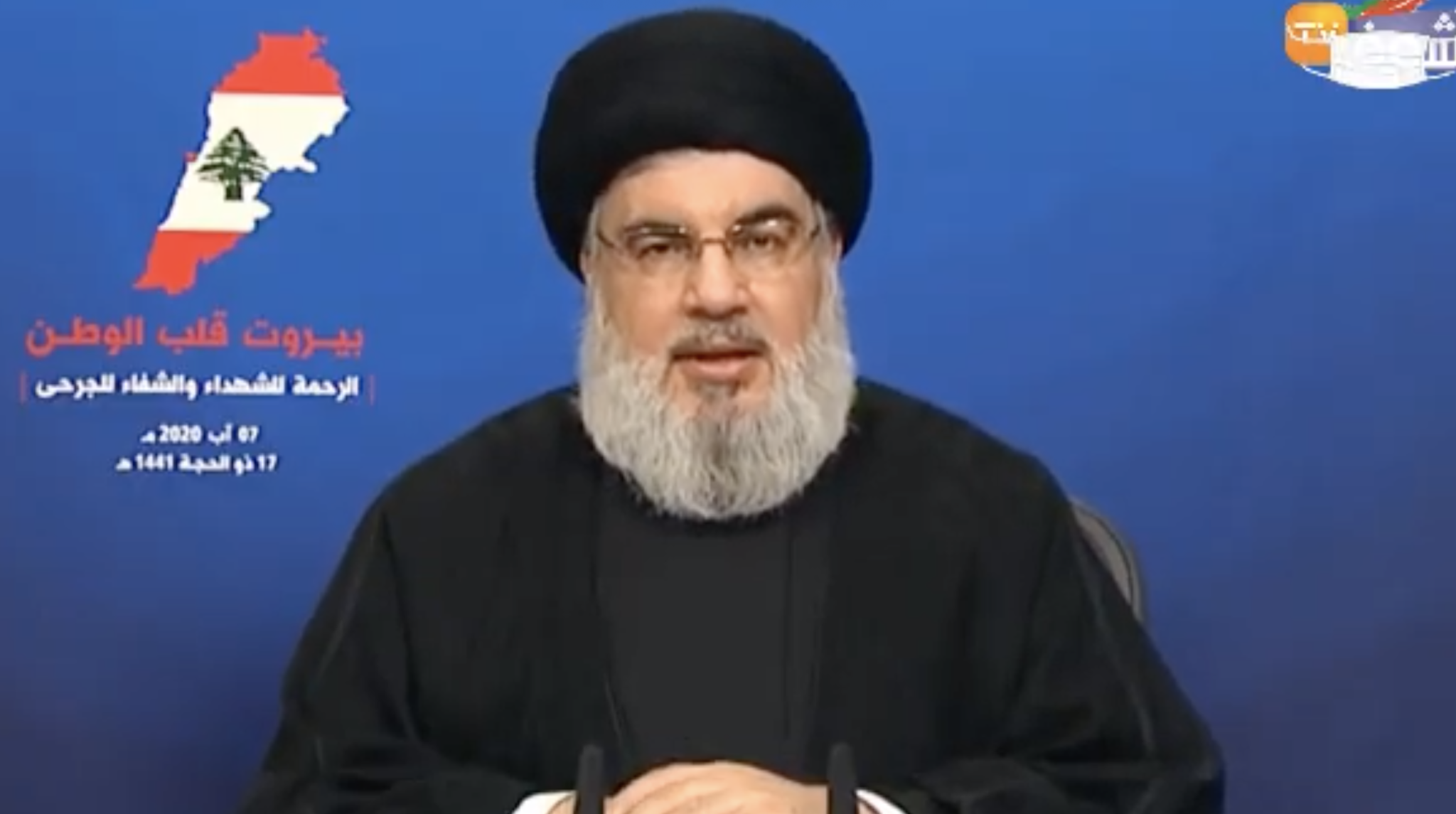
Hezbollah secretary general Hassan Nasrallah gives a speech in the aftermath of the deadly explosion in Beirut, on August 7, 2020 (al-Manar screenshot)

Hezbollah secretary general Hassan Nasrallah gives a speech in the aftermath of the deadly explosion in Beirut, on August 7, 2020 (al-Manar screenshot)

Hezbollah chief Hassan Nasrallah warned Israel on Friday that his organization intended to carry out a game changing revenge attack for the death of one of its fighters in an airstrike last month that was widely attributed to Israel.

Israel had been on high alert along the northern border, but slightly reduced its troop presence following the deadly explosions that rocked Beirut last week, killing over 200 people, injuring thousands, and leaving nearly a third of a million people homeless.

“Everything that happened since July until today, the high alert of the Israeli military and more is our punishment to Israel,” Nasrallah said in a televised speech commemorating the anniversary of the end of the bloody 2006 conflict between Israel and the Iran-backed terror group. “If you kill us, you need to wait across the border for the reaction. This is a decision that is still in force, nothing has changed it is just a question of time.”

Nasrallah warned that Hezbollah’s reaction will “redefine the rules of the game along the border,” adding that only a “considered, serious reaction, not some public relations stunt, can do this.”

Israel has been bracing for a possible attack from Hezbollah in retaliation for a July 20 airstrike in Syria attributed to the IDF, in which a member of the Iran-backed terror group was killed.

Israeli mobile artillery units sit in place in northern Israel near the border with Lebanon, July 28, 2020. (AP Photo/Ariel Schalit)

Defensively, the IDF moved troops away from areas vulnerable to attack and stepped up surveillance along the frontiers, and to prepare for the need to retaliate forcefully, the IDF also deployed infantry, special forces and artillery reinforcements to the area.

The IDF credits its heightened state of alertness with foiling an attempted attack by Hezbollah on July 26, in which a group of at least three armed terrorist operatives entered the Israeli-controlled area of Mount Dov, also known as Shebaa Farms, along the border.

Hezbollah denied carrying out the attack, saying the IDF’s claims were “absolutely false.” The group also said that it still plans to retaliate for the killing of its member.

In his speech, Nasrallah also warned that Hezbollah was waiting for the results of the investigation into the Beirut port blast, saying that if any evidence was found of Israeli involvement, then there would be massive retaliation.

Nasrallah also said he did not trust any international investigation — claiming the first thing it would do is clear Israel of any responsibility in the port explosion.

Rescue teams search for missing people at the site of the August 4 explosion that killed more than 170 people, injured thousands and caused widespread destruction, in Beirut, Lebanon, Friday, August 14, 2020. (AP Photo/Hassan Ammar)

“There is a possibility that someone put a bomb in the port that caused the explosion. It could have been any number of sources and Israel is one of them,” Nasrallah said, adding that the blast could also have been caused by negligence.

“If Israel is behind the explosion, Hezbollah will not be silent and Israel will receive an equally devastating response.” he said

Israel has denied any involvement in the blast and so far no evidence has emerged pointing otherwise. Most observers have blamed the August 4 blast at Beirut’s port, when thousands of tons of ammonium nitrate ignited setting off a massive explosion, on negligence and corruption.

In his speech, which came hours after he was reported to have met with visiting Iranian Foreign Minister Mohammad Javad Zarif, Nasrallah also condemned the normalization agreement announced Thursday between Israel and the United Arab Emirates.

Lebanese Foreign Minister Charbel Wehbe, right, speaks during a joint press conference with his Iranian counterpart Mohammad Javad Zarif, outside the Lebanese foreign ministry, Aug. 14, 2020. (AP Photo/Hussein Malla)

“This is a betrayal of Islam and Arabism, it is a betrayal of Jerusalem, of the Palestinian people,” Nasrallah said.

“What the UAE did was give a personal electoral favor to President Trump,” he added.

Nasrallah also said that Hezbollah will ignore the verdict due next week by a UN-backed court on the 2005 murder of former Lebanese premier Rafik Hariri.

The Special Tribunal for Lebanon is expected to hand down its verdict on Tuesday to four suspects, who were all being tried in absentia and are alleged members of Hezbollah.

“We do not feel concerned by the STL’s decisions,” Nasrallah said.

“For us it will be as if no decision was ever announced,” he said. “If our brothers are unjustly sentenced, as we expect, we will maintain their innocence.”

Nasrallah has repeatedly expressed similar views completely rejecting the jurisdiction and independence of the court, which is based in The Netherlands.

The slain former prime minister’s son Saad Hariri, himself a former premier, is expected in The Hague for the verdict.

The four defendants went on trial in 2014 on charges including the “intentional homicide” of Hariri and 21 others, attempted homicide of 226 people wounded in the bombing, and conspiracy to commit a terrorist act.

Nasrallah warned that “some will attempt to exploit the STL to target the resistance and Hezbollah” but urged his supporters to be “patient” when the verdict is announced.

https://www.timesofisrael.com/nasrallah-to-israel-expect-game-changing-retaliation-for-death-of-group-member/


‘We are not a gift to be awarded to the Israelis at some stage if they satisfy Palestinian demands,’ says top diplomat, adding that move was made in best interests of UAE


Tel Aviv City Hall is lit up with the flags of the United Arab Emirates and Israel as the countries announced they would be establishing full diplomatic ties, on August 13, 2020. (AP Photo/Oded Balilty)

Tel Aviv City Hall is lit up with the flags of the United Arab Emirates and Israel as the countries announced they would be establishing full diplomatic ties, on August 13, 2020. (AP Photo/Oded Balilty)

DUBAI (AFP) — The UAE on Friday offered a muscular defense of its bombshell move to establish ties with Israel, saying it was designed to “shake up” the Middle East impasse and serve Emirati interests.

The historic deal, the first for a Gulf state, sees Israel pledge to suspend its planned annexation of parts of the West Bank but has been condemned by the Palestinian leadership as a “betrayal” of their cause.

Omar Saif Ghobash, assistant Minister for Culture and Public Diplomacy, rejected the charge, insisting the agreement had made progress in the absence of any other workable proposal from the Arab world.

“I think we’ve demonstrated that we are able to enter a very staid and tired situation and to shake things up, and we look forward to seeing positive developments coming out of this real engagement,” he told AFP in an interview.

Omar Saif Ghobash (Twitter)

The deal, announced by US President Donald Trump on Thursday, is only the third such accord Israel has struck with an Arab country, and raises the prospect of similar deals with other pro-Western Gulf states.

But regional power Saudi Arabia, whose own efforts to induce Israel to withdraw from territories claimed by the Palestinians have been effectively sidelined by the United Arab Emirates move, has remained conspicuously silent.

“We didn’t consult with anybody, we didn’t inform anybody, and as a sovereign state we don’t feel that we have the obligation to do that,” Ghobash said, asked if long-time ally Riyadh was consulted in advance.

“We are in the process now of informing our friends and partners and others in the region as to why we took the step” but “it’s to be expected that not everybody will … applaud or comment”.

“We have taken the decision as a sovereign state with our own interests and our own calculations in mind.”

We are not a gift

The establishment of ties with Israel comes after years of quiet rapprochement, including the hosting of athletes and ministers from the Jewish state.

Apart from the diplomatic implications, there are obvious economic benefits.

The UAE, rich in oil and with big ambitions in space and technology, will be able to do business openly with Israel, which will have access to the modern cities of Dubai and Abu Dhabi as they attract talent and investment.

Kayakers race in front of the Burj Khalifa, the world’s tallest building, off the coast of Dubai, United Arab Emirates on June 19, 2020. (AP/Jon Gambrell)

“We as a country are very globally connected and we do find that the connections are incredibly lucrative and contribute to our GDP,” Ghobash said, in an unusually candid assessment.

“We are driven by pragmatic considerations.”

The UAE, which has sent a probe to Mars and pressed the button on a nuclear power program in the past month, is growing in prominence on the world stage.

Ghobash, a former ambassador to Russia and France, said the Israel deal demonstrated its diplomatic independence.

“We are not a gift to be awarded to the Israelis at some stage if they satisfy Palestinian demands,” he said.

“We are very clearly stating that it is in our sovereign interest to make this move and therefore that sovereign interest will be served,” he said.

“We have spent the last 20 years developing relationships with all kinds of countries across the globe. We have an active foreign policy and we will make our own sovereign decisions.”

No back-stabbers

Oman and Bahrain have welcomed the announcement as advancing the prospects for peace in the Middle East.

But Prime Minister Benjamin Netanyahu stressed the deal did not mean Israel was abandoning its plans to one day annex the Jordan Valley and Jewish settlements across the West Bank.

Palestinians burn pictures of US President Donald Trump, Abu Dhabi Crown Prince Mohammed bin Zayed al-Nahyan and and Prime Minister Benjamin Netanyahu during a protest against the United Arab Emirates’ deal with Israel, in the West Bank city of Nablus, Friday, August 14, 2020. (AP Photo/Majdi Mohammed)

“The primary gain is to take annexation out of the equation for the time being,” Ghobash said.

The minister rejected criticism from the Palestinians, saying there was “no other plan on the table from our Arab side to suggest that some solution might be forthcoming”.

“I am trying to understand in what sense this is a back stab given that what we have done is actually open the door for a rethink on the Israeli side about annexation,” he said.

“We strongly believe in the rights of the Palestinians’ cause and the rights of the Palestinians,” said Ghobash.

“So we have taken the step in accordance with these deeply held beliefs but also in accordance with the new reading of the region.”

In 2002, Saudi Arabia sponsored the Arab Peace Initiative, which called for Israel’s complete withdrawal from the West Bank and Gaza Strip in exchange for peace and full normalization of relations.

“We are now in 2020, so 18 years have passed and we haven’t seen any outcome from the Arab Peace Initiative.

“We believe that the way in which we should approach these questions is by dialogue and communication,” Ghobash said.

https://www.timesofisrael.com/uae-defends-israel-deal-as-shake-up-of-tired-mideast-diplomacy/


Hours after UAE and Israel establish relations in deal announced by Trump, Hebrew media reports indicate Bahrain may follow soon


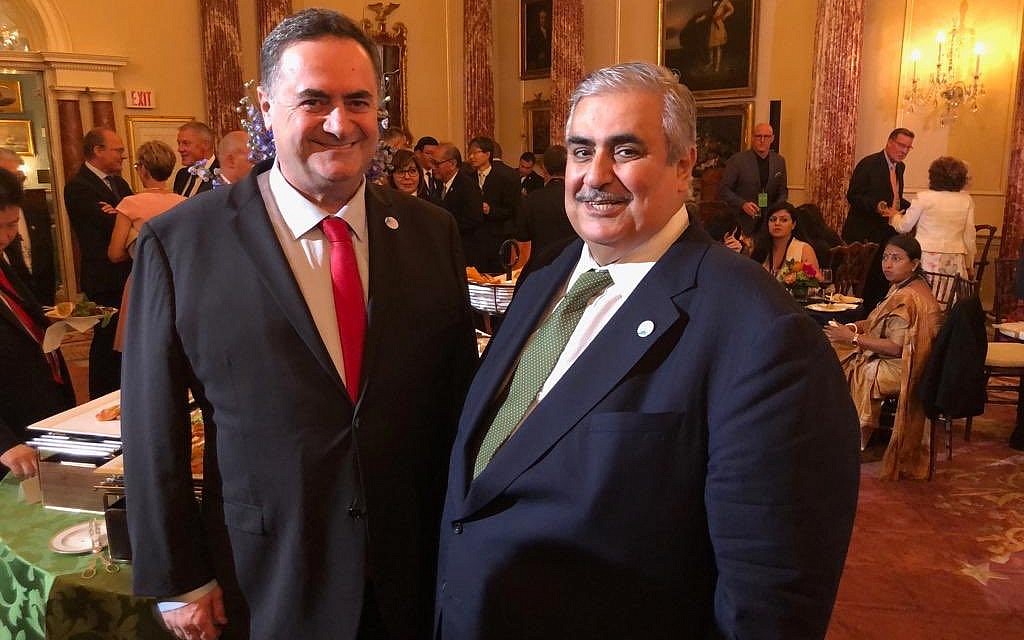
Foreign Minister Israel Katz and his Bahraini counterpart Khalid bin Ahmed Al-Khalifa (R) pose for a photograph at the State Department in Washington on July 17, 2019. (Courtesy)

Then foreign minister Israel Katz and his Bahraini counterpart Khalid bin Ahmed Al-Khalifa (R) pose for a photograph at the State Department in Washington on July 17, 2019. (Courtesy)

Senior Israeli officials reportedly said Thursday that they are in advanced talks with Bahrain about normalizing ties with the Gulf state, hours after the historic announcement on Israel’s establishment of ties with the United Arab Emirates.

Bahrain is expected to be the next country to establish official ties with Israel, a senior official told the Kan public broadcaster.

A senior American official told Palestinian media that Bahrain and Oman are expected to normalize ties with Israel in the near future, the report also said.

The contacts with Bahrain were also reported by Army Radio, which said that multiple Israeli officials said they were in “advanced contacts” with Bahrain about the potential move.

Israel and the United Arab Emirates announced their agreement Thursday afternoon. They “agreed to the full normalization of relations between Israel and the UAE,” they said in a joint statement with the US that was released by President Donald Trump.

Said Trump: “This is a monumental step to forging ties of cooperation in the Middle East and I think you’re going to have other countries come forward. I can tell you we already do and they want to make a deal. They’re going to have peace in the Middle East.”

Bahrain was among those welcoming the deal: “This historic step will contribute to strengthening stability and peace in the region,” the government in Manama said in a statement on the national news agency.

Bahrain also said the accord stopped “the annexation of Palestinian lands and [was] advancing the region towards peace.”

The UAE-Israel deal marks the third such agreement the Jewish state has struck with an Arab country after Egypt (1979) and Jordan (1994).

Israeli and UAE delegations will meet in the coming weeks to sign bilateral agreements regarding investment, tourism, direct flights, security and the establishment of reciprocal embassies, their statement said.

Prime Minister Benjamin Netanyahu said on Thursday night that Israel had entered “new era of Israeli relations with the Arab world,” and that other deals with Arab countries would follow.

He said the agreement reflected the “dramatic change” in the way Israel was perceived in the region. In the past, it was regarded “as an enemy and source of instability” but today “many, many states see Israel as a strategic ally for stability, for security, for advancement and also for peace.

“There will be other Arab and Muslim states that will join the circle of peace with us,” he predicted. Israel and moderate states in the region “stand aligned in favor of advancement and against the extremist forces that threaten us and world peace.”

Prime Minister Benjamin Netanyahu discusses the agreement for Israel and the UAE to establish diplomatic relations, at the Prime Minister’s Office in Jerusalem, on August 13, 2020. (Yonatan Sindel/FLASH90)

Netanyahu said he has been working toward the goal of normalization with the Gulf since 2009.

“I always thought it was possible… I have been doing this constantly, for years,” he said, noting his contacts with Oman, Sudan and other states in the area that don’t have official ties with Israel.

Trump’s son-in-law and senior adviser Jared Kushner said later Thursday that more Arab countries may soon announce normalized ties with Israel.

“We hope this is an icebreaker where Israel can now normalize relations with other countries,” Kushner said at a briefing with reporters, shortly after Trump announced the pact, adding that he thought there was a “very good chance” of another Israeli-Arab deal within months.

Kushner said the administration had been in talks with other Arab states to normalize ties with Israel, too. He suggested that more announcements will come over the next few months.

“We have a couple who were upset that they weren’t first,” Kushner said. “But… we will work very hard to create more and more normalizations over the coming time ahead.”

“I do think that this makes them more inevitable,” he continued. “But it will take trust being built and dialogue being facilitated. Hopefully, this makes it easier for others.

At one point, he was asked which other countries were in the mix. “Who is next?” Kushner asked back. “You will find out next.”

The governments of Bahrain and Egypt, and a Saudi official, welcomed the agreement, while Jordan issued a more tepid response. The Palestinians reacted with fury to the deal, calling it “a despicable betrayal.”

Israel agreed to shelve annexation of parts of the West Bank as part of the deal, but it was unclear if the move had been put on hold permanently or temporarily. Netanyahu said his plan to apply Israeli sovereignty in Judea and Samaria with full American coordination had not changed and was still on the table, but that Trump had requested a temporary halt.

https://www.timesofisrael.com/senior-israeli-officials-reportedly-say-bahrain-next-in-line-for-normalization/?fbclid=IwAR0J3lZhU7dkL0Z_-byqZWcRxFkukTR4wgBDdFlYcdA4I3wSwGgxLoRsyYU