Adviser to Iranian parliament speaker says that with normalization deal, Abu Dhabi turned back on Palestinians, serves ‘Zionist crimes’


Iranian official, Hossein Amir-Abdollahian, then deputy foreign minister, speaks during a press conference in Moscow, Russia, August 3, 2012. (AP Photo/Misha Japaridze)

Iranian official, Hossein Amir-Abdollahian, then deputy foreign minister, speaks during a press conference in Moscow, Russia, August 3, 2012. (AP Photo/Misha Japaridze)

A special adviser to the speaker of Iran’s parliament issued the first response from an Iranian official to the normalization deal announced between Israel and the United Arab Emirates on Thursday.

“UAE’s new approach for normalizing ties w/fake, criminal #Israel doesn’t maintain peace & security, but serves ongoing Zionists’ crimes,” wrote Hossein Amir-Abdollahian, an adviser on international affairs and a former deputy foreign minister.

“Abu Dhabi’s behavior has no justification, turning back on the Palestine cause. W/ that strategic mistake, #UAE will be engulfed in Zionism fire,” he added.

The text was accompanied by a graphic showing a Star of David being “deleted” on a computer.

Israel and the United Arab Emirates announced the agreement Thursday afternoon. They “agreed to the full normalization of relations between Israel and the United Arab Emirates,” they said in a joint statement.

The deal marks the third such agreement the Jewish state has struck with an Arab country after Egypt (1979) and Jordan (1994).

Israeli and UAE delegations will meet in the coming weeks to sign bilateral agreements regarding investment, tourism, direct flights, security and the establishment of reciprocal embassies, their statement said.

“As a result of this diplomatic breakthrough, and at the request of President Trump with the support of the United Arab Emirates, Israel will suspend declaring sovereignty over areas outlined in the President’s Vision for Peace and focus its efforts now on expanding ties with other countries in the Arab and Muslim world,” the statement added.

UAE officials commenting on the agreement to “establish a roadmap towards launching common cooperation,” as UAE Foreign Minister Anwar Gargash put it, emphasized that it would halt Israeli annexation and revive the peace process.

The Palestinian Authority reacted with fury to the announcement, calling for the United Arab Emirates to “immediately retract” its agreement, which it called a “despicable decision.”

PA President Mahmoud Abbas called an emergency meeting in response to the agreement, while the PA recalled its ambassador to the UAE in protest over the deal.

“The Palestinian leadership rejects the actions of the Emirati government, considering it to be a betrayal of the Palestinian people and Jerusalem and al-Aqsa,” PA spokesperson Nabil Abu Rudeineh said in a statement read aloud on Palestine TV.

Senior Fatah and Palestinian Liberation Organization officials also lashed the accord, as did the Hamas and Islamic Jihad terror groups.

Abbas and Hamas political chief Ismail Haniyeh spoke over the phone Thursday night to discuss the UAE-Israel agreement.

Israel’s Arab allies — those with whom the Jewish state has signed treaties and some of those who have preferred to stay in the shadows so far — mostly hailed the agreement, including Egypt, Bahrain, and a Saudi official.

Jordan issued a more tepid statement, calling for Israel to stop “all illegal measures which undermine peace opportunities,” and enter into negotiations with the Palestinians.

https://www.timesofisrael.com/in-1st-response-from-iran-official-says-uae-will-be-engulfed-in-zionism-fire/?utm_source=dlvr.it&utm_medium=twitter


Featured image

The Trump administration is threatening to veto a resolution to extend the UN’s long-standing peacekeeping mission in southern Lebanon if its mandate isn’t changed, Israeli and U.S. officials tell me.

Why it matters: The U.S. is the main funder of the UN Interim Force in Lebanon (UNIFIL), which has an annual budget of $250 million. The veto threat is a tactical move, and part of a broader effort to put pressure on Iran and its proxy in Lebanon, Hezbollah.

  • The resolution will come before the UN Security Council for a vote at the end of this month.
  • It comes in the midst of a deep political crisis in Lebanon, following the Beirut port explosion, and with tensions running high between Israel and Hezbollah.
  • The U.S. argues that Hezbollah is restricting the access and movements of the UN force, compromising its effectiveness.
  • It wants all restrictions on the peacekeepers’ movements lifted, along with enhanced reporting to the Security Council when UNIFIL’s operations are challenged.

The Trump administration is also demanding the following changes to UNIFIL’s mandate, per Israeli and U.S. officials.

  • Cutting the maximum troop presence from 15,000 to 11,000.
  • Reducing the mandate’s extension period from one year to six months to allow for more modifications as the situation on the ground changes.
  • Immediately implementing recommendations from UN Secretary-General António Guterres, who called for more peacekeepers to be moved to the Israel-Lebanon border area and for the force’s weapons, technology and vehicles to be upgraded.

The big picture: UNIFIL was established in 1978 following an Israeli invasion of Lebanon, and its mandate was broadened after the 2006 Iran-Hezbollah War.

  • Since then, both Israel and the U.S. have supported the force while also criticizing its failure to prevent Hezbollah’s military entrenchment in southern Lebanon, near the border with Israel.
  • Israeli and U.S. officials now say that the force is not implementing its mandate, and so troop numbers should be cut.

In the last several weeks, the U.S. has told Security Council members and the countries supplying the bulk of UNIFIL’s troops that they will not agree to a technical rollover of UNIFIL’s mandate in a vote scheduled for Aug. 31, Israeli and U.S. officials say.

  • In conversations with their counterparts, U.S. and Israeli diplomats have cited the discoveries of Hezbollah’s cross-border tunnels into Israel, the cutting of a border fence, limitations on the access and movement of UN peacekeepers by Hezbollah, and a recent attempted attack by Hezbollah on an Israeli outpost.
  • “Both us and the Americans stress that in the current reality Hezbollah is just too comfortable with UNIFIL, and this is unacceptable,” a senior Israeli official tells me.

In the last few days, the permanent members of the council — China, France, Russia, the U.K. and U.S. — held negotiations on the resolution in New York.

  • France is the “pen holder” for the UNIFIL resolution, and French officials have been told by U.S. officials — including Secretary of State Mike Pompeo — that they will veto the resolution if their demands aren’t met.
  • In the event of a veto, UNIFIL’s operations will cease and the force will be disband.

Between the lines: The U.S. and Israel don’t actually want that to happen, and also realize that other members are wary of dramatic steps while Lebanon is in crisis. But both the U.S. and Israel think that only a strong veto threat would convince the other members to agree to substantial changes, officials tell me.

  • A State Deperment spokesperson says the U.S. wants UNIFIL to “fully implement its mandate, consider and pursue revisions which reinforce success and recognize shortcomings,” a State Department spokesperson told me. “We are deeply concerned about Hizballah’s challenges to UNIFIL’s freedom of movement and this is unacceptable.”

Where things stand: The French are not impressed by the U.S. veto threat.

  • “Veto and then what? They will deploy 10,000 marines to replace UNIFIL?” a senior French diplomat told me.
  • The diplomat says France is prepared to work with the U.S. on the matter, but won’t agree to all of its demands. “I believe the mandate will be renewed before the end of the month without too much trouble,” the diplomat said.


Touting ‘full and formal peace’ with advanced, innovative Gulf nation, PM says Israelis will soon be flying direct to Abu Dhabi; insists annexation plan is only temporarily halted


Israeli Prime Minister Benjamin Netanyahu discusses the agreement for Israel and the UAE to establish diplomatic relations, at the Prime Minister's Office in Jerusalem, on August 13, 2020. (Yonatan Sindel/FLASH90)

Israeli Prime Minister Benjamin Netanyahu discusses the agreement for Israel and the UAE to establish diplomatic relations, at the Prime Minister’s Office in Jerusalem, on August 13, 2020. (Yonatan Sindel/FLASH90)

Announcing details of the historic agreement for full diplomatic relations between Israel and the United Arab Emirates, Prime Minister Benjamin Netanyahu on Thursday night hailed what he called a “new era of Israeli relations with the Arab world,” and said other deals with Arab countries would follow.

He also insisted that he would continue to seek to extend Israeli sovereignty to parts of the West Bank land, in coordination with the US, but acknowledged that his plan for unilateral annexation was being temporarily halted, in line with the joint statement issued by the US, Israel and the UAE which specified that Israel would “suspend” the move.

In a televised address delivered hours after US President Donald Trump announced the breakthrough on Twitter, Netanyahu said that the UAE, Israel and the US had agreed on “a full and formal peace” in a phone call Thursday.

According to Netanyahu, there will be a “full” exchange of embassies, ambassadors, economic exchanges, direct flights and more. “Together, with our joint strengths, we can bring a great future for our peoples and our region,” he added, saying the countries would share their advanced technological knowledge for mutual benefit.

“This is very important for our economy, the regional economy and our future,” the prime minister said.

He said the UAE would make investments that would boost the Israeli economy, and that the two countries would work together on a vaccine for COVID-19.

He hailed the UAE as a rising world power, like Israel, and one that had made the desert bloom, like Israel, noting its skyscrapers, artificial islands, space program and culture of innovation.

He also said the agreement reflected the “dramatic change” in the way Israel was perceived in the region. In the past, it was regarded “as an enemy and source of instability” but today “many, many states see Israel as a strategic ally for stability, for security, for advancement and also for peace.

“There will be other Arab and Muslim states that will join the circle of peace with us,” he predicted. Israel and moderate states in the region “stand aligned in favor of advancement and against the extremist forces that threaten us and world peace.”
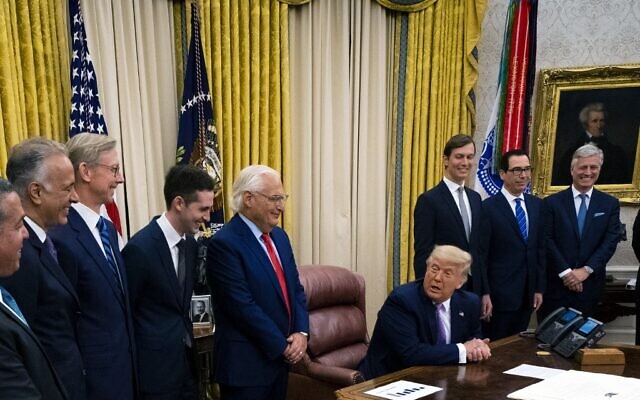
President Donald Trump announces an agreement to establish diplomatic ties between Israel and the UAE, in the Oval Office of the White House on August 13, 2020 in Washington, DC. (Doug Mills-Pool/Getty Images/AFP)

Netanyahu also hailed Trump, “one of Israel’s greatest friends,” for enabling the deal, said advancing genuine, sustainable peace was Israel’s defining mission, and expressed confidence that all Israeli citizens would welcome the accord.

Placing himself as the latest in the short line of Israeli prime ministers to sign historic peace deals with Arab states, following Menachem Begin with Egypt (1979) and Yitzhak Rabin with Jordan (1994), Netanyahu said it was an “honor…after years of my making efforts, dreaming of it, working toward it… to establish the third peace agreement between Israel and an Arab state, the United Arab Emirates.”
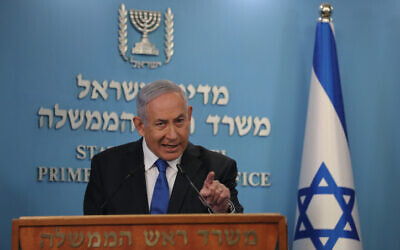
Israeli Prime Minister Benjamin Netanyahu discusses the agreement for Israel and the UAE to establish diplomatic relations, at the Prime Minister’s Office in Jerusalem, on August 13, 2020. (Yonatan Sindel/FLASH90)

Earlier Thursday afternoon, a White House announcement said the leaders of the US, Israel and the UAE “spoke today and agreed to the full normalization of relations between Israel and the United Arab Emirates.”

Israeli and UAE delegations will meet in the coming weeks to sign bilateral agreements regarding investment, tourism, direct flights, security and the establishment of reciprocal embassies, it said.

Announcing the deal, Trump wrote on Twitter: “HUGE breakthrough today. Historic Peace Agreement between our two GREAT friends, Israel and the United Arab Emirates!”

Netanyahu said he has been working toward the goal of normalization with the Gulf since 2009.

“I always thought it was possible… I have been doing this constantly, for years,” he said, noting his contacts with Oman, Sudan and other states in the area that don’t have official ties with Israel.

Netanyahu asserted he had proven wrong those who said it would be impossible to forge peace with an Arab country without reaching an accord with the Palestinians first and without withdrawing to the pre-1967 lines.

“I say to the residents of the United Arab Emirates: Salam Alaikum. Shalom Aleichem. Peace be to you, and us,” Netanyahu concluded his prepared remarks.
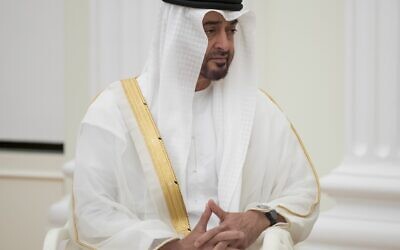
Abu Dhabi Crown Prince Mohammed bin Zayed al-Nahyan (AP Photo/Pavel Golovkin, Pool)

Later answering questions, Netanyahu insisted that that the agreement was not made in exchange for anything, and said there is “no change in my plans for annexation, [in] full coordination with the US.”

Netanyahu claimed that Trump had only requested a “temporary” suspension of annexation plans and that “temporary means temporary.” He said he was committed to sovereignty, and will “never give up on our rights in our land.

“Just as I brought peace, I will bring sovereignty [to the West Bank],” he vowed, adding “I did not take sovereignty off the table.” He went on: “Nobody ever believes my promises” but “I always prove them wrong.”

The joint statement issued by the White House states that “Israel will suspend declaring sovereignty over areas outlined in the President’s Vision for Peace and focus its efforts now on expanding ties with other countries in the Arab and Muslim world. The United States, Israel, and the United Arab Emirates are confident that additional diplomatic breakthroughs with other nations are possible, and will work together to achieve this goal.”

Asked if he supports a two state solution, Netanyahu said he was committed to the Trump peace plan, calling it the most realistic plan since 1967, while at the same time refusing to define what a Palestinian entity would be.

In response to his comments, a senior UAE official told The Times of Israel that Abu Dhabi remained committed to the establishment of a Palestinian state and the terms of the Arab Peace Initiative.

“The UAE, US and Israel have agreed on suspending Israeli annexation of Palestinian territories in order to establish bilateral relations towards a stable and peaceful region via dialogue and diplomacy,” Hend al-Otaiba, the director of strategic communications of the Emirati Foreign Ministry, stressed.

Speaking to reporters after his own announcement, Trump suggested that more diplomatic breakthroughs between Israel and its Muslim neighbors in the region were expected.

“Things are happening that I can’t talk about,” the US president said.

https://www.timesofisrael.com/hailing-new-era-with-arab-world-pm-vows-others-will-follow-in-uaes-steps/

