Incendiary balloons found near Gaza border communities early Saturday.

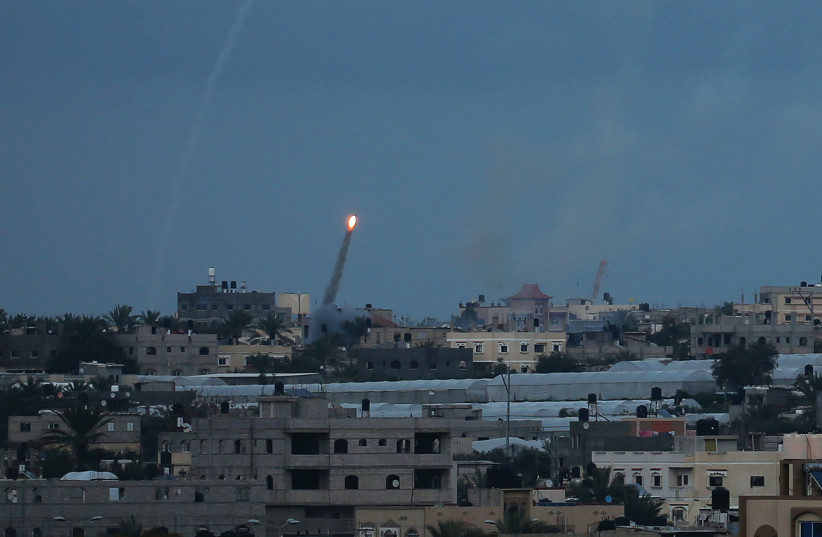
A ROCKET IS fired toward Israel from the southern Gaza Strip in February. (photo credit: IBRAHEEM ABU MUSTAFA / REUTERS)
A ROCKET IS fired toward Israel from the southern Gaza Strip in February.
(photo credit: IBRAHEEM ABU MUSTAFA / REUTERS)
A suspicious object attached to a set of balloons was found in an agricultural area within the Eshkol region, which was suspected to have come from the Gaza Strip.
“A police sapper and security personnel are at the scene to neutralize the item,” according toa statement from the Eshkol Regional Council.
In addition, an explosion was heard in Netivot late Friday. An inspection by a sapper who arrived at the scene revealed that it was an explosive item which arrived via a balloon and exploded on the spot. The location of the explosion is currently under investigation.
In similar news, it was reported in the Lebanese newspaper Al-Akhbar, widely considered a pro-Hezbollah and pro-March 8th alliance (pro-Syrian government) outlet, that Hamas and other terrorist organizations in the Gaza Strip had informed the Egyptian mediator that the period of calm on the border with Israel would come to an end soon.
The report came amid rising tensions between Israel and Hamas following a string of incendiary balloon launching and Israeli reprisal attacks in recent days.
IDF fighter jets attacked a Hamas underground infrastructure in the northern Gaza Strip late Thursday, the IDF Spokesperson confirmed. The attack was in response to several incendiary balloon launches from Gaza into Israeli territory on that day.
Earlier on Thursday, after nearly six months without incendiary balloons, five fires broke out in the Gaza border communities. At least three of them were caused by incendiary balloons.
Furthermore, a balloon carrying an explosive device was found in the Arad industrial zone.
“The State of Israel will not accept any violation of sovereignty and harm to the residents of the south,” said Alternate Prime Minister and Defense Minister Benny Gantz on Thursday.
“In Gaza, it should be understood that there is no other solution – only returning our boys home and peace will lead to economic growth in the Gaza Strip. If the terrorist organizations have not yet understood: Whoever puts Israel to the test will be severely harmed,” added Gantz.
This is the third time this week that there has been an escalation between Israel and Gaza. Overnight Sunday, the IDF attacked Hamas targets in the Gaza Strip after the terrorist organization fired rockets into Israeli territory.


TV cites assessment Nasrallah may have intended to use stockpile that caused port blast in ‘Third Lebanon War’, notes cases in Germany, UK where Hezbollah caught with same material


An explosion in Beirut's port on August 4, 2020. (screen capture: Twitter)

An explosion in Beirut’s port on August 4, 2020. (screen capture: Twitter)

Hezbollah apparently planned to use the ammonium nitrate stockpile that caused a massive bast at Beirut’s port this week against Israel in a “Third Lebanon War,” according to an unsourced assessment publicized on Israel’s Channel 13 Friday night.

The report was broadcast hours after Hezbollah’s leader, Hassan Nasrallah, gave a speech “categorically” denying that his group had stored any weapons or explosives at Beirut’s port, following the massive explosion there Tuesday that has claimed over 157 lives and wounded thousands. “I would like to absolutely, categorically rule out anything belonging to us at the port. No weapons, no missiles, or bombs or rifles or even a bullet or ammonium nitrate,” Nasrallah said. “No cache, no nothing. Not now, not ever.”

Israel has not formally alleged that Hezbollah was connected to the Tuesday blast.

Ammonium nitrate is used in the manufacture of explosives and is also an ingredient in making fertilizer. It has been blamed for massive industrial accidents in the past, and was also a main ingredient in a bomb that destroyed a federal building in Oklahoma City in 1995. Last year, reports in Israel claimed that the Mossad had tipped off European intelligence agencies about Hezbollah storing caches of ammonium nitrate for use in bombs in London, Cyprus and elsewhere.
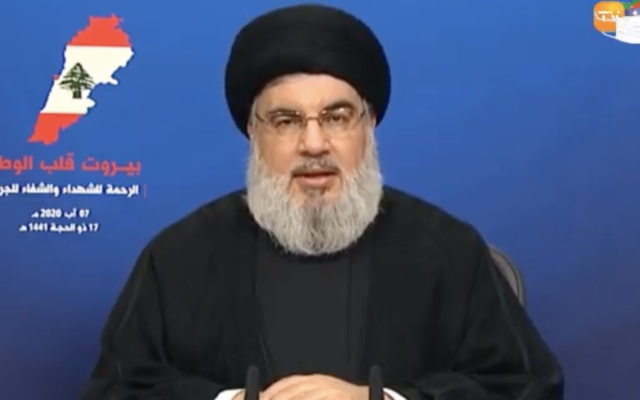
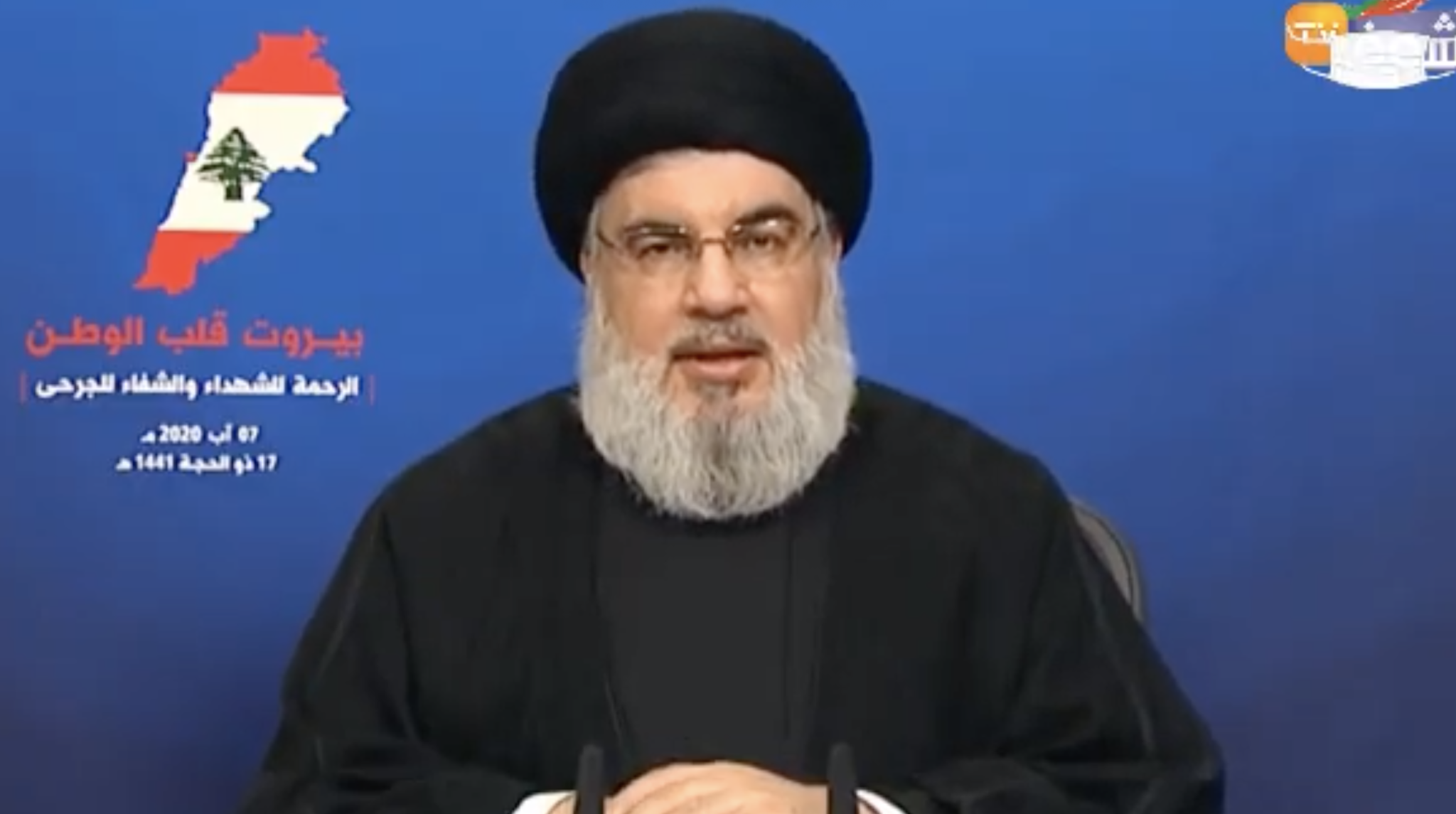
Hezbollah Secretary General Hassan Nasrallah gives a speech in the aftermath of a deadly explosion in Beirut, on Friday August 7, 2020 (al-Manar screenshot)

The Channel 13 report noted that “the material that exploded in the port is not new to Nasrallah and Hezbollah.”

It detailed Hezbollah’s previous connections to ammonium nitrate, including incidents in Germany and the UK, both widely reported at the time, in which its agents were reportedly found with substantial quantities of the material. In London in 2015, following a Mossad tip off, British intelligence found four Hezbollah operatives with 3 tons of ammonium nitrate held in flour sacks, the TV report said, citing foreign reports. A similar process led to the discovery in Germany of Hezbollah operatives with enough ammonium nitrate “to blow up a city,” the report said. Germany subsequently banned Hezbollah as a terrorist organization.

“That’s what Nasrallah intended to do in Europe,” the TV report said. “Regarding what was stored in Beirut port, the assessment is Nasrallah intended to use it in the Third Lebanon War.” (Israel has fought two wars with Lebanon — in 1982, and, following a cross-border raid by Hezbollah in which Israeli soldiers were killed and abducted, in 2006.)
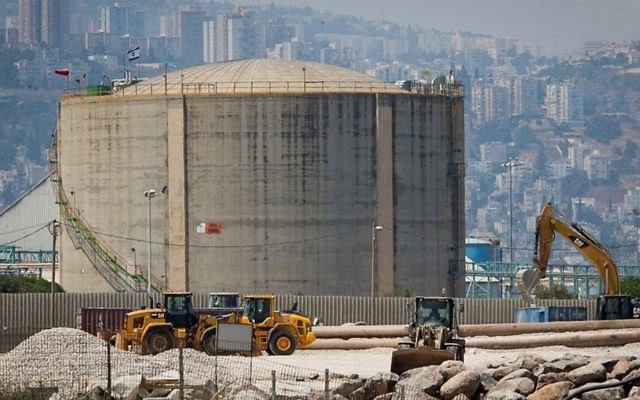
A view of the ammonia tank in Haifa on June 30, 2017. (Flash90)

The TV report also noted that Nasrallah, in a 2016 speech, threatened to fire missiles at an Israeli ammonia storage tank in the northern port city of Haifa. “Lebanon has a ‘nuclear bomb’ today,” Nasrallah said in the speech. “The idea is that some of our missiles, combined with the ammonia in Haifa, will create the effect of an atom bomb.” (The tank has since been emptied out.)
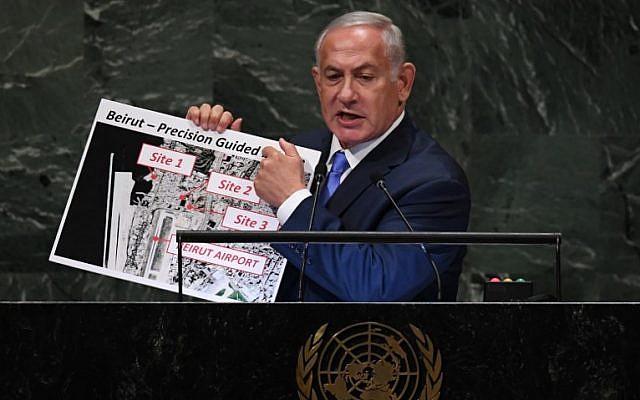
Prime Minister Benjamin Netanyahu addresses the General Assembly at the United Nations in New York September 27, 2018, and holds up a placard detailing alleged Hezbollah missile sites in Beirut. (AFP / TIMOTHY A. CLARY)

And it also cited a speech by Israeli Prime Minister Benjamin Netanyahu to the UN General Assembly in 2018, in which Netanyahu accused Hezbollah of storing missiles and other weapons in civilian areas. The prime minister alleged that one such site was “on the water’s edge” in Beirut.

Preliminary evidence released by Lebanese officials indicates that the explosion was connected to 2,750 metric tons of highly explosive ammonium nitrate which was left unsupervised in the port for almost six years. Documents allege that customs officials asked to move the vast trove numerous times but never received a reply.

In May, Israel’s Channel 12 reported that the Jewish state carried out a months-long delicate operation to assess Hezbollah’s operations in Germany and presented its findings to German intelligence and law agencies. Mossad reportedly gave Germany information about warehouses in the south of the country where Hezbollah stashed hundreds of kilograms of ammonium nitrate. Israeli intelligence was also said to have handed over details of key individuals in Hezbollah’s operations in Germany.
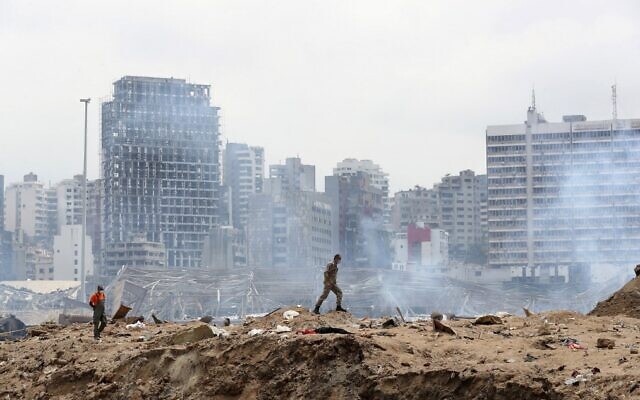
A soldier walks at the site of the massive explosion at the port of Beirut, August 6, 2020. (Thibault Camus/Pool/AFP)

The Friday Channel 13 report speculated that Nasrallah is fearful of an international probe of this week’s blast, possibly out of concern that Hezbollah might be implicated.
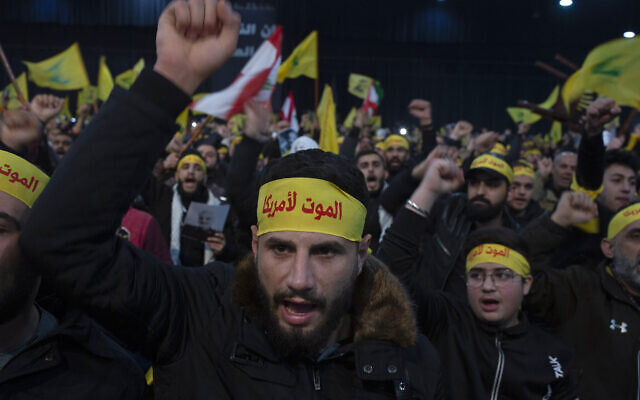
Supporters of Hezbollah terror group leader Hassan Nasrallah chant slogans ahead of his televised speech in a southern suburb of Beirut, Lebanon, January 5, 2020. (Maya Alleruzzo/AP)

Amid rising tensions with Israel in recent weeks, Nasrallah had originally intended to address the country on Wednesday, but postponed his speech after Tuesday night’s port explosion sent the country reeling. So far 157 people have been confirmed dead and over 5,000 wounded. Around 300,000 Beirut residents were rendered homeless as the blast tore apart homes miles from the port.

Israel firmly denied initial speculation that it had anything to do with the explosion, has sent condolences, and offered medical aid. Senior Hezbollah officials speaking on condition of anonymity to Lebanese media have been equally insistent that neither Hezbollah nor Israel were involved.

Israel TV: Hezbollah apparently wanted Beirut’s ammonium nitrate for Israel war


Russia warns it will see any incoming missile as nuclear

MOSCOW (AP) — Russia will perceive any ballistic missile launched at its territory as a nuclear attack that warrants a nuclear retaliation, the military warned in an article published Friday.

The harsh warning in the official military newspaper Krasnaya Zvezda (Red Star) is directed at the United States, which has worked to develop long-range non-nuclear weapons.

The article follows the publication in June of Russia’s nuclear deterrent policy that envisages the use of atomic weapons in response to what could be a conventional strike targeting the nation’s critical government and military infrastructure.

In the Krasnaya Zvezda article, senior officers of the Russian military’s General Staff, Maj.-Gen. Andrei Sterlin and Col. Alexander Khryapin, noted that there will be no way to determine if an incoming ballistic missile is fitted with a nuclear or a conventional warhead, and so the military will see it as a nuclear attack.

“Any attacking missile will be perceived as carrying a nuclear warhead,” the article said. “The information about the missile launch will be automatically relayed to the Russian military-political leadership, which will determine the scope of retaliatory action by nuclear forces depending on the evolving situation.”

The argument reflects Russia’s longtime concerns about the development of weapons that could give Washington the capability to knock out key military assets and government facilities without resorting to atomic weapons.

In line with Russian military doctrine, the new nuclear deterrent policy reaffirmed that the country could use nuclear weapons in response to a nuclear attack or an aggression involving conventional weapons that “threatens the very existence of the state.”

The policy document offered a detailed description of situations that could trigger the use of nuclear weapons, including the use of nuclear weapons or other weapons of mass destruction against Russia or its allies.

In addition to that, the document states for the first time that Russia could use its nuclear arsenal if it receives “reliable information” about the launch of ballistic missiles targeting its territory or its allies and also in the case of ”enemy impact on critically important government or military facilities of the Russian Federation, the incapacitation of which could result in the failure of retaliatory action of nuclear forces.”

U.S.-Russia relations are at post-Cold War lows over the Ukrainian crisis, the accusations of Russian meddling in the U.S. 2016 presidential election and other differences.

Russian officials have cast the U.S.-led missile defense program and its plans to put weapons in orbit as a top threat, arguing that the new capability could tempt Washington to strike Russia with impunity in the hope of fending off a retaliatory strike.

The Krasnaya Zvezda article emphasized that the publication of the new nuclear deterrent policy was intended to unambiguously explain what Russia sees as aggression.

“Russia has designated the ‘red lines’ that we don’t advise anyone to cross,” it said. “If a potential adversary dares to do that, the answer will undoubtedly be devastating. The specifics of retaliatory action, such as where, when and how much will be determined by Russia’s military-political leadership depending on the situation.”

Russia warns it will see any incoming missile as nuclear