“Anyone who sees the disaster in Beirut should understand that it can happen here too, in Haifa Bay.”
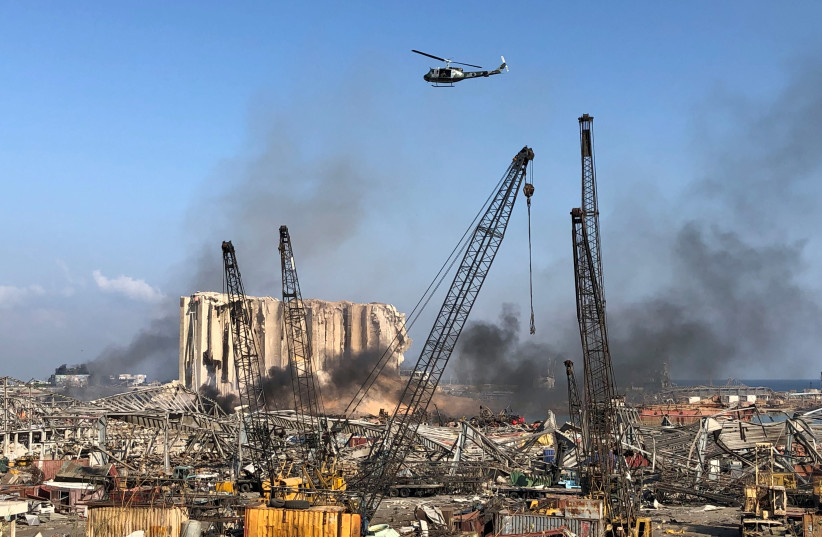
A Lebanese army helicopter flies over the site of Tuesday’s blast in Beirut’s port area
(photo credit: REUTERS/ISSAM ABDALLAH)
As Lebanese lawmakers express outrage after an explosion occurred at a warehouse at the Beirut port that stored over 2,750 tons of ammonium nitrate for six years, Israelis raised concerns about similar risks at the Haifa port.

“We need to remove the dangerous chemicals from the Haifa bay,” said Likud MK Gila Gamliel to 103FM. “The plan is to remove the [chemicals] within five years and then another five years to clean the area.”
Eli Levi, a writer for Channel 13, told 103FM that “Anyone who sees the disaster in Beirut should understand that it can happen here too, in Haifa Bay – we have huge fuel tanks, a bromine and ammonia reservoir, albeit not in a tank, but in dozens of trucks in the bay.”
The chairman of the Knesset Internal Affairs and Environment Committee Miki Haimovich stressed that Israel should be “very troubled” by the explosion in Beirut and called to promote a plan to close the petrochemical industry in Haifa “in the heart of a bay and a population.”
Haimovich intends to call a meeting with all relevant authorities to examine the state’s readiness for a disaster such as the one in Beirut, including prevention, risk management and disaster preparedness.
The Haifa Environmental Research Center stated on Wednesday that there are “1,500 aggregate risk areas and 800 types of dangerous chemicals in the Haifa Bay in factories right next to our bedrooms.”
The Shafir report for examining risks in Haifa found that “factories and hazardous materials facilities in Haifa will be damaged in an emergency – as a factual determination.”
“The incident in Lebanon illustrates the danger of a concentration of hazardous materials near a dense population and pushes the urgent need to close flammable and explosive industries,” said the research center.

A large storage tank held about 12,000 tons of ammonia in the Haifa port was emptied in 2017 after the tank was found to be a dangerous risk by the Environmental Protection Ministry’s Shafir Committee. Temporary supplies of ammonia are allowed into the country via small ships and sent directly to consumers via a pipeline. The government is working to find a permanent solution for ammonia consumers.

Hezbollah Secretary-General Hassan Nasrallah threatened to hit the ammonia tank in 2016, prompting Israeli officials to work to empty and close the tank.
“This would be exactly like a nuclear bomb, and we can say that Lebanon today has a nuclear bomb, seeing as any rocket that might hit these tanks is capable of creating a nuclear bomb effect,” said Nasrallah, at the time.
Despite the ammonia tank in Haifa being emptied, the research center stressed that tankers carrying ammonia are located near residential areas. A fertilizer plant that prepares fertilizer and explosives is located in the center of Haifa and houses a container with 15 tons of unprotected ammonia.

The research center called on the government to raise the plan to close dangerous factories for an urgent vote.

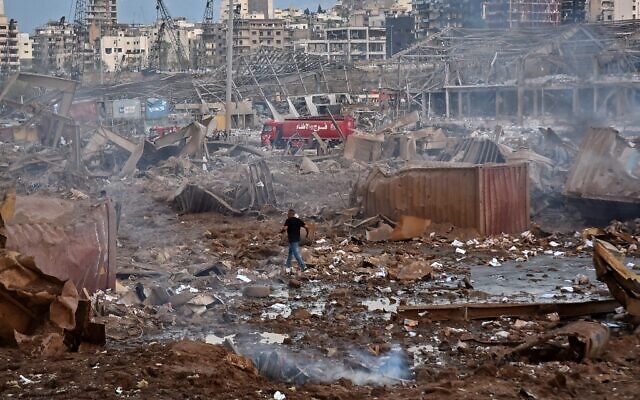
Over a hundred people were killed and thousands were wounded in an explosion that damaged buildings and vehicles throughout Beirut on Tuesday.

The exact cause of the explosion remained uncertain as of Tuesday night, but Lebanon’s Supreme Council of Defense stated that over 2,700 tons of ammonium nitrate were stored for six years at the warehouse where the explosion occurred, calling this “unacceptable.”
After the explosion, Israel offered to provide humanitarian aid to Lebanon.

Following the explosion, Defense Minister Benny Gantz and Foreign Minister Gabi Ashkenazi conveyed via diplomatic and security channels Israel’s offer to provide humanitarian relief and medical support to the Lebanese people. Israeli defense officials denied that Israel was connected to the explosion, which came as the IDF was on high alert along the northern border in anticipation of a Hezbollah attack.

“We just want to lend a helping hand,” said the director of the Galilee Medical Center Dr. Masad Barhoum in an Arabic address to Lebanon’s prime minister on Army Radio. “Those who come to us will receive treatment and leave, G-d willing, healthy and whole.”
“Officials contacted us, through the army,” added Barhoum. “We are ready to establish a field hospital today. All the teams are ready for action and staff absorption.”

Ariel Ben Solomon and Yaakov Lapin contributed to this report.+


Lebanese terror group says ‘no truth’ to rumors of airstrike on one of its weapons caches; Israeli official says Jerusalem had nothing to do with explosion


A destroyed silo at the scene of an explosion at the port in the Lebanese capital Beirut, on August 4, 2020 (STR / AFP)

A destroyed silo at the scene of an explosion at the port in the Lebanese capital Beirut, on August 4, 2020 (STR / AFP)

Massive blasts that struck Beirut were not caused by Israeli activity, sources in Lebanon and Jerusalem said Tuesday afternoon, as officials attempted to determine what sparked the huge explosions.

Lebanese officials indicated that an initial explosion was caused by fireworks stored at the port, and a second, even larger explosion may have been caused by the fire reaching explosive material that has been kept there for years.

The blasts came amid high tensions between Israel and Lebanon and hours after Prime Minister Benjamin Netanyahu issued a fresh warning to the Iran-backed terror group.

Senior Hezbollah officials told OTV Lebanon that social media rumors about an Israeli attack were false.

“There is no truth to rumors about an Israeli strike against Hezbollah weapons in the port,” a source told the station.

A picture shows the scene of an explosion near the the port in Beirut, August 4, 2020. (STR / AFP)

An Israeli official told journalists that Israel was not involved. The official spoke on condition of anonymity.

Foreign Minister Gabi Ashkenazi also indicated that Israel was not involved, telling the country’s Channel 12 news “I see no reason to not believe the reports that it was an accident.”

Foreign Minister Gabi Ashkenazi speaks at a joint press conference with German Foreign Minister Heiko Maas, on June 10, 2020. (Foreign Ministry/courtesy)

Despite the lack of Israeli involvement, there was still some speculation that the blast would have been caused by explosive materials stored by Hezbollah.

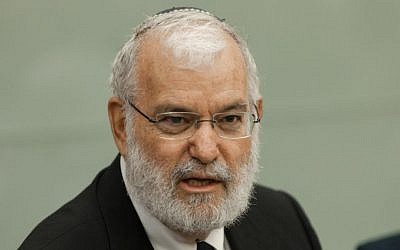
Yaakov Amidror, a former head of the National Security Council, indicated to Army Radio that the blast may have been the result of Hezbollah munitions exploding.

“You need to take a look at which irresponsible entity puts things like that in a civilian port,” he said. “Even if Hezbollah is responsible for this, it is not the worst thing it is doing to Lebanon.”

Lebanon analyst David Daoud said that he thought it was unlikely that Israel was involved in the explosion, saying that Israel has no interest in escalation at this point. At the same time, he noted that much still remains unclear about the situation.

“I’m skeptical that this is an airstrike. It’s not impossible, but we know the rules of the game between Israel and Hezbollah. If the Israelis did this, it is a declaration of war. What we know for certain is that there was a preliminary explosion and a secondary explosion, which is commonly associated with an airstrike…but it’s still very unclear,” Daoud said.

“This could just be a perfect storm of noise,” Daoud added.

With rising tensions between Israel and Lebanon in previous days, many Lebanese had leaped to blame Israel for the explosion. Some interviewed by Lebanese channel LBC said that they had seen a missile strike the port, with one woman adding that she had “heard a plane.” The Lebanese Air Force, however, had not reported any Israeli activity in its airspace since Monday night.

Former Israeli national security adviser Yaakov Amidror (Flash90)

At least 30 people were killed in the pair of explosions, Lebanon’s health minister said. Lebanese Red Cross director George Kataneh told al-Manar that more than 2,200 people were wounded.

The initial explosion Tuesday afternoon sent plumes of smoke into the sky and then a huge explosion that rocked the city. Video footage of the second blast showed an enormous orange fireball that dwarfed nearby buildings and sent a devastating tornado-like shockwave ripping through the city.

The first explosion in Beirut, according to Hezbollah-linked television station al-Manar, began with an electrical spark.

Beirut governor Marwan Aboud said that a team of first responders was dispatched to deal with the fire. The first fire, which burned for several minutes, led to a second, much more powerful explosion, which destroyed nearby buildings and shattered windows across the city.

The second explosion, according to Lebanese Customs Director Badri Daher, was caused by “nitrates.” Firefighters who were sent to the scene are still missing, Aboud said, possibly lost under the rubble in the collapsed port.

The incident came amid heightened tension on Israel’s northern frontier following a recent airstrike attributed to the Israeli military that killed a Hezbollah fighter in Syria, and anticipation that the Lebanese terror group would retaliate.

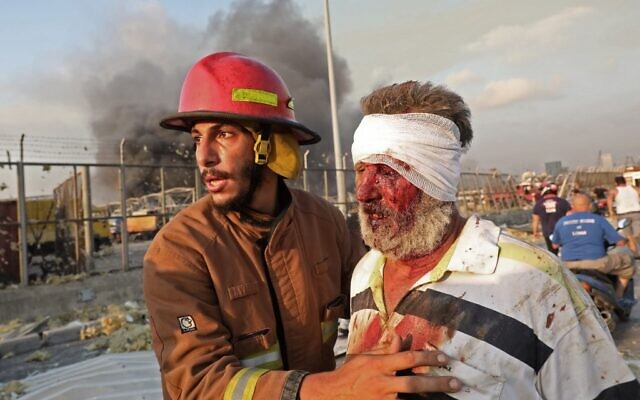
A wounded man is helped by a fireman near the scene of the explosion in Beirut, on August 4, 2020. (ANWAR AMRO / AFP)

Following the airstrike, the Golan Heights was hit by explosives fired from Syria and Israel responded by attacking Syrian military positions and beefing up its forces in the area.

Last week, Israel also said it thwarted an infiltration attempt from Lebanon by Hezbollah operatives, setting off one of the heaviest exchanges of fire along the volatile Israel-Lebanon frontier since a 2006 war between the bitter enemies.

Then on Monday, the IDF announced that it had struck targets in Syria after militants tried to plant explosives along the border in the Golan Heights. The four suspects in the incident were believed to have been killed by an Israeli missile strike while carrying out the attempted attack in the pre-dawn hours of Monday.

The scene of the explosion in Beirut, August 4, 2020. (STR / AFP)

Since 2011, Israel has launched hundreds of strikes in Syria, targeting government troops, allied Iranian and Hezbollah forces, and weapons heading to Lebanon while also vowing to end Iran’s military presence there. By contrast, though it sometimes uses Lebanese airspace to carry out attacks in Syria, Israel has avoided bombing in Lebanon.

What is claimed to have been a rare exception is an incident in August 2019, when a drone attack targeted a Hezbollah stronghold in Beirut. The British Times newspaper reported the attack, which was attributed to Israel by Lebanese authorities, targeted the Lebanese terror group’s precision missile project.

Israel has said it will not allow Hezbollah to obtain advanced weapons, among them precision-guided missiles it says the Lebanese group is trying to develop with Iranian assistance.

Israeli involvement in massive Beirut blast ruled out by both sides


  • Hundreds of casualties with many trapped in their homes
  • Cause of blasts, which was felt in Cyprus, unknown

BEIRUT: Two massive explosions in Beirut killed at least 50 people, wounded more than 2,700 and caused extensive damage across the Lebanese capital.

The blasts took place at the city’s port area and were so large the explosions were felt in Cyprus 200 kilometers away.

Even in a city with a history of conflict, the scale of the explosions was unprecedented.

Videos showed an initial blast and fire, followed by a massive explosion and shockwave spreading through the city’s buildings.

People could be heard screaming and running for cover in restaurants and from balconies. Many thought they had been hit by a massive earthquake.

Buildings across the whole city were damaged, with windows blown out and ceilings collapsed.

Lebanon’s health minister Hamad Hasan said the explosion caused a “very high number of injuries.”

Lebanese Red Cross official Georges Kettaneh said there had been hundreds of casualties, including dead, wounded. He said many people remained trapped in their homes.

The cause of the blast remains unknown. An Israeli official told Reuters that the country had nothing to do with the blasts.

Lebanon’s internal security chief Abbas Ibrahim said the explosions took place in a section of the port housing highly-explosive materials.

He declined to speculate about the cause of the explosion in Lebanon’s capital, saying “we cannot preempt investigations.”

The blasts took place just days before a UN tribunal was due to deliver verdicts against four men accused of killing the former Prime Minister Rafik Hariri and 21 others in a 2005 bombing that shook the region. The suspects are members of Hezbollah, the Iran-backed militant group which has since increased its role in the country’s government and conflicts across the region.

Prime Minister Hassan Diab declared a day of mourning for Wednesday.

President Michel Aoun called for an emergency meeting of the country’s Supreme Defence Council.

The explosions, which took place amid a desperate financial crisis and as the country struggles to contain COVID-19 left people in shock.

Many scrambled to contact relatives and friends, while assessing the damage to their homes.

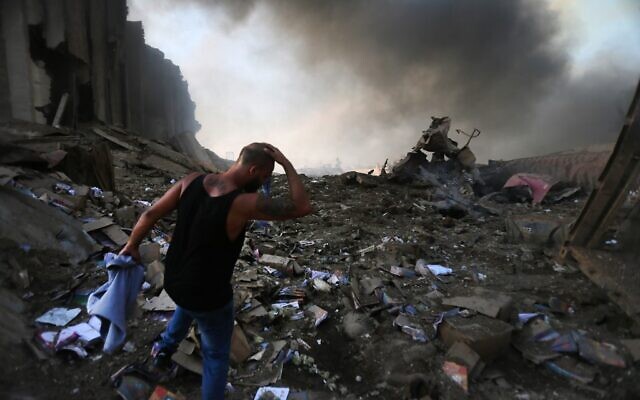
Lebanese firefighters work at the scene of an explosion in the Lebanese capital Beirut on Aug. 4, 2020. (AFP)

Lebanese directer Jan Choueiri said the scenes near his home in the Achrafieh neighborhood “looked like the apocalypse.”

“I could have died,” he said on Facebook. “I am relatively safe along with everyone here with me. I still can’t reach everyone to know who is well and who is not … Blood is everywhere on the streets of Achrafieh. People are injured everywhere around if not dead.”

Lebanese journalist Rima Maktabi tearfully described the damage to her home.

“My house is gone I think”, she told Al-Arabiya, the channel she works for. “There are a lot of injuries and lots of shattered glass.”
Raja Farah, a pastry chef, said he was just half a kilometer from the explosion.

“It is impossible to explain the magnitude of this explosion,” he said on Facebook. “I was thrown to the ground and a cloud of what felt like sand burnt my face.”

He added: “I was about as far from the Hariri explosion a few years back, and this was, no exaggeration, 100 times more powerful.”

*With agencies

Massive explosions in Beirut kill dozens and injure thousands, cause extensive damage