
The airstrikes were intensive, with 15 militia members reportedly killed.
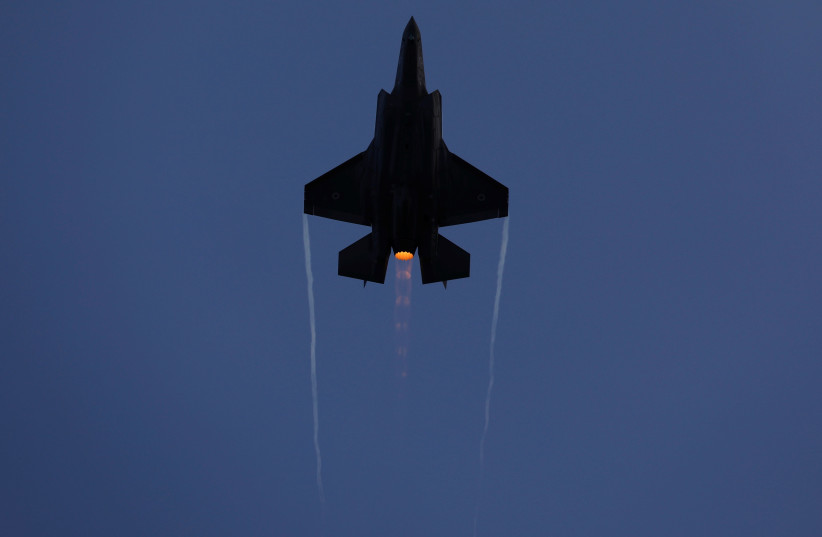
An Israeli Air Force F-35 fighter jet flies during an aerial demonstration at a graduation ceremony for Israeli air force pilots  (photo credit: REUTERS/AMIR COHEN)
An Israeli Air Force F-35 fighter jet flies during an aerial demonstration at a graduation ceremony for Israeli air force pilots
(photo credit: REUTERS/AMIR COHEN)
Iranian positions near Albukamal, a key border city in Syria that is near Iraq, were hit by “unidentified jets,” according to the Syrian Observatory for Human Rights. These areas are festooned with pro-Iranian militias who have entrenched at a base called Imam Ali and spread themselves like a carpet along the western bank of the Euphrates river. They have a network of bases and smuggling routes and houses they occupy all the way to Deir Ezzor and also inland towards bases known as T-4, T-3 and T-2. This area has been hit by airstrikes monthly for more than a year.

The recent attacks took place between five in the morning and nine in the morning, apparently on August 3 although the reports emerged on August 4. They targeted Iranian-backed forces at Imam Ali, an area named Al-Sekka and also in the desert near Deir Ezzor. There were casualties and weapons were destroyed. “Military vehicles affiliated with the targeted forces transported the dead and injured,” SOHR says.
The SOHR report was picked up at Al-Ain where the report also notes that “15 Iraqi militia members loyal to Iran” were killed. The airstrikes were intensive. Al-Ain says that a major explosion also happened at Al-Hizam al-Akhdar area near Albukamal, targeting an Iranian militia there. Iran has some 20-30,000 affiliated militias in Syria but only around 800 actual Iranian operatives linked to the IRGC. Iran has signed a deal to support Syrian air defense which could see it deploy the 3rd Khordad or Bavar systems. Iran tried to move a 3rd Khordad to T-4 base in April 2018 but it was hit by an airstrike.
The Syrian regime blames Israel for airstrikes in Syria. Israel has carried out more than 1,000 airstrikes on Iranian targeted in the past. Israel says it carried out other airstrikes in Syria on August 3 in retaliation for a thwarted IED planting effort by an unknown group in Syria near the Golan. “Jets, attack helicopters and aircraft struck military targets in southern Syrian belonging to the Syrian armed forces,” the Israel Defense Forces said on Monday. Al-Ain says that this is “noteworthy” in its reports about the strikes by unknown aircraft near Albukamal.
Hezbollah says one of is members was killed on July 20 in airstrikes in Syria and Hezbollah blamed Israel, leading to tensions. On June 24 wide ranging airstrikes hit a number of locations in Syria, including “dish hill” near Suwayda and also points near Deir Ezzor. At least seven Iranians and Syrians were allegedly killed in those strikes and reports at the time indicated Iran might respond.


140 new immigrants arrive from France

Immigration and Absorption Minister Pnina Tamano-Shata welcomes new olim from France at Ben Gurion Airport.

Arutz Sheva Staff , 03/08/20 22:11


New Olim from France arrive in Israel

New Olim from France arrive in Israel

Olivier Fitoussi

One hundred and forty olim (immigrants) from France arrived in Israel this evening and were welcomed at Ben Gurion Airport by Israeli Minister of Immigration and Absorption, Pnina Tamano-Shata and President of the International Fellowship of Christians and Jews (The Fellowship), Yael Eckstein, whose organization arranged for the flight.

Several days before her flight with her husband and three children, Barbara Simha Bohadana said from Paris: “I was fired because I was Jewish. A pharmacy manager, who I worked for as a pharmacist, did not even try to hide the reason for my dismissal. He just told me that a wig or any other sign of my Jewishness was not acceptable and that if I did not have them removed, I should just get up and leave. So I got up and left. My husband, Dan, an anesthesiologist by profession, also had a hard time finding a job because of his Jewish background.

“We have always been Zionists and we knew we would make aliyah. We are a religious family and abide by a traditional Jewish lifestyle. I am so happy that we are moving to Israel and that we will never have to go through such experiences again.”

Forty-one-year-old Lionel Giuili, who made aliyah with his wife Stephanie and their three children, noted: “My parents live in Israel, as well as my sister and a lot of other family members. We always knew we would make aliyah. We were always connected to Israel and maintained Jewish tradition. However, the Hypercacher Kosher Supermarket Siege was the straw that broke the camel’s back, and we finally decided to make aliyah.”

Although Lionel and his family did not suffer any physical violence, the plague of anti-Semitism has had a direct impact on every member of the Jewish community. Lionel added: “If, for example, while I was sitting and eating in my store and I heard someone enter the store, I automatically took off my kippah. Neither I nor my children walked around the street with Jewish symbols.”

Lionel had visited his family in Israel quite often before making aliyah. “My parents live in Jerusalem, and even before they made aliyah, I already had family living in Israel. I always felt at home in Israel. I feel free in Israel, and I no longer have to hide my Jewish identity. This reflex I developed that made me take my kippah off and put it in my pocket will no longer be necessary as I will be living in Israel.

“My children are very excited about making aliyah. They expect to see their grandparents and cousins, and I think they are going to be visiting the Mediterranean Sea all the time.”

Moving to Israel during the coronavirus pandemic has not scared the family. “We are aware of the situation in Israel. Israel as a whole has coped well with the situation, especially in the first wave, when France was facing a shortage of masks.”

Minister of Immigration and Absorption, Pnina Tamano-Shata said: “In 2020, we will welcome over ten thousand olim from all over the world. It is a great privilege for me, as the Minister of Immigration and Absorption of the State of Israel, to manage aliyah during this challenging time.

“I congratulate our brothers and sisters from France, who are Zionists and full of love for this country, and who today, thanks to The Fellowship, realized their dream of making aliyah and uniting with the people living in Zion. The Jews of Europe and the rest of the world are currently facing complex challenges, and every Jew should know that the gates of this country are still open, even during an emergency or crisis. The Ministry of Immigration and Absorption will accompany the olim in their first steps towards integration into Israeli society because only together are we stronger.”

President of The Fellowship, Yael Eckstein, said: “We are proud to continue to bring hundreds of olim to Israel, even during a complex period as the coronavirus pandemic and its economic consequences. The arrival of the olim is not only a fulfillment of Zionism; it is also a sign for prospective olim to make aliyah in any situation. The Minister of Immigration and Absorption and her staff will ensure the optimal integration for each new citizen as well as their success and contribution to Israel’s society and economy.”

Nearly half of the olim (60) are children under the age of 18. Eleven of the olim are medical and paramedical professionals. Seventeen have careers in high-tech while 27 have experience in liberal arts professions. Fifty of the 140 olim will be moving to the coastal city of Netanya while 31 will find their new homes in Israel’s capital, Jerusalem.

For more than 20 years, the International Fellowship of Christians and Jews has been helping Jews to make aliyah and has invested more than $200 million in bringing more than 750,000 olim (immigrants) to Israel. The Fellowship has also been a major contributor to the Jewish Agency and helped to establish the Nefesh B’Nefesh organization. In 2014, The Fellowship began operating independently in the field of immigration. Since then, it has brought more than 23,000 olim to Israel from 30 countries around the world. The olim receive comprehensive assistance from The Fellowship, including special grants of $500 per adult and $300 per child. The Fellowship also sponsors their flights to Israel and ensures that they receive the klitah (resettlement) assistance that they need. Additionally, The Fellowship helps immigrant families with housing and employment, and continues to advise them as they become accustomed to life in Israel


The targets hit in the strikes included lookout points, intelligence gathering mechanisms, anti-tank weapons and means of control and command at Syrian military bases.

Attack in Syria on August 25, 2019. (photo credit: ARAB MEDIA)
Attack in Syria on August 25, 2019.
(photo credit: ARAB MEDIA)
The IDF carried out airstrikes against targets belonging to the Syrian military in southern Syria on Monday night in response to an attempted terrorist attack that was thwarted along the Syrian border on Sunday night.
IDF aircraft, including fighter jets and helicopters, carried out the strikes, according to the IDF Spokesperson’s Unit.
The targets hit in the strikes included lookout points, intelligence gathering mechanisms, anti-tank weapons and means of control and command at Syrian military bases.
“The IDF sees the Syrian regime as responsible for all operations carried out in its territory and will continue to act with determination against all attacks on the sovereignty of the State of Israel,” said the IDF in a statement.
Syrian air defenses responded to “enemy targets” southwest of Damascus on Monday night, according to Syrian state news agency SANA.
According to SANA, only material damage was caused in strikes that targeted the Quneitra area in southern Syria. Al-Arabiya reported that injuries were caused in the strikes.
Shortly before the strikes in Quneitra, the Syrian Observatory for Human Rights reported that airstrikes by unidentified aircraft targeted sites belonging to pro-Iranian militias in Albukamal in the Deir Ezzor area of Syria near the Iraqi-Syrian border. Deaths and injuries were reported in the strikes that damaged armories and other sites belonging to the militias.
IDF soldiers thwarted an attempt to place explosive devices near the Syrian border fence late Sunday night.
“Special forces that were carrying out an ambush near an IDF post in the southern Golan Heights spotted a cell with a number of terrorists planting explosive devices along the border. An IDF force and an aircraft opened fire together on the four-member cell and hit them,” the IDF said, adding that no soldiers were harmed in the incident.
“We don’t know who sent them,” said IDF spokesperson Brig.-Gen. Hidai Zilberman on Monday. “There are a lot of players in Syria, some acting for Iran and some not. We cannot say right now that this is a Hezbollah attack, but we can’t rule it out either.”
Later on Monday, the IDF said during an investigation of the scene, some 25 meters from the perimeter fence inside Israeli territory, weapons and a bag containing a number of explosive devices were found.
The foiled attack took place near an abandoned military post in the southern Golan Heights on the Syrian border where the IDF operated the Mazor Ladach field clinic, which was opened in August 2017 and closed a year later, Zilberman told reporters.
Anna Ahronheim contributed to this report.