Nazareth may be best known for its famous ancient resident — Jesus — but as British-Israeli archaeologist Yardenna Alexandre notes in this week’s The Times of Israel Podcast, the once small village with huge name recognition existed well before and well after his lifetime.
Alexandre discusses what archaeology tells us about the Jews who lived in Nazareth and its surroundings two millennia ago, and how by hewing into the soft chalk stone under the village houses the residents evaded taxes, and also may have saved their skins during the Great Revolt against the Romans in 66 CE.
Based on excavated evidence, the tiny, off-the-beaten-path hamlet was inhabited from the Iron Age (10th–8th centuries BCE) onward. It was only in the 1850s that the Europeans turned the one-camel town into a holy site, and the village turned into the sprawling modern Arab Israeli city we find today.
Alexandre published a new excavation report on Nazareth in the current issue of the Israel Antiquities Authority’s ‘Atiqot journal that describes its early settlement history and findings from her excavations and those of other researchers. What is arguably of most interest in the report is what was discovered in very bedrock of the village.
Among her digs, in 2009, Alexandre discovered the first example of a residential building from the time of Jesus. It was found near today’s Church of the Annunciation, which was constructed in 1969 on top of three earlier churches, including a 4th century CE structure. In her report, Alexandre describes the structure as “a simple house comprising small rooms and an inner courtyard was inhabited in the late Hellenistic and the Early Roman periods.” In earlier excavations on the site, some early Roman period storage pits and cisterns were also found.

The 2009 excavation of a 2,000-year-old Nazareth Jewish home, next to the Church of the Annunciation. (Assaf Peretz, courtesy of the Israel Antiquities Authority)
Catholic tradition believes the churches were built on the location of a cave that was thought to be the familial house of Mary, Jesus’s mother. According to New Testament tradition, the Angel Gabriel revealed to Mary (then an unmarried young woman) that she would become pregnant through the Holy Spirit and give birth to the Son of God. (The eventual birth took place in a little town of Bethlehem, where Mary’s husband Joseph had family.)
In a Times of Israel Podcast interview this week, Alexandre says that Jewish settlers came to the Galilee during a northward expansion of un-landed Hasmonean soldiers and others from the late Hellenistic to Early Roman periods (late second century BCE to early or mid-second century CE). Among these residents who arrived during the Judeans’ manifest destiny movement were presumably the family of Jesus’s mother Mary.
Salvaging knowledge ahead of development
Alexandre has been excavating sites in the Lower Galilee on behalf of the IAA for the past three decades. Born in London, she immigrated to Israel in 1980 and earned an MA in archaeology at Tel Aviv University before moving north.
As an archaeologist who is not affiliated with a research facility, Alexandre leads salvage excavations for the IAA to uncover artifacts and information prior to land development. In a crowded city such as Nazareth, the possibility of excavation is rare and comes up when, for example, an institution wishes to expand or a local business reinvents itself from a car garage to a luxury hotel.
“I go where I’m sent and create the story from the material that turns up. It’s quite exciting in a way because you never what what you’re going to land with,” said Alexandre.

Archaeologist Yardenna Alexandre next to a display of artifacts in Nazareth’s Legacy Hotel. (courtesy)
Today’s booming, packed Nazareth is not at all on the scale of the little village where Jesus was raised, she says.
“The Nazareth that we know today is really the result of the second half of the 19th century development onwards. Because it was only in about the 1850s that the Europeans began to develop their interest in Nazareth as a Holy City, a city holy to Christianity. All the main European powers started taking interest and they built churches and other institutions,” she said.
However, if we were to step back in time and visit Nazareth at the time of Jesus, we would see a very small village settled by a few families. Around Nazareth there were larger, important towns such as Tzippori (Sephoris), which was only about 5 kilometers to the west of Nazareth, as well as the village of Kana, near today’s Kfar Kana, which was 3-4 kilometers to the north from Nazareth.

An in situ image of stone vessels unearthed inside the ancient workshop at the stone quarry and tool production center excavations at Reina, a few kilometers from Nazareth, in Lower Galilee. (Samuel Magal/IAA)
Alexandre said that scant excavations in Nazareth have not uncovered any ritual baths or synagogues, but it was clearly a Jewish settlement due to the types of pottery found, as well as the chalk-stone vessels, which were only used by the Jewish populations of the era because they were not susceptible to ritual impurity.
“Jewish families would make sure they had several of the stone vessels in their cupboards,” she said. Along with the nod to Jewish law, or halacha, Alexandre and other excavators in the area have discovered numerous Herodian-style lamps of the sort found in Jerusalem.
“Petrographic analysis of the sherds have allowed us to come to the conclusion that the lamps from the Galilee were actually manufactured in Jerusalem,” she said, and were taken back to the tiny town as souvenirs from pilgrimages to Jerusalem and the Temple Mount.

IAA archaeologist Yardenna Alexandre in an underground system of rooms under ancient Nazareth. (Screenshot)
There are geographical, environmental explanations for Nazareth being so small, she said. Nazareth was set in a small basin surrounded by hills and wasn’t very accessible. It did have a water supply from what is called today Mary’s Well, and there is evidence of some limited terraced agriculture, as well as pasture fields. But since the town wasn’t located on a roadway, “people didn’t go through Nazareth unless they specifically wanted to go there. And that was really the reason that it remained a small site until the 19th century.”
Nazareth is the pits
While few remains of structures from the time of Jesus have been discovered, the most intriguing discoveries dating to the early Roman period is the proliferation of subterranean systems of rooms under ancient Nazareth that were hewn into the soft chalk bedrock.
The people who lived in Nazareth dug out pits for storage, and for other practical uses, she said, such as the production of wine, including treading grapes, and oil-pressing. Such storage pits have been found elsewhere in the Lower Galilee and Alexandre believes that the Jews eventually also used them for secreting their wares — aka tax evasion — and even themselves during the Great Revolt of 66 CE.

IAA archaeologist Yardenna Alexandre in an underground system of rooms under ancient Nazareth. (Screenshot)
“What we did find in Nazareth is a development of this kind of concept — not only did they dig individual pits for storage, but they dug below the pits, down to a second level, deeper down, and a third level, and often there were underground passages leading from one to another. So really in the times of danger or in times when people wanted to hide things, they would be able to do so,” she said.
In one site, Alexandre discovered a bell-shaped system of rooms that would have been connected. “The triple layer of pit that I found, each pit was about 1.7 meters [5.5 feet] and 1.5 meters [5 feet], so we’d be going down about 5 meters [16.5 feet] below ground,” she said.
In the times of danger or in times when people wanted to hide things, they would be able to do so
According to the pottery in the various excavations, the pits under Nazareth were in use from the Bronze or Iron Age on through the Byzantine era.
Alexandre believes they were enlarged and used as hiding spaces, “because we found finds that specifically date the use of these pits to the early Roman period, and even more specifically to the time of the Great Revolt.”
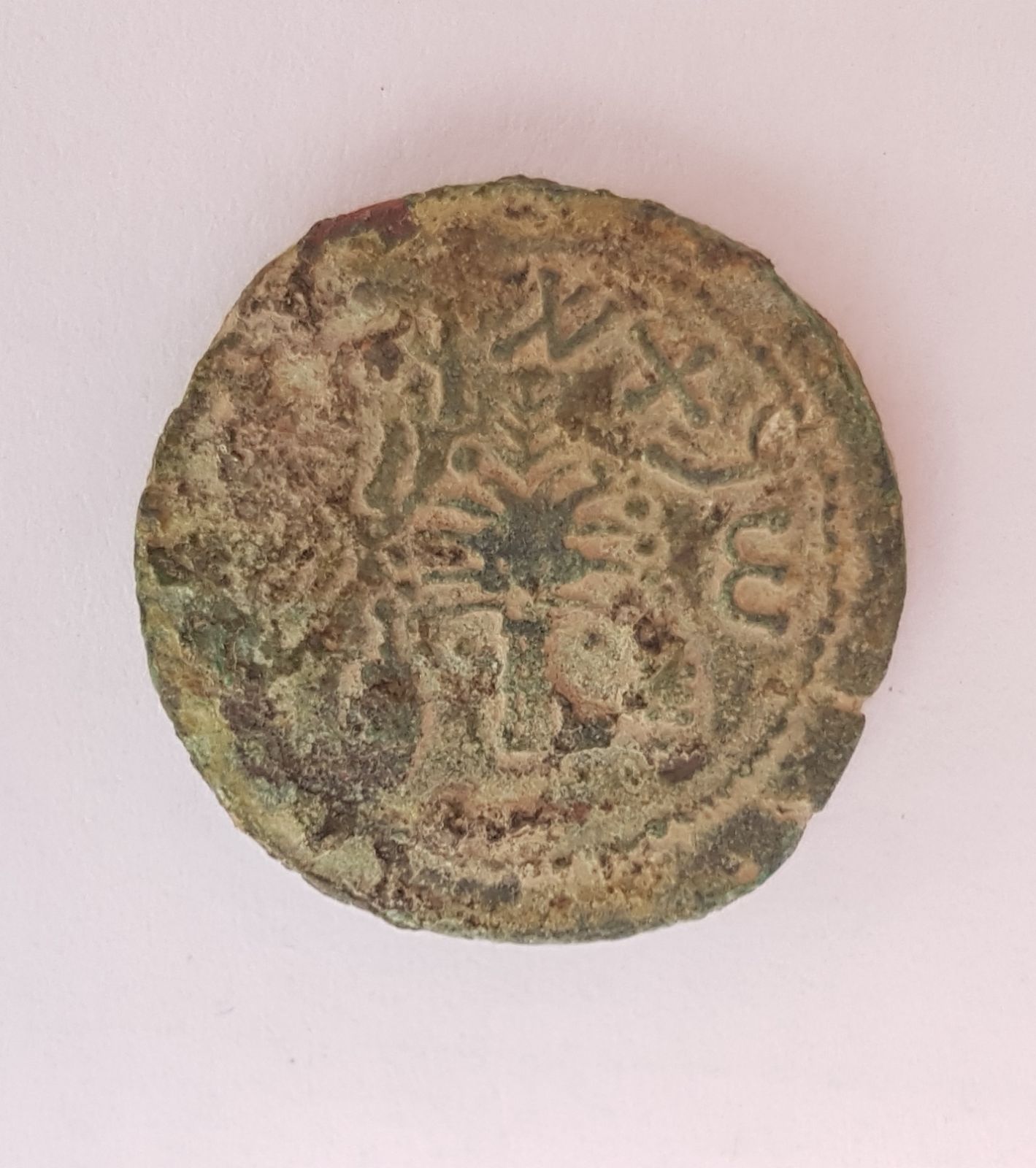
Among the artifacts is a coin of Emperor Claudius that was uncovered on the floor of a corridor that led into a three-story pit complex. According to the report, “The coin was minted in ‘Akko-Ptolemais in 50–51 CE. The coin provides support for the functioning of the complex in the latter half of the first century CE, possibly in the context of the preparations for the First Jewish–Roman War in 66–67 CE.”

Illustrative: A rare bronze Year Four coin, minted in 69-70 CE during the Great Jewish Revolt, discovered in wet sifting of material from the City of David, June 2018. (Ilan Shilmaiv/City of David)
In addition to artifacts supporting the subterranean system’s use for hiding are recorded documentation from the main Jewish commander in the Galilee Josephus, who became the era’s most well-known Jewish historian. Alexandre believes that the pits were used to shelter women, children and other non-fighting Jews.
“Not everybody went out to war, people had to protect themselves, and the people who were not fighting had to hide,” she said.
In the time of Jesus, residents of Nazareth likely only had the single storage units under their homes, Alexandre believes. It was only in the Great Revolt, she said, that they would have dug deeper for hiding places for themselves.
“What we did observe is that the first, the highest pits, were well carved, and the two below it were rather more hurriedly and slovenly created. The second and third layer down were added in time of danger,” she said.
These pits were found in other locations, such as nearby Kana, where Jesus and Mary attended a wedding that was recorded in the Christian New Testament. Alexandre also discovered ritual baths under private dwellings in this seemingly more affluent village that was likewise settled by Hasmonean Jews.

Illustration of subterranean silos found under Nazareth. (Courtesy/Screen shot)
In reference to Nazareth’s small stature, Alexandre quotes from the Book of John, in which Nathanael of Kana wonders to Philip, one of the 12 apostles, “Can anything good come out of Nazareth?”
“It was just a little hamlet, and the idea that such a leader [as Jesus] came out of Nazareth was surprising, was worth noting,” said Alexandre.
The Times of Israel podcasts are available for download on iTunes, Soundcloud, TuneIn, Pocket Casts, Stitcher, PlayerFM or wherever you get your podcasts.