
Could archeology and modern medicine help validate the Bible?

“The observation of a unique medical condition and the discovery of a related archaeological object could help explain one of the most bizarre accounts in the Bible.”
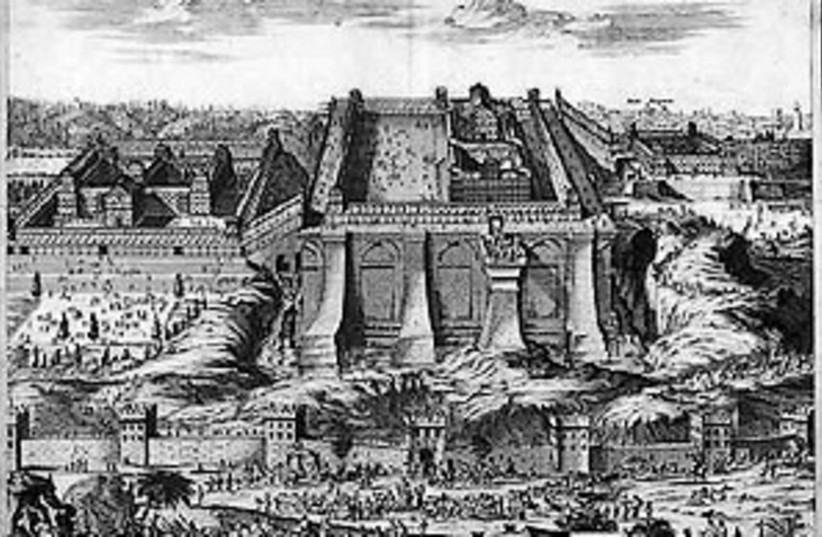
first temple 298
(photo credit: Courtesy)
Archeology and modern medical techniques may be able to shed some light on one of the Bible’s most intriguing stories – the madness of the Babylonian king Nebuchadnezzar II, according to a research reported by the Daily Express on Sunday.

The Bible is celebrated by billions of people around the world as a spiritual document, but some researchers believe it could also be used as a tool for gaining insights into our history. One of those researchers is Prof. Tom Meyer, an expert in Middle Eastern languages from the Shasta Bible College and Graduate School in California, who believes archeology, combined with the medical knowledge we possess today, can help validate many stories in the Bible.

“The observation of a unique medical condition and the discovery of a related archaeological object could help explain one of the most bizarre accounts in the Bible, the cruel and unusual divine punishment of the famous sixth century BC king of Babylon, Nebuchadnezzar,” Prof. Meyer said.

King Nebuchadnezzar II ruled the Babylonian empire between 605 BC and 562 BC. He is considered the longest-reigning and perhaps the most powerful ruler of the ancient Babylonian empire, being described as the “destroyer of nations” in the Book of Jeremiah.

The Book of Kings depicts Nebuchadnezzar as the king responsible for two sieges of Jerusalem, one in 597 BC and another one ten years later, in 587 BC, which brought about the destruction of Solomon’s Temple, also known as the First Temple, which marked the conquest of Judah.

Prof. Meyer explains that “… after the destruction of Jerusalem in 586 BC and at the zenith of Nebuchadnezzar’s power, when his heart was lifted up with pride, the God of Israel took away his royal authority for seven years by driving him from human society.

The Book of Daniel depicts Nebuchadnezzar’s period of madness as a punishment from God, after Daniel interprets a dream of the king as a prophecy by God meaning that world powers will rise and fall soon and that Nebuchadnezzar will be the first to suffer such fate, which happened, as the king “was driven from men and did eat grass as oxen” (Daniel 4:33.)

While many scholars view the Book of Daniel as mostly fictional for different reasons, Prof. Meyer and his colleagues believe otherwise.

“The most famous and powerful king in the world was condemned to spend seven years in the fields with the wild animals and to eat grass like a cow until he learned that the God of Israel has power over human kingdoms and that he can give them to anyone he chooses,” Prof. Meyer said.

In modern medical terms, according to this interpretation, the king suffered from a mental condition known as boanthropy, which would explain his bizarre behavior depicted in the Book of Daniel.

Boanthropy is a personality disorder that causes a person to believe they are a cow or an ox. Nebuchadnezzar II is considered the most famous figure to suffer from this condition.

“In 1946 Dr Raymond Harrison of England recorded his experiences of observing a modern-day case of boanthropy … Dr Harrison observed that the patient’s only physical abnormality was the lengthening of his hair and a thickened condition of the nails, the same anomalies that beset Nebuchadnezzar,” according to Prof. Meyer who added that “like the famous king, the observed patient spent the entire day roaming the asylum grounds from dusk till dawn eating handfuls of grass and drinking out of puddles like an animal.”

Another explanation for Nebuchadnezzar’s bizarre behavior could be that he was afflicted by porphyria, a name given to a group of disorders that result from the buildup of porphyrins in the body, organic compounds that are essential for the proper function of hemoglobin but may negatively affect the nervous system when in high levels.

As for the archaeological object linked to this narrative, Prof. Meyer mentions that “Assyriologist A.K. Grayson published a sixth century BC cuneiform tablet found in Babylon and now on display at the British Museum – object number 34113 – that states Nebuchadnezzar’s life appeared of no value and that he continually gave contradictory orders, could not recognize his own family members, or contribute in any of his building projects.

“This period of madness likely took place during the seven years he was driven from human society.

“Through the data uncovered by medical and archaeological research, we are able to measure the Bible’s historical accuracy.

“In every instance where the Bible’s claims can be tested, even in such bizarre accounts as the humbling of the famous Nebuchadnezzar, the Bible proves to be accurate and reliable,” Prof. Meyer concluded.


Associates of PM quoted saying he won’t allow budget to pass by August deadline, leading to new national vote; reportedly fears courts will ban him from post over trial


A supporter of Prime Minister Benjamin Netanyahu protests outside the Jerusalem District Court during a hearing in his trial on July 19, 2020 (Yonatan Sindel/Flash90)

A supporter of Prime Minister Benjamin Netanyahu protests outside the Jerusalem District Court during a hearing in his trial on July 19, 2020 (Yonatan Sindel/Flash90)

Prime Minister Benjamin Netanyahu has reportedly decided against passing a state budget by a late-August deadline, which would trigger new elections in November.

Quoting sources who have spoken with Netanyahu and his associates, Haaretz reported Wednesday evening that the premier is seeking to create a sense of chaos in the coalition to shore up public support for breaking up the government.

The current government, led by Netanyahu’s Likud party and Defense Minister Benny Gantz’s Blue and White, was sworn in in May after a 508-day crisis that saw Israel slog through three inconclusive rounds of elections. While Gantz campaigned on not joining a government led by Netanyahu due to the prime minister’s indictment on corruption charges, he cited the coronavirus pandemic as the explanation for his reversal.

According to the report, Netanyahu decided to seek another round of elections following the Jerusalem District Court’s ruling last week that witnesses will begin testifying in his criminal trial in January, with hearings to take place three times a week. The report said Netanyahu fears petitions to the High Court of Justice will demand he be barred from continuing to serve as prime minister while he is on trial and that Attorney General Avichai Mandelblit will back this stance, making it easier for the justices to rule in favor of the petitioners.

Unnamed associates of Netanyahu were quoted as saying that the premier’s main aim was to obtain control over the Justice Ministry and that he would campaign heavily against the judicial system ahead of the elections. The current justice minister, Blue and White’s Avi Nissenkorn, has defended the legal system amid unsubstantiated claims by Netanyahu and his allies that he is the victim of a “attempted political coup.”

While aware of the risks of another election, which would come as Israel is mired in the coronavirus pandemic and a major economic crisis, the report said Netanyahu has decided that it is better than the alternatives, and that he has no intention of honoring a rotation agreement that would see Gantz take over for him as prime minister in November 2021.

Prime Minister Benjamin Netanyahu (R) and Defense Minister Benny Gantz at the weekly cabinet meeting, at the Foreign Affairs Ministry in Jerusalem, on July 5, 2020. (Amit Shabi/POOL)

Though the coalition deal between Likud and Blue and White mandates a two-year budget, Netanyahu has been pushing for a budget that will only cover the rest of 2020, citing the uncertainty caused by the pandemic. Gantz, however, has insisted that a two-year budget be passed, as stipulated in the coalition deal, saying it would provide greater financial certainty to those hurt economically by the government’s lockdown measures.

The passage of only a one-year budget — or the failure to pass one at all — could allow Netanyahu to enter new elections without having to hand over the premiership to Gantz as stipulated by the coalition deal.

Interior Minister Aryeh Deri, head of the ultra-Orthodox Shas party, came out Wednesday against the possibility of new elections.

“We’re on the brink of an abyss. This isn’t an exaggeration. The country can’t allow itself political paralysis like this while we’re stuck in a severe health, social and economic crisis,” he told the party’s weekly newspaper HaDerech. “The destruction of the coalition and moving up of elections can’t be allowed. The people of Israel won’t forgive whoever leads them to elections at the peak of the coronavirus pandemic.”

Prime Minister Benjamin Netanyahu, left, with Shas party chairman Interior Minister Aryeh Deri, March 4, 2020. (Yonatan Sindel/Flash90)

He said it was possible to resolve the disagreements over the budget and that Shas would back any solution supported by Likud and Blue and White.

The Haaretz report came as the coalition was again thrust into crisis, after the Blue and White party voted in favor of a bill outlawing psychotherapists from performing gay conversion, despite the opposition of Likud and its ultra-Orthodox allies.

Under the coalition agreement, no decisions — apart from West Bank annexation — can be promoted without the mutual agreement of both Likud and Blue and White.

A Blue and White source was quoted by Channel 12 news acknowledging the vote was “retaliation” for Likud’s backing of a proposed parliamentary panel to probe Supreme Court judges’ alleged conflicts of interests. That move, opposed by Blue and White, was ultimately rejected by the parliament despite Likud’s support.

The Walla news site said Gantz had told the United Torah Judaism party that Blue and White backed the bill to outlaw conversion therapy because Netanyahu wants elections.

“We won’t turn the other cheek,” a Blue and White official told the website.

The Knesset plenum on July 22, 2020. (Screenshot: Knesset Channel)

In light of the latest flareup in the coalition and ongoing disagreements over the budget, coalition sources told Channel 13 news on Wednesday evening that there was a “real danger” of fresh elections later this year.

“The odds are 50-50,” an ally of Netanyahu told the network.

The report said Blue and White did not believe that Netanyahu is truly gunning for new elections and they were therefore hoping he would back a two-year budget. Netanyahu’s associates were claiming that they had a majority to pass a short-term budget without Blue and White’s support, but refused to say where they would get the votes from.

Recent polls have forecast that together with right-wing religious parties, Likud would secure a Knesset majority if new elections were called. But the polls have also shown a sharp drop in approval of Netanyahu’s handling of the pandemic, in particular with regard to the economic fallout.

Netanyahu said to be set on dissolving coalition, with new elections in November