Ali Khamenei tells visiting Iraq PM that Tehran will exact revenge over drone strike in Baghdad that killed top general, says Islamic Republic won’t interfere in Iraqi-US relations


Iranian Supreme Leader Ayatollah Ali Khamenei, left, speaks with Iraqi Prime Minister Mustafa al-Kadhimi as they wear protective face masks to help prevent spread of the coronavirus, during their meeting in Tehran, Iran, July 21, 2020. (Office of the Iranian Supreme Leader via AP)

Iranian Supreme Leader Ayatollah Ali Khamenei, left, speaks with Iraqi Prime Minister Mustafa al-Kadhimi as they wear protective face masks to help prevent spread of the coronavirus, during their meeting in Tehran, Iran, July 21, 2020. (Office of the Iranian Supreme Leader via AP)

TEHRAN, Iran — Iran’s supreme leader told Iraq’s visiting premier on Tuesday that Tehran will exact revenge from the US over the killing of a top general earlier this year, but said his country will not interfere in Baghdad’s relations with Washington

Prime Minister Mustafa al-Kadhemi of Iraq met Ayatollah Ali Khamenei in the Iranian capital during his first trip abroad since taking office.

Kamenei warned that the US presence next door to the Islamic Republic was a cause of insecurity and pointed to the US killing of Iran’s top general Qasem Soleimani in a January drone strike in Baghdad, after which parliament voted to expel US troops.

“They killed your guest in your house and blatantly confessed to it,” the Iranian leader said, according to his official website.

Iran “will never forget this and will certainly deal a reciprocal blow to the Americans,” Khamenei said.

US soldiers stand amid damage at a site of Iranian bombing at Ain al-Asad air base, in Anbar, Iraq, January 13, 2020. (AP/Qassim Abdul-Zahra)

Iran retaliated for Soleimani’s death days after by firing a volley of missiles at US troops stationed in Iraq, but US President Donald Trump opted against responding militarily.

While the attack on the western Iraqi base of Ain al-Asad left no US soldiers dead, dozens suffered brain trauma.

“Iran will not interfere in Iraq’s relations with America but expects Iraqi friends to know America and realize that their presence in any country causes corruption, ruin and destruction,” Khamenei said.

“The Islamic Republic expects… (the Iraqi) parliament’s decision to expel the Americans to be adhered to since their presence is a cause of insecurity.”

According to Khamenei, Iran was opposed to “whatever may weaken the Iraqi government” in contrast to the US, which he said did not want “an independent, strong Iraqi government elected by popular vote.”

Tug-of-war

Kadhemi had been scheduled to visit Iran’s regional rival Saudi Arabia as his first trip abroad, then quickly follow it up with a trip to Tehran, in a carefully calibrated balancing act.

The Saudi leg was postponed after King Salman was hospitalized on Monday.

Baghdad has often found itself caught in the tug-of-war between Riyadh, Tehran and Washington, which Kadhemi is also set to visit within weeks.

Kadhemi rose to the premiership in May after serving as head of Iraq’s National Intelligence Service for nearly four years.

He formed close ties to Tehran, Washington and Riyadh during that time, prompting speculation he could serve as a rare mediator between the capitals.

His trip to Tehran comes after he received Iran’s top diplomat Mohammad Javad Zarif in Baghdad on Sunday.

Relations between the two countries were not always close — they fought a bloody war from 1980 to 1988.

Tehran’s influence in Baghdad grew after the 2003 US-led invasion of Iraq toppled the government of Saddam Hussein.

Iran is now said to have significant leverage over many of Iraq’s Shiite political groups.

$20 billion trade goal

Iraq’s delegation includes the ministers of foreign affairs, finance, health and planning, as well as Kadhemi’s national security adviser, some of whom also met their Iranian counterparts.

Kadhemi also held talks with President Hassan Rouhani to discuss closer trade ties, fighting the novel coronavirus and efforts to ensure regional stability, state television said.

“The two governments’ will is to expand bilateral trade ties to $20 billion,” Rouhani said after their hour-long meeting.

Commander of Iran’s Quds Force, Qassem Soleimani, right, greets Supreme Leader Ayatollah Ali Khamenei while attending a religious ceremony in a mosque at his residence in Tehran, Iran, March 27, 2015. (Office of the Iranian Supreme Leader via AP)

Iraq is one of Iran’s main markets for non-oil exports but trade has dipped as the COVID-19 pandemic forced temporary border closures.

Rouhani said Iran was ready to “stand with Iraq for the stability and security of Iraq and the region.”

He hailed as “heroes” Soleimani and an Iraqi commander killed alongside him in the US drone strike near Baghdad airport.

“I deem it necessary to honor the two heroes of the fight against terrorism, martyrs General Qasem Soleimani and Abu Mahdi al-Muhandis,” he said.

The Iranian president also pledged to help Baghdad fight coronavirus.

Iran says COVID-19 has claimed more than 14,600 lives and infected 278,800 in the country, while has reported close to 4,000 virus deaths and 97,000 cases.

Iran’s supreme leader threatens ‘reciprocal blow’ to US over Soleimani killing


The Ayatollah stressed that while Iran does not inteere in Iraq, it is the “corrupt” Americans who are interfering in Iraq and who only sow destruction in the region.

Iran’s Supreme Leader Ayatollah Ali Khamenei meets with Iraqi Prime Minister Mustafa al-Kadhimi as they wear protective masks, in Tehran, Iran, July 21, 2020.
(photo credit: REUTERS)
In a tag team pressure campaign aimed at Iraq the Iranian leadership sent one after another of its heavies to meet Iraqi Prime Minister Mustafa Kadhimi during rounds of talks in Tehran this week. Kadhimi is a relatively new face in Baghdad, a former intelligence chief and activist who became Prime Minister this spring after Iraq failed twice to find another man to replace Adel Abdul Mahdi. Mahdi resigned last year due to protests.

Kadhimi is an energetic man who is compassionate towards activists and appears to want to do the best for Iraq. But he is stuck in the middle of rising Iran-US tensions and the frequent attacks on US forces by Iranian-backed militias that are also part of his security forces. These groups like Kataib Hezbollah, Asaib Ahl al-Haq, Harakat Hezbollah al-Nujaba and Badr all seem to operate with their own clerics and power structure rather than listening to Baghdad’s decisions. When Kadhimi tried to have counter-terror forces detain members of Kataib Hezbollah, the men were quickly released and celebrated by burning the Prime Minister’s photo.

The Iraqi leader is now on a regional tour. He went to Iran on Tuesday to meet with the Supreme Leader Ayatollah Ali Khamenei. The Ayatollah stressed that while Iran does not interfere in Iraq, it is the “corrupt” Americans who are interfering in Iraq and who only sow destruction in the region. Kadhimi listened and waited for the Ayatollah to end the speech. He went on, accusing the US of spreading chaos and targeting Iraq. He said the US opposes the close political, religious and cultural contacts between Iraq and Iran.

Khamenei also said the US had committed atrocities in January when a US airstrike killed Abu Mahdi Al-Muhandis, the head of Kataib Hezbollah, and IRGC Quds Force head Qasem Soleimani. “they killed your guest at your house and explicitly confessed to the crime,” the Iranian leader said. Soleimani, in this sense, was the “guest” in Iraq. This appeared to be a bit more than a friendly conversation, almost a threat that Iraq had not protected Soleimani. Iran has vowed revenge against the US killing. Iraq could be where the revenge takes place. Already Iran has fired missiles at US forces on Iraqi bases in Iraq.

Kadhimi also met with Ali Shamkhani, the head of the Supreme National Security Council. Shamkhani has visited Iraq earlier this year to pressure Iraq to expel US forces. There are thousands of Us forces in Iraq as part of the anti-ISIS Coalition. In March when pro-Iranian groups fired rockets at US forces on a base, killing three, the US retaliated with more airstrikes. The US generals at CENTCOM call this “contested deterrence,” a word that lacks clear meaning but apparently means Iran is sort of deterred, but not completely deterred, from more attacks.

Shamkhani’s meeting with Kadhimi was meant to be yet another piece of Iran’s maximum pressure to get US forces out of Iraq. Shamkhani said the Us was “evil” and that it was a “malicious,  terrorist” element in Iraq that was leading to insecurity. The US meanwhile says it wants to continue strategic dialogue with Iraq which kicked off earlier this year. Shamkhani also condemned “counter-revolutionary” groups in the autonomous Kurdistan region and said they must be dealt with. This refers to dissident groups that oppose Iran’s regime. Iranian Foreign Minister Javad Zarif recently visited Iraq and the Kurdistan region where he also pressured against the hosting of any dissidents. The Kurdistan Region is a powerful autonomous area but is also facing challenges from new Turkish airstrikes against the Kurdistan Workers Party that has bases in the mountains. It is now being pressured by Iran as well.

The main message of the Shamkhani meeting was Iran-Iraq cooperation. Kadhimi thanked Iran for help during the ISIS war and said the two countries would remain brothers. Iran said it hoped Iraq would play a greater role in regional security, apparently meaning helping Iran work with Syria and perhaps be a conduit for Iran’s weapons trafficking to Syria. Iran has sent ballistic missiles to Iraq in 2018 and 2019 and trafficking precision guided munitions via Iraq’s Al-Qaim border area with Syria. Iraq has recently tried to replace some units on the border to make the border more secure. Regional security, for Iran, means regional Iranian hegemony. Iraq is Iran’s “near abroad” in this equation. The pressure on Kadhimi was intense during the recent visit and Iran showed it means business in terms of pressuring the US to leave Iraq.


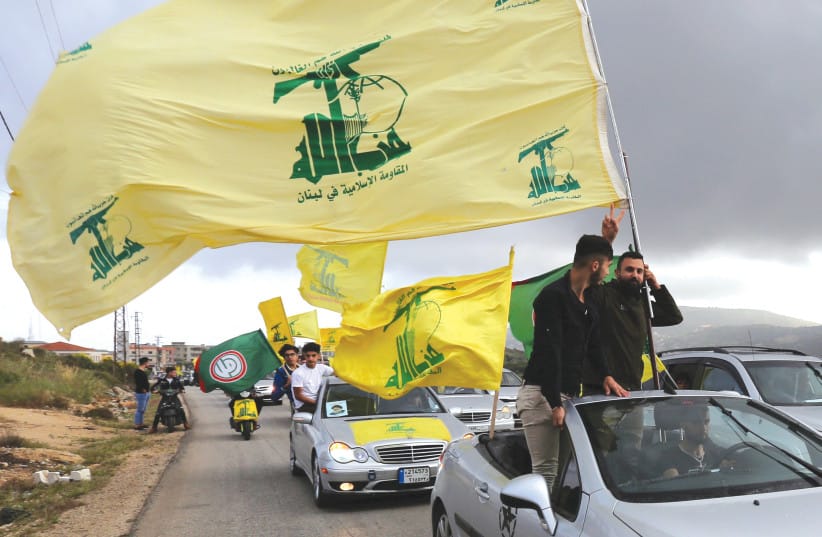
One account showed Hezbollah driving a car toward the Dome of the Rock in Jerusalem, a comon style iconography, suggesting the liberation of Jerusalem from Israel.

Iran's proxies, including Hezbollah, are empowered throughout the Middle East  (photo credit: REUTERS)
Iran’s proxies, including Hezbollah, are empowered throughout the Middle East
(photo credit: REUTERS)
Hezbollah-linked social media accounts are mourning a member killed in Syria. On Tuesday night hundreds of accounts shared images of the dead “martyr” and also vowed revenge against Israel.

One account showed Hezbollah driving a car toward the Dome of the Rock in Jerusalem, a common style iconography, suggesting the liberation of Jerusalem from Israel, among pro-Iran and Hezbollah accounts.

Many accounts quoted various religious texts to mourn the death of a man whose name was given as Ali Kamel Mohsin. Al-Mayadeen media, which is pro-Hezbollah, said Israel was in fear of reprisal.

Statements attributed to Hezbollah leader Hassan Nasrallah also suggested Israelis keep an eye open in case of an attack. Hezbollah monitored Israeli media for responses, suggesting Israel was concerned. “There is fear and alertness in Israel,” Al-Mayadeen noted.

Social media accounts put up hashtags indicating it was a “sincere promise” to retaliate. Images of Mohsin showed him in fatigues with a rifle. He was allegedly killed during airstrikes in or near Damascus in the early morning hours of Tuesday. “If the blood of the martyrs awaken us wherever we fall asleep, hope ignites us that the possibility of responding is an opportunity to come,” one social media user noted.

The loss of this Hezbollah fighter is one of several who have been killed in Syria in the last year. Last fall Israel carried out an airstrikes against a “killer drone” team and killed two Hezbollah members. Other Hezbollah members have been killed fighting on behalf of the Syrian regime.

A Hezbollah member named Jad Yasin Sufan was buried on July 10 in Syria near the Sayyida Zaynab shrine. There was an airstrike on a vehicle in Syria on April 15 near the Lebanese border which Hezbollah blamed on Israel. Hezbollah cut five holes in the fence along the Israel-Lebanon border in retaliation. In addition a Hezbollah member was killed in February in Syria near the Golan Heights. Another Hezbollah operative named Mashhour Zidan was killed near the Golan in July 2019, a year ago.