The Biden administration and Biden’s adviser were briefed on the details of Witkoff’s meeting in Israel, sources with knowledge of the subject told the ‘Post’.
By AMICHAI STEIN, JERUSALEM POST STAFF, WALLA!Updated: JANUARY 11, 2025 21:51Prime Minister Benjamin Netanyahu meets Steve Witkoff in Jerusalem, January 11, 2025(photo credit: PRIME MINISTER’S OFFICE)
US President-elect Donald Trump’s envoy, Steve Witkoff, is now returning to Qatar to join the hostage deal talks after he was in Israel on Saturday to discuss the hostage deal after previously being in Qatar, a source familiar with the subject told The Jerusalem Post.
After Netanyahu’s meeting with Witkoff, a conference call was held with Biden’s adviser Brett McGurk who is in Qatar.
The Biden administration and Biden’s adviser were briefed on the details of Witkoff’s meeting in Israel, sources with knowledge of the subject told the Post. The two administrations are working closely together.
At the conclusion of a situational assessment of the hostages held by Netanyahu, the prime minister instructed Mossad Chief David Barnea, Shin Bet Chief, Maj.-Gen. (res.) Nitzan Alon, and Diplomatic Adviser Ophir Falk to travel to Doha to continue advancing a hostage deal.
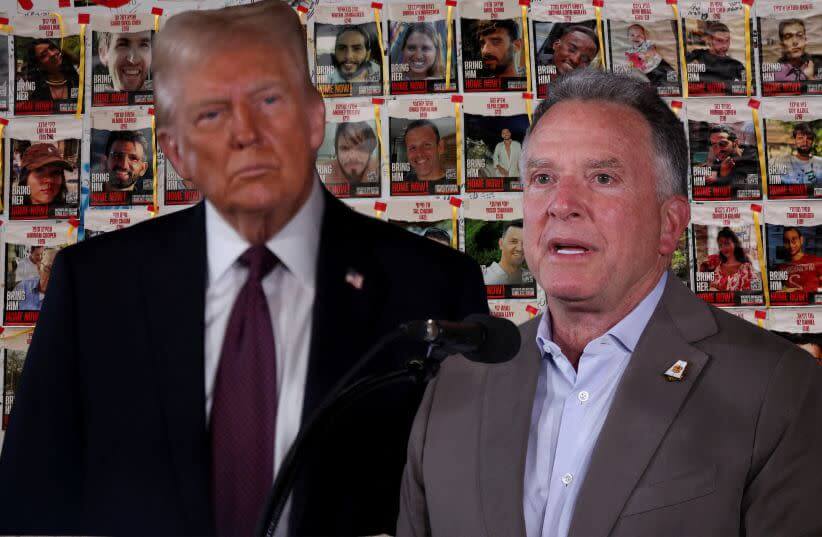
American business person Steve Witkoff makes remarks next to US President-elect Donald Trump, at Mar-a-Lago in Palm Beach, Florida, US January 7, 2025 (illustration). (credit: Canva, REUTERS/CARLOS BARRIA, Shannon Stapleton/Reuters)
The Israeli official had noted earlier that an assessment was underway to determine whether hostage deal progress justified elevating the Israeli delegation by sending the Mossad chief, Shin Bet director, and Maj.-Gen. Nitzan Alon to Doha.
A White House spokesperson told reporters on Friday, “We have made some progress, but Hamas continues to create obstacles at the negotiating table.”
American and Israeli officials have expressed concerns that if an agreement is not reached before former US President Donald Trump takes office, the negotiations could reach a serious impasse.
Hostage deal
This news comes after a Friday report by Al-Araby Al-Jadeed , which claimed that Hamas sources said that Netanyahu had agreed to end the war following the completion of the first phase of a ceasefire deal.
A source from Hamas told the London-based news outlet that some of the changes were regarding agreements to postpone discussions on some contentious issues until later stages of the negotiations.
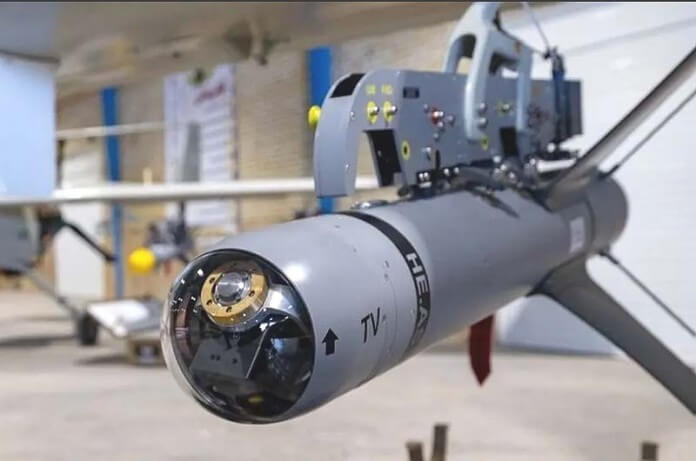
The loitering munition drone Rezvan unveiled by Iran’s IRGC.
The Islamic Revolution Guards Corps (IRGC) of Iran has revealed its latest loitering munition suicide drone (a.k.a. kamikaze drone), Rezvan, featuring a 20-kilometer range and the capability to fly for up to 20 minutes. This makes it the perfect weapon against Israeli settlements south of the Lebanese border.
The Tasnim News Agency reported that the Rezvan drone enhances the IRGC’s rapid response units, offering them new capabilities to combat terrorist groups, especially in challenging mountainous terrain.
However, in early 2025, Tehran may be more focused on strengthening its own capabilities, following significant setbacks: its proxy in Lebanon, Hezbollah, was heavily weakened by Israeli operations, and its key regional ally, the Assad regime in Syria, was toppled by rebel forces.
Iranian media outlets mentioned that the military plans to acquire 1,000 “strategic” drones in the near future.
The Rezvan loitering munition drone’s system. / Tasnim
The Rezvan is equipped with a forward-facing camera that transmits images back to the operator. After launch from a cylindrical launcher, the operator can choose and strike specific targets. This new drone bolsters the IRGC’s rapid response units, particularly enhancing their ability to confront unsuspecting civilians as well as military units in challenging mountainous environments.
Kamikaze drones are aerial weapons equipped with a built-in warhead, designed to hover over a target area until a target is identified, then attack by crashing into it. These drones provide faster reaction times against targets that emerge briefly, without risking high-value platforms in the vicinity. They also allow for more precise targeting, as the attack can be adjusted mid-flight or aborted.
Kamikaze drones occupy a unique position between cruise missiles and unmanned combat aerial vehicles (UCAVs). While they share features with both, they differ from cruise missiles by their ability to loiter around the target area for an extended period. Unlike UCAVs, which are reusable, Kamikaze drones are intended for a single use and are equipped with a warhead. Consequently, they can be viewed as a nontraditional ranged weapon.
Rep. Pat Fallon (R-Tx), Chairman of the House Military Personnel Subcommittee, tweeted on Saturday: “Iran’s Rezvan loitering munition and its growing drone capabilities underscores the need for the US to bolster its own defense capabilities. Innovative anti-drone defenses and countermeasures are essential to our military’s readiness.”
Dr. Shay Har-Zvi discusses what Trump’s return means for US economic and foreign policy, especially in the Middle East and the question of Iran.
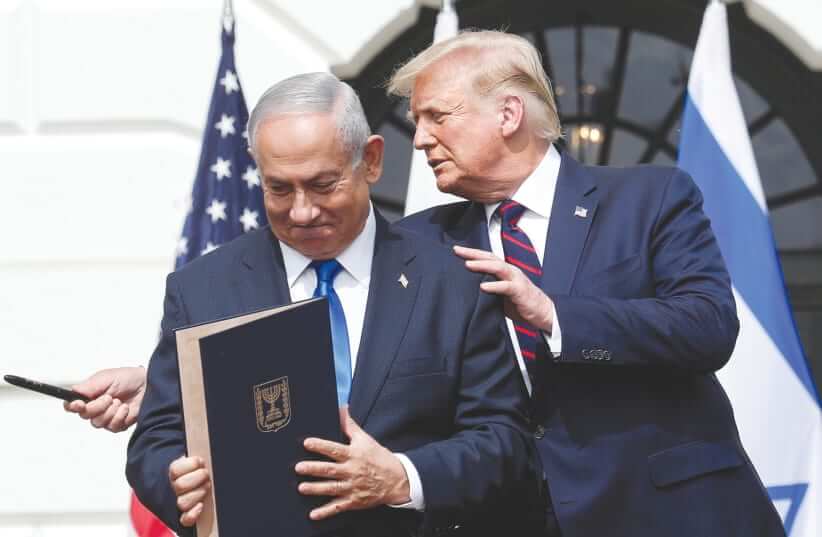
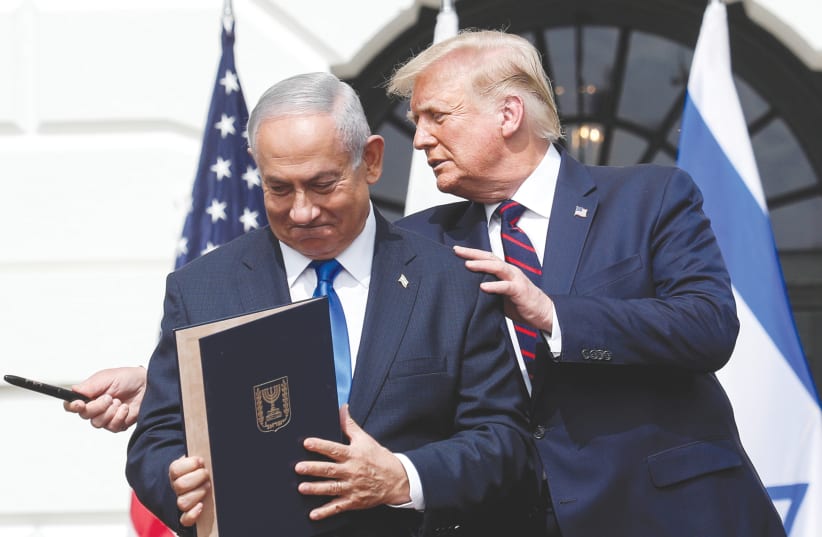
By PELED ARBELIUpdated: JANUARY 12, 2025 10:49US PRESIDENT Donald Trump and Prime Minister Benjamin Netanyahu signed the Abraham Accords in 2020.(photo credit: TOM BRENNER/REUTERS)
“[President-elect Donald] Trump’s return to the White House will inevitably lead to significant shifts in US policy, both internationally and regionally, due to his contrasting worldview and leadership style compared to Biden,” US policy expert and a senior researcher at the Institute for Policy and Strategy at Reichman University, Dr. Shay Har-Zvi told Maariv on Sunday.
“This time, Trump seems more prepared and focused. He understands the governmental system more deeply and is aware that this may be his last opportunity to secure a lasting historical legacy. Therefore, it’s likely he will seek to implement most of his domestic and foreign policy initiatives within the first two years, ahead of the 2026 midterm elections, capitalizing on the conservative Republican majority in the Senate, House of Representatives, and Supreme Court,” Har-Zvi said.
Har-Zvi described Trump’s leadership approach as one driven by the mindset of a businessman seeking to “close deals from a position of strength.” He noted: “Trump’s key priorities include improving the US economy, lowering the cost of living, and addressing the immigration crisis—his core campaign promises. To achieve these, he may create controlled crises and leverage America’s diplomatic, economic, and military power.”
Har-Zvi referenced previous examples, such as Trump’s threats to regain control of the Panama Canal, his desire to purchase Greenland, and his strong rebukes of Canadian Prime Minister Justin Trudeau, as well as his demands for NATO members to increase defense spending. “These actions were not symbolic; they aimed to secure economic benefits, reduce tariffs on US goods, control key shipping routes and natural resources, and decrease US global military expenditures.”
Regarding ongoing global conflicts, Har-Zvi explained that Trump’s desire to end the wars in Ukraine and the Middle East stems from his understanding of their high political and economic costs. “The longer these conflicts continue, the greater the risk that the US could be drawn deeper, which would hinder Trump’s ability to focus on what he views as top priorities.”
US PRESIDENT-elect Donald Trump speaks after meeting with Republicans in Congress at the Capitol Building on Wednesday. With Trump returning to the White House, there is reason to believe he will give Israel the backing or active collaboration necessary to cut Iran down to size, says the writer. (credit: JEENAH MOON/REUTERS)
Har-Zvi believes Trump’s foreign policy efforts will largely center on confronting China, particularly in the economic and technological spheres. “Trump’s objective of ending the war in Ukraine also serves this purpose. Resolving that conflict could reduce Russia’s reliance on China,” he added.
Focus on the Middle East
Turning to the Middle East, Har-Zvi outlined three main objectives for Trump: ending the war in Gaza and ensuring the return of hostages, brokering a normalization agreement between Israel and Saudi Arabia, and preventing Iran from obtaining nuclear weapons.
Har-Zvi stressed that Trump sees these objectives as interconnected. “Without resolving the Gaza conflict, normalizing relations and strengthening ties between Israel and the broader Arab and Muslim world will be extremely difficult, if not impossible. Failure to achieve normalization could hinder efforts to form a regional coalition against Iran and would forfeit economic opportunities for both the Middle East and the US.”
Har-Zvi also discussed Trump’s potential strategy toward Israel and Prime Minister Benjamin Netanyahu: “Trump will likely push hard to advance normalization efforts from the outset and may pressure Netanyahu to be more flexible in meeting the demands of Saudi Crown Prince Mohammed bin Salman—particularly on ending the war in Gaza and signaling a political horizon for the Palestinians.”
The Iran Question
On Iran, Har-Zvi suggested that Trump’s preferred strategy would involve negotiating a “nuclear deal 2.0” designed to prevent Tehran from developing nuclear weapons. “To achieve this, Trump may adopt a ‘maximum pressure’ approach, threatening severe economic sanctions and possibly hinting at military action against Iran’s nuclear sites to show the consequences of rejecting a new agreement.”
However, Har-Zvi noted a crucial question: “Will Trump insist on a comprehensive deal that fully blocks Iran’s nuclear ambitions, or will he compromise to secure an agreement, recognizing that failure could lead to an escalation in the Israel-Iran conflict?”
In closing, Har-Zvi emphasized that “even before taking office, Trump is already influencing regional dynamics, particularly with the potential for a new hostage deal. His policies could reshape both the global and Middle Eastern landscapes. On one hand, Trump appears ready to put all options on the table. On the other, he seems intent on rebuilding US economic and military strength while avoiding new wars. Trump’s first term showed he is unafraid to pressure US allies to achieve his objectives. Israel must consider this as it formulates its policies moving forward.”