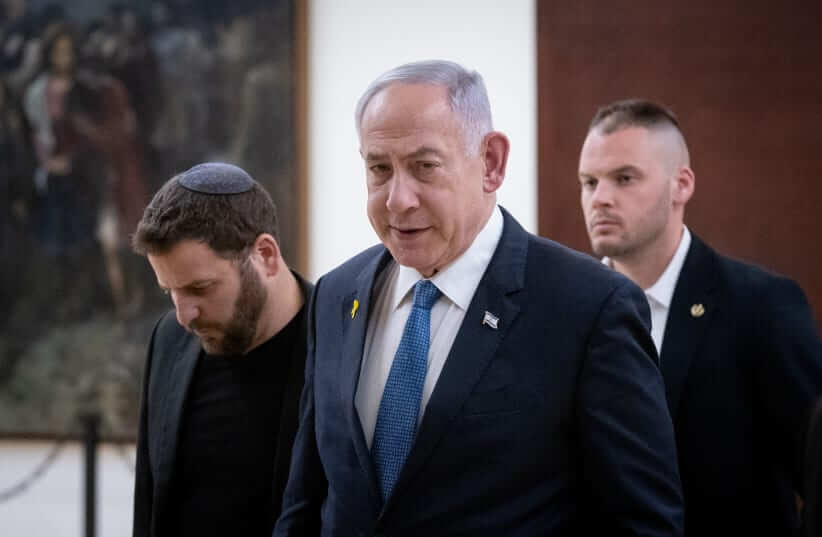
Netanyahu is set to cement his strategic goals: tightening his military control over Gaza, thwarting Iran’s nuclear ambitions, and capitalizing on the dismantling of Tehran’s allies.

 Israeli prime minister Benjamin Netanyahu seen in the Israeli parliament, December 16, 2024. (photo credit: Chaim Goldberg FLASH90)
Israeli prime minister Benjamin Netanyahu seen in the Israeli parliament, December 16, 2024.
(photo credit: Chaim Goldberg FLASH90)
2025 will be a year of reckoning for Israeli Prime Minister Benjamin Netanyahu and his country’s arch-foe Iran.

The veteran Israeli leader is set to cement his strategic goals: tightening his military control over Gaza, thwarting Iran’s nuclear ambitions, and capitalizing on the dismantling of Tehran’s allies — Palestinian Hamas, Lebanon’s Hezbollah, and the removal of Syrian president Bashar al-Assad.

Assad’s collapse, the elimination of the top leaders of Hamas and Hezbollah, and the destruction of their military structure mark a succession of monumental wins for Netanyahu.

Without Syria, the alliances Tehran has nurtured for decades have unraveled. As Iran’s influence weakens, Israel is emerging as the dominant power in the region.

Netanyahu is poised to zero in on Iran’s nuclear ambitions and missile program, applying an unyielding focus to dismantling and neutralizing these strategic threats to Israel.

 Prime Minister Benjamin Netanyahu arrives at the District Court in Tel Aviv, December 16, 2024 (credit: POOL, REUTERS/STOYAN NENOV, SHUTTERSTOCK)Enlrage image
Prime Minister Benjamin Netanyahu arrives at the District Court in Tel Aviv, December 16, 2024 (credit: POOL, REUTERS/STOYAN NENOV, SHUTTERSTOCK)

Iran, Middle East observers say, faces a stark choice: Either continue its nuclear enrichment program or scale back its atomic activities and agree to negotiations.

“Iran is very vulnerable to an Israeli attack, particularly against its nuclear program,” said Joost R. Hiltermann, Middle East and North Africa Program Director of the International Crisis Group. “I wouldn’t be surprised if Israel did it, but that doesn’t get rid of Iran.”

“If they (Iranians) do not back down, Trump and Netanyahu might strike, as nothing now prevents them,” said Palestinian analyst Ghassan al-Khatib, referring to President-elect Donald Trump. Khatib argued that the Iranian leadership, having demonstrated pragmatism in the past, may be willing to compromise to avert a military confrontation.

Trump, who withdrew from a 2015 agreement between Iran and six world powers aimed at curbing Tehran’s nuclear goals, is likely to step up sanctions on Iran’s oil industry despite calls to return to negotiations from critics who see diplomacy as a more effective long-term policy.

Defining legacy

Amid the turmoil of Iran and Gaza, Netanyahu’s long-running corruption trial, which resumed in December, will also play a defining role in shaping his legacy. For the first time since the outbreak of the Gaza war in 2023, Netanyahu took the stand in proceedings that have bitterly divided Israelis.

With 2024 coming to an end, the Israeli prime minister will likely agree to sign a ceasefire accord with Hamas to halt the 14-month-old Israel-Hamas War in Gaza and free Israeli hostages held in the enclave, according to sources close to the negotiations.

But Gaza would stay under Israeli military control in the absence of a post-war US plan for Israel to cede power to the Palestinian Authority (PA), which Netanyahu rejects. Arab states have shown little inclination to press Israel to compromise or push the decaying PA to overhaul its leadership to take over.

“Israel will remain in Gaza militarily in the foreseeable future because any withdrawal carries the risk of Hamas reorganizing. Israel believes that the only way to maintain the military gains is to stay in Gaza,” Khatib told Reuters.

For Netanyahu, such a result would mark a strategic victory, consolidating a status quo that aligns with his vision: Preventing Palestinian statehood while ensuring Israel’s long-term control over Gaza, the West Bank, and east Jerusalem.

The Gaza war erupted when Hamas terrorists stormed into Israel on Oct. 7, 2023, killing 1,200 people and taking 250 hostages. Israel responded with an air and land offensive that has killed 45,000 people, the Hamas-run health ministry in Gaza claims, displaced 1.2 million, and left much of the enclave in ruins.

The Gazan-reported death toll in the Strip has come under scrutiny a number of times over the course of the war. Recently, an independent group of researchers at the Henry Jackson Society found that civilian death counts in the Gaza war have been inflated to portray Israel as deliberately targeting civilians.

While the ceasefire pact would bring an immediate end to the Gaza hostilities, it would not address the deeper, decades-old Palestinian-Israeli conflict, Arab and Western officials say.

On the ground, prospects for a Palestinian state, an option repeatedly ruled out by Netanyahu’s government, have become increasingly unattainable, with Israeli settler leaders optimistic that Trump will align closely with their views.

A surge in settler violence and the increasing confidence of the settler movement – highway billboards in some West Bank areas bear the message in Arabic “No Future in Palestine” – reflect a growing squeeze on Palestinians.

Even if the Trump administration were to push for an end to the conflict, “any resolution would be on Israel’s terms,” said Hiltermann of the Crisis Group.

“It’s over when it comes to a Palestinian state, but the Palestinians are still there,” he said.

In Trump’s previous term, Netanyahu secured several diplomatic wins, including the “Deal of the Century,” a US-backed peace plan that Trump floated in 2020 to resolve the Israeli-Palestinian conflict.

The plan, if implemented, marks a dramatic shift in US policy and international agreements by overtly aligning with Israel and deviating sharply from a long-standing land-for-peace framework that has historically guided negotiations.

It would allow Israel to annex vast stretches of land in the West Bank, including Israeli settlements and the Jordan Valley. It would also recognize Jerusalem as the “undivided capital of Israel” – effectively denying Palestinian claims to east Jerusalem as their capital, a central aspiration in their statehood goals and in accordance with UN resolutions.

Syria at a critical crossroads

Across the border from Israel, Syria stands at a critical juncture following the overthrow of Assad by Hayat Tahrir al-Sham (HTS) rebel forces led by Ahmad al-Sharaa, better known as Abu Mohammed al-Golani.

 Top rebel commander Abu Mohammed al-Golani speaks to a crowd at Ummayad Mosque in Damascus, after Syrian rebels announced that they have ousted President Bashar al-Assad, Syria December 8, 2024. (credit: REUTERS/MAHMOUD HASSANO/FILE PHOTO)Enlrage image
Top rebel commander Abu Mohammed al-Golani speaks to a crowd at Ummayad Mosque in Damascus, after Syrian rebels announced that they have ousted President Bashar al-Assad, Syria December 8, 2024. (credit: REUTERS/MAHMOUD HASSANO/FILE PHOTO)

Golani now faces the monumental task of consolidating control over a fractured Syria, where the military and police force have collapsed. HTS has to rebuild from scratch, securing borders and maintaining internal stability against threats from jihadists, remnants of the Assad regime, and other adversaries.

The greatest fear among Syrians and observers alike is whether HTS, once linked to al-Qaeda but now presenting itself as a Syrian nationalist force to gain legitimacy, reverts to a rigid Islamist ideology.

The group’s ability – or failure – to navigate this balance will shape the future of Syria, home to diverse communities of Sunnis, Shi’ites, Alawites, Kurds, Druze, and Christians.

“If they succeed in that (Syrian nationalism), there’s hope for Syria, but if they revert to their comfort zone of quite strongly ideologically-tainted Islamism, then it’s going to be divisive in Syria,” said Hiltermann.

“You could have chaos and a weak Syria for a long time, just like we saw in Libya and Iraq.”
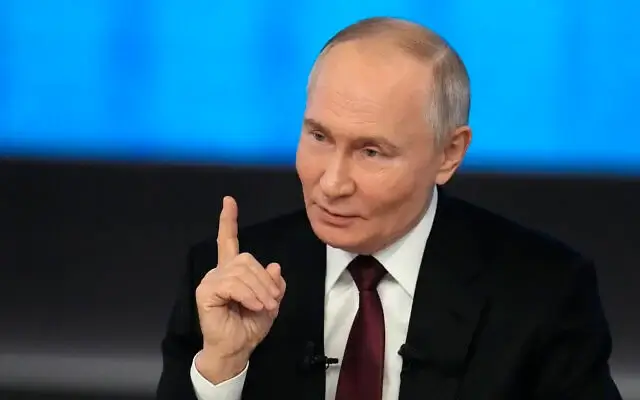

Comments made during press conference echo Soviet-era antisemitism under Josef Stalin, when the Kremlin persecuted Jews and accused them of being ‘rootless cosmopolitans’


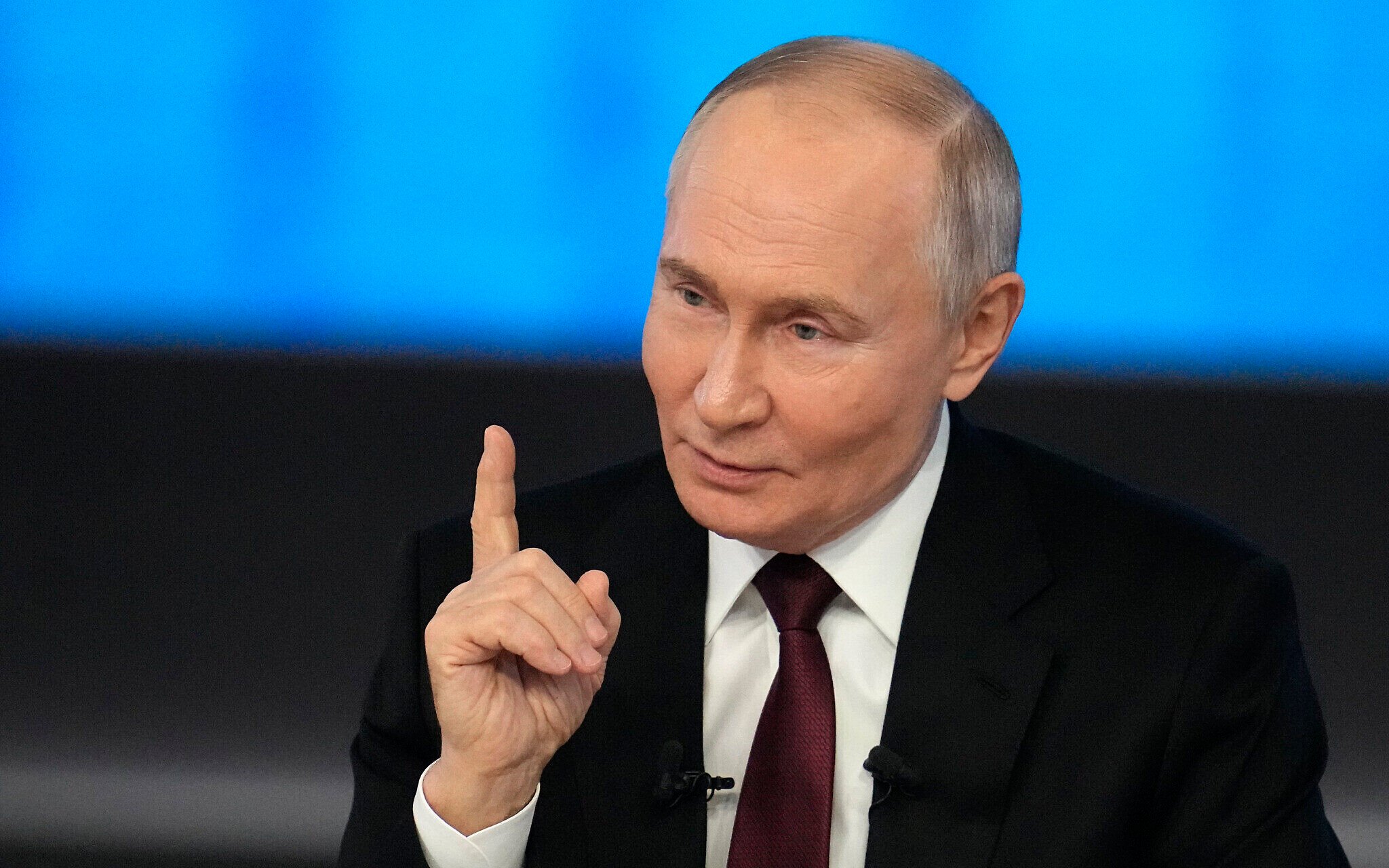
Russian President Vladimir Putin gestures while speaking during his annual news conference and call-in show at Gostinny Dvor in Moscow, Russia, December 19, 2024. (AP/Alexander Zemlianichenko)

Russian President Vladimir Putin gestures while speaking during his annual news conference and call-in show at Gostinny Dvor in Moscow, Russia, December 19, 2024. (AP/Alexander Zemlianichenko)

Russian President Vladimir Putin on Thursday used antisemitic rhetoric during his lengthy end-of-year press conference, accusing people including “ethnic Jews” of tearing apart the Russian Orthodox Church.

During the press conference, Putin was asked about punitive measures some European countries have taken against the Russian Orthodox Church in the wake of the 2022 invasion of Ukraine over the church’s close relationship with Putin’s regime. The Council of Europe recently labeled the church a propaganda tool of the Kremlin, and several European countries have expelled church officials due to security concerns.

“These people that are attacking the church, they are not atheists,” said Putin. “They are absolutely faithless people, Godless people. Well, ethnically, many of them are Jews, but you haven’t seen them visit any synagogue.”

After adding that the alleged opponents of the church were also neither Orthodox Christian nor Muslim, he added, “These are people without kin or memory, with no roots. They don’t cherish what we cherish and the majority of the Ukrainian people cherish as well.”

Critics of Putin decried the statement as antisemitic, noting parallels to Soviet state antisemitism under Josef Stalin, when the Kremlin persecuted Jews and accused them of being “rootless cosmopolitans.”

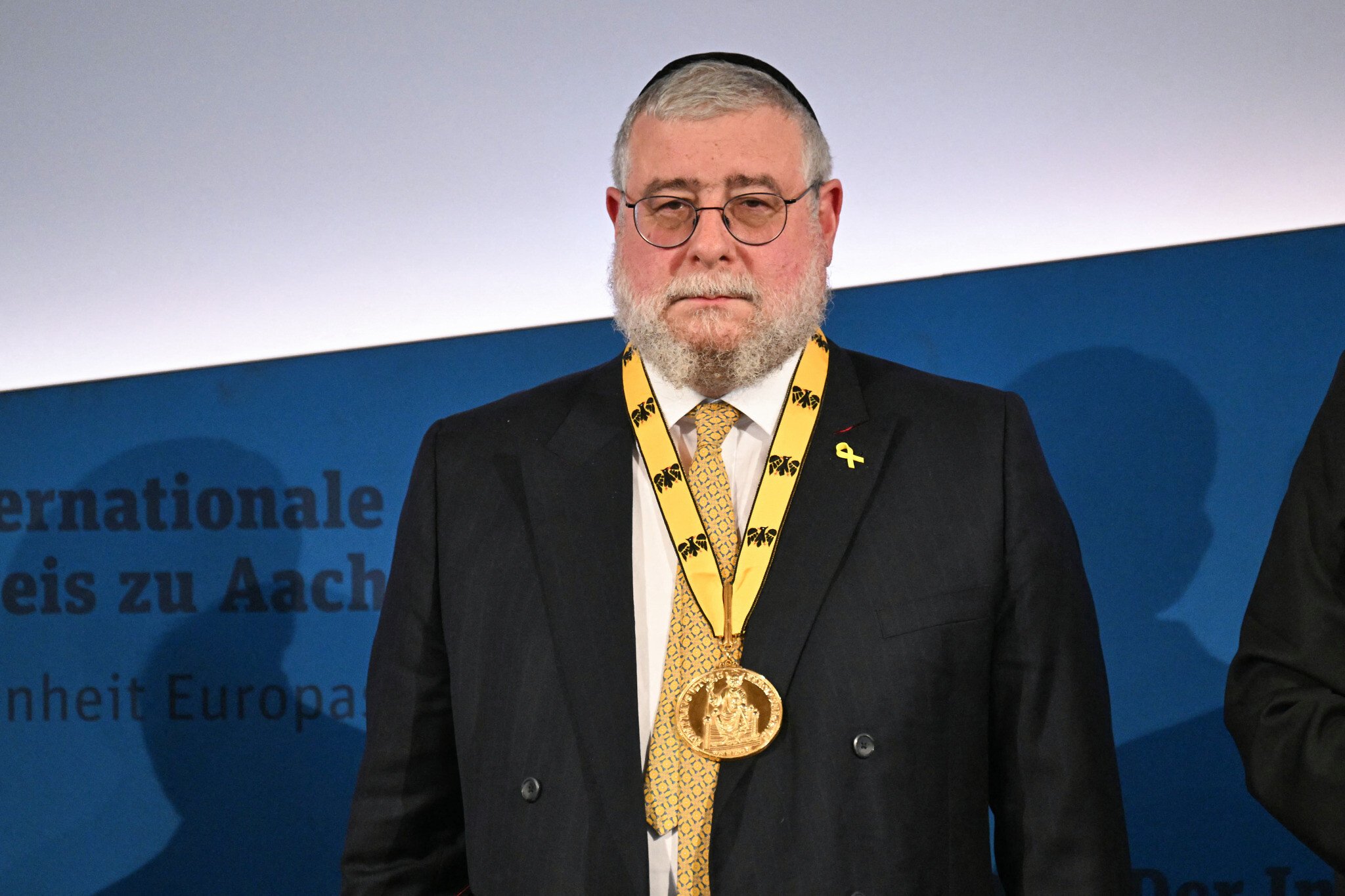
Rabbi Pinchas Goldschmidt, the president of the Conference of European Rabbis, warned that Putin’s characterization of Jews in this way could have dangerous consequences.

Pinchas Goldschmidt, Swiss-born rabbi and Jewish community leader, is pictured after receiving the International Charlemagne Prize of Aachen 2024 (Karlspreis) on May 9, 2024 in Aachen, western Germany. (Ina Fassbender / AFP)

“This is just one example of his regime’s explicit and virulent antisemitism, which has intensified following his 2022 invasion of Ukraine and the 2023 events of October 7th,” Goldschmidt said. “This is all reminiscent of Stalin’s “Fight against Cosmopolitanism” and the “Doctors’ Plot” of 1948–53, the brutal antisemitic campaign in the Soviet Union, resulting in the arrest and killing of much of the Soviet Jewish leadership in the Soviet Union.”

“We cannot emphasize enough the dangerous effect of such statements in a semi-totalitarian society,” Goldschmidt continued.

The Russian Orthodox Church has been widely criticized by international watchdogs for its close relationship with the Russian government. The Council of Europe recently labeled the church a propaganda tool of the Kremlin, and several European countries have expelled church officials due to security concerns.

Putin and his deputies have employed antisemitic rhetoric in their arguments for their invasion of Ukraine. Although Ukrainian President Volodymyr Zelensky is Jewish, Putin has claimed that Ukraine is led by a “neo-Nazi regime.”

Russia’s Jewish population has decreased steeply since the invasion of Ukraine and during the decade leading up to it. In the Russian census of 2021, some 83,000 people identified as Jewish. The previous census, in 2010, showed about 160,000 Jews living in Russia, and an estimated 150,000 Jews were still living there in 2021, the year before the invasion.

Putin’s latest bout of antisemitic rhetoric came during his traditional year-end question-and-answer session — largely a televised show, and a rare setting in which Putin is put on the spot with some uncomfortable questions. The 72-year-old Kremlin leader spoke for just under four and a half hours on Thursday.


Houthi missile attack destroys central Israel elementary school

Houthi missile attack destroys central Israel elementary school
Damage sustained to a Ramat Gan school after a Houthi missile attack

Houthi missile attack destroys central Israel elementary school

Ramat Gan mayor says it was “great luck” that missile fired overnight, and not during school hours.

By World Israel News Staff

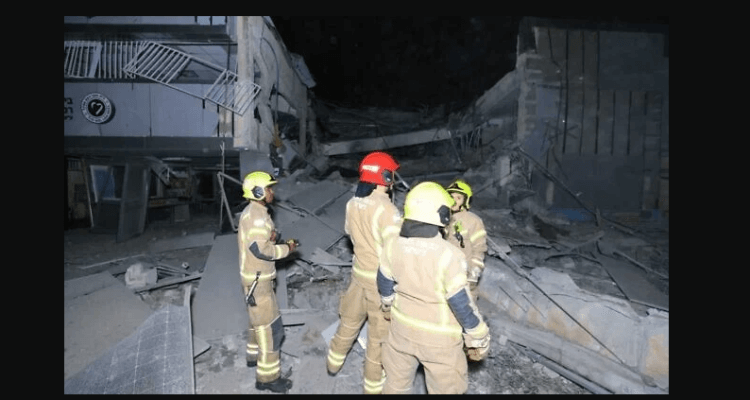
An elementary school in a Tel Aviv suburb was seriously damaged in the early hours of Thursday morning, as Houthi terrorists launched a ballistic missile at central Israel around 2:30 AM.

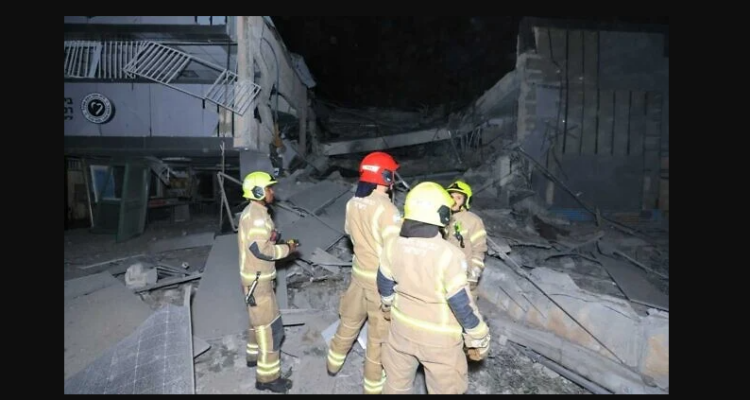
Although the missile was said to be intercepted, Ramat Efal Elementary School, located in Ramat Gan, sustained such severe damage that a building collapsed.

No casualties were reported. Nearby cars and homes were also damaged in the attack.

Footage from the scene circulating on social media showed a building with its wall blown off, exposing the classroom inside. Partially collapsed roofs, shattered glass, and scattered debris are also seen.

The damage may have come from a large piece of shrapnel from the missile, or it may have been that an unexploded warhead struck the school.

Last month, an interception only partially destroyed the warhead of a Hezbollah missile, with the explosive load impacting in Ramat Gan.

Ramat Efal Elementary School will not be operational until further notice and its students will need to learn elsewhere, Ramat Gan Mayor Carmel Shama HaCohen said in a statement.

“This night ended with great luck for the residents of the city of Ramat Gan. As the mayor and as the father of a child at Ramat Efal Elementary School, I do not want to think about a situation in which this missile would have been fired during school hours,” Shama HaCohen said.

“Teams from the municipality are on the ground and conducting a damage assessment, as well as initial clean-up of the scene.”

The Ramat Gan municipality said in a statement that students in 1st through 4th grade, including special education students, will learn in nearby schools.

Students in 5th and 6th grades will attend classes online.