Despite the reported sticking points, “the status of ongoing negotiations in Doha is excellent,” Hamas sources said.

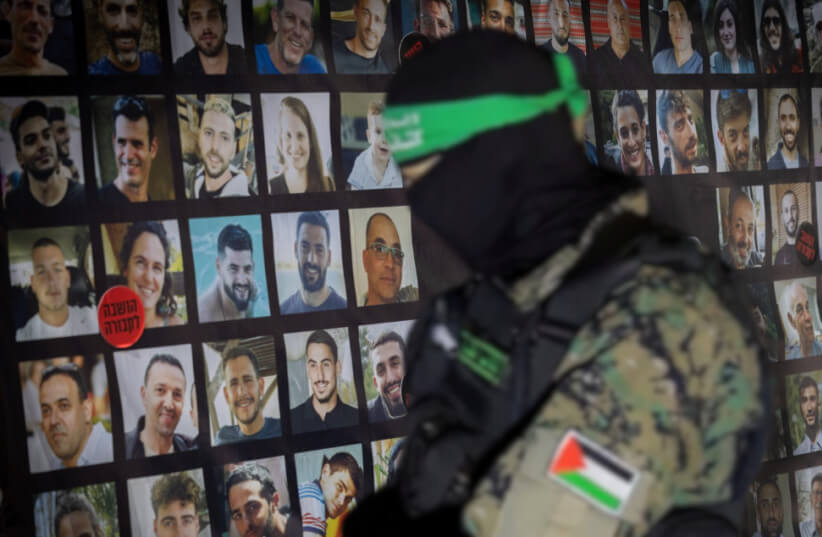
 A Hamas terrorists in front of hostage posters. (Illustrative) (photo credit: Canva, Hamas Military Wing/Handout via REUTERS, Shannon Stapleton/Reuters)
A Hamas terrorists in front of hostage posters. (Illustrative)
(photo credit: Canva, Hamas Military Wing/Handout via REUTERS, Shannon Stapleton/Reuters)
Two primary obstacles remain in the hostage deal/ceasefire negotiations in Doha, Hamas sources told the Hezbollah-affiliated Lebanese news outlet Al-Akhbar on Thursday.

The first of these issues is Israel’s demand that Hamas provide it with “a list of the names of all living and deceased prisoners,” the sources told Al-Akhbar. The second reportedly concerns an Israeli demand that soldiers held hostage in Gaza be included “in lists of prisoners who meet the criteria for the humanitarian phase.”

According to the Hamas sources, the first demand would first require, at minimum, a week-long pause in the fighting that Hamas and other terror organizations in Gaza could use to locate and determine the status of the hostages remaining in the Strip.

Hamas reportedly sees the latter demand as an alteration to the previously agreed-upon ceasefire/hostage deal framework.

‘Status of ongoing negotiations in Doha is excellent’

Despite the reported sticking points, “the status of ongoing negotiations in Doha is excellent, with the majority of outstanding issues resolved, making it likely that we are very close to reaching an agreement,” the Hamas sources told the Lebanese outlet.

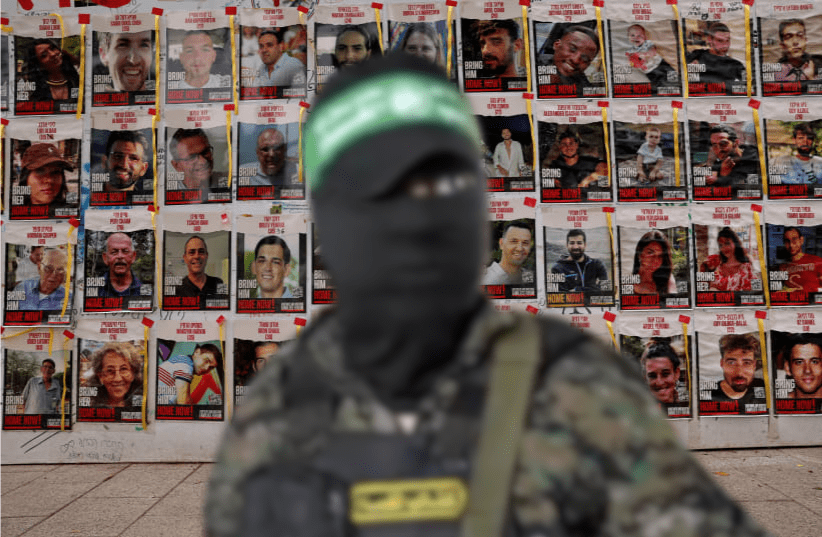
 Hamas terrorist in front of Gaza hostage posters. (Illustrative) (credit: Hamas Military Wing/Handout via REUTERS, MIRIAM ALSTER/FLASH90)Enlrage image
Hamas terrorist in front of Gaza hostage posters. (Illustrative) (credit: Hamas Military Wing/Handout via REUTERS, MIRIAM ALSTER/FLASH90)

Further, the sources told Al-Akhbar that Hamas believes that if Israel is genuinely motivated to complete a deal, the two issues of disagreement can be overcome.

Speaking to The Jerusalem Post on Wednesday, diplomats familiar with the negotiations noted that there were still several hurdles ahead in the ongoing talks.

According to the diplomats, Hamas had neither come up with a list of hostages it was willing to release nor provided mediators with a list of prisoners it would like released from Israeli prisons as a part of the deal.

Nevertheless, Arab media reported on Wednesday that security prisoners released in a potential could be subsequently deported to Qatar and Turkey.

Amichay Stein and Jerusalem Post Staff contributed to this report.


European trio sounds alarm over Tehran’s ‘capability to rapidly produce sufficient fissile material for multiple nuclear weapons,’ says it must ‘reverse its nuclear escalation’


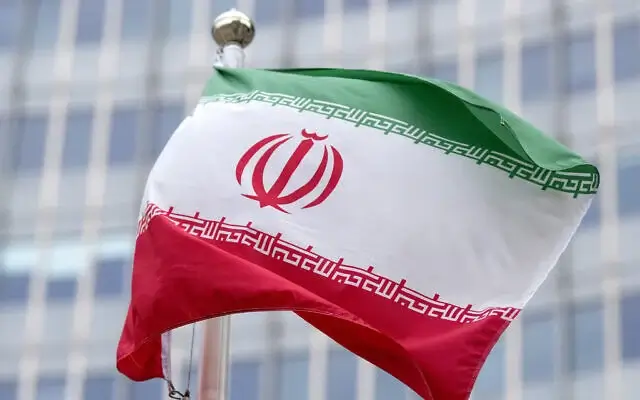
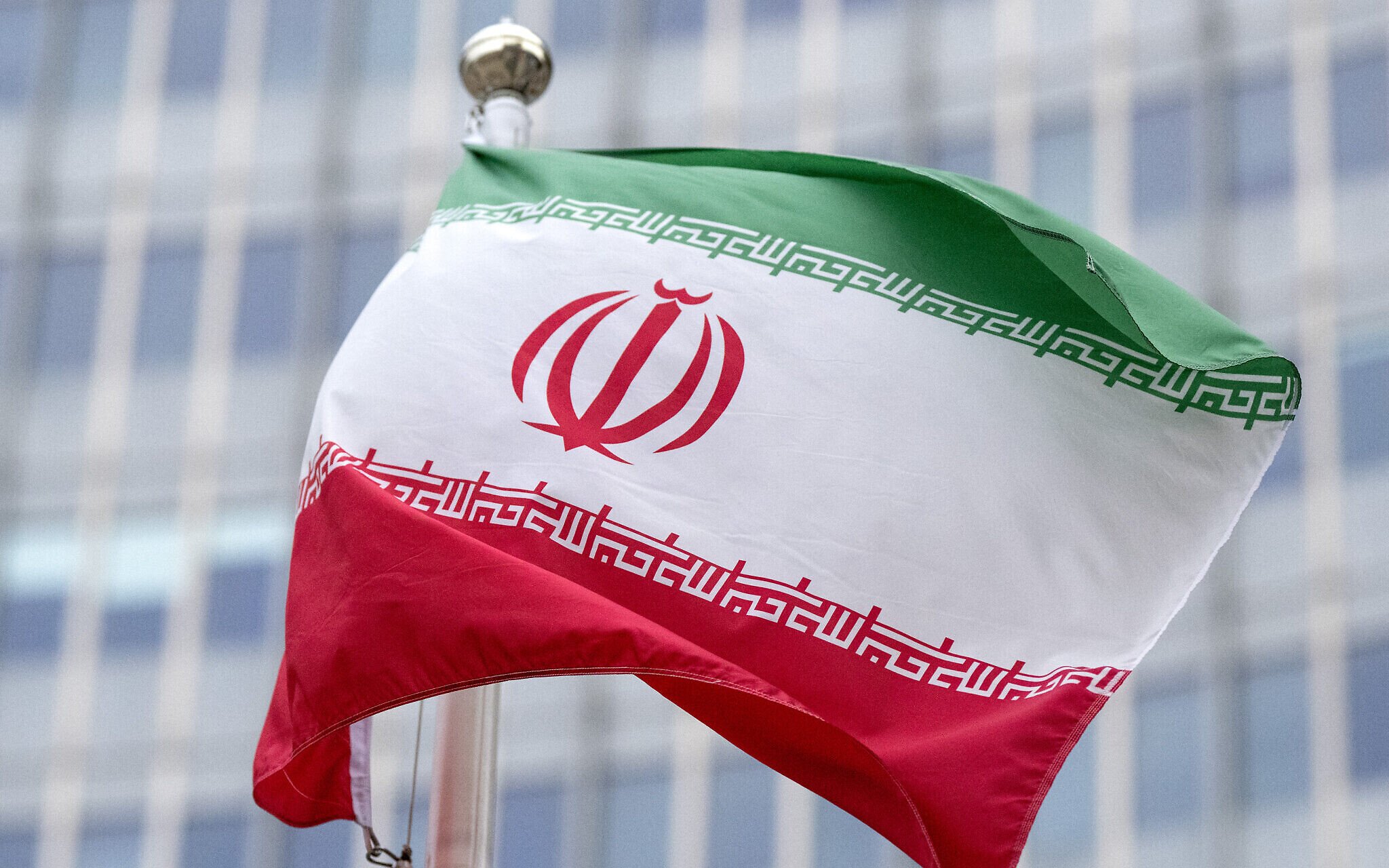
The Iranian flag outside the IAEA headquarters during the International Atomic Energy Agency's Board of Governors meeting at the agency's headquarters in Vienna, Austria, on November 20, 2024. (Joe Klamar/AFP)

The Iranian flag outside the IAEA headquarters during the International Atomic Energy Agency’s Board of Governors meeting at the agency’s headquarters in Vienna, Austria, on November 20, 2024. (Joe Klamar/AFP)

Britain, France and Germany on Tuesday accused Iran of growing its stockpile of high enriched uranium to “unprecedented levels” without “any credible civilian justification.”

The three countries known as the E3 said in a statement that Iran must “reverse its nuclear escalation.”

Iran has increased its manufacturing of enriched uranium such that it is the only non-nuclear weapons state to possess uranium enriched to 60 percent, the International Atomic Energy Agency (IAEA) nuclear watchdog said.

That level is well on the way to the 90% required for an atomic bomb.

“Iran’s stockpile of High Enriched Uranium has also reached unprecedented levels, again without any credible civilian justification. It gives Iran the capability to rapidly produce sufficient fissile material for multiple nuclear weapons,” the trio said in the statement.

According to an IAEA report handed to member states and leaked to the press earlier this month, Iran has begun to dramatically expand its production of uranium enriched to near-weapons grade levels, collecting enough material for several bombs already.
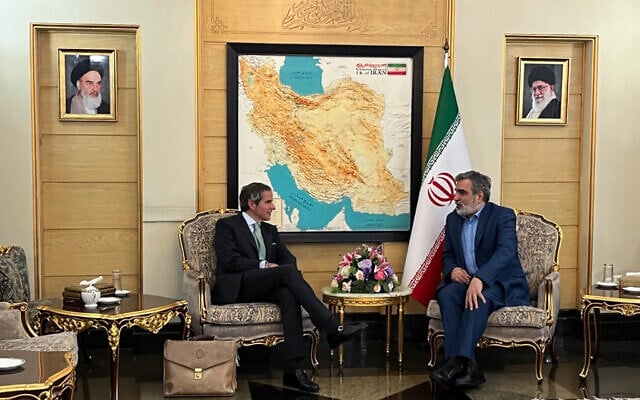
This handout photo released by Iran’s Atomic Energy Organisation shows its spokesman Behrouz Kamalvandi (R) meeting with Director General of the International Atomic Energy Agency (IAEA) Rafael Mariano Grossi upon his arrival in Tehran on November 13, 2024. (Atomic Energy Organization of Iran/AFP)

Earlier this week, the head of the IAEA, Rafael Grossi, said that there was little point in trying to revive the 2015 Iran nuclear deal with Iran on the cusp of nuclear weapons.

He added that Iran had “developed much stronger capabilities” regarding various aspects of its nuclear program, and said that country’s uranium enrichment levels are “practically at the same level as nuclear-armed states.”

In a report in early December, the Office of the United States Director of National Intelligence warned that “Iran now has enough fissile material to make more than a dozen nuclear weapons,” but said it had not yet decided to break out to a bomb.

Iran is not thought to have begun work needed to build and deploy a nuclear weapon, a move which, if detected, would likely invite a harsh Western response.

But the sheer size of its stockpile and the fact that 60% purity is just a short technical step away from the 90% needed for a bomb have served to heighten tensions, with Israel rumored to be mulling military action aimed at destroying key nuclear sites.
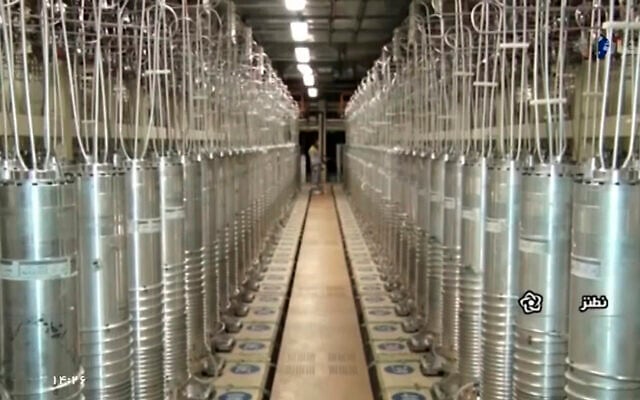
Centrifuges line a hall at the Uranium Enrichment Facility in Natanz, Iran, in a still image from a video aired by the Islamic Republic Iran Broadcasting company on April 17, 2021, six days after the hall had been damaged in a mysterious attack. (IRIB via AP)

Iran has always denied seeking nuclear weapons and says both its space program and nuclear activities are for purely civilian purposes.

However, US intelligence agencies and the IAEA say Iran had an organized military nuclear program up until 2003, and continued to develop its nuclear program beyond civilian necessity. Israel contends that the Islamic Republic never truly abandoned its nuclear weapons program.

Iran is committed to Israel’s destruction. Over the past year, it has twice fired massive barrages of missiles at Israel. Israel has struck key Iranian military facilities in retaliation for both attacks, which came in the context of a multifront war opened by Iranian terror proxies on the Jewish state.

“The young Syrians will liberate the territories occupied by the Zionist entity,” Khamenei previously wrote in a Hebrew post.

JERUSALEM POST STAFF

An illustrative image of Ayatollah Ali Khamenei.
(photo credit: REUTERS/Mahmoud Hasano/AFP PHOTO)
Iranian Supreme Leader Ayatollah Ali Khamenei wrote that Israel was “gravely mistaken” about developments in Syria in a Tuesday message posted to his Hebrew language X/Twitter account.

“The enemies imagine that after the developments in Syria, the uprising is already over. They are greatly mistaken,” he wrote.

Last week, Khamenei addressed the situation in Syria in a Hebrew post, noting, “The young Syrians will liberate the territories occupied by the Zionist entity.”

Blaming Israel for the developments in Syria

Following the toppling of former Syrian president Bashar al-Assad’s regime by Syrian rebel factions earlier in December, Iran lost much of its influence in the region. It has indicated its interest in working with the new government in Damascus.

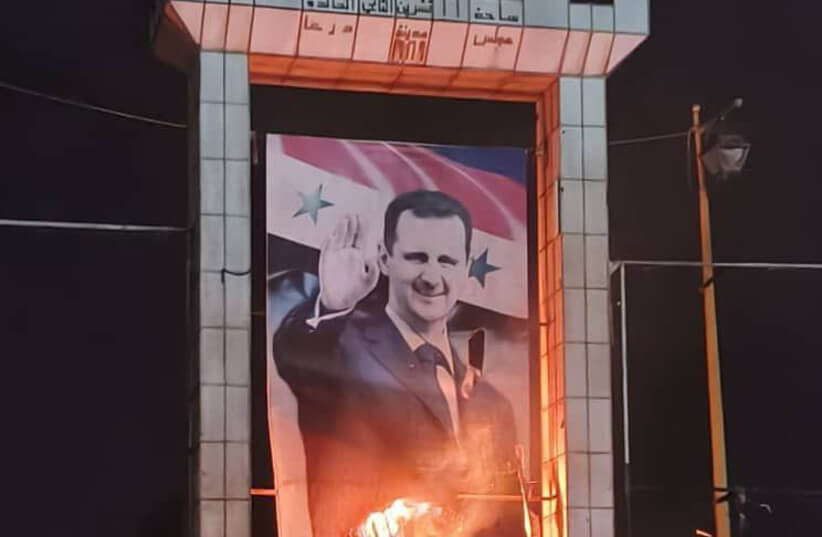
 Assad poster burns in Syria (credit: SCREENSHOT/X)
Assad poster burns in Syria (credit: SCREENSHOT/X)

The Islamic Republic has blamed both Israel and the US for the fall of the Syrian regime.

In October, Khamenei launched his Hebrew X account, which was subsequently suspended temporarily, with the social media platform citing a violation of rules.

Mathilda Heller and Seth J. Frantzman contributed to this report.