
Asharq Al-Awsat cited a Hamas official as stating that a deal was “imminent,” with the main points having already been agreed upon.

JERUSALEM POST STAFF

DECEMBER 18, 2024 08:47

Updated:

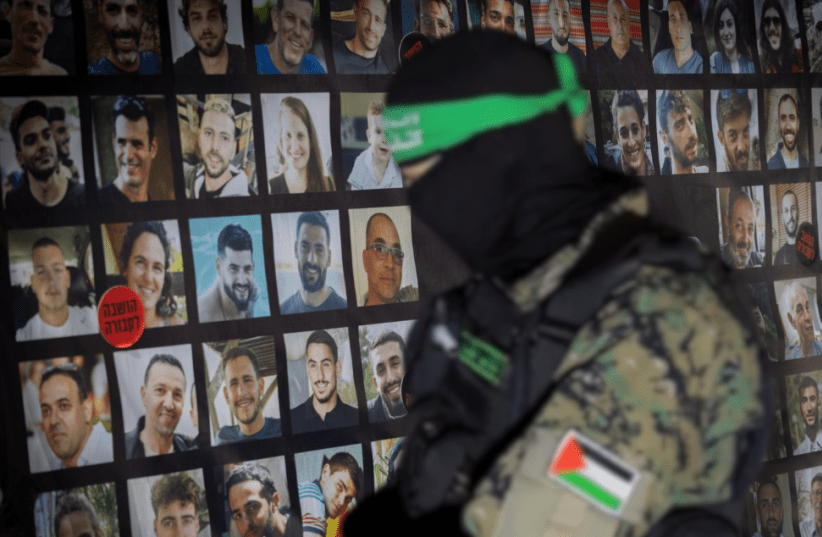
 Hamas terrorist in front of Gaza hostage posters. (Illustrative) (photo credit: Hamas Military Wing/Handout via REUTERS, MIRIAM ALSTER/FLASH90)
Hamas terrorist in front of Gaza hostage posters. (Illustrative)
(photo credit: Hamas Military Wing/Handout via REUTERS, MIRIAM ALSTER/FLASH90)
If no issues arise, a hostage deal could be signed by the end of this week, a Hamas official told the Saudi news outlet Asharq Al-Awsat.

The Wednesday report cited the official as stating that a deal was “imminent,” with the main points having already been agreed upon.

According to Asharq Al-Awsat, in the first stage of the agreement, which is supposed to last some 45-60 days, Hamas would release some 30 hostages, both alive and deceased, in exchange for Palestinian prisoners.

In addition, IDF troops would withdraw from cities within the Gaza Strip.

However, they would remain in the Philadelphi and Netazrim corridors. These corridors run parallel to the border with Egypt and cut across central Gaza, respectively.

 A woman stands next to posters with photos of hostages kidnapped in the deadly October 7 attack on Israel by the Palestinian Islamist group Hamas from Gaza, in Tel Aviv, Israel March 20, 2024. (credit: CARLOS GARCIA RAWLINS/REUTERS)
A woman stands next to posters with photos of hostages kidnapped in the deadly October 7 attack on Israel by the Palestinian Islamist group Hamas from Gaza, in Tel Aviv, Israel March 20, 2024. (credit: CARLOS GARCIA RAWLINS/REUTERS)

Palestinian women and children would be allowed to return to northern Gaza.

On Tuesday, officials with knowledge of the negotiations told The Jerusalem Post that a hostage deal could be achieved within a month, with significant advances being made.

Hostage deal reportedly ‘closer than ever’

This follows a Tuesday Washington Post report, citing a Hamas official, which claimed the terror group had ceded its demands that the war ends and that Israeli troops withdraw from the Gaza Strip in the framework of a hostage deal.

“There is a noticeable shift in public opinion,” a Hamas member was quoted as saying by the publication, adding, “There is now a strong desire to end the war at any cost.”

On Monday, Defense Minister Israel Katz said a hostage deal was closer than ever.


Such a remark was reiterated by a senior Hamas official, cited in the Saudi news outlet Asharq Al-Awsat.

“We are closer than ever to reaching a prisoner exchange deal and a ceasefire, provided that Netanyahu does not obstruct the agreement,” he reportedly said.

Amichai Stein, Sam Halpern and Raquel Guertzenstein Frohlich contributed to this report. 

David Israel

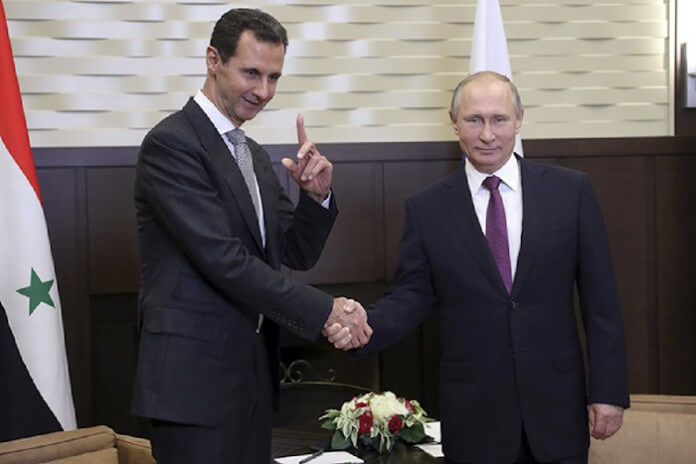
President Vladimir Putin with former President Bashar al-Assad.

Russia has cautioned Israel against exploiting the shifting dynamics in Syria, warning against any actions that could escalate tensions, particularly concerning the Golan Heights. In an interview with TASS, Deputy Foreign Minister Sergey Ryabkov underscored Moscow’s firm stance, calling the annexation of the disputed territory “absolutely unacceptable.”

Ryabkov also revealed the Russian effort to smuggle President al-Assad from Syria in a clandestine operation.

“Undoubtedly, Israel is the primary beneficiary of recent developments,” the deputy minister told TASS. “I would like to caution certain ‘hotheads’ in West Jerusalem against overestimating their leverage. I would also remind them, among other things, that the annexation of the Golan Heights, as many are now saying, remains entirely impermissible. Israel must return to full compliance with the well-known 1974 agreement with Syria.”

Deputy Minister of Foreign Affairs of the Russian Federation, Sergey Ryabkov. / National Nuclear Research University (MEPhI) / Flickr

After the Six-Day War of 1967, Israel occupied and assumed control over the Golan Heights. In the aftermath, Syria rejected any negotiations with Israel, as outlined in the Khartoum Resolution during the 1967 Arab League summit.

Following the 1973 Yom Kippur War, a disengagement agreement restored the civil administration of one-third of the Golan Heights, including the city of Quneitra, to Syria. Meanwhile, Israel began constructing settlements in the remaining territory, which continued under military administration until the Knesset passed the Golan Heights Law in 1981, effectively extending Israeli law to the region. This move was widely regarded as an annexation.

The United Nations Security Council condemned the law in Resolution 497, declaring that Israel’s decision to impose its laws, jurisdiction, and administration on the occupied Syrian Golan Heights was “null and void and without international legal effect.”

On March 25, 2019, the United States formally recognized Israeli sovereignty over the Golan Heights. This declaration, issued by the Trump administration, marked the first time any country had acknowledged Israeli control over the territory, which is internationally still regarded as part of Syria.

FLY ME ON A GHOST JET

Deputy Foreign Minister Sergei Ryabkov also told NBC News that Vladimir Putin personally granted political asylum to Bashar al-Assad on Sunday, December 8, after he had been overthrown by rebels and forced to flee. Ryabkov stated that al-Assad had been transferred to Russia on a military plane “in the most secure manner.”

Russian agents reportedly urged the Syrian President to flee as soon as rebel forces had seized key cities across Syria. They conveyed Putin’s blunt, brief warning to Assad: “You’re going to lose.”

It is understood that President Vladimir Putin personally approved Bashar al-Assad’s rescue, though the Russian leader reportedly has no intention of meeting with Assad now that he is in exile.

Russian intelligence agents orchestrated the dramatic escape, flying al-Assad out of Syria to Moscow via a Russian air base on the Syrian coast, Bloomberg News reported, citing key sources. The ousted dictator was instructed to reveal nothing about the operation, and the aircraft’s transport signals had been disabled to prevent tracking – which is why the plane disappeared in mid-flight and was considered downed.

Putin has yet to comment publicly on the collapse of the Assad regime.


Netanyahu said, quoting Hezbollah leader Naim Qassem, “Hezbollah has lost its supply route through Syria.”

 (Illustrative) Prime Minister Benjamin Netanyahu over a backdrop of Iran and Hezbollah flags. (photo credit: Canva, PMO, SHUTTERSTOCK)
(Illustrative) Prime Minister Benjamin Netanyahu over a backdrop of Iran and Hezbollah flags.
(photo credit: Canva, PMO, SHUTTERSTOCK)
Prime Minister Benjamin Netanyahu on Sunday warned Iran and Hezbollah that Israel will continue to act against them to achieve total victory and that he discussed this matter with US President-elect Donald Trump.


“I say to Iran and Hezbollah, to prevent you from harming us, we will continue to act against you as much as is required, anytime, anywhere,” Netanyahu said in a speech posted to X/Twitter.

Addressing Israel’s actions regarding recent developments in Syria, Netanyahu stressed, “Israel has no interest in confronting Syria. We will shape our policy based on the reality on the ground. For decades, Syria was an active enemy of the State of Israel.

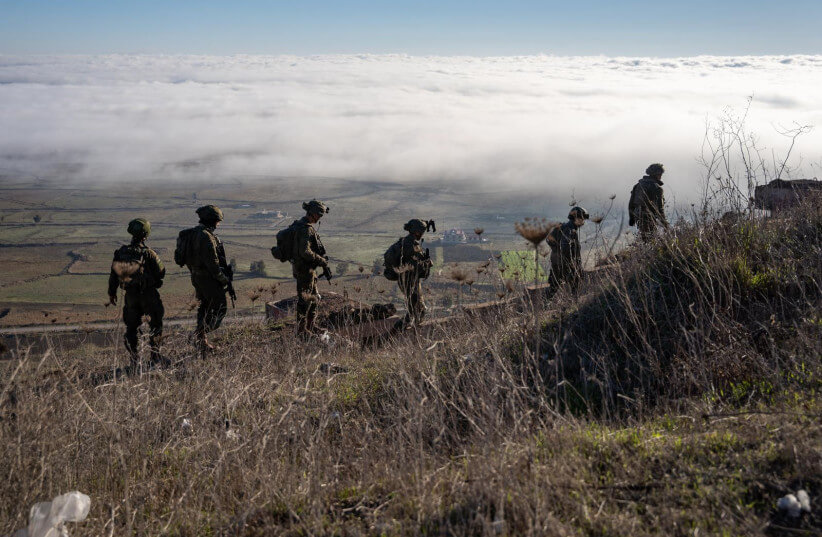
IDF operates in the buffer zone between Israel and Syria on December 13, 2024. (credit: IDF SPOKESPERSON'S UNIT)Enlrage image
IDF operates in the buffer zone between Israel and Syria on December 13, 2024. (credit: IDF SPOKESPERSON’S UNIT)

Preventing Hezbollah from rearming 

“In recent days, we have taken a series of intensive actions. Together with Defense Minister Katz, I directed the IDF to thwart potential threats from Syria and prevent terrorist elements from gaining a foothold near our border.”

Netanyahu stated that Israel’s actions in Syria have been justified through the effects they’ve had on Hezbollah’s capabilities.

Netanyahu said, quoting Hezbollah leader Naim Qassem from a televised speech on Saturday, “Hezbollah has lost its supply route through Syria.”

While reiterating Israel’s preference to avoid conflict, Netanyahu affirmed the nation’s determination to curb Hezbollah’s rearmament. “This is an ongoing test for Israel. We must meet it – and we will meet it,” he said.

Netanyahu described his conversation with Trump as “very friendly, very warm, and very important.”

“We discussed the need to complete Israel’s victory and spoke extensively about the efforts we are making to bring our hostages home. We are working tirelessly to bring back our hostages, both the living and the fallen,” Netanyahu said. “I’ll add that the less we talk about this, the better our chances of success, and with God’s help, we will succeed,” his speech concluded.