Syrian media on Friday morning reported one dead and one wounded in an Israeli attack on a vehicle on the road leading to Damascus airport. According to the Saudi news channel Al-Hadith, the deceased is a member of the Iranian-backed Iraqi militia Kata’ib Hezbollah (battalions of God’s party).

The attack, which is attributed to Israel and was first reported by the pro-Iranian news agency Saberin earlier, has not been reported by any official Syrian media so far.

According to Saberin, Friday’s attack in Damascus targeted the commander of Kata’ib Hezbollah, killing one person and moderately wounding another.

A Syrian security source also stated that the attack was carried out by a UAV, which launched two missiles at the terrorist group’s headquarters located in a residential area of Damascus. According to the source, the assassinated official is Abu Haider al-Khafaji, an Iraqi national.

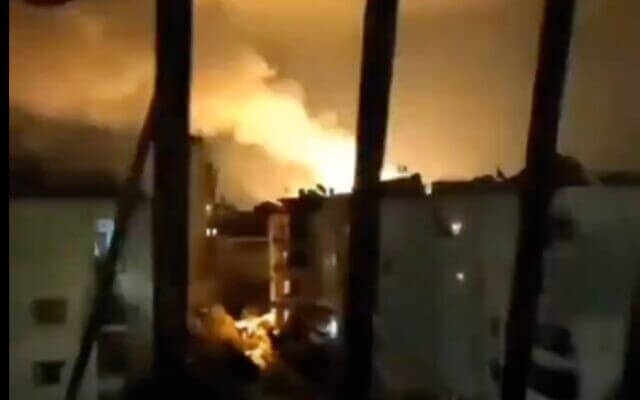
Israel initiated a series of airstrikes targeting Hezbollah positions in southern Lebanon on Thursday, just moments before Hezbollah leader Hassan Nasrallah declared from his bunker that the two days of intense assaults on the beepers and walkie-talkies of his members constituted a declaration of war.

Thursday’s airstrikes were the most extensive since October 9, when skirmishes between Israel and Hezbollah had begun. In his speech, Nasrallah discussed the explosive incidents that had left his followers astonished by the magnitude of the attacks. It also blinded more than 500 of them and wounded hundreds more in delicate parts of their anatomy, guaranteeing they would not produce new little Hezbollah terrorists.

Israeli aircraft flew over Beirut, producing sonic booms, a tactic they have employed repeatedly in recent months to instill fear in the group and panic in the residents of the Lebanese capital. Nasrallah called the attack on his members’ means of receiving orders to murder Israeli civilians “a significant terrorist operation,” and a declaration of war.

Hezbollah now confronts a daunting challenge in reconstructing its leadership structure following the severe disruption of its fundamental communication networks and the directed assassinations of its top commanders. These assassinations stopped just shy of taking down Nasrallah himself. The terrorist group must now simultaneously rebuild confidence among its ranks while identifying and addressing the vulnerabilities or infiltrators that enabled the security breach.

Israeli officials this week indicated a shift in their focus from the conflict with Hamas in the Gaza Strip to the confrontation with Hezbollah in Lebanon. The IDF has progressively allocated more resources and personnel to this engagement, primarily along its northern border.


Hezbollah leader promises attacks on Israel until Gaza war ends, says country’s northern ‘settlers’ won’t be able to return home until then; IAF jets fly low over Beirut during speech


An image grab taken from Hezbollah's Al-Manar TV shows the Lebanese terror group's chief Hassan Nasrallah addressing the nation from an undisclosed location on September 19, 2024. (Al-Manar/AFP)

An image grab taken from Hezbollah’s Al-Manar TV shows the Lebanese terror group’s chief Hassan Nasrallah addressing the nation from an undisclosed location on September 19, 2024. (Al-Manar/AFP)

Hezbollah leader Hassan Nasrallah conceded on Thursday that the terror group had suffered a “major and unprecedented” blow this week when thousands of its communications devices suddenly exploded, but vowed that the Lebanon-based terror organization would recover and not lay off its attacks on Israel after months of cross-border fire.

In a televised public address, Nasrallah blamed Israel for the pager and walkie-talkie attacks of Tuesday and Wednesday, which he said constituted “an unprecedented massacre.”

“There is no doubt that we have been subjected to a major security and military blow that is unprecedented in the history of the resistance and unprecedented in the history of Lebanon,” Nasrallah said in his address, filmed at an undisclosed location.

“This type of killing, targeting and crime may be unprecedented in the world,” he said, appearing in front of a featureless red background in his customary black turban.

The attacks “crossed all red lines”, he said. “The enemy went beyond all controls, laws and morals,” he said, adding the attacks “could be considered war crimes or a declaration of war.”

The first round of attacks took place on Tuesday when at least 12 people were killed and thousands injured as pagers held by Hezbollah members across Lebanon exploded in what appeared to be a widescale, coordinated attack. A fresh wave of explosions ripped across Lebanon on Wednesday, appearing to target mainly handheld radios used by Hezbollah members, killing at least 25 people and injuring at least 450, according to Lebanese officials.

An Israeli report Wednesday said Jerusalem believes the death toll to be higher than reported, with Hezbollah’s elite Radwan unit hit hard by the attacks.

Claiming that the attacks had been meant to kill thousands, Nasrallah asserted that “the Israeli effort has largely been thwarted.”

He added that the group would probe how the attacks had happened.

Videos posted to social media showed Israeli fighter jets flying low over Beirut and breaking the sound barrier as Nasrallah spoke from an undisclosed location.

Fears have risen that 11 months of exchanges of fire between the two sides could escalate into an all-out war, particularly after this week’s device bombings. Hezbollah-led forces have attacked Israeli communities and military posts along the border on a near-daily basis since October 8, with the group saying it is doing so to support Gaza amid the war there.

Israel began moving more troops to its border with Lebanon on Wednesday as a precautionary measure, according to Israeli officials. Israel Defense Forces chief Herzi Halevi held an assessment and approved battle plans for the northern front on Thursday, a short while before Nasrallah’s speech began.

Nasrallah said Hezbollah actually hoped IDF troops would enter southern Lebanon because “what they see as a threat we see as an opportunity.”

He said Hezbollah was using all means to seek out Israeli soldiers and tanks, and this task would be easier “if they come out toward us. Welcome.”

Nasrallah also derided an idea recently put forward by IDF Northern Command head Maj. Gen. Ori Gordin of creating a buffer zone in southern Lebanon, calling the commander an “imbecile.”

“We will not fall, and we will come out stronger. We are preparing to face even worse attacks,” Nasrallah said.

In terms of retaliation, he vowed, “There will be a just punishment. I will not say when, where or how. You will know when the time comes.”

“On Tuesday, Israel intended to kill 4,000 people in one minute by detonating the pagers. Many of them were civilians,” Nasrallah said, though the attacks appeared to have hit only devices used by Hezbollah operatives. “The following day, 1,000 more in one minute. In two minutes, Israel intended to kill 5,000.”

“We have suffered a heavy blow. This is war, this is conflict. We know the enemy, not only Israel, but also the US and NATO, has technological superiority,” he said.

Lebanese first responders carry a man who was wounded after his handheld pager exploded in an attack blamed on Israel targeting Hezbollah, in the southern port city of Sidon, Lebanon, September 17, 2024. (AP Photo)

The Shiite terror leader also referenced the upcoming anniversary of Hamas’s October 7 onslaught in southern Israel. “Shortly, we will celebrate the one-year anniversary of the blessed Al-Aqsa flood operation,” he said.

“There is no doubt that Hezbollah, since it joined the fight, has registered impressive achievements in the north of Israel,” he said, claiming that the “criminal” attacks against Hezbollah’s portable devices were conducted by Israel to cover up its incapacity to achieve a military breakthrough against Hezbollah in the north, where it is “embroiled in a war of attrition.”

“We say to [Prime Minister Benjamin] Netanyahu, [Defense Minister Yoav] Gallant and the Israeli people: We will not stop our attacks as long as the enemy continues its war in Gaza.”

Nasrallah specifically vowed that the terror group would prevent Israel from realizing its recently added war objective of returning Israeli citizens displaced from northern communities near the Lebanon border to their homes.

“The goal of the resistance is to prevent the enemy from realizing its goals. Its latest objective is to return settlers to their homes in the north of occupied Palestine. Let me tell the Israeli government, the Israeli army and the Israeli people: You will not manage. I tell Prime Minister Netanyahu: You can do what you want, you will not manage,” he said.

“The only solution is to halt the aggression against the people of Gaza. No military escalation, no killings, no total war will return your settlers to the border area. You know it.”

IDF tanks seen on top of a truck in traffic, on their way to the northern border with Lebanon, September 18, 2024. (Yossi Aloni/Flash90)

Hezbollah’s backers in Tehran also vowed revenge for the device explosions, with Iran’s Revolutionary Guards Commander Hossein Salami telling Nasrallah on Thursday that Israel would face “a crushing response from the axis of resistance,” according to Iranian state media.

“Such terrorist acts are undoubtedly the result of the Zionist regime’s despair and successive failures. This will soon be met with a crushing response from the axis of resistance and we will witness the destruction of this bloodthirsty and criminal regime,” Salami said in his message to Nasrallah.

The axis of resistance refers to Iran’s proxies in the Middle East, including Hamas and Hezbollah, along with Yemen’s Houthis, and Iraq’s Popular Mobilization Forces.

Iran’s envoy to Lebanon, Mojtaba Amani, was among those wounded in Tuesday’s explosions, suffering injuries to the hand and the face and reportedly losing an eye.

A man places a poster of Hezbollah leader Hassan Nasrallah near bouquets of flowers in front of the Lebanese Embassy in Tehran, Iran, September 18, 2024. (AP Photo/Vahid Salemi)

So far, the skirmishes on the northern border with Lebanon have resulted in 26 civilian deaths on the Israeli side, as well as the deaths of 22 IDF soldiers and reservists. There have also been several attacks from Syria, without any injuries.

Hezbollah has named 478 members who have been killed by Israel during the ongoing skirmishes, mostly in Lebanon but some also in Syria. Another 79 operatives from other terror groups, a Lebanese soldier, and dozens of civilians have also been killed.


Tel Aviv University Professor says that Hezbollah is compromised at an organizational level.

 Ambulances arrive to American University of Beirut Medical Center (AUBMC) as more than 1,000 people, including Hezbollah fighters and medics, were wounded when the pagers they use to communicate exploded across Lebanon, according to a security source, in Beirut, Lebanon September 17, 2024. (photo credit: REUTERS/MOHAMED AZAKIR)
Ambulances arrive to American University of Beirut Medical Center (AUBMC) as more than 1,000 people, including Hezbollah fighters and medics, were wounded when the pagers they use to communicate exploded across Lebanon, according to a security source, in Beirut, Lebanon September 17, 2024.
(photo credit: REUTERS/MOHAMED AZAKIR)
Professor Uzi Rabi, head of the Moshe Dayan Center at Tel Aviv University, spoke Wednesday on 103FM about the severe blow Hezbollah suffered in the beeper attack and the future of the northern front.

“This is a multidimensional blow,” said Rabi. “It’s clearly visible on an operational or physical level, but I’d also say it highlights a high level of infiltration. It shows that the organization is completely compromised when it comes to information security. Nasrallah, as we’ve come to know him in recent years – with his inflated ego and the belief that he’s Lebanon’s protector, constantly claiming he’s defending the country – now finds himself, in my view, in a very problematic position.”

This came before Nasrallah’s speech on Wednesday, in which he dared Israel to enter Lebanese territory and called escalation in the North “a historic opportunity.”

According to Rabi, the Arab world is recognizing Hezbollah’s difficult position online. “This is also reflected in the discourse on social networks, particularly Arab social media. Hezbollah has suffered a blow that forces it not only to pick up the pieces but also to rethink its next steps. Until recently, Hezbollah was letting the situation unfold on its own. It operated under the assumption that a truce in Gaza would lead to a truce in the North and tied itself closely to the Gaza narrative.”

 Lebanese Hezbollah supporters attend a protest in support of Palestinians in Gaza, amid the ongoing conflict between Israel and the Palestinian Islamist group Hamas, in Nabatieh, southern Lebanon November 18, 2023 (credit: REUTERS/ALAA AL-MARJANI)Enlrage image
Lebanese Hezbollah supporters attend a protest in support of Palestinians in Gaza, amid the ongoing conflict between Israel and the Palestinian Islamist group Hamas, in Nabatieh, southern Lebanon November 18, 2023 (credit: REUTERS/ALAA AL-MARJANI)

He continued by saying that with the front in Gaza waning, Hezbollah leadership faces multi-pronged trouble moving forward.

“Right now, with Gaza both literally and figuratively distant, I think Nasrallah is facing a real dilemma. He’s holding onto it, genuinely unsure about how to move forward. From our experience with Hezbollah, we know they don’t react impulsively – they prefer to analyze the situation. But it’s clear to him that, in terms of both image and operations, he’s been pushed back a few years in some respects. Of course, he’ll need to reassess this from our perspective. Israel is in a momentum that can’t be denied. Nearly all of southern Lebanon, including the Shi’ite and Christian villages, has been evacuated. I think winter is something to consider – if there’s something to be done, it’s best to do it before winter arrives,” he said.

How can Israel keep Hezbollah at bay?

According to Rabi, events like the pager attack this past week could help deter attacks from Hezbollah in the future.

“Like the preemptive strike we saw not too long ago, which we praised extensively, but let’s be honest – it has lost some of its significance or weight in the overall picture. I really hope what we saw yesterday was a phenomenal event in terms of capabilities and technology. I hope it doesn’t end up being an isolated event that collapses.”

As for what comes next, Rabi says the government’s newly updated war aims should take precedence.

“The goal is to bring the residents of the North back home. I wish Hezbollah would just pack up and retreat, but that’s not going to happen. So, what needs to be done? In the end, a very carefully calculated offensive is needed. I know what Israel needs to do, but I’ll say it cautiously – I hope we’re capable of doing it. Let’s just say we understand that we can’t do everything at all times, and sometimes, the blanket is too short in certain areas. We need to set priorities.”