Speculation suggests Iran could attack Israel from its own territory rather thanIsrael beefs up air defenses, calls up troops as Iran payback for Syria strike looms through proxies, sparking wider hostilities; Gallant says IDF prepared for every scenario
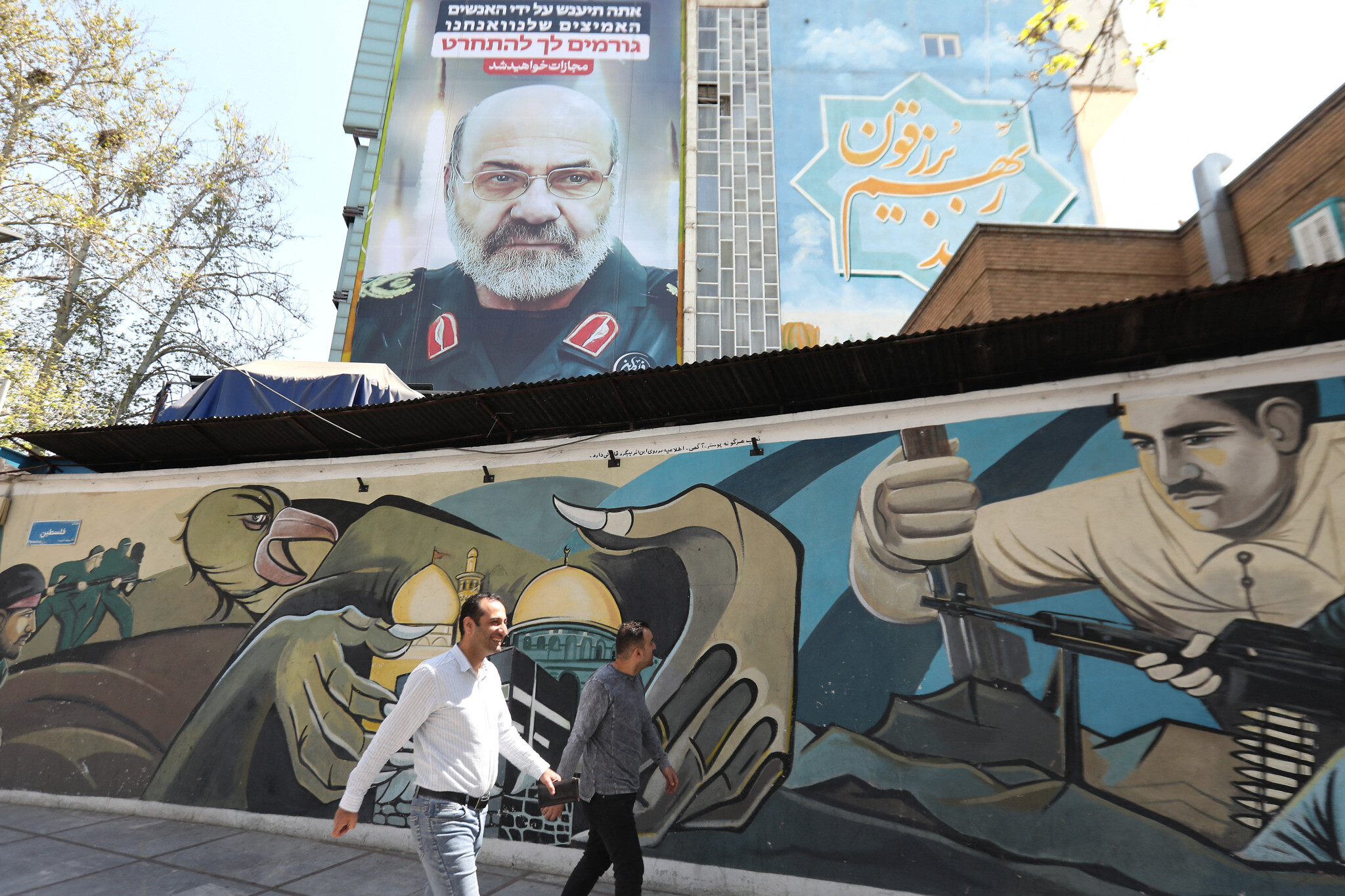
 

A billboard displays a portrait of slain Iran's Brigadier General Mohammad Reza Zahedi with a slogan in Hebrew saying, "You will be punished", on April 3, 2024 at Palestine Square in Tehran. (ATTA KENARE / AFP)

A billboard displays a portrait of slain Iran’s Brigadier General Mohammad Reza Zahedi with a slogan in Hebrew saying, “You will be punished”, on April 3, 2024 at Palestine Square in Tehran. (ATTA KENARE / AFP)

The IDF said on Wednesday that it bolstered its air defense array and had called up reservists, as the country girded for a potential Iranian response to the strike in Syria earlier this week, in which several high-ranking Iranian military officials were killed.

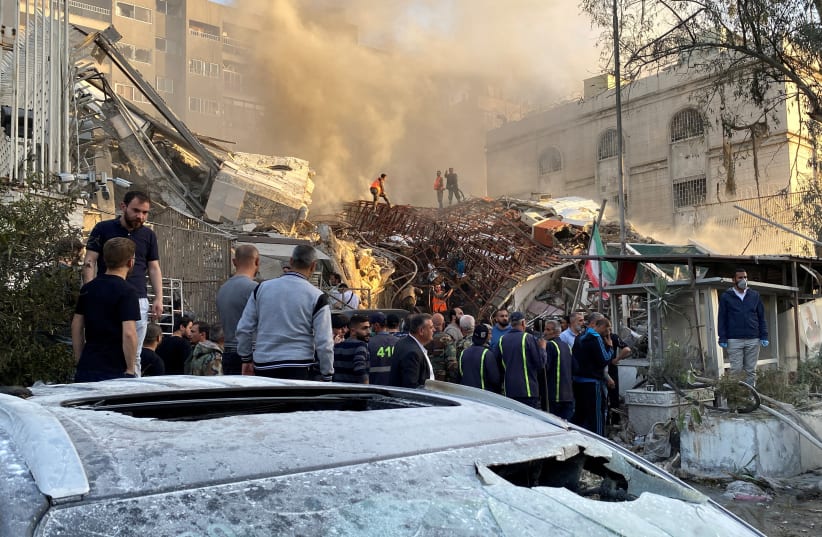
Both Iran and its proxy Hezbollah have vowed that Israel will not go unpunished for the Monday attack on a consular building next to Iran’s embassy in Damascus, which killed Mohammad Reza Zahedi, the Islamic Revolutionary Guard Corps’ most senior official in Syria, along with his deputy, five other IRGC officers, and at least one member of the Hezbollah terror group.

A Channel 12 news report reflecting Israeli speculation on a possible reprisal pointed to the possibility that Iran could respond by directly launching missiles from its own territory rather than via any of its proxy groups, which includes militias in Lebanon, Iraq and Yemen.

While Israel could suffice with letting the round of hostilities fizzle out, in the event that Iran responds via a proxy, such as a Hezbollah rocket barrage, an attack from Iranian territory would likely push the Israeli Defense Forces to launch a significant reprisal, risking sending tensions snowballing further.

“I won’t be surprised if Iran fires directly at Israel,” former Military Intelligence head Amos Yadlin told the network, explaining that a January missile strike carried out by Iran on neighboring Pakistan set a precedent for such action.

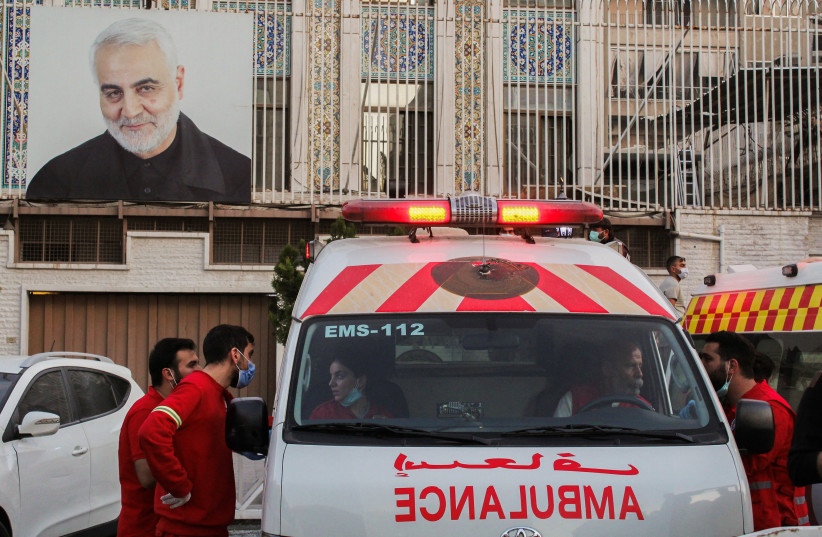
Emergency services work at Iran’s consulate after it was hit by an alleged Israeli strike in Damascus, Syria, April 1, 2024. (AP Photo/Omar Sanadiki)

Hebrew-language media reports said the decision to beef up air defenses and call up troops came following a threat assessment.

Several rockets have been fired at Israel from Lebanon by Hezbollah since Monday’s attack, though there has been no indication that they went beyond daily cross-border fire that have raised tensions on Israel’s northern frontier since October 8.

Iranian Supreme Leader Ayatollah Ali Khamenei has vowed revenge for the Monday strike, and posters parroting his words have gone up around Tehran, in a sign of public pressure for an Iranian response.

“The defeat of the Zionist regime in Gaza will continue and this regime will be close to decline and dissolution,” Khamenei said in a speech to the country’s officials in Tehran Wednesday.

Protesters attend an anti-Israel gathering as they wave Palestinian flags at the Felestin (Palestine) Sq. in downtown Tehran, Iran, April 1, 2024. (AP Photo/Vahid Salemi)

“Desperate efforts like the one they committed in Syria will not save them from defeat. Of course, they will also be slapped for that action,” he added.

Defense Minister Yoav Gallant said earlier on Wednesday that Israel is “increasing preparedness” in the face of threats from across the Middle East.

Speaking at a home-front readiness drill in Haifa, Gallant said that the country’s defense establishment is “expanding our operations against Hezbollah, against other bodies that threaten us,” and reiterated that Israel “strikes our enemies all over the Middle East.”

“We need to be prepared and ready for every scenario and every threat,” against near enemies and distant enemies,” Gallant said, vowing that “we will know how to protect the citizens of Israel and we will know how to attack our enemies.”

Addressing the daily attacks on the northern border by the Iran-backed Hezbollah in Lebanon, Gallant said that one of the main issues Israel is facing is how it will let some 80,000 displaced Israelis return to their homes in northern Israel.

“We prefer… an agreement that will result in the removal of the threat, but we have to prepare for the possibility of [using] force in Lebanon that can also take into account the scenario we are describing here, which is a scenario of war, and we need to be prepared for this issue and understand that it can happen,” Gallant said.

Defense Minister Yoav Gallant speaks during a home front command drill in Haifa, April 3, 2024. (Ariel Hermoni/ Defense Ministry)

The drill evaluated the coordination between local authorities, government ministries, and rescue services in a war scenario, “in light of the increasing need to return the residents of the north to their homes,” the Defense Ministry said.

Since October 8, Hezbollah-led forces have attacked Israeli communities and military posts along the border on a near-daily basis, with the group saying it is doing so to support Gaza, amid the war there.

So far, the skirmishes on the border have resulted in eight civilian deaths on the Israeli side, as well as the deaths of 10 IDF soldiers and reservists. There have also been several attacks from Syria, without any injuries. Hezbollah has named 267 members who have been killed by Israel during the ongoing skirmishes, mostly in Lebanon but some also in Syria.

In Lebanon, another 50 operatives from other terror groups, a Lebanese soldier, and at least 60 civilians, three of whom were journalists, have been killed.

The alleged Israeli attack on Damascus came after Israel indicated it was stepping up action against Hezbollah, hitting sites deeper inside Lebanon, in a bid to pressure the group into stopping the daily rocket fire.

It also occured hours after an Iran-backed militia launched a drone at Eilat, hitting a naval base, in one of the more serious attacks on Israel since war erupted on October 7.

Speaking on condition of anonymity, US officials said they were watching closely to see if, as in the past, Iran-backed proxies would attack US troops based in Iraq and Syria after Monday’s Israeli strike, but had no picked up any intelligence suggesting they would do so.

Such Iranian attacks ceased in February after Washington retaliated for the killing of three US troops in Jordan with dozens of air strikes on targets in Syria and Iraq linked to Iran’s Revolutionary Guard Corps and the militias it backs.

A missile is launched during a military drill in southern Iran, on January 19, 2024. (Iranian Army official website via AP)

One source who tracks the issue carefully, and who spoke on condition of anonymity, said Iran faced the conundrum of wanting to respond to deter further such Israeli strikes while avoiding an all-out war.

“They have faced this real dilemma that if they respond they could be courting a confrontation which they clearly don’t want,” he said. “They are trying to modulate their actions in a way that shows that they are responsive but not escalatory.”

“If they don’t respond in this case, it really would be a signal that their deterrence is a paper tiger,” he added, saying Iran might attack Israel proper, Israeli embassies or Jewish facilities abroad.

The US official said given the significance of the Israeli strike, Iran may be forced to respond by attacking Israeli interests, rather than going after US troops.

Elliott Abrams, a Middle East expert at the Council on Foreign Relations US think tank, also said he believed Iran did not want an all-out war with Israel, but could target Israeli interests.

“I think Iran does not want a big Israel-Hezbollah war right now, so any response will not come in the form of a big Hezbollah action,” Abrams said, referring to the Lebanese group seen as Tehran’s most powerful military proxy.

“They have many other ways to respond… for example by trying to blow up an Israeli embassy,” he added.

Iran could also respond by accelerating its nuclear program, which Tehran has ramped up since then-US president Donald Trump in 2018 abandoned the 2015 Iran nuclear deal designed to constrain it in return for economic benefits.

But the two most dramatic steps — increasing the purity of its enriched uranium to 90 percent, which is considered bomb grade, or reviving work to design an actual weapon — could backfire and invite Israeli or US strikes.

“Either one of those would be viewed by Israel and by the US as a decision to acquire a bomb. So… they are really taking a big risk. Are they ready to do it? I would not think so,” said the source, who tracks the issue closely.


Ex-CIA agent tells NYT alleged Israeli attack aimed to ‘punish’ Guard Corps for efforts to harm Israelis abroad; retired US general says Iran’s options for response ‘very limited’


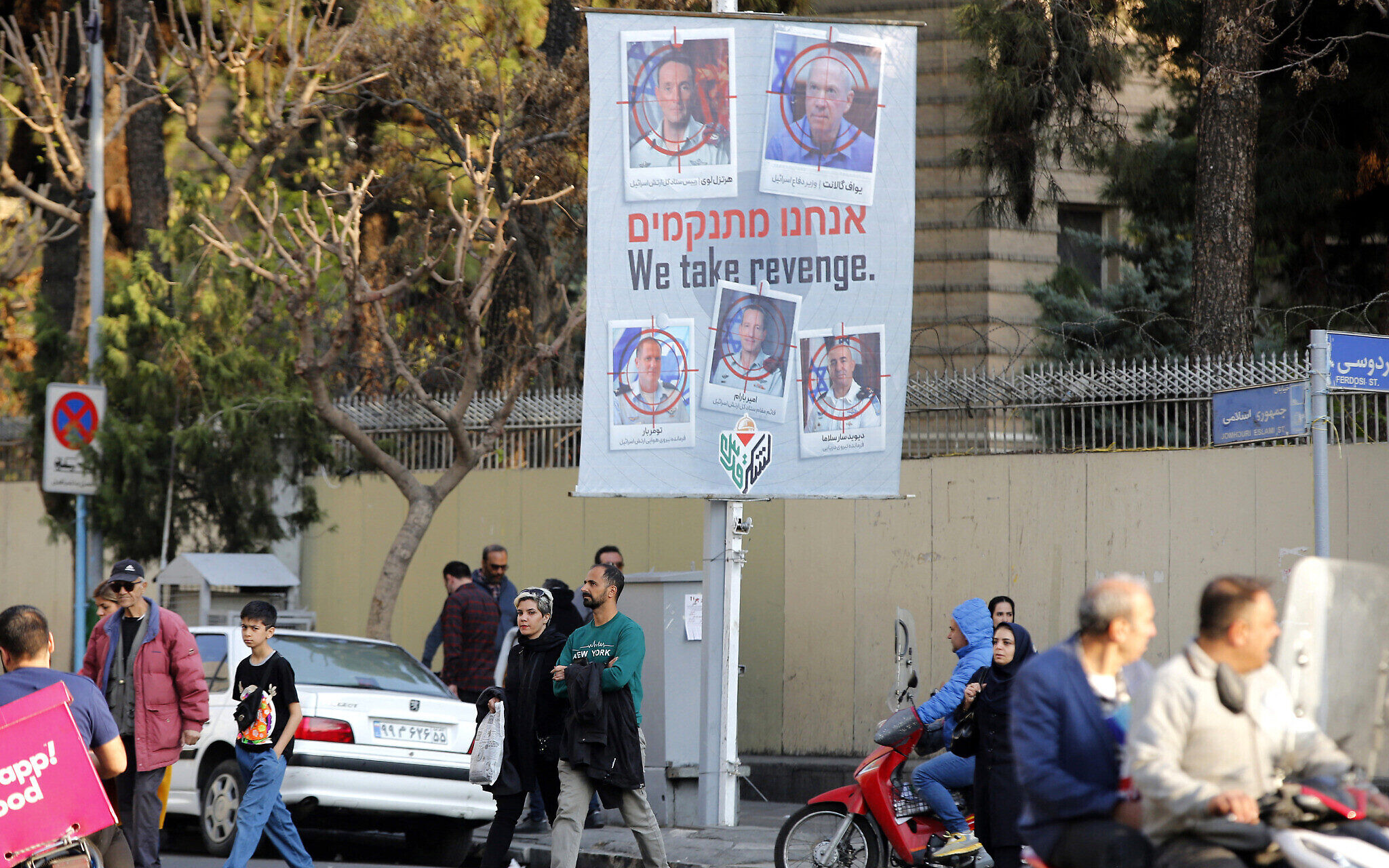
A banner displaying pictures of Israeli army officials with their faces encircled by a red crosshair icon, hang in Tehran on April 2, 2024 following a suspected Israeli strike in Damascus that killed the top IRGC officer in Syria. (ATTA KENARE / AFP)

A banner displaying pictures of Israeli army officials with their faces encircled by a red crosshair icon, hang in Tehran on April 2, 2024 following a suspected Israeli strike in Damascus that killed the top IRGC officer in Syria. (ATTA KENARE / AFP)

The alleged Israeli strike that killed Iran’s top Islamic Revolutionary Guard Corps commander in Syria was a strategic blow to Tehran and may risk an escalation of tensions in the region, current and former US officials told The New York Times Tuesday.

Though it was blamed by Iran and its allies, Israel has not officially commented on the attack on the building in Damascus, which killed Gen. Mohammad Reza Zahedi, the IRGC’s most senior official in Syria, along with his deputy Gen. Mohammad Hadi Hajriahimi, five other IRGC officers and at least one member of Hezbollah.

In the wake of the strike, US troops based in southeastern Syria intercepted an attack drone, marking the first such incident in two months, a Defense Department told The Times, speaking on condition of anonymity. Iran-backed militias had refrained from attacking US bases in an apparent attempt at deescalation after three US troops were killed in a drone strike in Jordan in January.

Ralph Goff, a former senior CIA official who operated in the Middle East, called the alleged Israeli strike “reckless,” adding that “it will only result in escalation by Iran and its proxies.”

He told the Times that the attack was in line with Israel’s long-term strategy of weakening the IRGC and “punishing them for ongoing plots to kill or kidnap Israeli Jews around the world.”

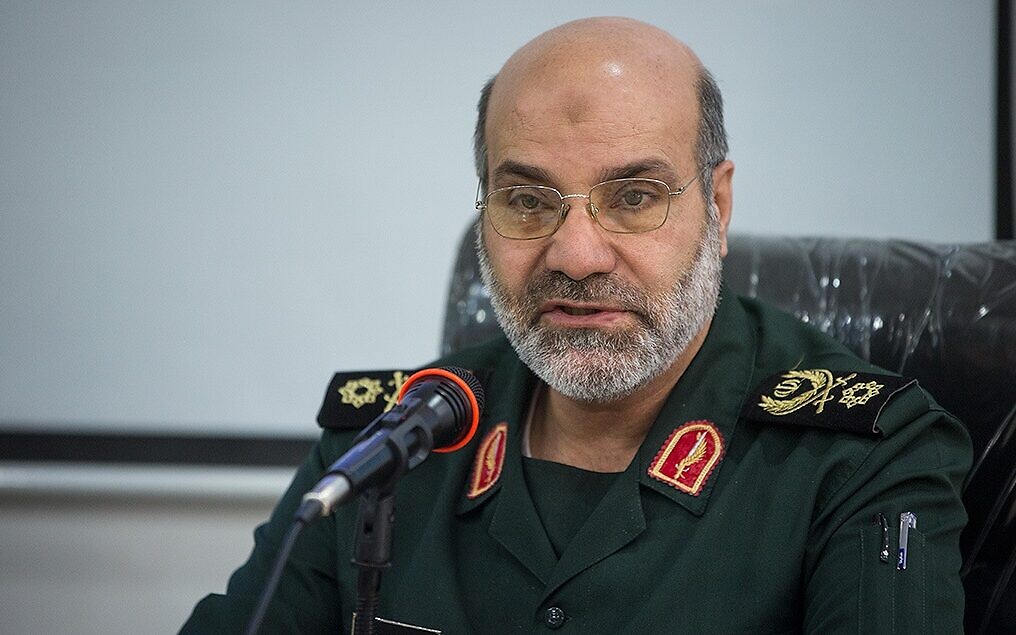
IRGC official Mohammad Reza Zahedi, July 2, 2017. (Ali Khara/Fars Media Corporation, via Wikimedia CC BY 4.0)

But he doubted the risk of a major retaliation, stating that “Iran’s options to hit Israel are very, very limited,” and “the Israelis aren’t going to back down.”

Dana Stroul, the Pentagon’s former top Middle East policy official, labeled the attack “the Israeli version of the US strike on Qassem Suleimani,” referring to the assassination of the Quds Force chief in Baghdad in January 2020, and warning that it was a “significant escalation and risks tipping an already volatile, unstable region into full-scale war.”

“The question is, will Iran respond in a manner that deescalates the situation, or will it climb further up the escalation ladder?” she said.

The strike “should have strategic effect on how the Quds Force operates abroad and should erode any semblance of invincibility or deniability that this terrorist organization only brings instability and violence to the places it seeks to operate,” added Stroul.

Sabrina Singh, a Pentagon spokesperson, emphasized that the US played no part in the strike and wanted to avoid an escalation.

“Tensions being high in the region, we wanted to make it very clear in private channels that the US had no involvement in the strike in Damascus,” she said.

Zahedi was reportedly responsible for the IRGC’s operations in Syria and Lebanon, for Iranian militias there, and for ties with Hezbollah, and was thus the most senior commander of Iranian forces in the two countries. The IRGC is a US-designated terrorist organization.

Emergency and security personnel search the rubble at the site of strikes which hit a building annexed to the Iranian embassy in Syria’s capital Damascus, on April 1, 2024. (LOUAI BESHARA/ AFP)

Faced with ongoing attacks by the Iran-backed Hezbollah and Shiite militias throughout the Middle East in the wake of Hamas’s brutal October 7 massacre, which sparked the war in Gaza, Israel has escalated its strikes on Iran-linked terror targets in Syria, reportedly killing numerous IRGC operatives, as well as members of Hezbollah and other Iranian proxy groups.

Israel has grown increasingly impatient with the daily exchanges of fire with Hezbollah, which have escalated in recent days, and warned of the possibility of a full-fledged war. Houthi rebels have also been launching long-range missiles toward Israel, including on Monday.

While Israel does not, as a rule, comment on specific strikes in Syria, it has admitted to conducting hundreds of sorties against Iran-backed terror groups attempting to gain a foothold in the country over the last decade. The Israel Defense Forces says it attacks arms shipments believed to be bound for those groups, chief among them Hezbollah. Additionally, airstrikes attributed to Israel have repeatedly targeted Syrian air defense systems.

Iran and Hezbollah have vowed to respond to the strike on the IRGC generals, with Iranian state TV reporting that the country’s Supreme National Security Council, a key decision-making body, met late Monday and decided on a “required” reaction.

In an online statement, Iranian President Ebrahim Raisi blamed Israel for the attack, saying the “cowardly crime will not go unanswered.”

“After repeated defeats and failures against the faith and will of the Resistance Front fighters, the Zionist regime has put blind assassinations on its agenda in the struggle to save itself,” his statement added.

“The evil Zionist regime will be punished at the hands of our brave men. We will make them regret this crime and the other ones,” Iran’s supreme leader Ayatollah Ali Khamenei said in a message published on his official website.


An alleged Israeli airstrike on the Iranian consulate building in Damascus Monday night resulted in the killing of a number of Iranian Revolutionary Guard and Quds Force generals.

 Smoke rises after what the Iranian media said was an Israeli strike on a building close to the Iranian embassy in Damascus, Syria April 1, 2024. (photo credit: REUTERS/FIRAS MAKDESI)
Smoke rises after what the Iranian media said was an Israeli strike on a building close to the Iranian embassy in Damascus, Syria April 1, 2024.
(photo credit: REUTERS/FIRAS MAKDESI)
An alleged Israeli airstrike on the Iranian consulate building in Damascus Monday night resulted in the killing of a number of Iranian Revolutionary Guard and Quds Force generals, and it is considered one of the biggest strikes against these two Iranian organizations after the killing of Qassem Soleimani—the commander of the Iranian Quds Force—in a US airstrike in Baghdad in January 2020.

For more stories from The Media Line go to themedialine.org

According to Iranian, Iraqi, and Syrian media loyal to Iran, the highest of these leaders is General Mohammad Reza Zahedi, commander of the Revolutionary Guards in Syria and Lebanon. He is considered the de facto ruler of the Iranian-backed militias in Damascus and Beirut. In addition to Zahedi, among the dead were the Chief of Staff of the Revolutionary Guard, Mohammad Hadi Rahimi, General Hossein Aman Allahi, General Hossein Aman Allahi, Seyyed Mehdi Jaladati, Engineer Mohsen Sadaqat, Ali Agha Babaei, and Seyed Ali Salehi Rouzbahani, according to a statement by the Iranian Revolutionary Guard.

Also, according to what was reported by Lebanese media close to Hezbollah, among the dead were also Muhammad Adnan Sanbour and Mustafa Suleiman, who were leaders in the Lebanese Hezbollah.

The Supreme Leader of Iran, Ali Khamenei, said in a statement published by Iranian news agencies, “The malicious Zionist entity will receive its punishment at the hands of our brave men. We will make the Zionists regret the crime of attacking the Iranian consulate in Damascus and others like it.”

 Members of Syrian Red Crescent work near the damaged site after what Syrian and Iranian media described as an Israeli air strike on Iran's consulate in the Syrian capital Damascus April 1, 2024. (credit: FIRAS MAKDESI/REUTERS)Enlrage image
Members of Syrian Red Crescent work near the damaged site after what Syrian and Iranian media described as an Israeli air strike on Iran’s consulate in the Syrian capital Damascus April 1, 2024. (credit: FIRAS MAKDESI/REUTERS)

On Monday evening, the Iranian Supreme Security Council held a meeting in the presence of Iranian President Ebrahim Raisi after the Israeli bombing of the Iranian consulate in Damascus. The Secretariat of the Iranian Supreme National Security Council said, “The Council took the appropriate decisions regarding the war crime related to the Israeli bombing of the Iranian consulate in Damascus,” noting that the Council’s decisions were taken in a session attended by Raisi, which took place on Monday evening.

The success of the strike

Sufyan al-Samarrai, head of the Baghdad Post website, told The Media Line, “This is one of the largest strikes directed against the Iranian Revolutionary Guard, the Quds Force, and Hezbollah.” He continued, “This Israeli military strike was successful, and in its goal, they were involved in major war crimes in Syria and Lebanon, and they were also running an operations room to conspire against Jordan and Saudi Arabia.”

He also said, “We can only applaud this successful strike. All of Iran’s followers and militias must be eliminated so that the region can enjoy security and stability.”

Echoing the sentiment of accountability yet spotlighting the human cost, Syrian journalist Majd Kanaan told The Media Line, “These leaders were involved in the blood of the Syrian and Lebanese people, and they were planning to destroy several countries in the region.”

“The Khomeini regime in Iran is experiencing its worst period. It is in unnatural humiliation and cannot respond, even though Israel is only a few hundred kilometers away from Damascus, and they have large forces stationed in the Syrian capital.”

He added, “The most we will see is bombing some empty American bases in Iraq. This is all they can do.”

Bridging perspectives on the aftermath, Saudi political analyst Enad Al-Shamrani told The Media Line, “Striking the heads of sedition and terrorism is a popular demand. These are not leaders for liberating Jerusalem, but leaders for occupying Arab capitals.”

“General Zahedi was the responsible person in Syria, and we can say that he is the de facto ruler of Syria, but now he has been killed, and we do not know who will come after him.” He added: “The second row of Iranian Revolutionary Guard and Quds Force generals are not as efficient as the leaders of the first row, of whom there are only a few remaining.”

According to Al-Shamrani, “The Gulf countries were not far from targeting the leaders of the Revolutionary Guard, and they are truly criminals.”

Amid discussions of the strike’s strategic ramifications, Ahmed Al-Shibl, a member of Hezbollah in the Iraqi capital, Baghdad, told The Media Line, “So far, there are no orders to respond to Israeli attacks.”

“These martyred leaders were killed because they were defending the truth with our brothers in Gaza. They were fighting the Zionist enemy, and that is why Israel targeted them.”

“The blood of the martyrs will not be shed,” he continued. “We will respond decisively against America, Israel, the evil triangle, and all the traitors and Zionists who help them, and our response will be decisive.”

He added, “We all go in sacrifice for the leaders. These are spiritual leaders before they are field commanders. The resistance does not abandon the blood of its martyrs.”

Intensifying the call for retribution, Hussain Khozam, an Iranian political activist, told The Media Line, “The Islamic resistance will not remain silent regarding these attacks. The response will be decisive against all Israeli interests, just as the response will be decisive from the resistance in Gaza.”

He continued, “These martyrs gave their lives in service of religion and to defend the oppressed in Syria, Lebanon, Palestine, Iraq, and Yemen. The resistance’s response will be decisive.”

In contrast, Mohammad Shazar, a Syrian dissident, told The Media Line, “Iran will not respond. All it will do is a few missiles that its militias will launch toward American bases in Iraq, and perhaps Saudi Arabia or even Jordan.”

Omar Banbih, an Iranian affairs specialist, told The Media Line, “The strike was painful for the Iranians. It is a fact that stopped many of its plans in Jordan, Syria, Palestine, Lebanon, and even the Gulf states.”

He continued, “Israel may have wanted to divert attention from its recent bombing of medical complexes in Gaza, and that is why it killed Iranian leaders who did not participate directly in the war in Gaza but rather committed other crimes in the Arab world.”