Iran could be nuclear within a week, new report says

Moreover, using its remaining stock of enriched uranium, the country could have in total enough weapon-grade uranium for six weapons in one month.

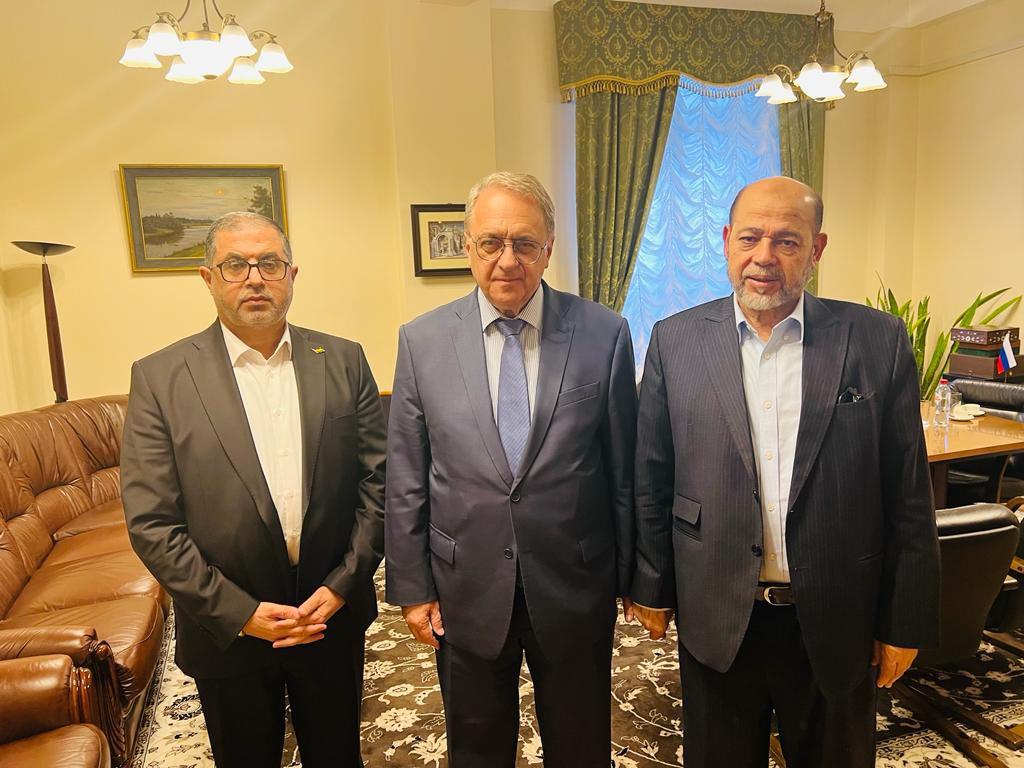
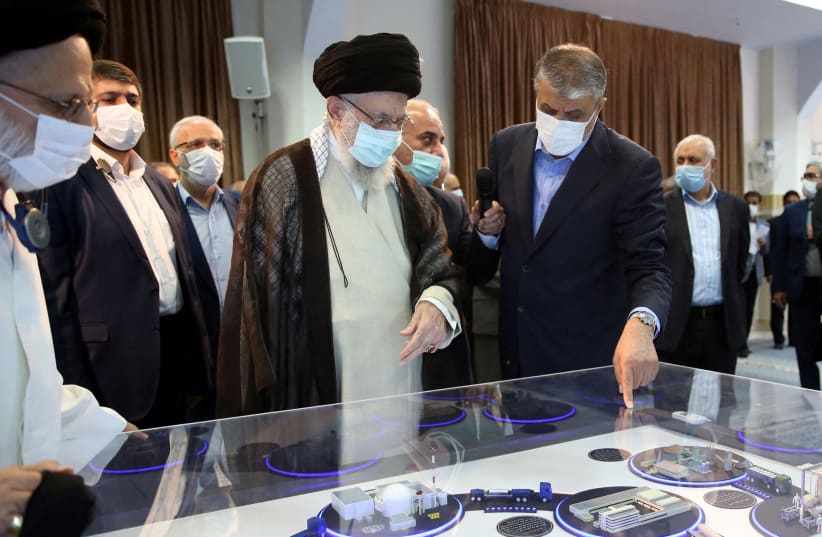
 Iran's Supreme Leader Ayatollah Ali Khamenei views a model of a nuclear facility, in Tehran, Iran June 11, 2023 (photo credit: Office of the Iranian Supreme Leader/WANA (West Asia News Agency) via REUTERS)
Iran’s Supreme Leader Ayatollah Ali Khamenei views a model of a nuclear facility, in Tehran, Iran June 11, 2023
(photo credit: Office of the Iranian Supreme Leader/WANA (West Asia News Agency) via REUTERS)
A new report from the Institute for Science and International Security (ISIS) is sounding the alarm on Iran’s closeness to going nuclear, upgrading its threat level to “Extreme Danger,” the highest of its six ratings, for the first time since the group began following the Iranian nuclear program in the 1990s.

Since 2022, the report says, Iran’s ‘breakout’ time has been zero— that is to say, Iran “has more than enough… highly enriched uranium (HEU) to directly fashion a nuclear explosive.” Uranium itself is not the only component required to fashion a nuclear weapon, though it is by far the hardest to come by. “If Iran wanted to further enrich its 60 percent enriched uranium up to 90 percent weapon-grade uranium (WGU)… it could do so quickly,” the report says.

“[Iran] can break out and produce enough weapon-grade enriched uranium for a nuclear weapon in a week,” it goes on, “using only a fraction of its 60 percent enriched uranium. This breakout could be difficult for inspectors to detect promptly, if Iran took steps to delay inspectors’ access.”

Moreover, using its remaining stock of enriched uranium, the country “could have in total enough weapon-grade uranium for six weapons in one month, and after five months of producing weapon-grade uranium, it could have enough for twelve.”

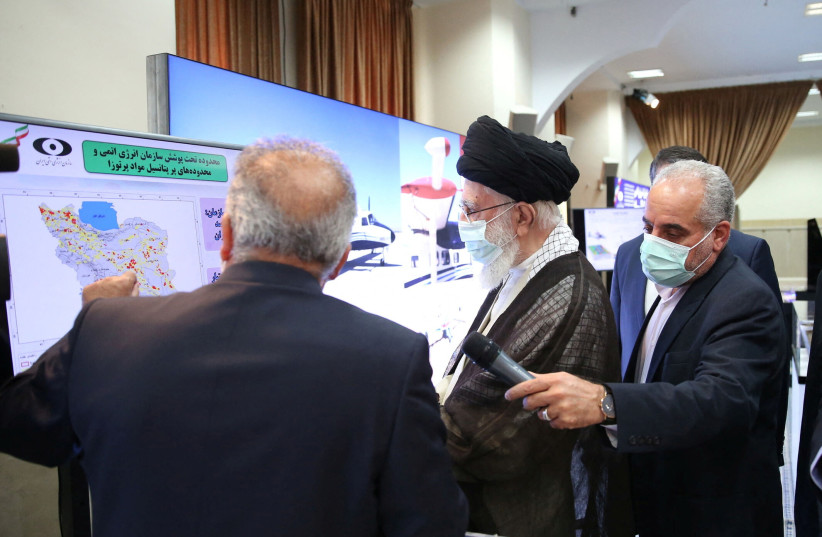
 Iran's Supreme Leader Ayatollah Ali Khamenei views the Iran nuclear achievements, in Tehran, Iran June 11, 2023.  (credit: Office of the Iranian Supreme Leader/WANA (West Asia News Agency) via REUTERS)Enlrage image
Iran’s Supreme Leader Ayatollah Ali Khamenei views the Iran nuclear achievements, in Tehran, Iran June 11, 2023. (credit: Office of the Iranian Supreme Leader/WANA (West Asia News Agency) via REUTERS)

A weapon itself would take longer, but not by much

Although manufacturing the delivery system for the weapon itself could take longer, an accelerated program to develop a simple warhead delivered by ship or truck “could be accomplished in about six months,” signaling Iran’s nuclearization “either dramatically via an underground nuclear test or stealthily via leaks about its accomplishment.”

Moreover, Iran has been uncooperative with international nuclear inspectors for the last several years, the report noted, making it less likely that the world would notice such activity in time to prevent its success.


Moscow laments ‘extremely unsuccessful start’ for recently appointed Ambassador Simona Halperin, claims her remarks misrepresent its foreign policy


Israel's Ambassador to Russia Simona Halperin (right) presents her credentials to Russian Deputy Foreign Minister Mikhail Bogdanov, January 1, 2024. (Simona Halperin's X account)

Israel’s Ambassador to Russia Simona Halperin (right) presents her credentials to Russian Deputy Foreign Minister Mikhail Bogdanov, January 1, 2024. (Simona Halperin’s X account)

Russia’s Foreign Ministry will summon Israeli ambassador Simona Halperin over “unacceptable comments” she made in an interview, the TASS news agency cited the ministry as saying on Monday.

Halperin, according to the ministry, misrepresented Russia’s foreign policy stance in the interview with Russia’s Kommersant daily, published on Sunday.

The ministry described her comments as “an extremely unsuccessful start” to her diplomatic posting, which began last December.

In the interview, Halperin criticized Russian Foreign Minister Sergey Lavrov for playing down the importance of the Holocaust and said Russia was too friendly with the Gaza-based Hamas terror group

Beyond the criticism, Halperin also hailed the close ties between Israel and Russia, noting Israel’s large Russian immigrant population, and that both her grandfathers fought for the Red Army in the “Great Patriotic War,” the Russian name for World War II.

File: Russian Foreign Minister Sergey Lavrov holds a press conference at UN headquarters in New York on January 24, 2024. (ANGELA WEISS / AFP)

“I don’t really understand why Foreign Minister Sergei Lavrov downplays the significance of this monstrous event,” she told Kommersant.

Last month, the Kremlin’s Foreign Ministry spokeswoman belittled the Holocaust’s impact on the Jewish people, characterizing it as a mass extermination of “various ethnic and social groups.”

“Yes, many nations suffered heavy losses, the Russian people paid for the victory over Nazism with millions and millions of lives. And we remember this. But never before in history has the world known such a massive and systematic extermination of people solely on ethnic grounds. Only the Jewish people experienced this. I will repeat this tirelessly,” she added.

Halperin said that Russia’s leadership had long “repeatedly stated that the security of Israel is a strategic interest of Russia” but “unfortunately, after October 7, we saw that this principle is no longer relevant.”

“It seems to me that the Russian leadership did not fully understand that we had found ourselves in a different, terrible reality. Hamas, backed by Iran, carried out a brutal, inhumane attack. They burned houses along with their residents, and killed women, old people, and children. More than 1,200 Israelis were killed and more than 240 were taken hostage, of whom 136 are still in the hands of Hamas,” she said, criticizing Russia for taking time before condemning the massacre, and noting that Russian citizens were also kidnapped.

Hamas has refused to comply with Russia’s request to release all Russian citizens currently held in captivity in Gaza, Hamas deputy politburo chairman Moussa Abu Marzouk told the Arabic edition of Russian state-owned media outlet RT last month.
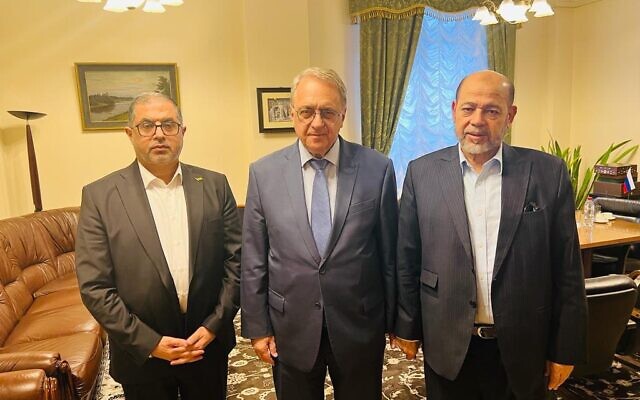
From left to right: Iran’s Deputy Foreign Minister Ali Bagheri Kani, Russian Deputy Foreign Minister and Putin’s Special Envoy to the Middle East Mikhail Bogdanov, and Hamas head of international relations Mousa Abu Marzouk, during a trilateral meeting in Moscow on October 26, 2023. (Hamas Telegram channel)

Halperin noted that while the Muslim Brotherhood is a terror group banned in Russia, its list does not include Hamas, a branch of the organization.

“But no, Hamas members are received in Moscow, hugged, and carpets are rolled out for them. We cannot understand this,” she said. “Russia, which itself suffered from terrorist attacks, does not support Israel’s fight against terrorism.”

“On the contrary, it stands in solidarity with the Republic of South Africa, which filed an absurd lawsuit against Israel with the International Court of Justice, accusing it of genocide,” Halperin said. “Russia’s position worries and depresses me since because of it, your country is losing the sympathy of Israelis, including Russian speakers.”

Since war broke out on October 7, Russia has regularly criticized Israel, including in the UN Security Council, while hosting leaders of Hamas in a development widely seen as an extension of its increasingly friendly ties with Iran.

Moscow has backed Israel’s right to defend itself but has blasted Israel for employing “cruel methods” in its campaign against the terror group.

Tehran has become a key ally as Moscow seeks support for its invasion of Ukraine. Israel had offered only relatively modest support for Kyiv in a bid to safeguard its relationship with Russia, but the once-close allies have nonetheless grown far apart.

Reports suggest Hamas rejected latest hostage deal

Hamas is reportedly demanding a complete cessation of operations in the Strip, a demand that Israel has repeatedly refused.

By Akiva Van Koningsveld, JNS

The Hamas terrorist organization is expected to turn down an offer for a hostages-for-ceasefire deal with Israel along the lines of the previous agreement, which saw over 100 captives being freed in November, the Saudi-owned Al Arabiya news channel reported on Sunday night.

As part of that deal, Israel released hundreds of female and teenage Palestinian security prisoners, in addition to pausing its military campaign in the Gaza Strip.

Hamas is demanding that Israel release more terrorists in exchange for each of the remaining hostages. Hamas is reportedly also demanding that Israel free terrorists who participated in the terrorist group’s Oct. 7 massacre of some 1,200 people in southern Israel.

According to Israel’s Kan News public broadcaster, Hamas is also seeking guarantees for the complete withdrawal of Israeli forces and a total end to the war in Gaza—a stance that is incompatible with Israel’s stated goal of destroying the terror group.

On Thursday, Qatar’s Foreign Ministry claimed that Doha had received an “initial positive confirmation” from Hamas. “Israel agreed to the ceasefire proposal, and we have initial positive confirmation from Hamas,” Al Jazeera cited spokesman Majed al-Ansari as saying.

  UN BLAMES EMPLOYEE’S ONLINE ANTI-ISRAEL RANTS ON HACKERS

The Israeli War Cabinet convened at the Kirya military headquarters in Tel Aviv on Sunday night ahead of Hamas’s expected response.

“The efforts to free the hostages are continuing at all times,” Israeli Prime Minister Benjamin Netanyahu told journalists earlier on Sunday. “However, we will not agree to every deal, and not at any price.”

“Many things that are being said in the media as if we had agreed to them, such as regarding the release of terrorists; we will simply not agree to them,” Netanyahu said ahead of the weekly meeting of the full Cabinet earlier on Sunday.

Speaking with ABC’s “This Week” on Sunday, U.S. National Security Advisor Jake Sullivan said the White House was in “constant contact” with Israel, Qatar, and Egypt to get a deal in place “as soon as possible.”

“Ultimately, that comes down to Hamas. And Hamas will have to be willing to say yes to an arrangement that brings hostages home. And we’re going to continue pressing from every direction to try to make that happen,” he stressed, adding that an agreement is not imminent.

“Ultimately, these kinds of negotiations unfold somewhat slowly until they unfold very quickly. And so it’s difficult to put a precise timetable on when something might come together or, frankly, if something might come together,” Sullivan told ABC anchor George Stephanopoulos.

  NETANYAHU VOWS ‘TOTAL VICTORY’ OVER HAMAS, WARNS HEZBOLLAH IS ‘NOT IMMUNE’

Washington regards a ceasefire-for-hostages deal as “critical for getting people home to their loved ones, but also being critical to generate a sustained pause in hostilities that can support the flow of humanitarian assistance and that can alleviate the suffering in Gaza,” Sullivan added.

Under a separate agreement brokered by France and Qatar last month, Jerusalem agreed to allow more goods, including medicine, into Gaza. Under the terms of the arrangement with Hamas, some of the medicines were supposed to go to the hostages.

“A senior Hamas official said that for every box provided for the hostages, 1,000 boxes of medicine would be sent in for Palestinians,” the Associated Press reported on Jan. 18.

The Hostages and Missing Families Forum, which represents relatives of the captives, has demanded “visual proof” that the aid reached the hostages. However, 19 days after the trucks entered Gaza, there has been no word on whether Hamas held up its part of the deal, the NGO said on Sunday.

The Israeli Prime Minister’s Office has also been unable to confirm whether the hostages received the medicines intended for them.

According to official figures, around 136 hostages remain in the Gaza Strip, although dozens are believed to be dead. Many of the captives are in desperate need of medical attention, experts previously told JNS.