I don’t think we should talk about the Middle East peace process anymore,” Borrell told reporters. “We should start talking specifically about the two-state-solution.”
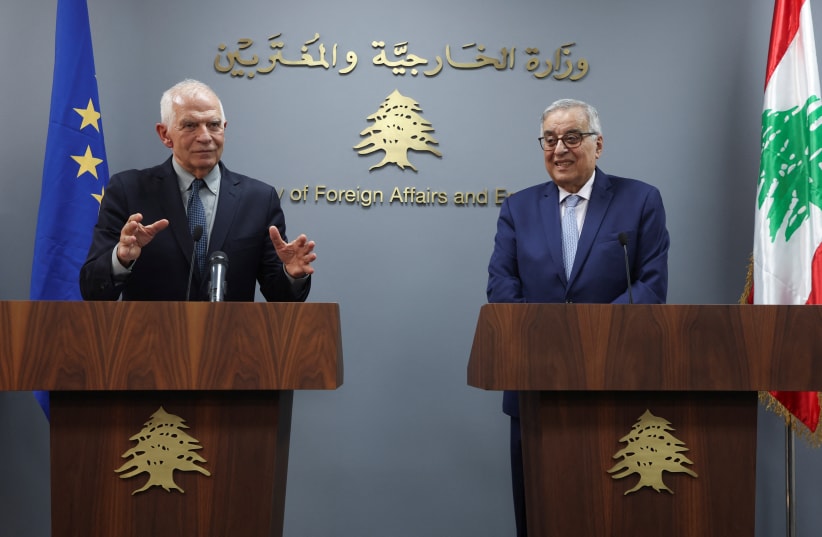
 European Union's foreign policy chief Josep Borrell speaks during a joint news conference with Lebanon's caretaker Foreign Minister Abdallah Bou Habib in Beirut, Lebanon January 6, 2024.  (photo credit: REUTERS/MOHAMED AZAKIR)
European Union’s foreign policy chief Josep Borrell speaks during a joint news conference with Lebanon’s caretaker Foreign Minister Abdallah Bou Habib in Beirut, Lebanon January 6, 2024.
(photo credit: REUTERS/MOHAMED AZAKIR)
European Union foreign policy chief Josep Borrell on Monday called for an international peace conference to draft a road map for a two-state solution for Israel and the Palestinians.

Tools exist to pressure Israel into participating, he said.

“There is an initial draft for a peace plan that will provide robust security for Israel and the future state of Palestine,” Borrell said.

If that “proposal isn’t agreed [upon] then there is some leverage” to force Israel’s engagement, Borrell said.

Background on the meeting

He spoke after the EU foreign ministers’ monthly meeting in Brussels, which included an unusual set of back-to-back talks with their Middle East counterparts.
 European flags fly outside the European Commission headquarters in Brussels, Belgium September 20, 2023. (credit:  REUTERS/YVES HERMAN/FILE PHOTO)Enlrage image
European flags fly outside the European Commission headquarters in Brussels, Belgium September 20, 2023. (credit: REUTERS/YVES HERMAN/FILE PHOTO)

The visiting foreign ministers were Israel Katz of Israel, Saudi Faisal bin Farhan Al Saud of Saudi Arabia, Ayman Safadi of Jordan, Sameh Shoukry of Egypt, and Riyad al-Maliki of the Palestinian Authority.

The EU foreign ministers also spoke with Arab League Secretary-General Ahmed Aboul Gheit.

“I don’t think we should talk about the Middle East peace process anymore,” Borrell told reporters after the meeting. “We should start talking specifically about the two-state-solution implementation process.”

“Peace is a very general objective,” he said. “Everyone agrees on the need for peace. No one would say they are against peace. But here we are not talking about peace in general. Here we are talking about peace via a specific process.”

Now, the conversation should be about how to implement a two-state solution, Borrell said.

Attempting to implement a two-state solution

“That is what we are trying to achieve, [and] not everyone agrees on that,” he said. “Some are in favor; some are against… If Israel doesn’t want that solution, it will be difficult for them to take part in discussions to build that solution. But that doesn’t stop everyone else from doing that.”

Israeli opposition to Palestinian statehood was nothing new, Borrell said. “It has been against it for 30 years.”There are quite a few separate initiatives on the table, including from Arab nations and the United States, Borrell said, adding that the EU was moving forward on its own plan.

Ahead of the meeting, Borrell sent a discussion paper to the EU’s 27 member countries, suggesting a road map to peace in the broader Israeli-Palestinian conflict.

At the heart of the plan is a call for a “preparatory peace conference” to be organized by the EU, Egypt, Jordan, Saudi Arabia, and the Arab League, with the US and the United Nations also invited.

All EU members agree that this is the only viable solution that could guarantee peace and security for both Israelis and Palestinians, Borrell said.

“If Israel won’t agree to participate, that would be difficult, but it should not prevent the other countries from discussing it,” he said.

The EU would now start preparation for the international conference, Borrell said, adding that Europe has a “moral obligation” to do so. He declined to say whether a solution would be imposed on Israel by the international community.

All EU member states agreed that the priority was to expand humanitarian assistance, stop all Israeli military activity, and address the issue of the hostages held in Gaza, Borrell said.

“Less than 100, maybe 80 trucks are entering the Strip per day, compared with more than 500 before the war,” he said.

The Gazans were now facing famine, Borrell said. He had made this clear to Katz that it was urgent to increase humanitarian aid in Gaza, he said.

“The priority is to stop the bombing,” Borrell said, adding that he did not believe the war would bring security to Israel.

There was not unanimity at EU Council level to support a ceasefire, Borrell said.

Borrell criticized Katz for his presentation earlier in the day of a video showing two possible projects: one for a regional train infrastructure linking Israel with the Gulf states, and the other of an artificial island off Gaza shores.

“The minister could have made better use of his time at the council, talking about the security of his country,” he said.

The foreign ministers also discussed “sanctions against extremists and violent settlers in the West Bank,” Borrell said, and the “work is ongoing. I hope it will be approved by member states.”

Reuters contributed to this report.
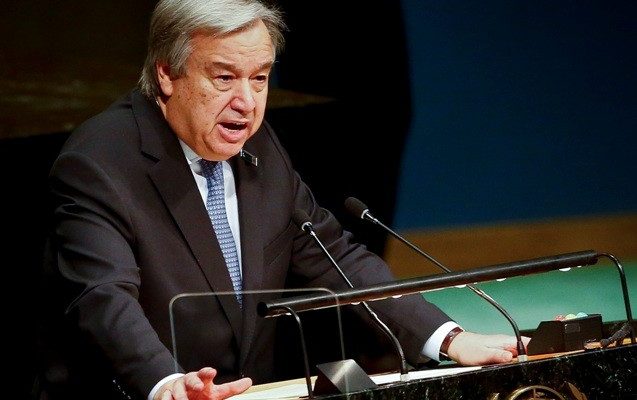

Guterres made no mention of consistent polling showing most Palestinians don’t favor a two-state solution.

By Mike Wagenheim, JNS

Without mentioning Benjamin Netanyahu by name, U.N. Secretary-General António Guterres took aim at the Israeli premier on Sunday.

On Shabbat, Netanyahu issued a statement suggesting that Israeli security needs are incompatible with Palestinian statehood.

“The repeated refusal yesterday to accept the two-state solution for Israelis and Palestinians is totally unacceptable,” Guterres said at the U.N. Third South Summit.

“The denial of the right to statehood for the Palestinian people would indefinitely prolong a conflict that has become a major threat to global peace and security, exacerbate
polarization and embolden extremists everywhere,” he added.

After a conversation with U.S. President Joe Biden on Friday, and comments from Biden suggesting he might be able to convince Netanyahu to accept a Palestinian state under the right conditions, Netanyahu posted on social media on Saturday, “I will not compromise on full Israeli security control over all the territory west of Jordan—and this is contrary to a Palestinian state.”

Those comments did not sit well with Guterres, who was addressing the South Summit, the supreme decision-making body of the Group of 77, which consists of 135 developing countries and includes China.

In the speech, which Guterres delivered in Kampala, Uganda, the Middle East was a major focus.

“In Gaza, Israel’s military operations have spread massive destruction and killed civilians on a scale unprecedented during my time as secretary-general, including more than 150 members of our own staff, following the horrific terror attacks by Hamas on Oct. 7,” said Guterres. “The Middle East is a tinderbox. We must do all we can to prevent conflict igniting across the region.”

After chastising Netanyahu, Guterres made no mention of consistent polling suggesting that most Palestinians don’t favor a two-state solution, or that Hamas officials have repeatedly called for Israel’s destruction.

After talking with Netanyahu on the phone on Friday for the first time in nearly a month, Biden told reporters that he thought Netanyahu could be persuaded to accept a two-state solution.

“There are a number of types of two-state solutions,” he said. “There’s a number of countries that are members of the U.N. that are still—don’t have their own military. A number of states that have limitations, and so I think there’s ways in which this can work.”

But a day later, Netanyahu’s office issued a rare Shabbat statement.

“In his conversation with President Biden, Prime Minister Netanyahu reiterated his policy that after Hamas is destroyed, Israel must retain security control over Gaza to ensure that Gaza will no longer pose a threat to Israel,” he said, “a requirement that contradicts the demand for Palestinian sovereignty.”


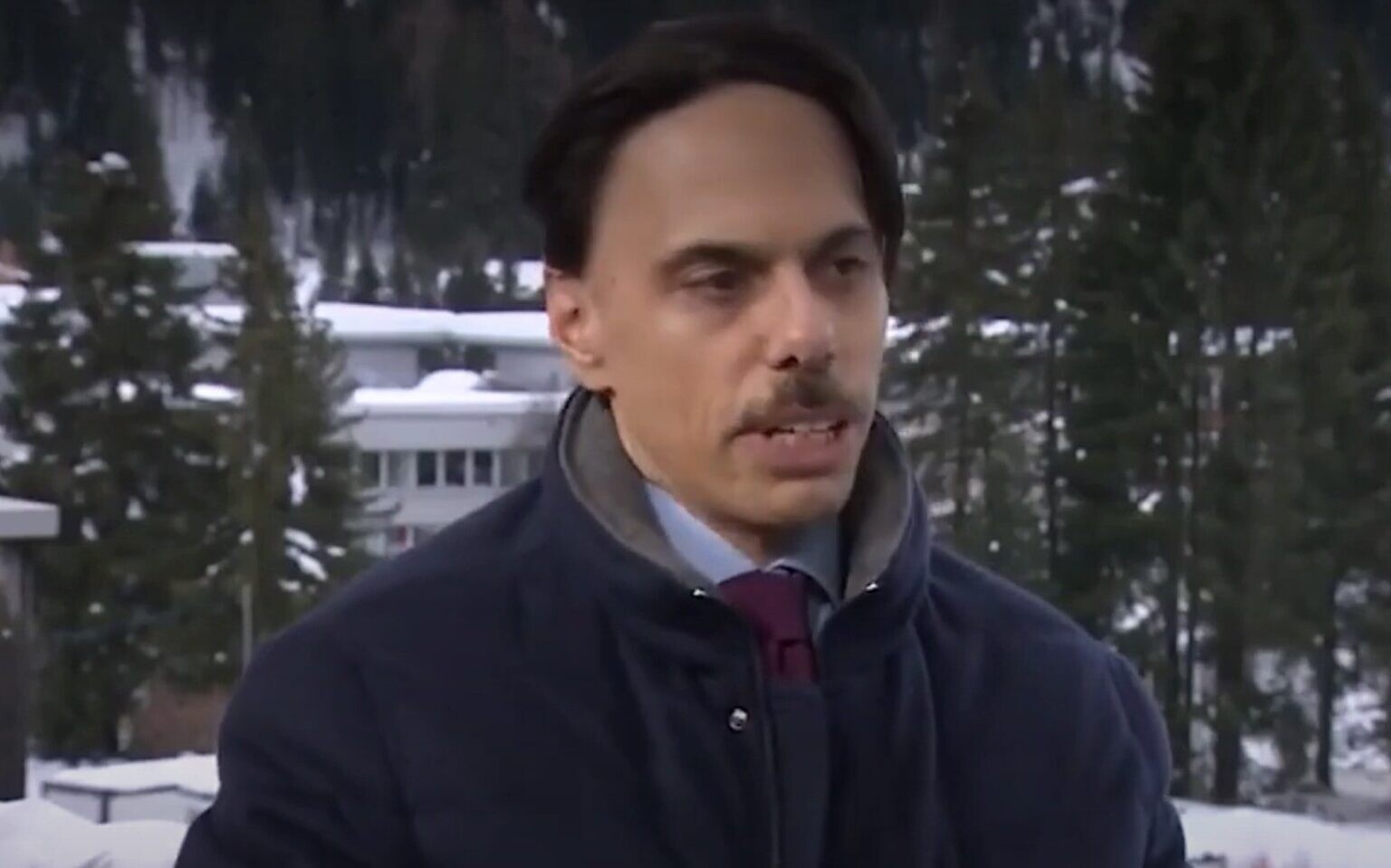
Prince Faisal bin Farhan tells CNN the kingdom isn’t interested in rebuilding Gaza only to return to pre-Oct. 7 status quo in a way that sets up another round of fighting

Screen capture from video of Saudi Arabia's Foreign Minister Faisal bin Farhan during an interview with CNN, January 21, 2024. (YouTube. Used in accordance with Clause 27a of the Copyright Law)

Screen capture from video of Saudi Arabia’s Foreign Minister Faisal bin Farhan during an interview with CNN, January 21, 2024. (YouTube. Used in accordance with Clause 27a of the Copyright Law)

Saudi Arabia’s foreign minister said the kingdom will not normalize relations with Israel nor contribute to Gaza’s reconstruction without a credible pathway to a Palestinian state.

Prince Faisal bin Farhan’s remarks in an interview with CNN broadcast late Sunday were some of the most direct yet from Saudi officials. It puts them at odds with Prime Minister Benjamin Netanyahu, who has rejected Palestinian statehood and described plans for open-ended military control over Gaza.

The dispute over Gaza’s future — coming as the war still rages with no end in sight — pits the United States and its Arab allies against Israel and poses a major obstacle to any plans for postwar governance or reconstruction in Gaza.

Before the October 7 Hamas attack that triggered the war, the US had been trying to broker a landmark agreement in which Saudi Arabia would normalize relations with Israel in exchange for US security guarantees, aid in establishing a civilian nuclear program in the kingdom, and progress toward resolving the Israeli-Palestinian conflict.

In September, Netanyahu had said Israel was “at the cusp” of such a deal, which he said would transform the Middle East.

“That’s the only way we’re going to get a benefit,” Prince Faisal replied. “So, yes.”

Earlier in the interview, when asked if oil-rich Saudi Arabia would finance reconstruction in Gaza — where Israel’s air and ground offensive has devastated vast swaths of the impoverished territory — Prince Faisal gave a similar answer.

“As long as we’re able to find a pathway to a solution, a resolution, a pathway that means that we’re not going to be here again in a year or two, then we can talk about anything,” he said. “But if we are just resetting to the status quo before October 7, in a way that sets us up for another round of this, as we have seen in the past, we’re not interested in that conversation.”

The Palestinians seek a state that would include Gaza, the West Bank, and East Jerusalem, territories Israel captured in the 1967 Six Day War.

Israel views all of Jerusalem as its capital and the West Bank as the historical and biblical heartland of the Jewish people. It has built scores of settlements across the West Bank that are home to hundreds of thousands of Jewish settlers. The last of several rounds of peace talks broke down nearly 15 years ago.

Death toll in Gaza said to top 25,000

The current war between Israel and Hamas, the fifth and by far deadliest, began when Hamas-led Palestinian terrorists broke through Israel’s defenses along the Gaza border and rampaged murderously through nearby communities, killing some 1,200 people, mostly civilians, taking around 250 people hostage to the Strip and shattering Israelis’ sense of security.

IDF troops operating in the Gaza Strip in pictures cleared for publication on January 21, 2024. (IDF)

Israel responded to the massive assault with an air, sea and land military campaign to destroy Hamas, remove it from power in Gaza, and release the hostages. Hamas has been the de facto regime in Gaza since 2007 when it seized control of the territory from the Palestinian Authority, which is based in the West Bank city of Ramallah.

According to the Hamas-run health ministry in Gaza, over 25,000 people have been killed in the IDF campaign, mostly women and children. These figures cannot be independently verified, and are believed to include both civilians and Hamas members killed in Gaza, including as a consequence of terror groups’ own rocket misfires.

The IDF says it has killed over 9,000 terror operatives in Gaza, in addition to some 1,000 terrorists inside Israel on October 7. That figure was somewhat corroborated by US intelligence agency assessments over the weekend, in a Wall Street Journal report that said the IDF has killed 20-30% of Hamas’s fighters in the Strip. Israel blames the high civilian death toll on Hamas because it positions fighters, tunnels, and other terror infrastructure inside dense residential areas.

Displaced Palestinian youths carry empty jerrycans up a hill to replenish their supply at a makeshift tent camp in Rafah near the border with Egypt in the southern Gaza Strip on January 21, 2024. (AFP)

Some 85 percent of Gaza’s population of 2.3 million have fled their homes, seeking elusive shelter in the south as Israel continues to strike all parts of the besieged enclave. UN officials say one in four people in Gaza are starving as the ongoing fighting and Israeli restrictions hinder the delivery of humanitarian aid. Israel has rejected those claims, saying there no shortages of food in the Strip and alleging that existing problems were caused by the inability of the UN to properly distribute the goods once they entered the enclave.

The war has also stoked tensions across the region, with Iran-backed groups in Lebanon, Syria, Iraq, and Yemen attacking Israeli and US targets as the risk of a wider conflict grows.

Netanyahu under mounting pressure from all sides

Netanyahu has vowed to continue the offensive until “complete victory” is achieved over Hamas and all of the remaining 132 hostages are released.

But Israelis are increasingly divided on the question of whether that’s possible.

Hamas is believed to be holding the hostages in tunnels deep underground and using them as shields for its top leaders. Israel has only successfully rescued one hostage, while Hamas claims several have been killed in Israeli airstrikes or during failed rescue operations. More than 100 were released in a ceasefire deal in November in exchange for hundreds of Palestinian security prisoners held by Israel.

Families of the hostages, as well as other protesters, have set up a tent camp outside Netanyahu’s residence in Jerusalem and vowed to remain until a deal is reached with Hamas to bring the rest of the hostages home. Other protests have called for new elections.

Prime Minister Benjamin Netanyahu speaks during a press conference at the Defense Ministry in Tel Aviv on January 18, 2024. (Yariv Katz/Flash90/pool)

Netanyahu has ruled out another ceasefire and exchange, saying military pressure is key to freeing the captives. Hamas has said it will only release more captives in exchange for an end to the war and the release of thousands more Palestinian security prisoners.

The long-serving prime minister, whose popularity has plummeted since October 7, faces pressure from the US — Israel’s top ally — to shift to more precise military operations, do more to facilitate humanitarian aid and embrace postwar plans with broad support across the region.

But Netanyahu’s governing coalition is beholden to far-right parties that want to step up the offensive, encourage the “voluntary” emigration of hundreds of thousands of Palestinians from Gaza, and reestablish Israeli settlements there.