If this is true, this would be the first time that Hezbollah has used white phosphorus.
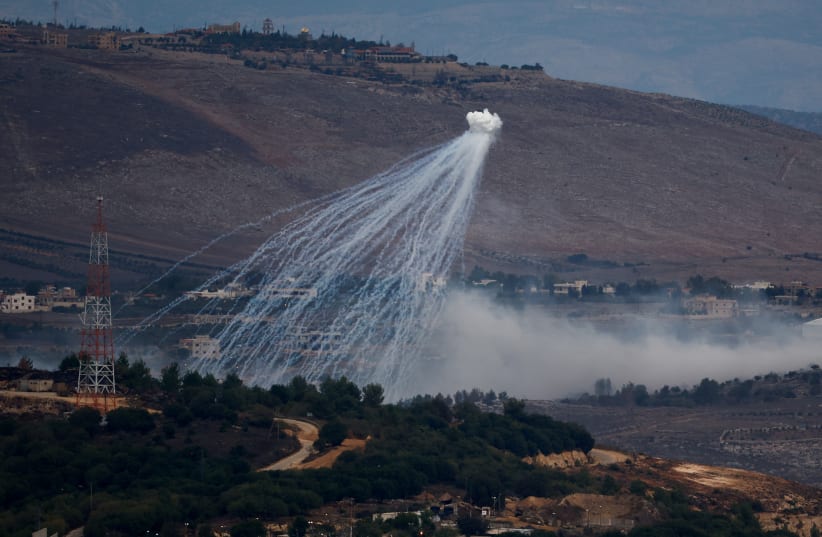
By JERUSALEM POST STAFFUpdated: JANUARY 24, 2024 22:46White phosphorus fired by Israeli army to create a smoke screen, is seen on the Israel-Lebanon border in northern Israel, November 12, 2023.(photo credit: EVELYN HOCKSTEIN/REUTERS)
Two mortar shells that were fired by Hezbollah from Lebanon into the Metulla area last week are suspected to have contained white phosphorus, according to Israeli media reports on Wednesday.
The reports say that after the mortars landed, the explosions led to a big fire and even engulfed part of the road that they hit.
If this is true, this would be the first time that Hezbollah has used white phosphorus.
White phosphorus can be legally used in some situations
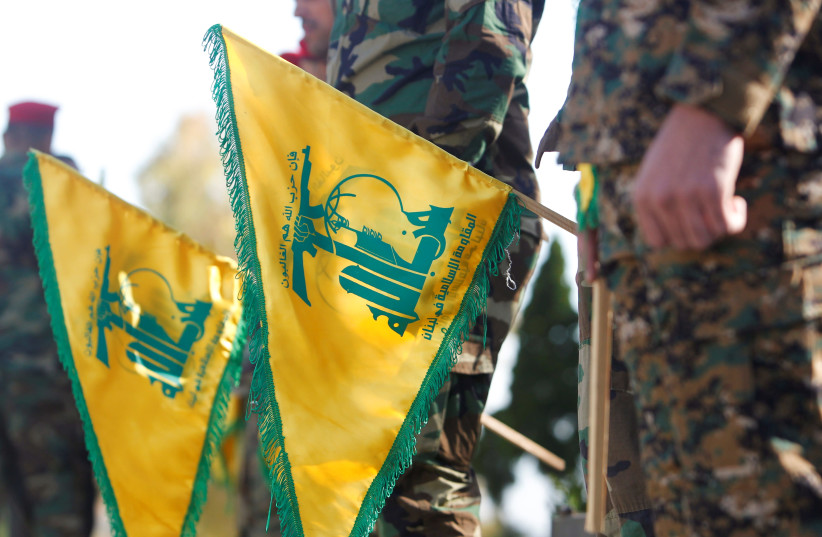
Hezbollah members hold flags marking Resistance and Liberation Day, in Kfar Kila near the border with Israel, southern Lebanon, May 25, 2021 (credit: REUTERS/AZIZ TAHER)
Under Protocol III of the Convention on Certain Conventional Weapons, white phosphorus is classified as an incendiary weapon. This protocol explicitly prohibits the use of incendiary weapons against military targets located in areas with civilian populations, such as Metulla, where the mortars landed. However, it is important to note that Hezbollah has not ratified the protocol and is not obligated by its provisions.
Hezbollah and the IDF have been regularly trading fire since the outbreak of the war.
By REUTERS and TOI STAFFToday, 11:54 pmd Hamas broadly agree in principle that an exchange of Israeli hostages for Palestinian prisoners could take place during a month-long ceasefire, but the framework plan is being held up by the two sides’ differences over how to bring a permanent end to the Gaza war, three sources say.
Intense mediation efforts led by Qatar, Washington and Egypt in recent weeks have focused on a phased approach to release different categories of Israeli hostages — starting with civilians and ending with soldiers — in return for a break in hostilities, the release of Palestinian prisoners and more aid to Gaza.
Israel is also said to have made an offer this week for a two-month ceasefire during which Hamas would release the hostages in exchange for Palestinian security prisoners in stages. Under the proposal, Yahya Sinwar and other top Hamas leaders in Gaza would be allowed to relocate to other countries.
An Egyptian official said today that Hamas rejected the proposal.
The latest round of international shuttle diplomacy started on December 28 and has narrowed disagreements about the length of an initial ceasefire to around 30 days, after Hamas had first proposed a pause of several months, said one of the sources, an official briefed on the negotiations.
However, Hamas has since refused to move forward with the plans until the future conditions of a permanent ceasefire are agreed, according to six sources. Most of the sources consulted for this story requested anonymity in order to speak freely about sensitive matters.
While Israel has sought to negotiate one stage at a time, Hamas is seeking “a package deal” that agrees on a permanent ceasefire before hostages are released during the initial phase, said one of the sources, a Palestinian official close to the mediation efforts. Israel and Hamas are speaking through the mediators, not talking directly.
It is believed that 132 hostages abducted by Hamas on October 7 remain in Gaza. The IDF has confirmed the deaths of 28 of those still held by Hamas, citing new intelligence and findings obtained by troops operating in Gaza.
The bodies of eight hostages have also been recovered and three hostages were mistakenly killed by the military. One more person has been listed as missing since October 7, and their fate is still unknown.
Hamas has also been holding the bodies of fallen IDF soldiers Oron Shaul and Hadar Goldin since 2014, as well as two Israeli civilians, Avera Mengistu and Hisham al-Sayed, who are both thought to be alive after entering the Strip of their own accord in 2014 and 2015 respectively.
Israel and Hamas broadly agree in principle that an exchange of Israeli hostages for Palestinian Arab prisoners could take place during a month-long ceasefire, Reuters reported on Tuesday, citing three sources.
The sources added, however, that the framework plan is being held up by the two sides’ differences over how to bring a permanent end to the Gaza war.
One of the sources said the disagreements about the length of an initial ceasefire have narrowed to around 30 days, after Hamas had first proposed a pause of several months.
However, Hamas has refused to move forward with the plans until the future conditions of a permanent ceasefire are agreed, other sources told Reuters.
While Israel has sought to negotiate one stage at a time, Hamas is seeking “a package deal” that agrees a permanent ceasefire before hostages are released during the initial phase, said one of the sources.
Two Egyptian security sources said that there was work underway to convince Hamas to accept a one-month truce to be followed by a permanent ceasefire. However, Hamas is requesting guarantees that the second phase of the deal would be carried out, in order to agree to the initial truce, the sources told Reuters.
Five sources said Israel had refused to discuss any end to the war that did not include Hamas being dismantled.
One offer by Israel is to end the war if Hamas removes six senior leaders from Gaza, including the group’s top two leaders, Yahya Sinwar and Mohammed Deif, one source told Reuters, adding Hamas “absolutely” rejected the proposal.
The source said the list included the masterminds of Hamas’ Oct. 7 attacks on Israel,
On Monday, Axios reported that Israel has given Hamas a proposal, through Qatari and Egyptian mediators, that includes up to two months of a pause in the fighting as part of a multi-phase deal that would include the release of all remaining hostages held in Gaza.
Israeli officials said they are waiting for a response from Hamas but stressed they are cautiously optimistic about the ability to make progress in the coming days.
Later, CNN reported that Israel has proposed that Hamas senior leaders could leave Gaza as part of a broader ceasefire agreement.
According to the report, Israel’s suggestion was discussed as part of broader ceasefire negotiations at least twice in recent weeks. However, Qatari Prime Minister Mohammed bin Abdulrahman al Thani said that the Israeli idea “would never work”.