Blocking Iranian oil exports to China among the options, US official tells Axios; Geneva to host next round of US-Iran talks, though second American official sees ‘zero chance’ of deal

US President Donald Trump (R) shakes hands with Prime Minister Benjamin Netanyahu as Trump listens to a question from a reporter at the end of a news conference at Mar-a-Lago, on December 29, 2025, in Palm Beach, Florida. (AP Photo/Alex Brandon)

US President Donald Trump (R) shakes hands with Prime Minister Benjamin Netanyahu as Trump listens to a question from a reporter at the end of a news conference at Mar-a-Lago, on December 29, 2025, in Palm Beach, Florida. (AP Photo/Alex Brandon)

US President Donald Trump and Prime Minister Benjamin Netanyahu agreed to intensify the “maximum pressure policy” in order to force Iran to give up its nuclear program, including clamping down on the sale of Tehran’s oil to China, according to a Saturday report citing two US officials.

At the two leaders’ meeting at the White House earlier this week, “we agreed that we will go full force with maximum pressure against Iran, for example, regarding Iranian oil sales to China,” a senior American official told Axios.

According to the report, some 80 percent of Iran’s oil exports go to China, leading the US and Israel to believe that clamping down on trade between the two countries would “significantly” increase economic pressure on Tehran.

Trump, under authority by an executive order he signed last week, could impose 25% tariffs on China for trading with Iran.

The pressure campaign will be implemented alongside the ongoing negotiations between Washington and Tehran, the report said.

Women march with a sign depicting US President Donald Trump with bloodied hands in Tehran on February 11, 2026, during a rally marking the 47th anniversary of the 1979 Islamic revolution (AFP)

The US believes that Iran will present its answer to Washington’s proposal during next week’s meeting, the report said, though a US official told Axios that there is “zero chance” of an agreement.

“We are sober and realistic about the Iranians. The ball is in their court. If it is not a real deal, we will not take it,” a second US official said.

The report also quoted Wednesday’s meeting at the White House between Trump and Netanyahu, with the prime minister expressing skepticism that Tehran would honor an agreement with the US, even if one is reached.

It’s “impossible” to do a deal with Iran, Netanyahu reportedly said, arguing that even if Tehran signs a deal, it will not abide by it.

“We’ll see if it’s possible. Let’s give it a shot,” Trump is said to have replied.

The report added that Trump’s envoys Steve Witkoff and Jared Kushner told the US president that the Iranians are “saying all the right things” in the talks, and that the pair “will continue with the negotiations and take a tough line.”

In this handout photo released by the Omani Ministry of Foreign Affairs on February 6, 2026, US special envoy Steve Witkoff (C), Jared Kushner and Oman’s Foreign Minister Badr bin Hamad al-Busaidi pose for a photo during a meeting in Muscat. (Handout/Omani Foreign Ministry/AFP)

If Iran agrees to what the US is asking, then the two envoys will give Trump the option “so that he can decide if he wants to do it,” a US official said, according to the report.

Axios also pointed to a recent report by an Iranian journalist, which claimed that Witkoff’s proposal included that Iran suspend its enrichment for “three to five years,” after which, Iran would be allowed to enrich uranium to “very low levels.”

The reported proposal also stipulated the “removal of 450 kilograms of highly enriched uranium” that Iran currently holds, and its relocation to a third country. Tehran rejected the proposal, according to the Iranian report.

Axios noted that a US official denied that Washington ever proposed such an offer.

Rubio: Trump would meet Khamenei

Also on Saturday, US Secretary of State Marco Rubio said that Trump would meet with Iran’s Supreme Leader Ayatollah Ali Khamenei to solve disputes between the two countries, in an interview with Bloomberg while in Munich attending the city’s global security conference.

US Secretary of State Marco Rubio walks to a meeting of G7 foreign ministers on the sidelines of the 62nd Munich Security Conference (MSC) on February 14, 2026, in Munich, southern Germany. (Alex Brandon / POOL / AFP)

“I’m pretty confident in saying that if the ayatollah said tomorrow he wanted to meet with President Trump, the President would meet him, not because he agrees with the ayatollah but because he thinks that’s the way you solve problems in the world, and he doesn’t view meeting someone as a concession,” Rubio said.

The top diplomat has said in the past that Trump is willing to meet with any world leader to resolve disputes.

“Number one is I think it’s pretty clear that Iran will never be allowed to have a nuclear weapon, that that poses a threat not just to the United States, to Europe, to world security, and to the region. There’s no doubt about it,” he said when asked if Washington is running out of patience with Tehran given that Trump is building up forces and sending another aircraft carrier to the region.

Women pose with a poster depicting Iran’s supreme leader Ayatollah Ali Khamenei as they stand before a banner depicting a US Navy aircraft carrier with US-flag-wrapped coffins on the deck, during a rally marking the 47th anniversary of the 1979 Islamic revolution in Tehran on February 11, 2026. The Persian calendar date of Bahman 22 celebrates the anniversary of the resignation of the ousted shah’s last prime minister and the formal assumption of power by revolutionary leader Ayatollah Ruhollah Khomeini. (Photo by AFP)

“The second is we obviously want to have forces in the region because Iran has shown the willingness and the capability to lash out and strike out at the United States presence in the region,” Rubio said.

“We have bases because of our alliances in the region, and Iran has shown in the past that they are willing to attack us and/or threaten our bases. So we have to have sufficient firepower in the region to ensure that they don’t make a mistake and come after us and trigger something larger,” he added, stressing that Trump prefers to resolve the dispute with a deal.


Discussion of potential attack is ongoing, CBS reports; as 2nd round of US-Iran talks set to start, PM demands Iran remove enriched uranium, dismantle facilities, limit missiles

US President Donald Trump (R) shakes hands with Prime Minister Benjamin Netanyahu as Trump listens to a question from a reporter at the end of a news conference at Mar-a-Lago, on December 29, 2025, in Palm Beach, Florida. (AP Photo/Alex Brandon)

US President Donald Trump (R) shakes hands with Prime Minister Benjamin Netanyahu as Trump listens to a question from a reporter at the end of a news conference at Mar-a-Lago, on December 29, 2025, in Palm Beach, Florida. (AP Photo/Alex Brandon)

US President Donald Trump told Prime Minister Netanyahu in December that he would support Israeli strikes on Iran’s ballistic missile program if the US and Iran could not reach a deal, CBS News reported on Sunday, citing two sources familiar with the matter.

The US outlet reported that discussions about such an attack, roughly eight months after the 12-day Israel-Iran war in June, are ongoing. During last year’s war, the US joined the Israeli strikes on Iranian nuclear facilities. This time, the American role in an Israeli attack would involve helping jets refuel in midair or aiding Israel in receiving permission to fly over neighboring countries, CBS reported.

Several countries have said they would not let their airspace be used for an attack on Iran.

The report came as Iran’s foreign minister departed for Geneva on Sunday ahead of a second round of talks with the United States over Tehran’s nuclear program, and as Netanyahu voiced skepticism that the negotiations would succeed.

US Secretary of State Marco Rubio also acknowledged that the talks could fail, while emphasizing that Trump remains committed to seeing them through. Iran, meanwhile, signaled flexibility on its nuclear program and urged Washington to pursue a deal with mutual economic benefits.

Since making the threats, Trump has pursued the negotiations over Iran’s nuclear program, saying after his White House meeting with Netanyahu last week that he “insisted” diplomacy be given a chance.

At the same time, however, he has built up US military force in the Middle East and warned Tehran of dire consequences if the talks fail. He said last week, regarding regime change in Iran, that it “seems like that would be the best thing that could happen.”

Israeli Air Force F-16 fighter jets prepare to take off for strikes in Iran, in a handout photo published on June 27, 2025. (Israel Defense Forces)

Netanyahu has consistently accused Iran of duplicity, a claim he repeated in a speech on Sunday. Speaking in Jerusalem, he told US Jewish leaders that Trump was “determined to exhaust the possibilities of achieving a deal, which he believes can be achieved now” with Iran, before resorting to force.

“I will not hide from you that I express my skepticism of any deal with Iran,” he told a delegation from the Conference of Presidents of Major American Jewish Organizations, “because, frankly, Iran is reliable on one thing — that they lie and they cheat.”

Netanyahu laid out four Israeli demands regarding any deal with Iran, including the removal of the country’s entire stock of enriched uranium and the dismantling of its nuclear facilities.

“The first is that all enriched material has to leave Iran,” he said. “The second is that there should be no enrichment capability… dismantle the equipment and the infrastructure that allows you to enrich in the first place.”

He also demanded that the talks limit Iran’s ballistic missile program and address its support for proxy terror groups — issues that Iran has said should not be part of the current negotiations.

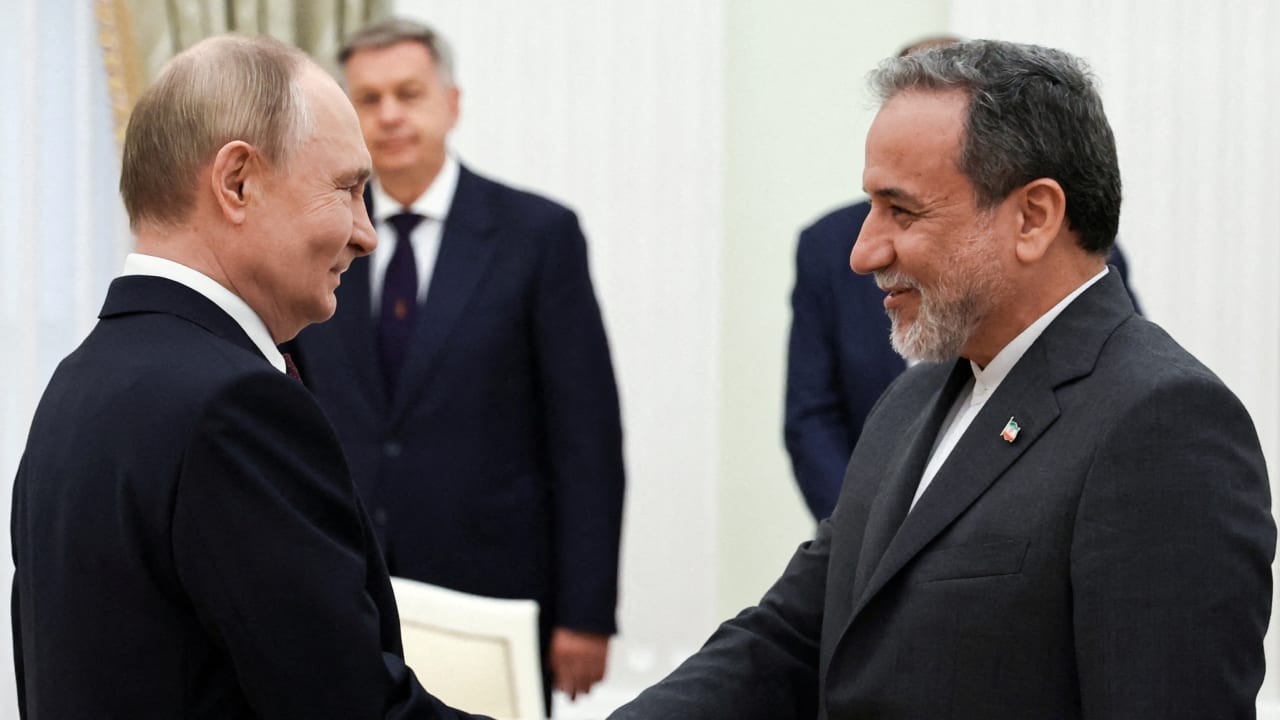
Iranian Foreign Minister Abbas Araghchi, center, heads to the venue for talks between Iran and the US, in Muscat, Oman, February 6, 2026. (Iranian Foreign Ministry via AP, File)

US Secretary of State Rubio, also speaking on Sunday, said Trump would prefer a negotiated settlement but likewise expressed skepticism.

“No one’s ever been able to do a successful deal with Iran, but we’re going to try,” he said at a news conference in Bratislava.

An unnamed source told Reuters last week that a US delegation, including envoys Steve Witkoff and Jared Kushner, would meet Iranian officials in Geneva on Tuesday, a meeting confirmed to Reuters by a senior Iranian official on Sunday.

“Steve Witkoff and Jared Kushner will be traveling, I think they are traveling right now, to have important meetings, and we’ll see how that turns out,” Rubio said, without providing further details.

Marco Rubio boards the airplane as he departs the Bratislava Airport in Bratislava, Slovakia, February 15, 2026. (AP/Alex Brandon, Pool)

During his visit to Geneva, Iranian Foreign Minister Abbas Araghchi is expected to hold talks with his Swiss and Omani counterparts as well as the head of the International Atomic Energy Agency, Rafael Grossi, and other international officials, the Iranian foreign ministry statement said.

Considerable uncertainty surrounds the fate of Iran’s stockpile of more than 400 kilograms of 60-percent enriched uranium that was last seen by nuclear watchdog inspectors in June.

Deputy Iranian Foreign Minister Majid Takht-Ravanchi signaled Iran’s readiness to compromise on its nuclear program in return for sanctions relief, telling the BBC earlier on Sunday that the ball was “in America’s court to prove that they want to do a deal.”

The senior official referred to the Iranian atomic chief’s statement the week prior that the country could agree to dilute its most highly enriched uranium in exchange for the lifting of sanctions as an example of Iran’s flexibility.

However, he reiterated that Tehran would not accept zero uranium enrichment, a key sticking point in past negotiations, with Washington viewing enrichment inside Iran as a potential pathway to nuclear weapons.

Iran has consistently denied seeking to acquire nuclear weapons. However, it enriched uranium to levels that have no peaceful application, obstructed international inspectors from checking its nuclear facilities, and expanded its ballistic missile capabilities.

Prime Minister Benjamin Netanyahu attends the Conference of Presidents Leadership Mission to Israel in Jerusalem, February 15, 2026 (Chaim Goldberg/Flash90)

Another Iranian official touted potential energy, mining, and aircraft deals that are on the table in the talks with the US.

“For the sake of an agreement’s durability, it is essential that the US also benefits in areas with high and quick economic returns,” foreign ministry deputy director for economic diplomacy Hamid Ghanbari said, according to the semi-official Fars news agency. “Common interests in the oil and gas fields, joint fields, mining investments, and even aircraft purchases are included in the negotiations.”

The talks are the second attempt at negotiations between Iran and the US since Trump returned to office early last year. Previous talks between the two countries fell apart shortly before the Israel-Iran war in June 2025.

In 2018, Trump unilaterally withdrew from the Barack Obama-era Iran deal, which reduced sanctions on Tehran in exchange for curbs to its nuclear program. Washington claimed Iranian non-compliance at the time of the withdrawal and began reimposing tough economic sanctions on the Islamic Republic.

While talks leading to the 2015 nuclear pact were multilateral, the current negotiations are confined to Iran and the United States, with Muscat acting as mediator.


An initial NIS 244 million is allocated for land registration for years 2026-2030, process could take 30 years. Levin, Smotrich laud ‘deepening grip’ on West Bank

The illegal settlement farming outpost of Hesed Olam in the central West Bank where a 'conference of appreciation' for illegal farming outposts was held by the Mateh Binyamin Regional Council, February 2, 2026. (Courtesy, Arutz 7)

The illegal settlement farming outpost of Hesed Olam in the central West Bank where a ‘conference of appreciation’ for illegal farming outposts was held by the Mateh Binyamin Regional Council, February 2, 2026. (Courtesy, Arutz 7)

The cabinet authorized on Sunday the opening of a land registration process in the West Bank for the first time since 1967, with the ministers who initiated the measure saying it would enable the registration of broad swaths of land as state land available for Israeli development.

The resolution authorized an initial budget of NIS 244 million ($79 million) for the land registration process in the years 2026 to 2030 in Area C of the West Bank, where Israel has full military and civilian control, and the establishment of 35 positions in various ministries and state agencies to conduct the registration work.

The explanatory text of the resolution noted, however, that the registration process will be lengthy and take at least a year and a half for every plot of land, if not more, and that registering all non-registered land in Area C could take up to 30 years.

The process of establishing the registration mechanisms could itself take a year and a half, the resolution stated, but nevertheless set a goal of registering 15 percent of the unregistered land within five years.

The Palestinian presidency condemned the step, saying it constitutes “a de facto annexation of occupied Palestinian territory and a declaration of the commencement of annexation plans aimed at entrenching the occupation through illegal settlement activity.”

Defense Minister Israel Katz, Finance Minister Bezalel Smotrich, and Justice Minister Yariv Levin lauded the decision, saying it will create legal certainty in the territory and protect the national interest.

A Palestinian man plows a small field in an olive grove in the West Bank on November 4, 2025. (John Wessels/ AFP)

The cabinet decision follows a controversial decision by the security cabinet last week that expanded Israeli oversight and enforcement activities into areas A and B of the West Bank, where the Palestinian Authority has military or civilian control, and enabled private Israeli citizens to buy land in the territory, something not previously possible.

Up until 1967, only about one-third of all land in the West Bank was formally registered in land registration processes conducted during the period of the British Mandate and then under Jordanian control from 1949 to 1967.

Israel halted that process in 1968, a year after it captured the West Bank, and it has never resumed until now.

The new registration process will only take place in Area C, which constitutes some 60% of the entire territory and where, like the rest of the West Bank, some two-thirds of the land is not formally registered.

The Oslo Accords Israel and the PA signed in the 1990s placed Area C under Israeli security and administrative control, but they stated that the territory should be gradually transferred to Palestinian jurisdiction.

While stopping short of formally annexing the entire territory amid opposition from US President Donald Trump, Prime Minister Benjamin Netanyahu’s government has passed a slew of measures aimed at cementing Israel’s control over Area C — along with other parts of the West Bank.

The terms of the cabinet resolution initiated by the defense, finance, and justice ministers instructed the commander of the IDF’s Central Command — the de facto military governor of the West Bank — to authorize the Land Registry department in the Justice Ministry to carry out the land registration process.
The Land Registry will establish a land settlement directorate to conduct the work.

Along with the initial budget of NIS 244 million for the next four years, 35 new positions will be created in the Justice Ministry, the Survey of Israel mapping agency, the Defense Ministry, and its Civil Administration department to carry out the work.

Efrat, Gush Etzion, in the West Bank, July 31, 2025. (Wisam Hashlamoun/Flash90)

“This matter is consistent with the needs of the area, particularly in light of the passage of time and the uncertainty that has arisen with respect to some locations, while respecting local law to the extent possible,” the resolution stated.

It also said that the process came to counter a similar land registration process being conducted by the Palestinian Authority, including in Area C, which it said the PA was barred from carrying out under the terms of agreements signed with Israel.

The Peace Now and Yesh Din organizations, which campaign against the settlement movement, denounced the decision, saying it was another step in Israel’s de facto annexation of the West Bank, with the former appealing directly to US President Donald Trump to halt the move.

A source in Peace Now said that although in theory there could be a fair and objective land registration process for all parties in the West Bank, it would be very hard under current conditions and regulations for Palestinians to prove and assert their ownership claims.

The source said this shift would likely lead to the declaration of hundreds of thousands of dunams of land in the territory as state land, meaning it will be available to Israel for the development of settlements, infrastructure, and transportation.

While state land is supposed to be managed for the benefit of all civilians, Israel makes it available almost exclusively for settlers.

“The government has approved a massive land grab in the West Bank on the way to de facto annexation, in complete contradiction to the will of the people and the Israeli interest,” Peace Now said, in response to the decision.

“We are warning President Trump — Netanyahu is deceiving you. You said you would not allow annexation, but he is annexing right under your nose.”

Trump has said on several occasions, including last week, that he opposes the annexation of the West Bank by Israel, but organizations opposed to Israeli control of the territory have said that his position ignores measures taken by the current government that are de facto tightening Israeli control over the West Bank.

The cabinet ministers who initiated the new land registry process extolled the cabinet decision.

“The resolution constitutes a real revolution in Judea and Samaria,” said Justice Minister Levin, using the biblical term for the West Bank. “The Land of Israel belongs to the people of Israel. The Israeli government is committed to deepening its grip on all parts [of the land], and this decision is an expression of that commitment.”

Smotrich, the finance minister, said the measure was “continuing the revolution of settlement and the grip on all parts of our country,” and claimed the new land registration process would “prevent conflict, create legal certainty… and enable legal and responsible development” in the West Bank.

Agencies contributed to this report.