Qatar’s PM met for the first time in Doha with the families of 6 of the abductees, and pointed out to them that “it is difficult to talk to Hamas because of what happened in Beirut.”
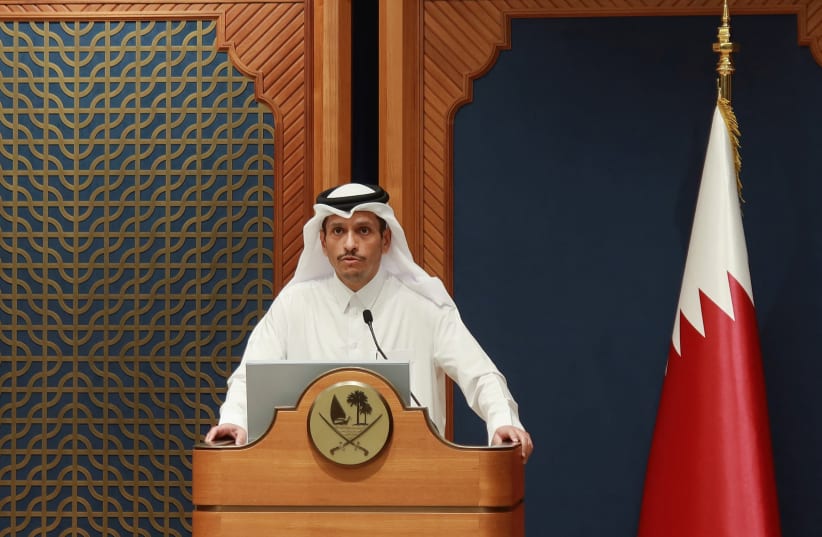
 Qatar's Prime Minister and Foreign Minister Sheikh Mohammed bin Abdulrahman Al Thani attends a joint press conference with French Foreign Minister Catherine Colonna (not pictured) at the Amiri Diwan, in Doha, Qatar November 5, 2023 (photo credit: REUTERS/IMAD CREIDI)
Qatar’s Prime Minister and Foreign Minister Sheikh Mohammed bin Abdulrahman Al Thani attends a joint press conference with French Foreign Minister Catherine Colonna (not pictured) at the Amiri Diwan, in Doha, Qatar November 5, 2023
(photo credit: REUTERS/IMAD CREIDI)
Qatari Prime Minister Sheikh Mohammed bin Abdulrahman bin Jassim Al Thani met with the families of six American and Israeli hostages on Saturday in Doha and told them that the assassination of the deputy head of the Hamas political bureau, Saleh al-Arouri, allegedly by Israel, made it difficult to continue developments on negotiations on a future hostage deal with Hamas, an official briefed on the meeting told Walla.

The meeting in Doha, to which the family members arrived on a direct flight from Israel, was the first time the Prime Minister of Qatar met families of Israeli abductees. The meeting emphasizes the importance that the Qatari government attaches to the issue of the Hamas hostages, yet at the same time the Qatari desire to resist pressure from members of the US Congress and Jewish organizations in the USA.The hostages’ family members also met with the Qatari Foreign Minister Mohammed bin Abdulaziz Al-Khulaifi, who heads Qatar’s negotiating team in talks with Hamas and Israel regarding the release of the abductees. Al-Khulaifi was one of the architects of the previous agreement under which over 100 hostages were released in late November.

A senior Qatari official and an Israeli source told Walla that the family members then met with PM Al Thani who heard from them the story of each of their family members who are held captive by Hamas.
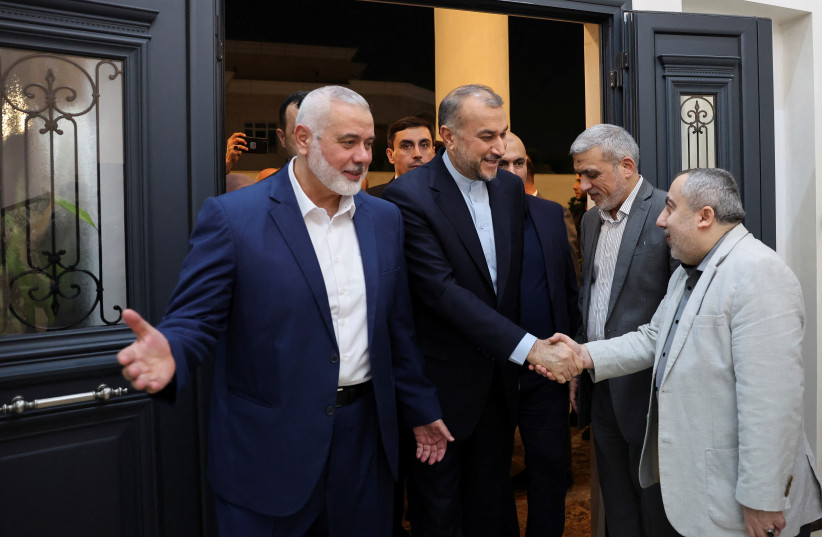
 Iran's Foreign Minister Hossein Amir Abdollahian meets with Palestinian group Hamas' top leader, Ismail Haniyeh in Doha, Qatar December 20, 2023.  (credit:  Iran's Foreign Ministry/WANA (West Asia News Agency)/Handout via REUTERS)Enlrage image
Iran’s Foreign Minister Hossein Amir Abdollahian meets with Palestinian group Hamas’ top leader, Ismail Haniyeh in Doha, Qatar December 20, 2023. (credit: Iran’s Foreign Ministry/WANA (West Asia News Agency)/Handout via REUTERS)

During the meeting, Al Thani noted that the current negotiations are very complicated and spoke about the difficulties he encountered in talks with Hamas and in talks with Israel as part of the attempts to reach a new deal, the Qatari official and the Israeli source said.

The Qatari official noted that Sheikh Mohammed indicated to the family members that the latest escalation following the assassination of Saleh al-Arouri made the negotiations difficult. “The prime minister said it was difficult to talk to Hamas because of what happened in Beirut,” the Qatari official noted.

The Qatari official and the Israeli source stated that Al Thani reassured the families that he is personally committed to continuing trying to secure a new deal for the release of the remaining hostages and that he will not give up despite the challenges.

“Qatar deeply understands the suffering of the abductees and their families. We met directly with the families of the abductees to share with them as much information as we could and to assure them that Qatar is committed to using all the means at its disposal to bring about their release. We will continue to be in contact with the families,” said a senior Qatari official.

The Qatari official noted that the most senior officials in the Qatari government are working day and night with Israel and the US to achieve a new deal for the release of hostages.

“Our efforts speak for themselves – the Qatari mediation has so far succeeded in bringing about the release of 110 hostages. But we are only mediators, and we do not control Hamas. We need to preserve the channels of communication (with Hamas) that proved to be effective in the negotiations on the release of the previous hostages. There is more work to be done and we are committed to continue as long as it is necessary,” said the Qatari official.

https://www.jpost.com/israel-hamas-war/article-781140

King Abdullah of Jordan warned US Secretary of State Antony Blinken on Sunday that the continuation of the war in Gaza would lead to “catastrophic consequences,” Israeli media reported.

Abdullah also added that Washington is required to put pressure on Israel to agree to an immediate ceasefire in Gaza.


Israel must have military self-reliance – opinion

The reality on the ground is undeniable. Israel will be involved in a continuous war for survival on multiple fronts for years to come.

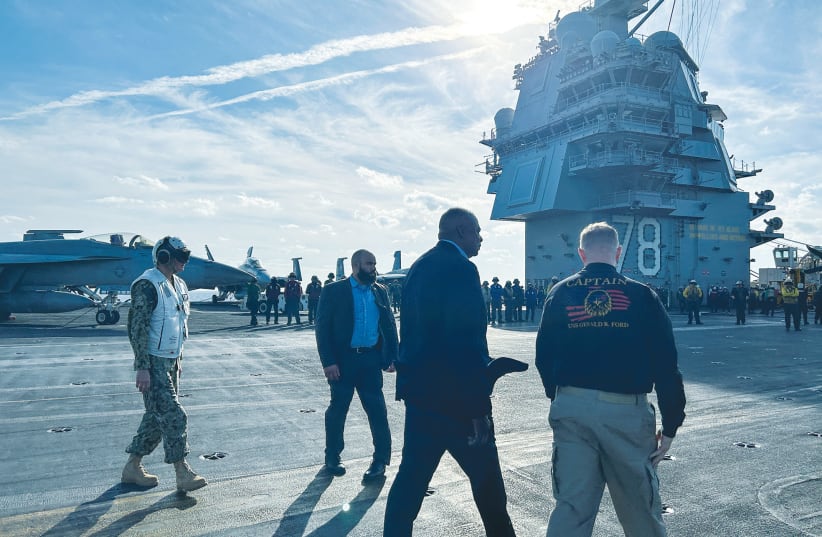
 US DEFENSE SECRETARY Lloyd Austin (second from right) visits the aircraft carrier ‘USS Gerald R. Ford,’ in the Eastern Mediterranean, last month.  (photo credit: REUTERS/PHIL STEWART)
US DEFENSE SECRETARY Lloyd Austin (second from right) visits the aircraft carrier ‘USS Gerald R. Ford,’ in the Eastern Mediterranean, last month.
(photo credit: REUTERS/PHIL STEWART)
Recent naval movements in the region have highlighted two grave threats to Israel’s existence. The US Navy has withdrawn its most advanced aircraft carrier, the USS Gerald R. Ford, from the Mediterranean, while the Iranian Alborz warship has entered the Red Sea through the strategic Bab el-Mandeb strait. This may or may not be a coincidence, but it highlights two alarming trends: Israel is encircled by jihadists who seek to wipe us out, and Israel is too reliant on the US for military support, which is not assured. We must act urgently to counter these threats and protect our people.

An exponential threat

Jihadist Islam is advancing steadily towards a confrontation with the West, with one clear aim: to annihilate the infidel and spread Islam. It does not hide its intentions and acts on them consistently. Jihadists are expanding across Africa, Europe, and the United States, mobilizing supporters, building infrastructure, radicalizing locals, and carrying out terror.

Over Christmas, Muslim extremists killed 195 Christians, including many women and children, in Nigeria. This was barely reported in the mainstream media; just another one of nearly 50,000 jihadist terror attacks in the past 40 years. A trend that is growing in number and scope over time.

Israel is the frontline of this war. We are fighting jihadists at various levels of intensity in Gaza, Judea and Samaria, Lebanon, Syria, Yemen, and Iran. While these terrorist groups have different names and forms, they all follow the same ideology: jihad, and for the most part are directed by the same mastermind, Iran.

In for the long haul

The reality on the ground is undeniable. Israel will be involved in a continuous war for survival on multiple fronts for years to come.

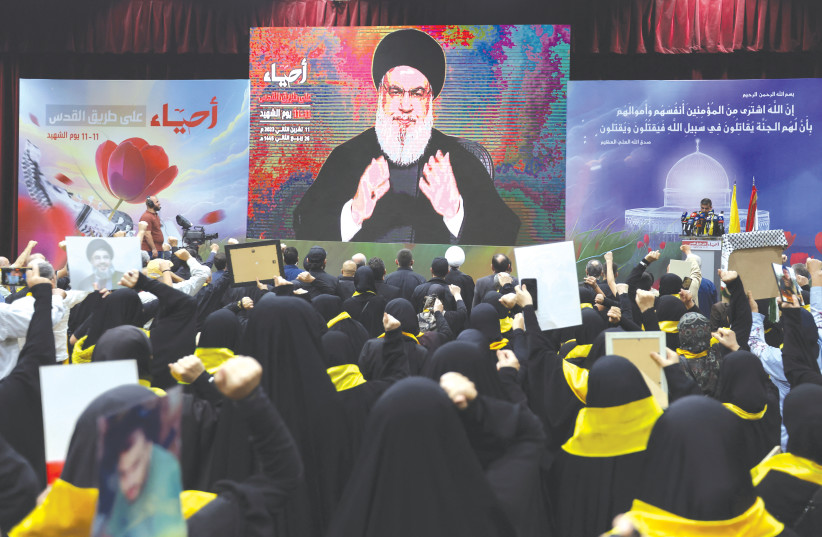
 HEZBOLLAH LEADER Hassan Nasrallah addresses his supporters during a rally commemorating the annual Hezbollah Martyrs’ Day, in Beirut last month.  (credit: AZIZ TAHER/REUTERS)Enlrage image
HEZBOLLAH LEADER Hassan Nasrallah addresses his supporters during a rally commemorating the annual Hezbollah Martyrs’ Day, in Beirut last month. (credit: AZIZ TAHER/REUTERS)

THERE WERE many failures of Israeli political, military, and security leaders in the years leading up to October 7. These will surely be examined and debated for decades. However, there are two strategic fallacies that we need to expose and correct immediately. We cannot afford to wait until “after the war.”

Bold assumptions

The first fallacy is the common assumption that the Middle East has entered a new era and that a full-scale war, let alone a war on all fronts simultaneously, is not a realistic scenario. This misguided view led the country to a huge lack of readiness.

While October 7 was a shocking wake-up call, we have not yet articulated and accepted the problem: Israel is engaged in a long-term, ongoing, and intensifying conflict between jihadist Islam and the West. And it will likely worsen in the coming years. We must declare this clearly, debate it openly, and embrace it mentally. If we do not, Israel will be woefully unprepared for the future escalation.

The second fallacy is the common belief that we can depend on the US to defend us. The US has always been our most valued and respected ally, and most Americans still appreciate the importance of maintaining superpower status, supporting allies, and advancing democratic countries like Israel around the world. However, American public opinion and demographics are changing. The withdrawal of the USS Gerald R Ford, the political difficulties in approving the recent $14.5 billion aid package, and the limited supply of military munitions to enable a restricted battle in Gaza without enough firepower to eliminate Hezbollah, the Houthis, and Iran send a clear message: We are helping you, but we don’t really have your back. A harsh reality. While Israel should obviously heavily invest in the strategic relationship with America, it would be unwise to rely on them entirely. We must take immediate action to increase the size and strength of our military and become self-reliant in our ability to produce the arms and munitions needed to fight a full-scale war on all fronts simultaneously.

In many ways, Israel today is in a similar position to the United States in 1940. The public has not yet realized that we are entering a long-term, multi-front war and that without massive American support, our military arsenal is inadequate. In 1940, when president Franklin D. Roosevelt recognized that the American military was not ready for war, he boldly appointed William Knudsen, then CEO of General Motors, as chairman of the Office of Production Management and tasked him with preparing the country for war. Over a period of 18 months, American military spending increased by an unprecedented 1000%, and under Knudsen’s leadership, the American military industrial complex boosted production and turned the 18th largest military in the world into the largest and most powerful one. In parallel, Roosevelt spoke regularly to the public, preparing the nation for war and positioning the US as the “great arsenal of democracy.” The result was total victory.

Israel today needs brave, resolute, and decisive leadership and a clear plan to rapidly scale up the IDF, our military industry, and munitions production. We need a Roosevelt and a Knudsen to prepare us psychologically, financially, and logistically to be self-sufficient for a prolonged full-scale war with the jihadists that surround us. If we get this wrong, there may not be anyone left to conduct a commission of inquiry.

The writer is an Israeli attorney, activist, and businessman.