KAN further reported that Minister Benny Gantz held conversations on the subject with the foreign ministers of the United Kingdom and France.
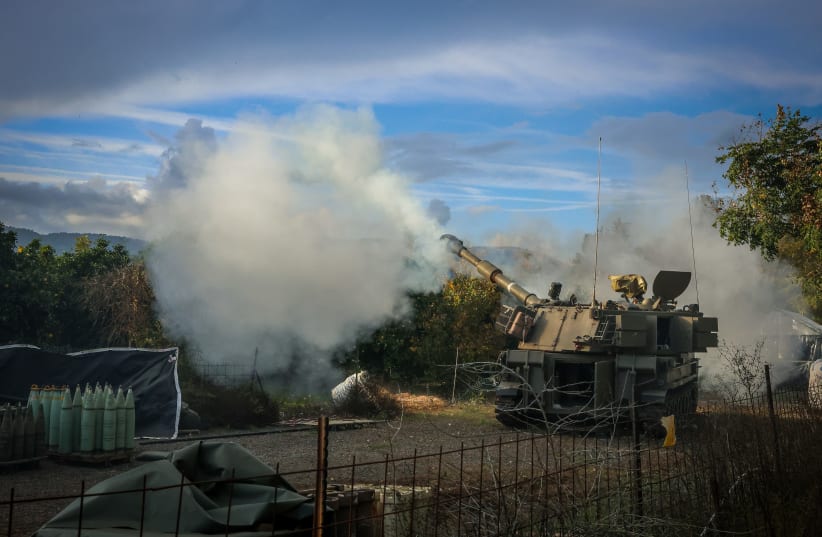
By JERUSALEM POST STAFFIsraeli artillery unit stationed near the Israeli border with Lebanon, northern Israel, December 12, 2023(photo credit: David Cohen/Flash90)Israel is close to reaching a “diplomatic solution” to move terror organization Hezbollah away from the northern border with Lebanon, KAN News reported Wednesday morning.
Along with Israel’s main goal of moving Hezbollah forces north of the Litani River and away from Israeli civilians, discussions with European partners included the potential strengthening of the United Nations Interim Forces in Lebanon (UNIFIL), situated in the country’s south.
KAN further reported that Minister Benny Gantz held conversations on the subject with the foreign ministers of the United Kingdom and France.
Hezbollah warns of ‘new escalation’ on Israel’s northern front
On Sunday, a Hezbollah MP warned that Israeli airstrikes that caused widespread damage in the town of Aitaroun near the Israeli-Lebanese border on Sunday were a “new escalation,” adding that the terrorist group would continue its attacks on Israel.
Lebanese media portrayed the IDF’s response to Hezbollah attacks on Sunday as a significant escalation compared to other clashes along the border in recent weeks.
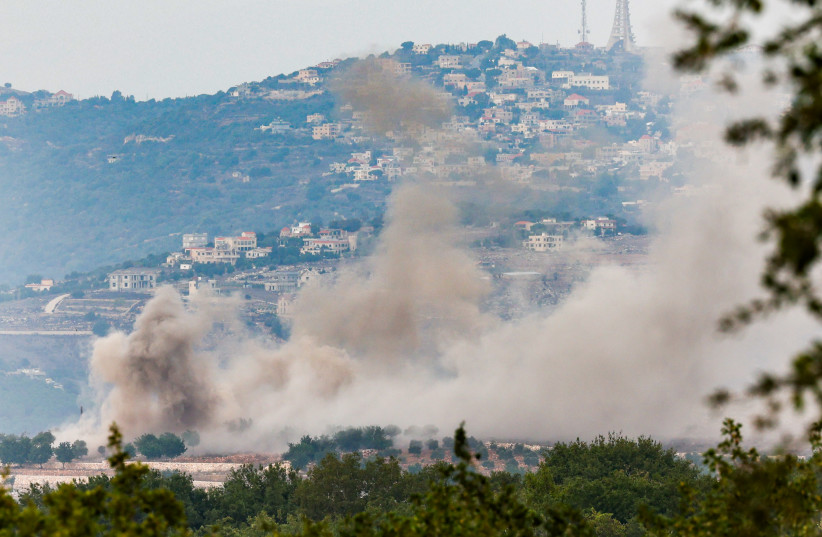
Smoke rises from areas in Lebanon during strikes by Israeli warplanes, October 9, 2023 (credit: David Cohen/Flash90)
Last week, Defense Minister Yoav Gallant told the leaders of communities near the northern border that Israel was attempting to reach a diplomatic solution in which Hezbollah would retreat to the Litani River, but was also prepared to remove the terrorist group through military means from the area near the border.
On Sunday, KAN news reported that Israel was preparing to set a deadline for a diplomatic solution and that Israeli officials believe the chances of such a solution are low.
Iran may have overplayed previous coverage accusing Israel of various “crimes” and now is setting its hopes on larger movements at the UN and in other spaces.
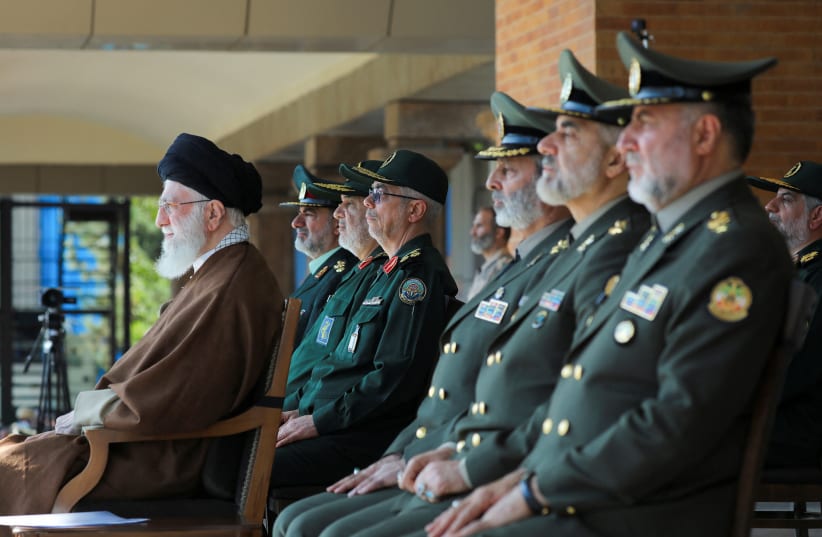
By SETH J. FRANTZMANUpdated: DECEMBER 13, 2023 10:18Iran’s Supreme Leader Ayatollah Ali Khamenei attends a graduation ceremony for armed forces officers at the Imam Ali academy in Tehran, Iran October 10, 2023(photo credit: Office of the Iranian Supreme Leader/WANA via REUTERS)The UN General Assembly voted overwhelmingly on Tuesday for an immediate ceasefire in Gaza. Only a handful of countries opposed the vote and around twenty abstained. While many countries legitimately want a ceasefire, Iran’s strategy here is more complex.
Iran backs Hamas and other groups in the Middle East that have sought to leverage the Hamas attack on October 7 to its benefit. For instance, there have been almost eighty attacks on US forces in Syria and Iraq by the Islamic Republic’s proxies.
Therefore, Iran’s own views on the ceasefire and how the war might end in Gaza are important. Amid various reports about Hamas officials traveling this week, leaving Doha for some other destination; there are a lot of questions about what comes next in Gaza.
Hamas units in northern Gaza are under siege and being slowly defeated. The terrorist group in Khan Yunis and other areas is fighting to remain intact enough to control Gaza after the war. Clearly, Israel’s policy is not to let Hamas re-take control—but Hamas’s top leaders continue to hold sway in Gaza and abroad.
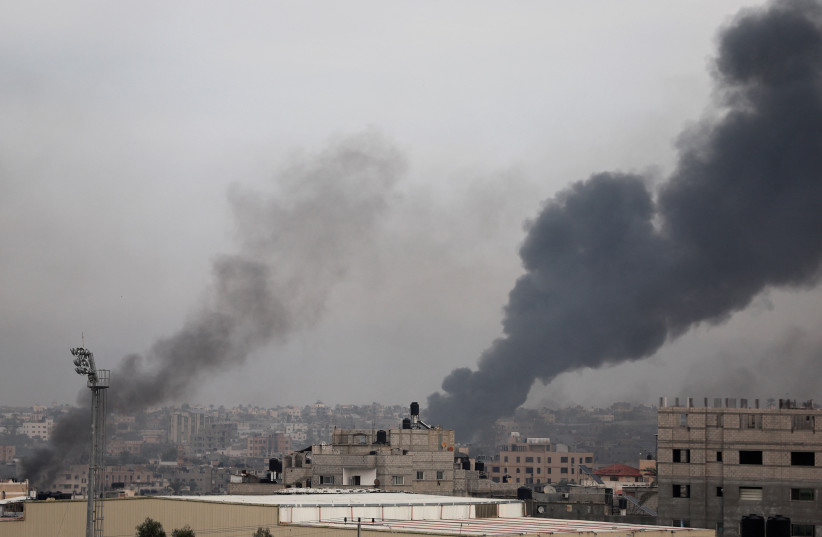
Smoke rises after Israeli strikes, amid the ongoing conflict between Israel Hamas, in Khan Younis in the southern Gaza Strip, December 10, 2023. (credit: REUTERS/Ibraheem Abu Mustafa)
Even if the group lost 7,000 fighters, it has another 15,000 in some 20 battalions that continue to fight on in one form or another.
Iranian media’s perspective
What does Hamas pro-regime media say? Tasnim News on Tuesday evening had a number of articles indicating how Iran’s Islamic Revolutionary Guard Corps views the conflict. The first says that the IRGC spotlights differences between Israel’s Prime Minister Benjamin Netanyahu and the Biden administration. Another writes that the corps highlights Israeli concerns that the Jewish state’s goals won’t be met in Gaza. A third says that it notes new warnings to the US by Iran’s foreign minister. The fourth Tasnim article says that Israel is losing support globally due to “indiscriminate bombing.”
Advertisement
Fars News, which is also close to the IRGC in Iran, highlighted the UN vote in reports it put out in the early hours of Wednesday morning. Fars News also reported on the Iranian foreign minister’s trip to Switzerland and his comments slamming Israel.
The Iranian coverage of the war is interesting. It is not bragging about Hamas’s success. In fact, the terrorist group has also not been bragging about any successes recently. This means that Iran now knows it must gamble on a ceasefire and hope to influence world opinion against Israel in the next stage. It appears to think that Jerusalem is triumphing tactically in Gaza.
Although the operation has now reached day 68 of the war, Hamas cannot hold out forever. Iran appears to know this and it likely did not think the war would last this long. It operationalized the Houthis, Hezbollah and other threats, in order to distract from the war in Gaza. It wants a wider regional war.
So far, since Iran has not been able to draw the US or Israel into a wider conflict, it is concerned. Tehran now appears to think that it needs to focus more on the strategic global agenda and less on Hamas in Gaza. It wants to use the besieged coastal enclave and the suffering there for leverage. But even the suffering is not highlighted in the Iranian regime media. This is a new shift as well.
Iran may have overplayed previous coverage accusing Israel of various “crimes” and is now setting its hopes on larger movements at the UN and in other spaces, such as Iran-Russia ties. This is an important shift in the Islamic Republic’s narrative and worth paying attention to in the coming weeks.
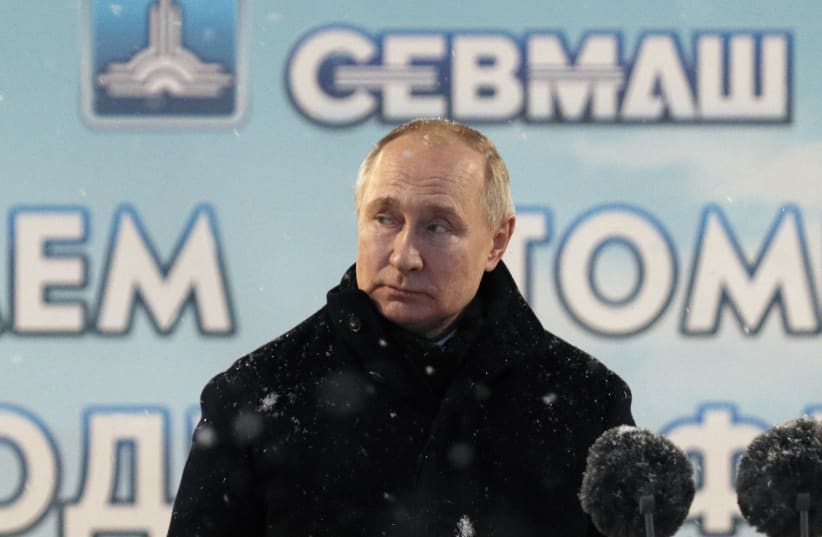
By REUTERSRussian President Vladimir Putin attends a flag-raising ceremony for two nuclear-powered submarines in the northern city of Severodvinsk, Russia, December 11, 2023(photo credit: Sputnik/Kirill Iodas/Pool via REUTERS)The prospect of six more years in power for Russian President Vladimir Putin is likely to mean no let-up in nuclear tensions with the United States, as time runs out on the last remaining treaty that limits the number of warheads each side can deploy.
Putin has boasted since launching his 2022 invasion of Ukraine that Russia has the world’s most advanced nuclear arms and said it could wipe out any aggressor.
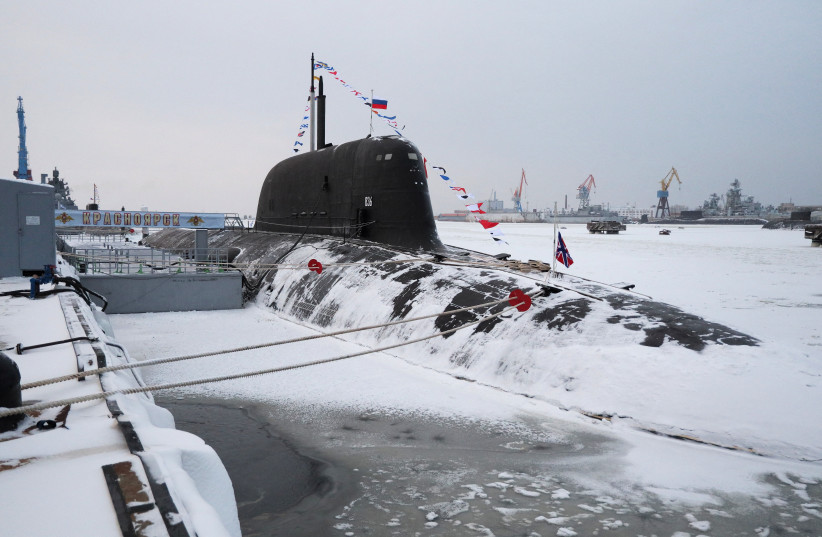
On Monday, three days after announcing he would stand for re-election in March, he presided at a flag-raising ceremony for two new submarines including the Emperor Alexander III, which last month tested a nuclear-capable Bulava intercontinental ballistic missile.
The nuclear-powered submarine Krasnoyarsk is seen during a flag-raising ceremony at the naval base in the northern city of Severodvinsk, Russia, December 11, 2023 (credit: Sputnik/Kirill Iodas/Pool via REUTERS)
While denying that Moscow is “brandishing” nuclear weapons and resisting calls to adopt a more aggressive doctrine on their possible use, he has placed his nuclear forces on raised alert and announced the deployment of tactical nuclear missiles in Belarus, his neighbor and ally.
Last month he signed a law revoking Russia’s ratification of the global treaty that bans nuclear testing, although Moscow says it will not carry out a test – which would be its first since the 1991 collapse of the Soviet Union – unless the United States does so.
Some security analysts say nuclear weapons have assumed greater importance in Putin’s thinking and rhetoric as his conventional forces have struggled in Ukraine and as Western countries have weaned themselves off Russian energy, weakening his ability to exert pressure by cutting off oil and gas.
Advertisement
The Kremlin leader has no interest in talking to Washington about reducing nuclear risk, analysts say, because Moscow believes it is precisely the fear that it may resort to nuclear weapons that has deterred the United States and its allies from directly joining the war on Ukraine’s side.
“How can you reduce the risk if you continue to play the nuclear card vis-a-vis the United States and NATO?” said former Soviet and Russian diplomat Nikolai Sokov, a senior fellow at the Vienna Center for Disarmament and Non-Proliferation.
“How can you discuss something to make sure that nuclear weapons are never, ever actually used if you want to keep the threat – maybe not really high but at least at some kind of visible and credible level?”
TICKING CLOCK
By the time Putin’s expected new term gets underway next May, there will be less than two years remaining until the New START treaty, which limits Russia and the United States to 1,550 strategic nuclear warheads and bombs on each side, expires on Feb. 4, 2026.
The agreement, originally due to run out in 2021, was hurriedly extended for five years after U.S. President Joe Biden was inaugurated at the start of that year.
But the prospects for a further extension, let alone a more ambitious successor pact, look doubtful for many reasons. China’s nuclear build-up is a complicating factor, and it’s not clear who will be in charge in the White House by 2026.
Putin this year suspended Russia’s participation in New START, and Deputy Foreign Minister Sergei Ryabkov said last month that Moscow would not resume dialog unless the United States dropped what he called its “fundamentally hostile course” towards Russia – a reference to U.S. backing for Ukraine which Biden has said is unshakeable.
Putin has frequently talked up the potential of Russia’s new weapons systems such as the Sarmat intercontinental ballistic missile and Burevestnik cruise missile, and Ryabkov said Washington was wrong if it thought it could win a news arms race against Russia of the kind that U.S. President Ronald Reagan conducted in the 1980s.
But such a contest would impose strains on Russia too.
“Russia knows that an uncontrolled new nuclear arms race is something they would not be able to afford and do not really have the capacity to sustain. Even more so now that in most respects Russia is much weaker as a consequence of its war against Ukraine,” said Nigel Gould-Davies of the International Institute for Strategic Studies in London.
He said sanctions, while they had not crippled Russia’s economy, were restricting its access to technology, citing the crash of its moon-landing mission in August as an example of a spectacular high-tech failure.
Sokov, the former Russian diplomat, expressed a different view, saying Russia’s research and development programs were far cheaper to run than those of the United States, and that Russia’s economy was in better shape than the Soviet Union’s in the 1980s.
“We are heading into a new arms race anyway, actually. It will not be a quantitative arms race in terms of changing numbers, it will be an arms race about the quality of weapons and new types and new capabilities,” he said.
“We will be living in a situation that is less stable and the prospects of arms control are quite bleak.”