While Israel and the US can agree that the conflict should end with Hamas’s removal from power, they differ on what things will look like the day after bullets stop flying


WASHINGTON (JTA) — Israel and the United States agree on how the Israel-Hamas war started — with the Gaza-ruling terror group’s savage October 7 massacres in southern Israel. They agree on how it should end — with the elimination of Hamas.
But there are differences over how to get there, which are becoming more pronounced.
On Tuesday, US President Joe Biden openly criticized Israel’s conduct in the war.
“Israel’s security can rest on the United States, but right now it has more than the United States,” Biden said at a fundraiser at a Washington hotel convened by Lee “Rosy” Rosenberg, a major donor to Democrats and pro-Israel causes. “It has the European Union, it has Europe, it has most of the world,” he said. “But they’re starting to lose that support by indiscriminate bombing that takes place.”
Over 18,000 Gazans have been killed so far in the fighting, according to the Hamas-run Gaza health ministry — a figure that cannot be verified and includes terrorists as well as civilians killed by errant Palestinian rocket fire. Israel says it has killed 7,000 Hamas operatives.
Over 1,200 people were killed in Israel on October 7, most of them civilians, when thousands of Hamas-led terrorists stormed the border and launched a murder and torture spree with monstrous brutality, raping women and girls, mutilating corpses and burning entire families alive. The terrorists abducted roughly 240 more people, taking them as hostages to the Gaza Strip.
The massacre led to Israel’s current military campaign, in which 115 IDF troops have so far been killed.

But there are stark differences between Israel and the United States over what happens the day after the war ends. Does Israel stay in the Gaza Strip? If so, for how long? And who takes its place?
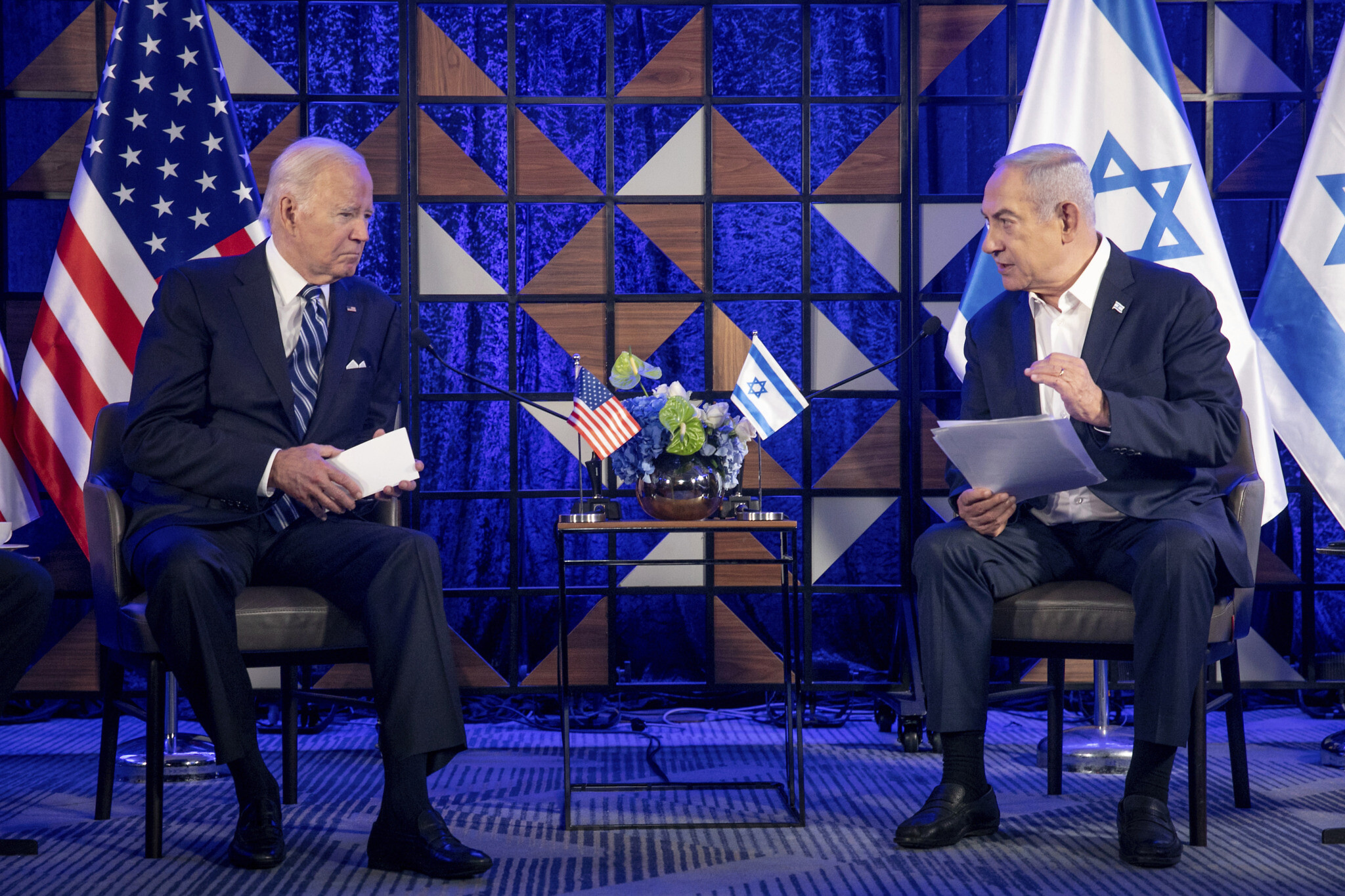
“Yes, there is disagreement about ‘the day after Hamas,’ and I hope that we will reach agreement here as well,” Netanyahu said Tuesday in a statement, describing what he called an “intensive dialogue” he had just completed with Biden.
Netanyahu made clear what the differences are: Biden has pushed for the Palestinian Authority — which governs Palestinian population centers in the West Bank — to take control of Gaza. Netanyahu rejected that idea, referencing the Oslo Accords, the 1993 agreement that created the PA, which is led by the Fatah Party.
“I will not allow Israel to repeat the mistake of Oslo,” Netanyahu said. He referenced longstanding Israeli complaints about the PA: that it glorifies violence against Israelis and pays stipends to convicted Palestinian terrorists in Israeli prisons.
“After the great sacrifice of our civilians and our soldiers, I will not allow the entry into Gaza of those who educate for terrorism, support terrorism and finance terrorism,” he said. “Gaza will be neither Hamastan nor Fatahstan.”

Netanyahu has said Israel will retain security control of the Gaza Strip after the war, though he has not elaborated on who will govern its day-to-day affairs or how long the Israeli security presence would last. That’s frustrating the Biden administration, said David Makovsky, a fellow with the Washington Institute for Near East Policy think tank, which has ties with the Israeli and US governments.
“The Americans want to know, like, OK, you have a military strategy. I get that. And maybe a very reasonable one, but tell me how it leads to political outcomes? The outcome is no Hamas. Okay. That’s good. That’s necessary. But is it sufficient?’”
Here’s a look at the outcomes the United States, Israel and other actors are talking about.
Will the Palestinian Authority govern Gaza?
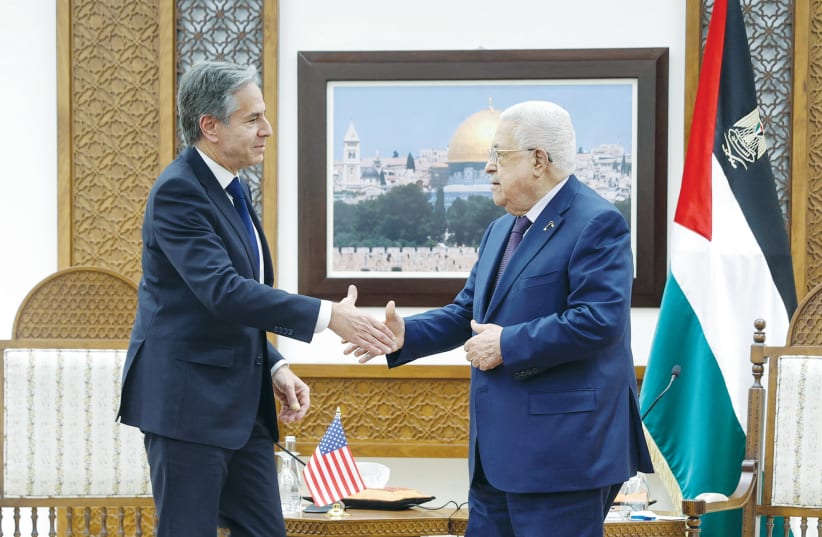
The Biden administration, for several weeks after Hamas’s massacre, talked about bringing the Palestinian Authority into the Gaza Strip.
“We must also work on the affirmative elements to get to a sustained peace,” US Secretary of State Antony Blinken said in Tokyo during a summit of the G7 industrial giants on November 8. “These must include the Palestinian people’s voices and aspirations at the center of post-crisis governance in Gaza. It must include Palestinian-led governance and Gaza unified with the West Bank under the Palestinian Authority.”

Netanyahu has emphatically counted out any PA role in the Gaza Strip, pointing to its continued payments to the families of jailed and killed terrorists and what he says is continued incitement in its textbooks and media.
That may explain why Blinken has been more circumspect in recent statements, in which he has envisioned the establishment of an independent Palestinian state uniting Gaza and the West Bank but hasn’t named the Palestinian Authority.
“When the major military operation is over, this is not over, because we have to have a durable, sustainable peace, and we have to make sure that we’re on the path to a durable, sustainable peace,” Blinken said Sunday on CNN’s State of the Union. “From our perspective, I think from the perspective of many around the world, that has to lead to a Palestinian state.”
Netanyahu is not the only obstacle to such an outcome. Mahmoud Abbas, the president of the Palestinian Authority, is not too eager to be seen as assuming control of the Gaza Strip on the heels of an Israeli invasion. Polls show that Abbas, who hasn’t run in (or won) an election in nearly two decades, has low approval ratings among Palestinians.
“I will not return on top of an Israeli tank,” the Associated Press quoted Abbas as telling his confidants last month.

The PA itself is seen as corrupt and weakened by decades of cooperating with Israeli security measures in the parts of the West Bank it governs. Some major West Bank cities, such as Jenin, are home to large concentrations of militant groups.
But a paper published this week by Israel Policy Forum (IPF) scholars Michael Koplow and Shira Efron says the end of the war is an opportunity for Israel to expand its relationship with the PA — and demand that it undergo reforms that address Israel’s concerns. IPF has long advocated for a two-state solution.
“Despite hopes to the contrary, no other players in the international community are willing to entertain long-term commitments to Gaza, let alone ruling the Strip, leaving the PA as the only viable option,” Efron and Koplow write.
Will Netanyahu preserve his hardline coalition?
Efron and Koplow added, however, that Netanyahu is rejecting cooperation with the PA in Gaza because of pressure from far-right parties in his coalition. Those parties, they said, wield an “absolute veto” over strengthening the PA.
Regarding Netanyahu’s political interests, Makovsky was blunter.
“He can’t say the word ‘PA’ — he can’t say it,” Makovsky said. “If the government seems completely shut down over being able to talk about the day after, that’s a function of the politics.”

On Tuesday, Biden appeared to suggest that it was time for Netanyahu to cut off his far-right partners, whom the president has long reviled.
“Bibi’s got a tough decision to make,” he said at the fundraising event, using Netanyahu’s nickname. “This is the most conservative government in Israel’s history,” that “doesn’t want a two-state solution.”
He appeared to hope Netanyahu might bring in the center-left opposition and drop the far-right. That’s not going to happen as long as the latter is ready to keep Netanyahu in office and shield him from the political consequences of the October 7 onslaught, said Nimrod Novik, another IPF scholar and a member of the executive committee of Commanders for Israel Security, which also favors a two-state outcome.
“The longer [the war] is, the farther the trauma of October 7,” Novilk said. “The longer it is, the farther the investigations of the responsibility for it all. Maybe people will forget, maybe something good will happen and he’ll get credit for it.”
Jonathan Schanzer, a vice president with the right-leaning Foundation for Defense of Democracies, said Netanyahu had every incentive to pursue the war until victory somewhat repairs his legacy shattered by October 7.
“He said ‘everybody will have to give answers’ [about what went wrong] when the war is over,” Schanzer said. “And he’s hoping that he can postpone that discussion until such a time that events on the ground will have swung in his favor.”
Will Israel reoccupy Gaza?
Although Netanyahu has discussed maintaining control of security in Gaza, he has not yet said the word “occupation”: For one thing, it would set off a firestorm at home. Before Israel withdrew from Gaza in 2005, many Israelis remember weeks of military reserve duty spent occupying the dangerous strip of land, and the costs it incurred in lives and resources.
For another, the Biden administration has said indefinite Israeli occupation of Gaza is not an option.

At the G7 summit in Tokyo last month, Blinken rejected every possible iteration of occupation that has apparently bubbled up under consideration by Netanyahu, according to leaks to the Israeli media. These include resettlement of Israelis in Gaza, military occupation, “buffer zones” that Israel would control along Gaza’s border, a return to blockading the strip — which was the status in place until October 6 — and the removal of a portion of the Palestinians, an action that would bolster charges of ethnic cleansing against Israel.
“The only way to ensure that this crisis never happens again is to begin setting the conditions for durable peace and security, and to frame our diplomatic efforts now with that in mind,” Blinken said. “The United States believes key elements should include no forcible displacement of Palestinians from Gaza — not now, not after the war. No use of Gaza as a platform for terrorism or other violent attacks. No reoccupation of Gaza after the conflict ends. No attempt to blockade or besiege Gaza. No reduction in the territory of Gaza.”
Many Palestinian commentators have focused their attention on the Gaza death toll over the past two months. But Diana Buttu, a former Palestinian negotiator, wrote in The New York Times on Tuesday that an ongoing Israeli occupation of Gaza would be the worst possible option.
“The future of Gaza — like that of the West Bank — is for Palestinians to decide,” she wrote. “That is the essence of self-determination. The international community must not continue to place Israel first, as has been done for decades.”
She added, “Palestinians must live freely, without the faintest sense of an Israeli noose around our necks.”
Will Israel’s Arab partners play a role in Gaza’s future?
Blinken has shuttled between Arab capitals for weeks seeking buy-in for the postwar scenario. But in public comments after meeting foreign ministers from Egypt, Jordan, Qatar, Saudi Arabia and Turkey, as well as a Palestinian Authority senior official, he was vague about what that scenario involves — beyond expressing hope for a Palestinian state.
Behind the scenes, reports have said, he has been more explicit, seeking pledges of funding for whatever form the government of Gaza takes after the war. He has also weighed asking Arab countries to commit troops to Gaza to help maintain the peace.
Arab states, which have been calling for a ceasefire, have not bitten at that offer, for myriad reasons: They, like Israel, distrust Abbas, who has gained a reputation for corruption and fecklessness. And while four Arab states have normalized relations with Israel in recent years, they are not ready to join with it in a military effort to keep Gaza calm.

According to The Wall Street Journal, the United Arab Emirates, which has cultivated increasingly close ties with Israel in recent years, said it would help with the reconstruction of Gaza only if there’s progress toward a two-state solution.
“We need to see a viable two-state solution plan, a road map that is serious before we talk about the next day and rebuilding the infrastructure of Gaza,” said the Emirati ambassador to the United Nations, Lana Nusseibeh.
In their paper, Efron and Koplow propose a US-led rehabilitation of Gaza that melds Arab buy-in with reconstituting the Palestinian Authority in the territory. Preparing for that future, they wrote, needs to begin even as the fighting is ongoing.
“Stabilizing Gaza, resuming necessary services, rebuilding infrastructure, and preventing the return of Hamas — assuming that Israel is successful in removing it from effective power — will require a concerted effort from multiple stakeholders: Israel, the Palestinians, Middle Eastern countries, the international community, and particularly the United States,” said the paper.
Ghaith al-Omari, a former adviser to Palestinian officials and a fellow at the Washington Institute, told The Washington Post last week that bringing in the PA was a prerequisite to getting other Arab countries to play a role in postwar Gaza.
Arab nations, “to even be able to engage with us, they need that framing, the two-state solution framing and the transitional framing,” he told the Post. “Because this way they can always claim, ‘We’re doing this to support the Palestinians.’”
Times of Israel staff contributed to this report.