Foreign Ministry says it voiced displeasure to Moscow’s envoy after Russian officials criticized Israel’s ‘cruel methods’ in Gaza while backing its right to self-defense
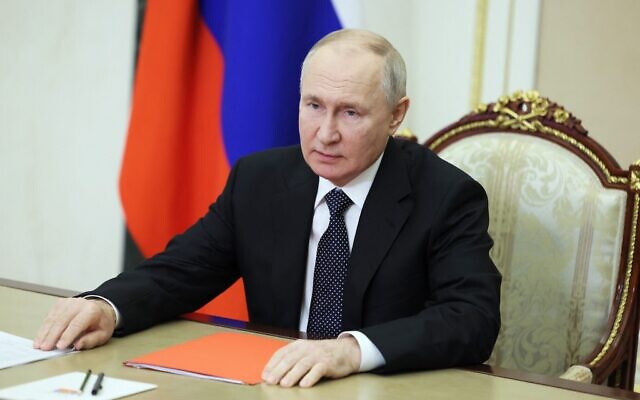
This pool photograph distributed by Russian state-owned agency Sputnik shows Russia's President Vladimir Putin chairing a Security Council meeting via a video link in Moscow on October 20, 2023. (Photo by Gavriil GRIGOROV / POOL / AFP)
This pool photograph distributed by Russian state-owned agency Sputnik shows Russia’s President Vladimir Putin chairing a Security Council meeting via a video link in Moscow on October 20, 2023. (Photo by Gavriil GRIGOROV / POOL / AFP)

Israel has expressed its dissatisfaction with Russia over its frequent statements against the Jewish state in the context of the war in Gaza, the Foreign Ministry told The Times of Israel on Tuesday.

An Israeli diplomat had a conversation with a Russian official this week to express Jerusalem’s “displeasure with the role Russia is playing” in the war against Hamas, and to stress Israel’s hope that Moscow will take “more balanced” positions, the ministry added.

Among other positions, Moscow submitted a UN Security Council resolution calling for a ceasefire that did not mention Hamas, and blasted Israel for employing “cruel methods” in its campaign against the terror group.

The war began with Hamas’s October 7 massacre, in which terrorists broke through the border fence, killed over 1,400 people in southern Israel, mostly civilians, and took at least 224 hostage into Gaza. Israel has launched an intense bombing campaign in the Strip, including cutting off almost all fuel, water and power supplies, and is planning a ground operation aimed at toppling Hamas’s rule over the territory.

Kan public broadcaster reported Tuesday that Jerusalem has conveyed messages to Moscow in recent days saying that “Russia’s conduct and the remarks against Israel don’t correspond with the severity of the situation Israel is in, which is a state of war.”

The unsourced report said Jerusalem is arguing that Russian President Vladimir Putin’s remarks backing Israel’s right to defend itself don’t match Moscow’s initiatives in international forums, such as its Security Council proposal, which failed to include an explicit condemnation of Hamas and was therefore voted down by the United States, Britain, France and others.

Russian Ambassador to Israel Anatoly Viktorov speaks to the media at the Russian Embassy in Tel Aviv, on March 3, 2022. (Avshalom Sassoni‎‏/Flash90)

Moscow has been walking a tightrope since the Israel-Hamas war erupted, seeking to maintain good relations with both sides. It has condemned the terror group’s onslaught and supported Israel’s right to self-defense, but has repeatedly criticized the Jewish state’s offensive, called for aid to Gaza, and urged a ceasefire.

In one remark that was viewed by some as particularly stinging, Putin compared the “unacceptable” Israeli siege of Gaza to the Nazi blockade of Leningrad, which was seen by some as implicitly likening Israel to Nazi Germany.

“Various scenarios are emerging, including the possibility of military and non-military measures being taken against the Gaza Strip comparable to the siege of Leningrad during World War II,” Putin told journalists on a visit to Kyrgyzstan.

“We understand what that entails. In my opinion, this is unacceptable. More than two million people live there. Far from all of them support Hamas by the way, far from all. But all of them have to suffer, including women and children. Of course it’s hard for anyone to agree with this,” he said.

Last week, Russia said it was sending 27 tons of humanitarian aid to Gaza, and its foreign ministry argued that “the right to self-defense does not mean having a license for mass and indiscriminate reprisals.”

On Monday, the Kremlin said Putin and Brazilian counterpart Luiz Inacio Lula da Silva held a phone call during which they “expressed serious concern about the growing number of civilian casualties and stressed the fundamental importance of an early ceasefire, the evacuation of foreign citizens from the Gaza Strip, and of ensuring unhindered access to the enclave for humanitarian aid.”

Agencies contributed to this report.
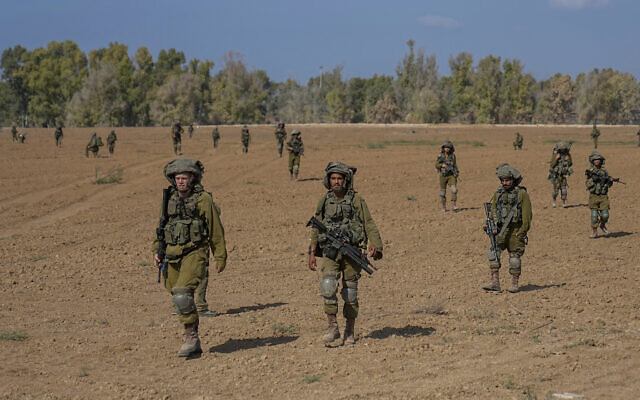


Officials indicate Israel still hasn’t decided whether it wants to launch major ground offensive or carry out combo of surgical strikes and targeted raids against Hamas terrorists

Israeli soldiers patrol next to communities near the Israeli-Gaza border, southern Israel, October 20, 2023. (AP Photo/Ohad Zwigenberg)

The Biden administration is reportedly concerned that Israel lacks achievable military goals for its operations in Gaza, leading US officials to believe that the IDF is not yet ready for a ground incursion.

US officials have held marathon meetings and phone calls with their Israeli counterparts to discuss the ground operation, which many thought the IDF would have launched by Monday — 17 days after the October 7 Hamas massacre, in which over 1,400 people were slaughtered in Israel and roughly 220 were taken hostage into Gaza. In the interim, the IDF has maintained a near-constant aerial bombardment it says is targeting Hamas terrorists and infrastructure, which has left thousands dead.

Defense Secretary Lloyd Austin has held near-daily phone calls with his Israeli counterpart, Yoav Gallant, during which the former has urged the importance of carefully considering how IDF troops conduct the incursion in Gaza, where terrorists will operate from tunnels and densely populated areas, The New York Times reported Monday, citing unnamed US officials.

In a Sunday interview with ABC’s “This Week,” Austin said the ground invasion Israel plans to launch could well take longer than the amount of time it took for the US to remove the Islamic State from power in Mosul, Iraq, when he was the head of the US Army’s Central Command.

“Urban combat is extremely difficult. It goes at a slow pace,” he said. “This may be a bit more difficult because of the underground network of tunnels that Hamas has constructed over time and the fact that they have had a long time to prepare for a fight.”

An Israeli army APC advances in a field near the southern Israeli city of Sderot, on October 23, 2023, amid ongoing battles between Israel and the Palestinian group Hamas. (Photo by Thomas COEX / AFP)

An Israeli official told The Times of Israel on Sunday that cabinet ministers have repeatedly pointed to Fallujah as an example of the kind of operation they want to see the IDF launch in Gaza.

Both strategies will result in heavy losses, though the Fallujah model would be far bloodier for both soldiers and civilians, the US officials told The Times, adding that many in the Pentagon accordingly prefer the Mosul blueprint. But even in that battle, 9,000 to 11,000 civilians were killed, according to the Associated Press.

The US officials told The Times that they’ve walked away from their conversations with Israeli counterparts feeling like they have not yet seen an achievable plan of action for accomplishing Prime Minister Benjamin Netanyahu’s stated goal of eradicating Hamas.

The report came two days after a senior diplomatic official told The Times of Israel that the US and several European countries were pressuring Israel to hold off on launching a ground incursion to allow for more time to negotiate the release of the over 220 hostages in Gaza. Four have been freed thus far following efforts by Qatar and Egypt.

The New York Times reported Sunday that the Biden administration also wants time to increase preparedness for any potential attacks on US targets in the region from Iran-based groups, which it believes are likely to increase as the war goes on.

Michael Herzog, Israel’s ambassador to the US, told CNN, “There is really no pressure. They give us advice, but they are not telling us what to do, what not to do.”

Biden administration officials have made similar claims publicly as well.

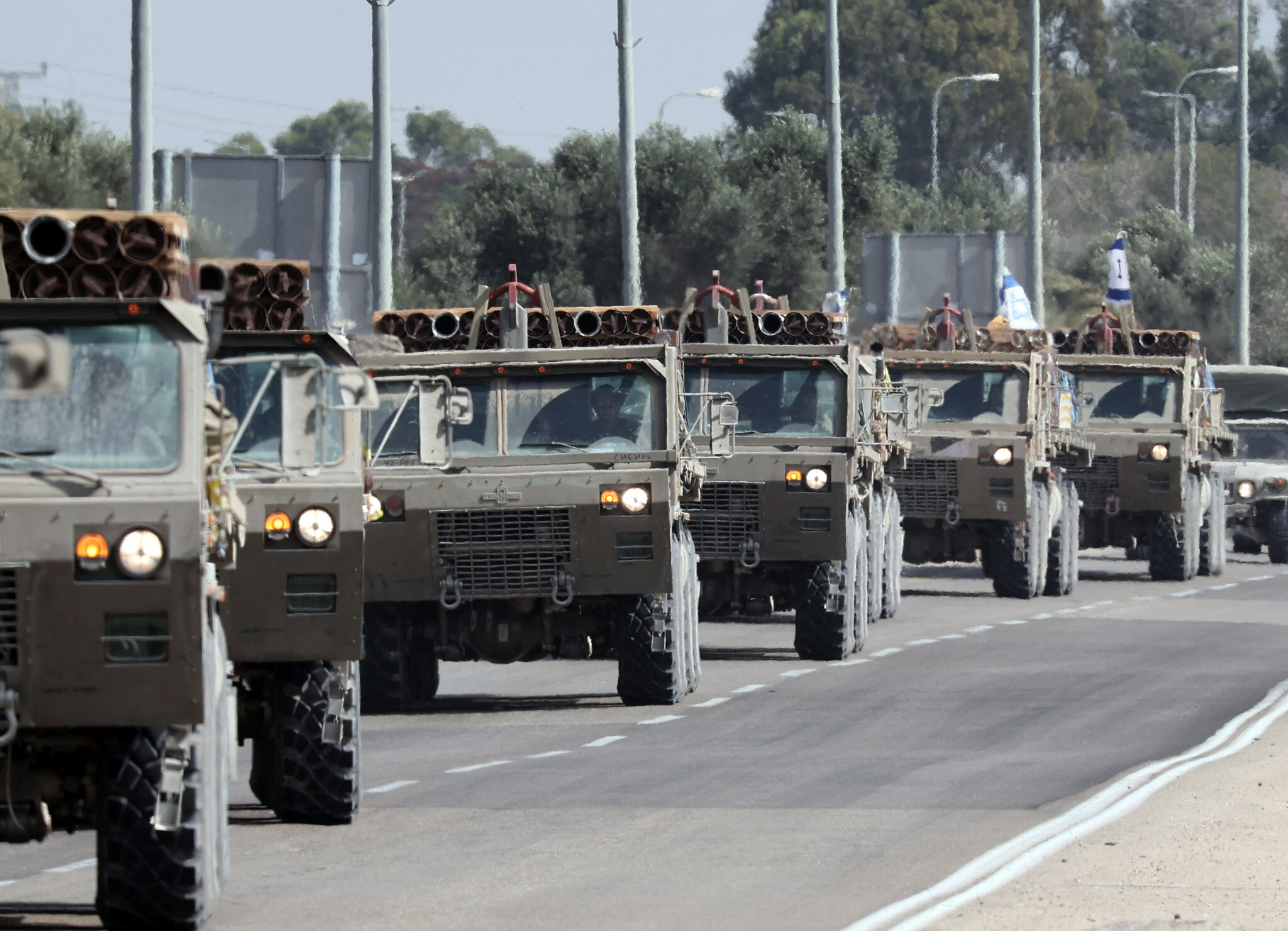
A convoy of Israeli army trucks carrying mortar shells advances on a road near the southern city of Sderot, On October 23, 2023, amid ongoing battles between Israel and the Palestinian group Hamas. (Photo by Thomas COEX / AFP)

White House National Security Council spokesperson John Kirby told reporters on Monday that several senior US Army officers who have experience in “the sorts of operations that Israel is conducting and may conduct in the future” have been dispatched to advise the IDF.

“We have asked several officials with relevant experience simply to help Israeli officials think through the difficult questions ahead and explore their options. The IDF will, as always, make its own decisions,” a Pentagon spokesperson added.

The advisers include Lt. Gen. James Glynn, a Marine three-star general who was involved in operations during the US fight against Islamic State in Iraq, Axios reported.

US Secretary of State Antony Blinken said Sunday that Israel should already be devising a strategy for who will rule Gaza if the IDF completes its stated mission of toppling Hamas.

It appeared to be the first time that Washington publicly urged Israel to think about its broader strategy, after officials speaking anonymously earlier said Biden and administration officials have privately been pressing Netanyahu and his aides to come up with one, in order to avoid making the same mistakes that the US made after the attacks of September 11, 2001, which led to it being bogged down in Mideast wars for over a decade.

Israeli officials have said publicly that they are currently focused on eradicating Hamas and are not thinking about what might come afterward.

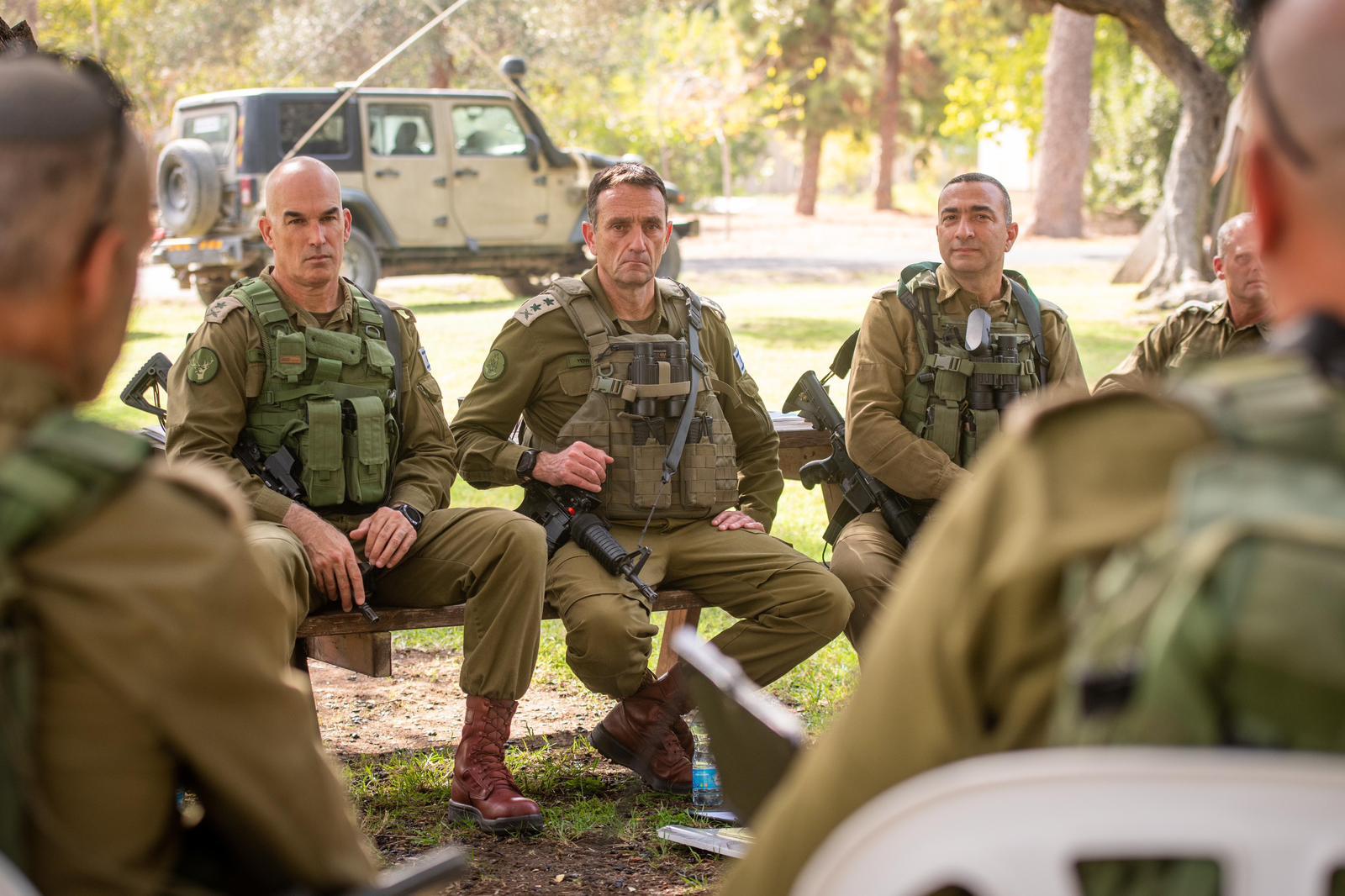
IDF Chief of Staff Lt. Gen. Herzi Halevi (center) speaks to commanders of the 146th Division in northern Israel, October 23, 2023. (Israel Defense Forces)

On Monday, The Times of Israel learned that the IDF believes it must begin its ground offensive sooner rather than later in order to achieve the government’s stated objectives.

The military has told the government that it is fully prepared for a ground offensive in the Gaza Strip, and believes it can achieve the goals set out for it, even at the risk of heavy casualties to soldiers, and amid ongoing attacks by Hezbollah in the north.

But the military fears that the government may not ever give the order to begin the ground offensive, or postpone it for a lengthy period.

Should the army need to move its focus to the northern front instead of Gaza, it is confident that it could pivot within just a few days. The IDF has already heavily bolstered the Lebanon border, but most forces remain near Gaza, ahead of the expected ground offensive.

Regarding the 220 confirmed hostages held by Hamas and other terror groups in the Gaza Strip, the military has been preparing for the possibility of rescue operations amid the ground offensive, according to information seen by The Times of Israel.

The army is concerned that further hostage releases by Hamas could lead the political leadership to delay a ground incursion or even halt it midway. Still, the IDF believes that an offensive may actually pressure Hamas to release further hostages.


Addressing this turbulent situation requires careful consideration of regional dynamics, diplomatic efforts and an understanding of the shared goals and motivations that drive these terrorist groups.

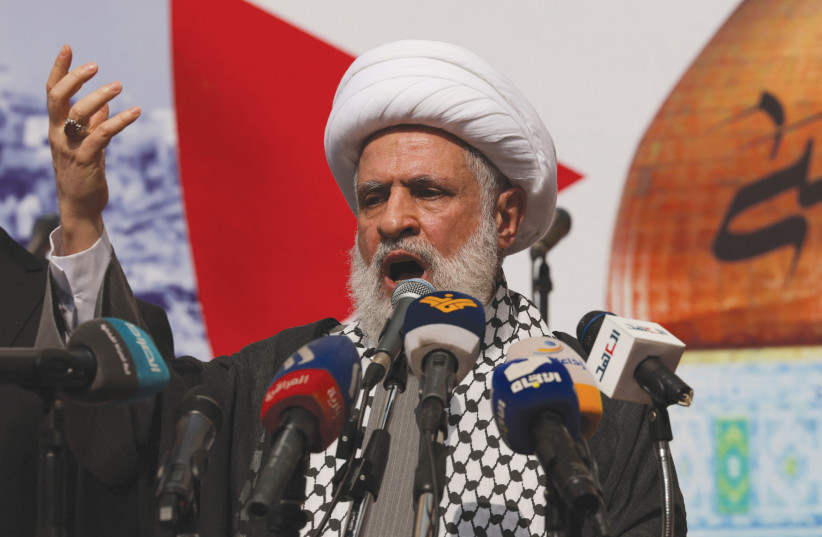
 HEZBOLLAH DEPUTY leader Sheikh Naim Qassem speaks in Beirut, at a rally supporting Palestinians in Gaza (photo credit: ZOHRA BENSEMRA/REUTERS)
HEZBOLLAH DEPUTY leader Sheikh Naim Qassem speaks in Beirut, at a rally supporting Palestinians in Gaza
(photo credit: ZOHRA BENSEMRA/REUTERS)
The IDF has been conducting targeted operations against Hezbollah terrorist targets in Lebanon. It has reported successful strikes on several Hezbollah targets in the southern region of Lebanon. These targets included an observation post situated near the coastline, from which anti-tank missiles were launched in the direction of Rosh Hanikra last Wednesday.

From one side, Iranian Foreign Minister Hossein Amir-Abdollahian warned on Monday evening that Iran’s proxies around the Middle East could launch preemptive strikes on Israel “in the coming hours. Israeli strikes against Hezbollah in Lebanon come hours after Iran’s foreign minister warned about his country “taking ‘preemptive action.”

Iran’s Supreme Leader Ali Khamenei has issued a warning that if Israel’s attacks on Gaza persist, the “Axis of Resistance” will continue to retaliate. This statement signifies his intention to challenge the United States and Israel. Without a doubt, he has direct involvement in the Hamas attack, and has been given the green light from Russia.

The term “resistance forces,” as cited by Ali Khamenei, refers to a transnational network of terrorist criminal groups that the mullah’s regime in Iran supports, including Islamic terrorists like Hamas, Palestinian Islamic Jihad, Hezbollah in Lebanon, Hashd al-Shaabi in Iraq, the Houthis in Yemen, and entities like the Fatemiyoun and Zainbiyoun brigades in Syria. These terrorist groups have received financial and military support from the Iranian regime, and Iran has been perpetuating and extending conflicts in the region.

Remarkably, Hamas and Hezbollah are two Islamic terrorist organizations with different origins, goals, and operations, but they share certain similarities and have some connections primarily based on their shared villainy against Israel and similar destructive ideology.

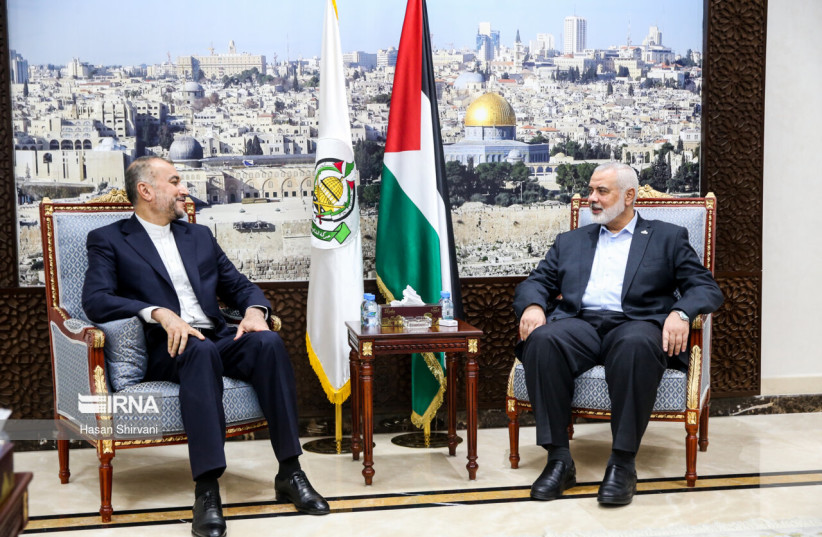
 Iranian Foreign Minister Hossein Amirabdollahian meets with Hamas leader Ismail Haniyeh in Qatar. October 15, 2023 (credit: Hasan Shirvani/IRNA)
Iranian Foreign Minister Hossein Amirabdollahian meets with Hamas leader Ismail Haniyeh in Qatar. October 15, 2023 (credit: Hasan Shirvani/IRNA)

• Ideological and terrorist ties: Both Hamas and Hezbollah are Islamist terrorist organizations that emerged in the late 1980s and early 1990s with a shared goal of attacking Israel and influence in the Middle East. They are both influenced by Shia Islam and share anti-Israel and anti-Western ideologies.

• The anti-Israel stance: Hamas and Hezbollah are united in their opposition to Israel and have engaged in terrorist conflicts with Israel. They both view Israel as a hostile state and seek its elimination.

• Iranian regime’s support: Both terrorist organizations receive significant support from Iran’s outlaw regime, a Shia theocracy. Iran provides financial, military, and logistical support to both Hamas in Gaza, and Hezbollah in Lebanon. Iran sees them as important as the terrorist Islamic Revolutionary Guard Corps (IRGC) in its struggle against Israel and its regional influence efforts. • Terrorism and operational cooperation: While they operate in different regions (Hamas primarily in the Gaza Strip and Hezbollah in Lebanon), they have exchanged military tactics and strategies. They share experience and expertise in guerrilla warfare, rocket attacks, and terrorist activities against Israeli targets.

• Training and funding: Hezbollah, with its well-established military structure and experience, has reportedly provided training and assistance to Hamas in terms of military tactics and organization. Additionally, both groups receive funding and support from IRGC terrorists and the Quds Force in Iran.

• Political alignment: Hamas and Hezbollah share some common ideological goals, including Islamic terrorism against Israel. They cooperate on certain diplomatic and political fronts, especially within the context of the Palestinian-Israeli conflict and broader regional dynamics. It’s important to note that while they share some commonalities and receive support from similar sources, they remain terrorist organizations with their own specific objectives and operational areas. Hamas primarily focuses on the Palestinian territories, especially the Gaza Strip, while Hezbollah is based in Lebanon.

• Iran’s regional ambitions: Hezbollah and Hamas in a unified front against Israel analysis: Iran’s influence in the Middle East has been a subject of global interest and concern for many years. One aspect of this vicious influence is its support for various terrorist organizations, such as Hezbollah in Lebanon and Hamas in the Gaza Strip, both of which share a common goal of opposing Israel.

The possibility of Iran pushing Hezbollah to join forces with Hamas in a war against Israel was crystal clear. The potential implications of such an alliance on the geopolitical landscape of the region should be considered. Iran has long been a supporter of Hezbollah and Hamas, providing them with financial, military, and ideological support. Hezbollah, based in Lebanon, has a history of terrorist conflict with Israel and is considered a powerful terrorist militia in the region. Hamas, based in the Gaza Strip, has also engaged in numerous terrorist conflicts with Israel and has strong ideological ties with the Iranian mullah’s regime.

• Shared objectives and ideological alignment: Iran supports both Hezbollah and Hamas due to their shared objective of opposing Israel and their ideological alignment as Islamist terrorist militant groups. Their common goal of governing Palestinian territories and their terrorist activities against Israel serve as a basis for potential collaboration.

• Military synergy and strategic alliance: Iran may see potential benefits in encouraging Hezbollah to collaborate with Hamas. Hezbollah possesses significant military capabilities and expertise, and joining forces with Hamas could create a more potent and coordinated front against Israel. Such an alliance could amplify their ability to launch coordinated attacks, engage in terrorist guerrilla warfare, and escalate the conflict strategically.

• Regional geostrategic calculations: Iran’s interest in promoting a united front against Israel is driven by its desire to establish regional dominance and reduce Israel’s influence in the Middle East. Encouraging cooperation between Hezbollah and Hamas allows Iran to further its geopolitical ambitions and strengthen its position as a major player in the region.

Potential implications of the alliance: 

An alliance between Hezbollah and Hamas could lead to a significant escalation of the conflict. The increased military capabilities and strategic coordination could result in more intense and prolonged conflicts, causing human suffering and instability in the region.

Such an alliance could potentially shift the balance of power in the Middle East, challenging the existing geopolitical dynamics and alliances. Israel and its allies may need to reassess their strategies and responses to effectively counter this new collaborative front.

The alliance might also pose challenges to diplomatic efforts and the peace process in the Middle East. The united front against Israel could undermine negotiation initiatives and dialogue, making the resolution of the Israeli-Palestinian conflict even more challenging.

In conclusion, while the idea of Hezbollah and Hamas forming a joint alliance against Israel is a possibility, the geopolitical implications of such a collaboration are substantial. Iran’s support for these groups and potential encouragement of this alliance underscores the complex and multifaceted dynamics in the Middle East.

Addressing this turbulent situation requires careful consideration of regional dynamics, diplomatic efforts, and an understanding of the shared goals and motivations that drive these terrorist groups and their supporters.

The Tehran regime plays a significant role in perpetuating and extending warfare, acting as a source of turmoil and Islamic terrorism, so that the terrorist-loving mullahs are the source of mayhem and instability. A bunch of criminal mullahs are ruling the civilized nation.

The writer is a counterterrorism analyst and Middle East studies researcher based in Washington. He is a Jewish Kurd of Iran and the author of The Gruesome Mullah. See more at www.erfanfard.com.