Israel uncovers ancient Christian inscription from Book of Psalms

Unearthing ancient faith: A Byzantine Greek inscription paraphrasing verse 86 in the Book of Psalms was found in an ancient fortress in the Judean Desert.
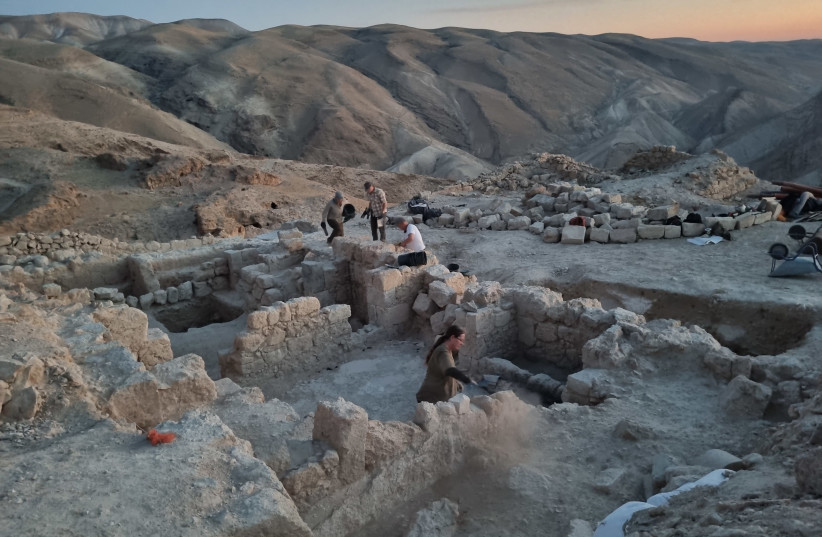
 The archeological team cleans the Hyrcania site. (photo credit: Dr. Oren Gutfeld and Michal Haber)
The archeological team cleans the Hyrcania site.
(photo credit: Dr. Oren Gutfeld and Michal Haber)
Archaeologists at the remote site of Hyrcania in the Judean Desert have unearthed a rare Byzantine Greek inscription paraphrasing a verse from the Book of Psalms. The excavation project is headed by archaeologists at the Hebrew University of Jerusalem.

Hyrcania was an ancient fortress built by Hasmonean ruler John Hyrcanus or his son Alexander Jannaeus in the second or first century BCE. The readable text is a paraphrase of Psalms 86: 1-2, known as “a prayer of David.” While the original lines are, “Hear me, Lord, and answer me, for I am poor and needy. Guard my life, for I am faithful to you,” the Hyrcania version reads: “Jesus Christ, guard me, for I am poor and needy.”

Built upon an imposing, artificially leveled hilltop situated about 17 kilometers southeast of Jerusalem and eight kilometers southwest of Qumran and the Dead Sea, it was one of a series of desert fortresses later rebuilt and enlarged by Herod the Great. The most famous of these strongholds are Masada and Herodion.

The inscription is in Koine Greek – biblical Greek or New Testament Greek that was the common supra-regional form of Greek that was spoken and written during the Hellenistic period, the Roman Empire, and the early Byzantine Empire that served as the lingua franca of much of the Mediterranean region and the Middle East during the following centuries.

Adorned with a cross, the Byzantine-era inscription was likely made by a knowledgeable monk and holds significance as a well-known prayer in the Masoretic text and Christian liturgy. An analysis of the script’s style suggests a dating no later than the first half of the sixth century CE, which was the height of the Byzantine era, and with minor grammatical errors, revealing the scribe’s mother tongue to be Semitic.
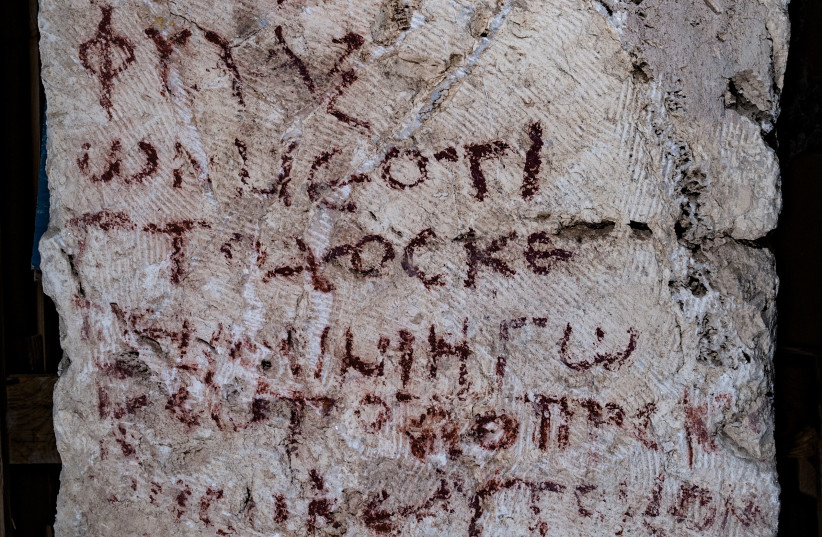
 The Greek inscription at the Hyrcania site. (credit: Dr. Oren Gutfeld and Michal Haber)
The Greek inscription at the Hyrcania site. (credit: Dr. Oren Gutfeld and Michal Haber)

Christian resettlement of the site

Shortly after the death of the latter in 4 BCE, Hyrcania lost its importance and was abandoned. It would then lie desolate for nearly half a millennium until the establishment of a small Christian monastery among its ruins in 492 CE by the monk Holy Sabbas, an expression of the monastic movement that took shape in the Judean Desert with the rise of the Byzantine period.

Dubbed Kastellion, or “Little Castle” in Greek, the monastery remained active past the Islamic conquest of Byzantine Palestine around 635 CE but was apparently abandoned by the early ninth century. The site is known also by its Arabic moniker, Khirbet el-Mird (“Ruins of the Fortress).” Attempts were made in the 1930s to revive the monastery, but harassment by local Bedouin cut short the venture.

Although a few isolated investigations of the site had been sporadically attempted in the past, no methodological, academic archaeological excavation had ever been conducted until now. Complex access and logistics have long played a role.

A Hebrew University team led by Dr. Oren Gutfeld and Michal Haber, with the support of Carson-Newman University (Jefferson City, Tennessee) and American Veterans Archaeological Recovery, recently spent four weeks at the site, uncovering key evidence of its remarkable history.

During this initial “pilot” season, efforts were focused mostly on two key areas. In the southeastern corner of the summit, a segment of the prominent upper fortification line was uncovered – a vital component of the Second Temple-period fortress dating back to the late second or first century BCE.

This discovery prompted Gutfeld to note: “There are certain architectural elements within these fortifications that strongly recall those of Herodium – all part of Herod’s extraordinary vision. It’s quite possible that the construction was even overseen by the same engineers and planners. It’s not by chance that we call Hyrcania ‘Herodium’s little sister.’”

In the northeast, the team peeled away a deep collapsed layer of building stones to unearth an elongated hall lined with piers, part of the lower level of an expansive compound constructed of finely drafted stones. Its original date of construction has yet to be determined, though it likely comprised part of the monastery.

Over the course of excavation, a sizable building stone was discovered lying on the plastered floor of the hall, bearing lines of text painted in red with a simple cross at its peak. Haber and Gutfeld immediately recognized the inscription as written in the New Testament’s Koine Greek but called on their colleague Dr. Avner Ecker of Bar-Ilan University, an expert epigraphist, to decipher it.

“This psalm holds a special place in the Masoretic text as a designated prayer and is notably one of the most frequently recited psalms in Christian liturgy,” Ecker said. “Thus, the monk drew a graffito of a cross onto the wall, accompanied by a prayer with which he was very familiar.”

Judging by the epigraphic style, he assigned the inscription a date within the first half of the sixth century CE.Ecker also cited the presence of a few grammatical errors typical of Byzantine Palestine that can be attributed to individuals whose native language was a Semitic one. He suggested that “these minor errors indicate that the priest was not a native Greek speaker, but likely someone from the region who was raised speaking a Semitic language.”

A few days following this initial discovery, an additional inscription was found in close proximity. It was also inscribed on a building stone from a collapsed wall and is currently undergoing analysis.

Haber emphasized the profound significance of these findings and said: “Few items hold such importance in the historical and archaeological record as do inscriptions, and it must be stressed that these are virtually the first examples from the site to have originated in an orderly, documented context. We are familiar with the papyrus fragments that came to light in the early 1950s, but they are all of shaky, unreliable provenance. These recent discoveries are truly exceptional.”

In addition, a child-sized gold ring, a little over one centimeter in diameter and adorned with a turquoise stone, was found on site. What adds to the special nature of the discovery is the miniature inscription incised in Arabic Kufic script on the stone.

Dr. Nitzan Amitai-Preiss, an expert in Early Arabic epigraphy at HU, was able to decipher the inscription as “Mashallah,” which translates to “God has willed it.” She dated the script style to the time of the Umayyad caliphate, which reigned during the seventh and eighth centuries CE.

Amitai-Preiss also observed a unique feature in the inscription: Two of the three words were mirror images, strongly suggesting that the ring may have originally served as a seal.

The origin of the turquoise stone itself adds another layer of historical intrigue. It was likely sourced in the newly conquered territory of the Sassanid Empire (modern-day Iran), part of the expanding Umayyad Caliphate. The exact path this remarkable artifact took to reach Hyrcania remains a mystery, as is the identity of whoever wore it.

The team is eagerly anticipating the next excavation season, which is scheduled for early 2024 in a continued collaborative effort with Carson-Newman University and American Veterans Archaeological Recovery.

Benny Har-Even, the staff officer for archaeology at the Civil Administration of Judea and Samaria, said: “The Civil Administration will continue its tireless efforts to preserve and develop the archaeological sites throughout Judea and Samaria. We are delighted to work in cooperation with leading Israeli academic institutions and all parties involved in the archaeology of the Land of Israel to reveal the ancient and rich past of the area.”

Dr. Stephen Humphreys, founder and CEO of American Veterans Archaeological Recovery, said: “Our organization serves to provide military veterans with challenging fieldwork opportunities, then gives them the support tools and training they need to excel… At Hyrcania, we saw the entire project team bond over the physical challenges and excitement of excavating this exceptional site. The training our veterans received at the site from the HU team will also make them more employable and better prepared to continue engaging with the field.”

Alongside their excitement, Haber and Gutfeld said they remained acutely aware of the complexities of safeguarding such a site. They emphasized the support they have received from the Staff Office of Archaeology of the Civil Administration in combating the ongoing phenomenon of antiquities looting.

“We are aware that our excavations will draw the attention of looters,” they said in a statement. “The problem persists; it was here before us and will likely continue after us, underscoring the need for academic excavation – particularly in such a sensitive site as Hyrcania, though this is just one example. We are simply trying to stay a few steps ahead.”
“The normalization will be between Israel and Saudi Arabia. If the Palestinians oppose it the kingdom will continue in its path,” according to one regional source.

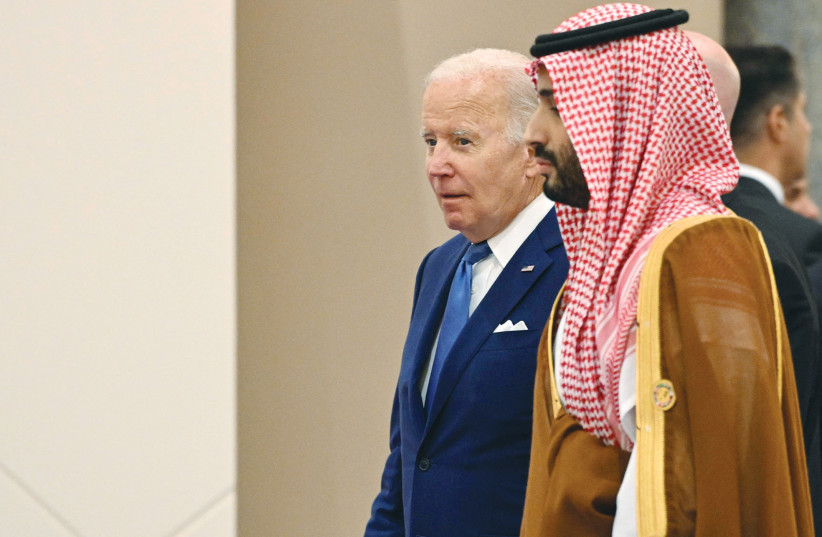
 US PRESIDENT Joe Biden and Saudi Crown Prince Mohammed bin Salman attend the Gulf Cooperation Council +3 meeting in Jeddah, last summer. (photo credit: MANDEL NGAN/REUTERS)
US PRESIDENT Joe Biden and Saudi Crown Prince Mohammed bin Salman attend the Gulf Cooperation Council +3 meeting in Jeddah, last summer.
(photo credit: MANDEL NGAN/REUTERS)
Saudi Arabia is determined to secure a military pact requiring the United States to defend the kingdom in return for opening ties with Israel and will not hold up a deal even if Israel does not offer major concessions to Palestinians in their bid for statehood, three regional sources familiar with the talks said.

A pact might fall short of the cast-iron, NATO-style defense guarantees the kingdom initially sought when the issue was first discussed between Crown Prince Mohammed bin Salman and Joe Biden during the US president’s visit to Saudi Arabia in July 2022.

Instead, a US source said it could look like treaties Washington has with Asian states or, if that would not win US Congress approval, it could be similar to a US agreement with Bahrain, where the US Navy Fifth Fleet is based. Such an agreement would not need congressional backing.

Washington could also sweeten any deal by designating Saudi Arabia a Major Non-NATO Ally, a status already given to Israel, the US source said.

But all the sources said Saudi Arabia would not settle for less than binding assurances of US protection if it faced attack, such as the Sept. 14, 2019 missile strikes on its oil sites that rattled world markets. Riyadh and Washington blamed Iran, the kingdom’s regional rival, although Tehran denied having a role.

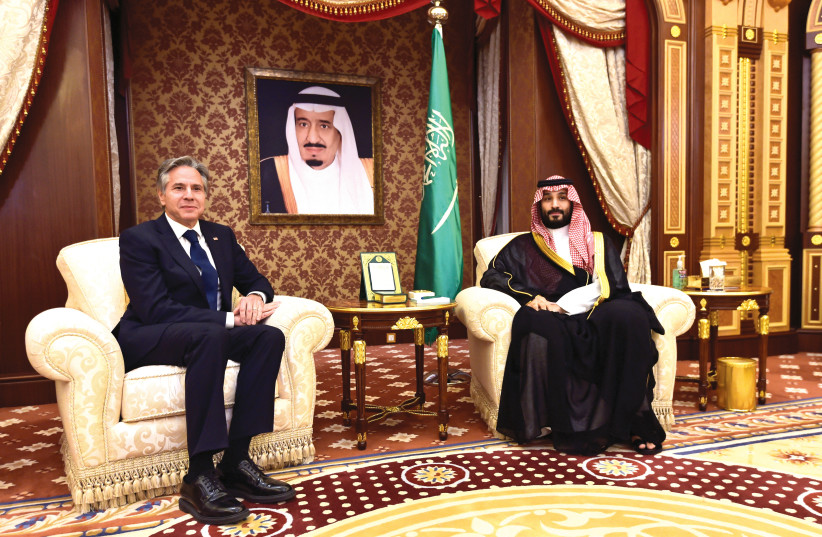
Saudi Arabia's Crown Prince Mohammed bin Salman meets with US Secretary of State Antony Blinken in Jeddah, earlier this month. (credit: AMER HILABI/REUTERS)
Saudi Arabia’s Crown Prince Mohammed bin Salman meets with US Secretary of State Antony Blinken in Jeddah, earlier this month. (credit: AMER HILABI/REUTERS)

Agreements giving the world’s biggest oil exporter US protection in return for normalization with Israel would reshape the Middle East by bringing together two longtime foes and binding Riyadh to Washington after China’s inroads in the region. For Biden, it would be a diplomatic victory to vaunt before the 2024 US election.

The Palestinians could get some Israeli restrictions eased but such moves would fall short of their aspirations for a state. As with other Arab-Israeli deals forged over the decades, the Palestinian core demand for statehood would take a back seat, the three regional sources familiar with the talks said.

Saudis will normalize relations with Israel, even without the Palestinians

“The normalization will be between Israel and Saudi Arabia. If the Palestinians oppose it the kingdom will continue in its path,” said one of the regional sources. “Saudi Arabia supports a peace plan for the Palestinians, but this time it wanted something for Saudi Arabia, not just for the Palestinians.”

The Saudi government and the US State Department did not respond to emailed questions about this article.

‘Less than a full treaty’

A US official, who like others declined to be named because of the sensitivity of the matter, said the parameters of a defense pact were still being worked out, adding that what was being discussed “would not be a treaty alliance or anything like that … It would be a mutual defense understanding, less than a full treaty.”

The official said it would be more like the US relationship with Israel, which receives the most advanced US weapons and holds joint air force and missile defense drills.

A source in Washington familiar with the discussions said MbS had asked for a NATO-style treaty but said Washington was reluctant to go as far as NATO’s Article 5 commitment that an attack on one ally is considered an attack on all.

The source said Biden’s aides could consider a pact patterned on those with Japan and other Asian allies, under which the US pledges military support but is less explicit about whether US troops would be deployed. However, the source said some US lawmakers might resist such a pact.

Another template, which would not need congressional approval, would be the agreement signed with Bahrain on Sept. 13, in which the US pledged to “deter and confront any external aggression” but also said the two governments would consult to determine what, if any, action would be taken.

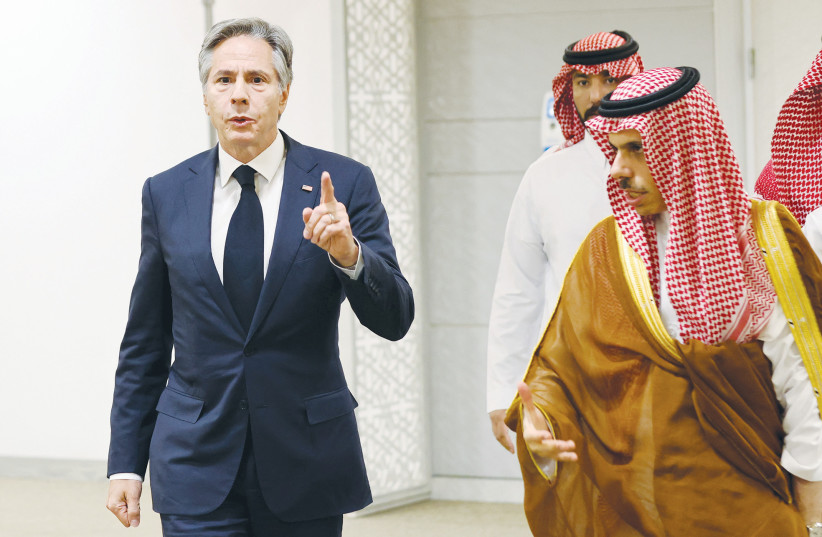
 US SECRETARY of State Antony Blinken walks with Saudi Arabia’s Foreign Minister Prince Faisal bin Farhan during a visit to Riyadh, in June.  (credit: Ahmed Yosri/Reuters)
US SECRETARY of State Antony Blinken walks with Saudi Arabia’s Foreign Minister Prince Faisal bin Farhan during a visit to Riyadh, in June. (credit: Ahmed Yosri/Reuters)

The source in Washington said Saudi Arabia could be designated a Major Non-NATO Ally, a step which had long been considered. This status, which several Arab states such as Egypt have, comes with a range of benefits, such as training.

The second of the regional sources said Riyadh was compromising in some demands to help secure a deal, including over its plans for civilian nuclear technology. The source said Saudi Arabia was ready to sign Section 123 of the US Atomic Energy Act, establishing a framework for US peaceful nuclear cooperation, a move Riyadh previously refused to take.

The Gulf source said the kingdom was prepared to accept a pact that did not match a NATO Article 5 guarantee but said the US had to commit to protecting Saudi Arabia if its territory was attacked. The source also said a deal could be similar to Bahrain’s agreement but with extra commitments.

Seeking Israeli commitments

Israel’s Prime Minister Benjamin Netanyahu has hailed the possibility of a “historic” peace with Saudi Arabia, the heartland of Islam. But to secure the prize, Netanyahu has to win the approval of parties in his a far-right coalition which reject any concessions to the Palestinians.

MbS said in a Fox News interview this month that the kingdom was moving steadily closer to normalizing ties with Israel. He spoke about the need for Israel to “ease the life of the Palestinians” but made no mention of Palestinian statehood.

Nevertheless, diplomats and the regional sources said MbS was insisting on some commitments from Israel to show he was not abandoning the Palestinians and that he was seeking to keep the door open to a two-state solution.

Those would include demanding Israel transfer some Israeli-controlled territory in the West Bank to the Palestinian Authority (PA), limit Jewish settlement activity and halt any steps to annex parts of the West Bank. Riyadh has also promised financial aid to the PA, the diplomats and sources said.

Palestinian President Mahmoud Abbas has said any bargain must recognize the Palestinian right to a state within the 1967 borders, including East Jerusalem, and must stop Israeli settlement building. However, all the sources said a Saudi-Israeli deal was unlikely to address those flashpoint issues.

Netanyahu has said Palestinians should not have a veto over any peacemaking deal.

Yet, even if the US, Israel, and Saudi Arabia agree, winning support from lawmakers in the US Congress remains a challenge.

Republicans and those in Biden’s Democratic Party have previously denounced Riyadh for its military intervention in Yemen, its moves to prop up oil prices, and its role in the 2018 killing of Saudi journalist Jamal Khashoggi, who worked for the Washington Post. MbS denied ordering the killing.

“What’s important for Saudi Arabia is for Biden to have the pact approved by Congress,” the first regional source said, pointing to concessions Riyadh was making to secure a deal.

For Biden, a deal that builds a US-Israeli-Saudi axis could put a brake on China’s diplomatic inroads after Beijing brokered a rapprochement between Saudi Arabia and Iran, which Washington accuses of seeking nuclear arms. Tehran denies this.

“There was a sense that the US has abandoned the region,” said one diplomat. “By courting China, the Saudis wanted to create some anxiety that will make the US re-engage. It has worked.”


A senior Israeli official said Netanyahu agreed to the principle in general.

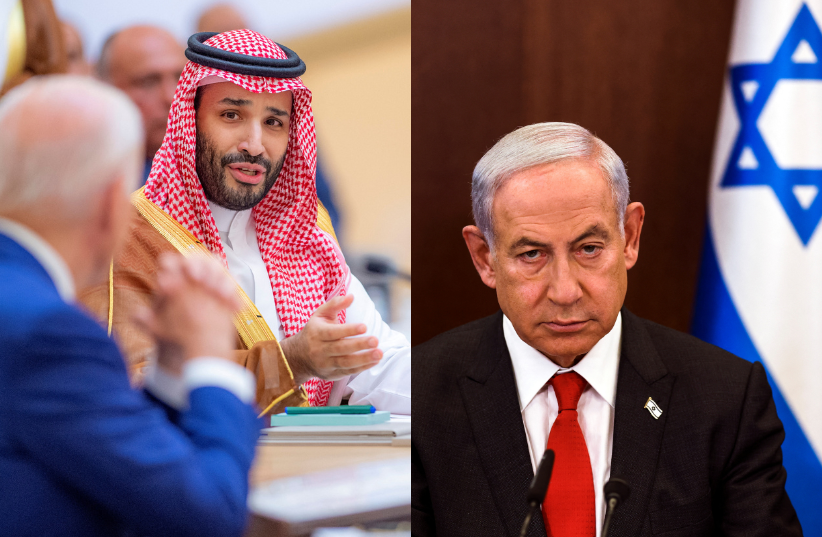
 (L-R) US President Joe Biden, Saudi Crown Prince Mohammed Bin Salman and Prime Minister Benjamin Netanyahu (photo credit: VIA REUTERS)
(L-R) US President Joe Biden, Saudi Crown Prince Mohammed Bin Salman and Prime Minister Benjamin Netanyahu
(photo credit: VIA REUTERS)
Prime Minister Benjamin Netanyahu and US President Joe Biden have agreed that the possibility of a two-state solution between Israel and the Palestinians must be kept open for any future Israel-Saudi deal, according to Israeli media reports.

According to the report, Biden did not give Netanyahu a list of demands for concessions for the Palestinians as part of an agreement with Saudi Arabia but emphasized that he expects steps that will keep the door open to a future Israeli-Palestinian peace agreement. A senior Israeli official said Netanyahu agreed to the principle in general and now the challenge will be how to translate this into practical steps.

This is a breaking story