Media outlets affiliated with the opposition in Syria reported overnight Sunday on an Israeli attack in the town of Al-Dimas, northwest of Damascus.
The Syrian website Voice of the Capital reported that the attack was aimed at an Iranian arms shipment that was going to be transferred to Lebanese territory.
The Syrian Observatory for Human Rights reported three explosions that took place in Damascus’s western suburb. As of now, Syrian officials have not commented on the reports.
A Canadian peacekeeping aircraft crashed after being shot down by three Syrian surface-to-air missiles on August 9, 1974 in Al-Dimas.
US nuclear report: Iran not pursuing a weapons program at this time, has the capacity to produce…a nuclear device in less than two weeks.
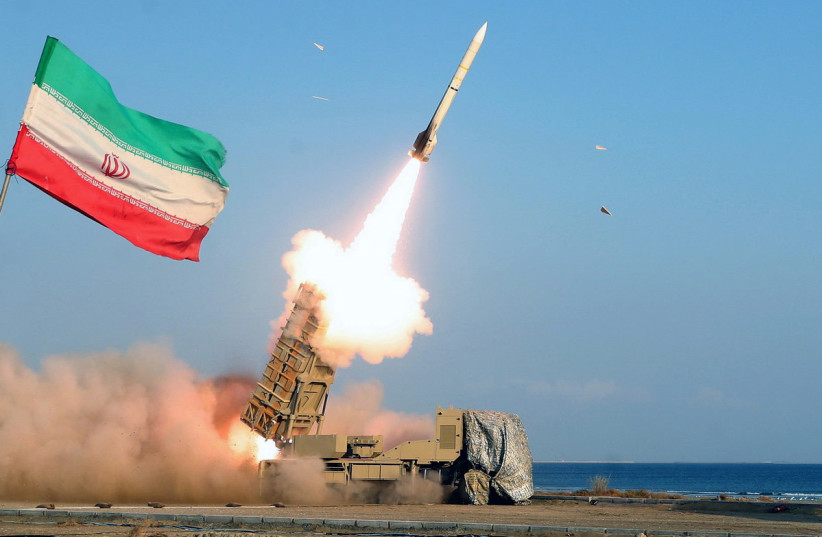
By JERUSALEM POST STAFFA missile is launched during an annual drill in the coastal area of the Gulf of Oman and near the Strait of Hormuz, Iran(photo credit: REUTERS)
Iran is not pursuing a nuclear weapons program at this time, the United States assessed in a newly released report on countering weapons of mass destruction published on Friday.
The report, titled 2023 Strategy for Countering Weapons of Mass Destruction, identified the Islamic Republic as a “persistent threat” and warned that it could build a nuclear weapon in two weeks.
“Iran not pursuing a nuclear weapons program at this time, but has the capacity to produce enough fissile material for a nuclear device in less than two weeks,” the report noted.
In the report, the US criticized Iran for its noncompliance with obligations made under the Chemical Weapons Convention and voiced concerns that Tehran is pursuing “dual-use central nervous system-acting chemicals for offensive purposes.”
The report also identified the Islamic Republic as a “regional threat” to the Middle East that must be addressed.
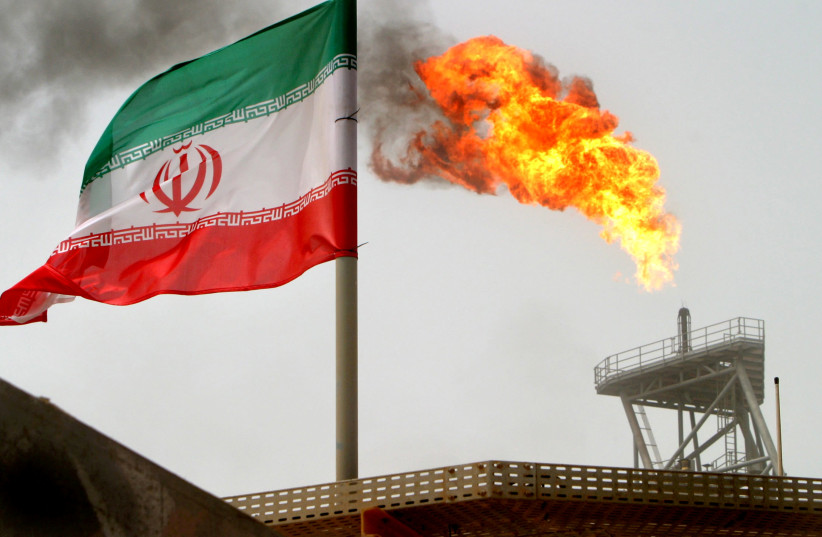
A gas flare on an oil production platform in the Soroush oil fields is seen alongside an Iranian flag in the Persian Gulf, Iran, July 25, 2005 (credit: RAHEB HOMAVANDI/REUTERS)
Israel: Iran continues to test its nuclear program
Last week, Israel’s Atomic Energy Commission director-general claimed that Iran is conducting a military nuclear program and continues to test and deploy long-range nuclear missiles in violation of the UN Security Council.
“Iran is still the spearhead of regional instability, and is a threat to peace and security worldwide,” Edri said as he addressed the 67th International Atomic Energy Agency’s General Conference in Vienna.
Halting Iran’s nuclear weapons activity requires the “full attention of the international community,” Edri stated.
It’s impossible not to see that BRICS is now becoming more heavily tied to the Middle East.
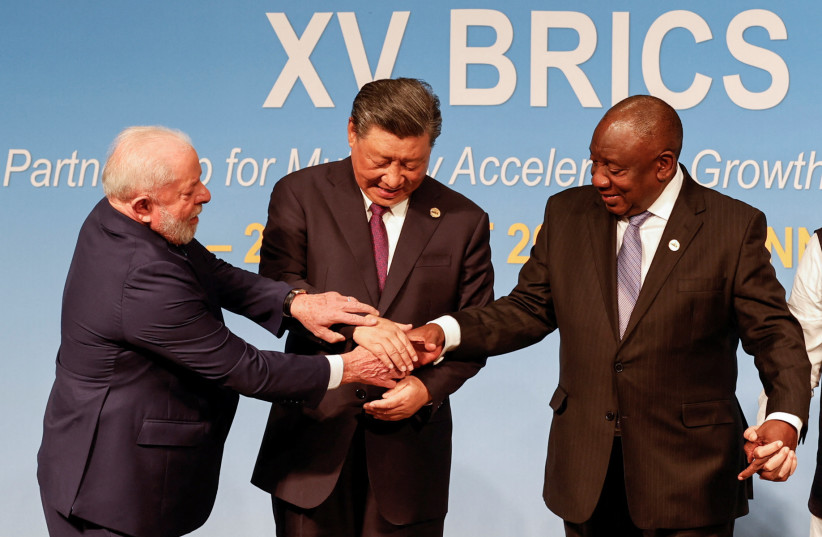
By SETH J. FRANTZMANUpdated: SEPTEMBER 30, 2023 14:15President of Brazil Luiz Inacio Lula da Silva, President of China Xi Jinping and South African President Cyril Ramaphosa gesture during the 2023 BRICS Summit at the Sandton Convention Centre in Johannesburg, South Africa on August 23, 2023(photo credit: GIANLUIGI GUERCIA/POOL VIA REUTERS)
Iran and other countries are joining the BRICS group of countries in the wake of the fifteenth summit of BRICS which took place in South Africa in August.
For Iran, this matters because it is gambling that the group, made up of Brazil, Russia, India, China, and South Africa, will shift the global balance of power. Iran has long believed a multi-polar world will emerge that will challenge the US-led world order that emerged in the 1990s. Iran sees BRICS as part of the new world order.
The Iranian agenda can be seen in a recent long article at Fars News, a pro-regime outlet that tends to parrot the regime’s long-term strategy and agenda.
What do we know about the BRICS expansion?
During a recent meeting in South Africa, South African President Cyril Ramaphosa invited the leaders of 67 countries to the summit. BRICS also announced its expansion to include Argentina, Egypt, Ethiopia, Iran, Saudi Arabia, and the United Arab Emirates. Membership for them begins in January 2024.
It’s impossible not to see that BRICS is now becoming more heavily tied to the Middle East. This matters because China is a key player and it wants to see more ties to the region. China also has used the SCO to reach out to the Middle East. Iran wants to be fully integrated into this new setup, positioning itself with China and Russia.
Iran’s current leadership wants to shift towards a focus on the East.
The new report at Fars said that “one of the most important events of this BRICS meeting for Iran was the official invitation of Iran and the five countries of Argentina, Saudi Arabia, and Egypt, UAE and Ethiopia for permanent membership in this group.” This is interesting because Iran only recently reconciled with Saudi Arabia, an initiative undertaken with the help of Iraq and China.
Iran has also only recently patched things up with the UAE and Egypt. Yet Iran now sees these countries and their role in BRICS as important.
“Although the new members of BRICS are developing countries, they have been able to show their importance to the economic powers of the world in the last few years, the analysis of the statements of the leaders of the member countries shows that the members of BRICS are not limited to economic cooperation. Even though the rapid economic growth These countries first brought them together, but the members of this group are now trying to act more actively in the political equations of the world,” the Fars report says. This hints at a lot going on behind the scenes in Tehran’s calculations.
Iran sees a number of impacts of the BRICS expansion. Fars reached out to Yahya Lotfi Nia, an expert on trade to discuss the new impact of the BRICS story. The expert characterized BRICS as a rival of the Western-led G7. The article highlights macroeconomic variables, such as population and production growth; as well as the impact on economic and policy-making power.
Some of the other issues discussed involved the importance of energy producers such as the UAE, Saudi Arabia and Iran and also the issue of “sensitive waterways” relating to Argentina and Ethiopia. It was not clear what this meant in relation to Argentina unless it refers to the Rio de la Plata, a wide river that forms the border between Argentina and Uruguay.
According to the Iranian Fars report the expansion of BRICS will add some 415 million people to a group that already has 3.2 billion members via the member states. Iran has a population of 88 million. The new states will add around ten percent to the annual production totals of the block. Saudi Arabia is the biggest contributor among the new states. “The export of the BRICS group is expected to grow by 17.3%. and reach about $46.3 trillion dollars,” the report said.
“Among the newly invited members, the United Arab Emirates exports the most with $335 billion dollars.”
Iran seeking new economic capacities amid US sanctions
The real story, from Iran’s perspective, is that the “BRICS group is seeking to create new economic and political capacities for itself in contrast to the global unipolar system centered and led by the United States.”
This matters to Tehran. It may matter less to the other states that joined; they may merely want to expand their membership and integration with various global blocs. They may be hedging their bets. Iran is not hedging, it wants to go all-in.
Iran also likes the BRICS has geographical diversity. The countries joining and which are members are where Iran has been putting its focus recently, such as in South America, Africa and Asia.
Iran also cares about getting outside of Western sanctions.
The report goes on to note that “it is possible, with the increase of economic ties between Iran and the United Arab Emirates, the pressures of economic sanctions will be reduced even more….the members of the group will increase and their political and economic ties will be strengthened. Iran believes it may make inroads with another 60 countries through what it believes is this new global order.