Biden’s Iran hostage deal imperils Israel and the rest of the world

September 13, 2023 | Washington Examiner


This week’s U.S.-brokered hostage exchange with Iran has Jerusalem on edge. The United States is providing Israel’s greatest adversary with billions in sanction relief while making major nuclear concessions that will only empower the regime in Tehran and put Israel, and the rest of the world, in peril.

The administration notified Congress on Monday that it intends to release $6 billion in frozen funds in exchange for five American hostages being held by Iran. The deal amounts to a ransom payment that will fund the terror-sponsoring regime’s malign activities across the Middle East while doing nothing to curb Iran’s progress toward a nuclear weapon. Israel’s leaders are more than justified in their concern.

First and foremost, Jerusalem is questioning the Biden administration’s commitment to preventing a nuclear Iran. The deal will do nothing to punish the regime for enriching uranium at 60%, which represents the vast majority of the effort to enrich to weapons-grade uranium. In essence, Washington is enabling the Iranian regime to remain on the cusp of weapons-grade nuclear enrichment — an estimated 1-2 weeks from breakout. This may explain why Ron Dermer, Israel’s minister of strategic affairs and close confidant of Prime Minister Benjamin Netanyahu, traveled to Washington last month to consult with Biden national security adviser Jake Sullivan on the potential for a U.S.-Israel defense pact.

The sanctions relief also poses a grave kinetic threat. Only days after completing the hostage deal, Tehran unveiled a new drone that it claims can reach the Jewish state. The regime continues to prioritize investment in its arms industry to advance its warfighting capabilities in a future clash with Israel. Billions of dollars, despite American claims that the funds will be limited to humanitarian allocations, are almost sure to be invested in these lethal weapons of war. The day after the administration’s announcement, Iranian President Ebrahim Raisi declared that Iran would decide how to spend the money.

But the concerns don’t end there. Iran funds no less than 19 terror organizations on Israel’s borders and has invested heavily in encircling the Jewish state. A former Israeli national security official estimates that Iran spends over a billion dollars a year funding the three most active terror groups whose raison d’etre is to destroy Israel: Hezbollah, Hamas, and Islamic Jihad. Recently, these proxies have demonstrated a new willingness to assume risk and test Israel’s resolve.

Since 2022, an emboldened Hezbollah has regularly violated the border with Israel with drones, mortars, encampments, and even operatives penetrating Israel to murder Israelis. Iranian proxies in Gaza have stepped up their efforts to export and activate terror cells in the West Bank, where terrorists have unprecedented access to sophisticated U.S.-made firearms and are developing weapons such as IEDs and rockets, all bearing the fingerprints of the Iranian regime.

Some connect the uptick in terror activity to the domestic upheaval in Israel. In truth, the trend of escalation began long before the Netanyahu government’s controversial judicial reform legislation was on the table. Nevertheless, terror leaders across the region have delighted at the spectacle of unrest in Israel. Amid reports of reservists refusing to serve, Netanyahu may be reticent to order a major operation to neutralize these recent threats.

Of course, Israel is not alone in its concerns over the deal. The Kingdom of Saudi Arabia is also watching with trepidation, prompting the government to make some new requests of the U.S. and its partners in the region. The asks include the delivery of more sophisticated weapons, signing a defense treaty, and a green light to enrich uranium. And while the Israelis are tempted to acquiesce to these demands to pave the way for a U.S.-brokered normalization deal, the fears of a nuclear cascade, a flood of other Arab states acquiring nuclear capabilities of their own, could threaten Israel’s existence.

The Israeli government must also pause to assess whether the U.S. bowing to Iran’s demands might make Saudi Arabia less inclined to make any deal with Washington. After all, the deal unquestionably strengthens Saudi Arabia’s most dangerous and determined foe.

As with previous nuclear agreements between the U.S. and Iran, Jerusalem fears the new arrangement will put the regime closer to a nuclear bomb with more money in the bank. These fears could provoke a long-anticipated Israeli strike on facilities supporting the Iranian nuclear program. Such a decision would not be taken lightly. An Israeli attack could very likely ignite a regional war, with Israel facing attacks from Iranian proxies on multiple fronts that inflict a heavy cost on the Israeli homeland.

Then again, as Israeli hawks see it, failing to address those threats now will also be self-defeating. As long as America keeps filling Iran’s coffers, these actors are only set to gain power.

Jonathan Schanzer is senior vice president for research at the Foundation for Defense of Democracies, a nonpartisan research institute focusing on national security and foreign policy. Enia Krivine is senior director of FDD’s Israel Program and National Security Network. Follow them on X: @JSchanzer and @EKrivine.

Saudi-owned site says hardline Netanyahu government’s refusal to make concessions to Palestinians at heart of decision to pull away; Israeli officials tell Channel 12 it’s untrue

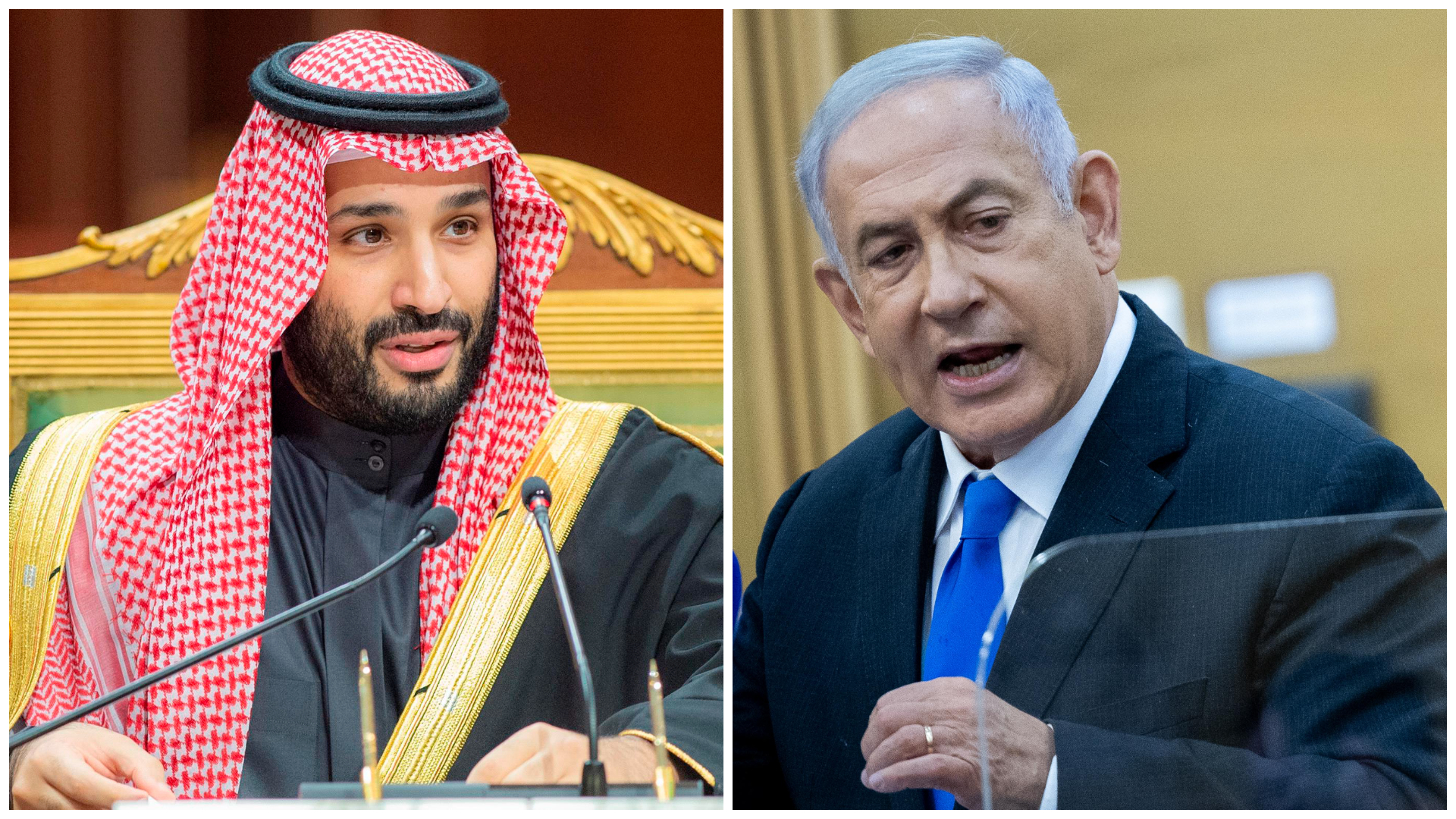
File: Benjamin Netanyahu (right) during a Likud party meeting at the Knesset in Jerusalem on December 13, 2021; Saudi Crown Prince Mohammed bin Salman (left) speaks during the Gulf Cooperation Council (GCC) Summit in Riyadh, Saudi Arabia, December 14, 2022. (Yonatan Sindel/Flash90; Bandar Aljaloud/Saudi Royal Palace via AP)

File: Benjamin Netanyahu (right) during a Likud party meeting at the Knesset in Jerusalem on December 13, 2021; Saudi Crown Prince Mohammed bin Salman (left) speaks during the Gulf Cooperation Council (GCC) Summit in Riyadh, Saudi Arabia, December 14, 2022. (Yonatan Sindel/Flash90; Bandar Aljaloud/Saudi Royal Palace via AP)

A Saudi-owned newspaper reported Sunday that the nation has told the Biden administration it is freezing US-brokered efforts to normalize relations with Israel because Prime Minister Benjamin Netanyahu’s hardline government is unwilling to make any concessions to the Palestinians.

Israeli officials denied the report, telling Channel 12 news it was untrue and talks were ongoing.

According to the report in the Elaph newspaper, citing officials in Netanyahu’s office, the US has informed Israel of the Saudi stance. It said that Israel was “confused” by the move, believing that the Saudis were prepared to move ahead with normalizing ties without linking it to the progress on the Palestinian issue.

The report by the London-based paper’s Israel correspondent singled out the insistence by far-right ministers Bezalel Smotrich and Itamar Ben Gvir that Israel not make any concessions to the Palestinians, adding that without progress with Ramallah, there could be no progress with Riyadh.

Last month, Netanyahu indicated that he was open to gestures to Palestinians if a normalization deal with Saudi Arabia depended on it, and hinted that he would not let coalition members block an agreement.

“Do I think it’s feasible to have that, and do I think that political questions will block it? I doubt it,” Netanyahu told Bloomberg News. “If there’s political will, there will be a political way to achieve normalization and a formal peace between Israel and Saudi Arabia.

Prime Minister Benjamin Netanyahu delivers a speech at the Prime Minister’s Office on September 13, 2023. (Haim Zach/GPO)

“I think there’s enough room to discuss possibilities,” he added.

Netanyahu’s comments were in line with what Foreign Minister Eli Cohen said the day before in an interview with Elaph, which is often seen as a conduit for public messaging between Jerusalem and Riyadh.

“The Palestinian issue will not be an obstacle to peace,” Cohen said.

“We also proved this in the Abraham Accords. We all have an interest in improving life in the areas of the Palestinian Authority.”

But Netanyahu’s far-right coalition partners have ruled out any compromise with the Palestinians.

“We will not make any concessions to the Palestinians. It’s a fiction,” Smotrich, who heads the far-right Religious Zionism party, told Army Radio last month.

Smotrich said that while Israel is interested in the US-brokered deal with Riyadh, “it has nothing to do with Judea and Samaria,” referring to the West Bank by its biblical names.

Finance Minister Bezalel Smotrich speaks during a rally in support of the government’s planned judicial overhaul outside the Supreme Court in Jerusalem, on September 7, 2023. (Arie Leib Abrams/Flash90)

However, in recent weeks the Saudis have stepped up their engagement with Palestinians.

Saudi Arabia will be co-hosting an event on the sidelines of the United Nations General Assembly this week focused on revamping the Israeli-Palestinian peace process, three UN diplomats told The Times of Israel on Thursday.

The event, titled “Peace Day Effort for Middle East Peace,” will take place on Monday and is being put on by Saudi Arabia along with the Arab League and the European Union in cooperation with Egypt and Jordan, one of the diplomats said. UN Secretary-General Antonio Guterres will be the keynote speaker.

Neither the Israeli nor the Palestinian missions were invited to the event, the UN diplomat said, explaining that it is focused on congregating important global stakeholders on the issue in order to “reinvigorate” the peace process.

The current Israeli government led by Netanyahu has refused to entertain the notion of peace talks with the Palestinian Authority, instead moving to radically expand Israel’s footprint in the West Bank. The PA supports a two-state solution, but its leadership is marred by charges of corruption and President Mahmoud Abbas was roundly criticized last week for a speech employing a range of antisemitic tropes.

Both Netanyahu and Abbas will be at the UN this week.

Two weeks ago, Riyadh hosted a Palestinian Authority delegation to discuss how to leverage a normalization deal to advance the Palestinian cause.

Saudi leaders assured the visiting delegation that Riyadh “will not abandon” the Palestinian cause, even as it discusses normalizing ties with Israel, a US and an Arab official told The Times of Israel last week.

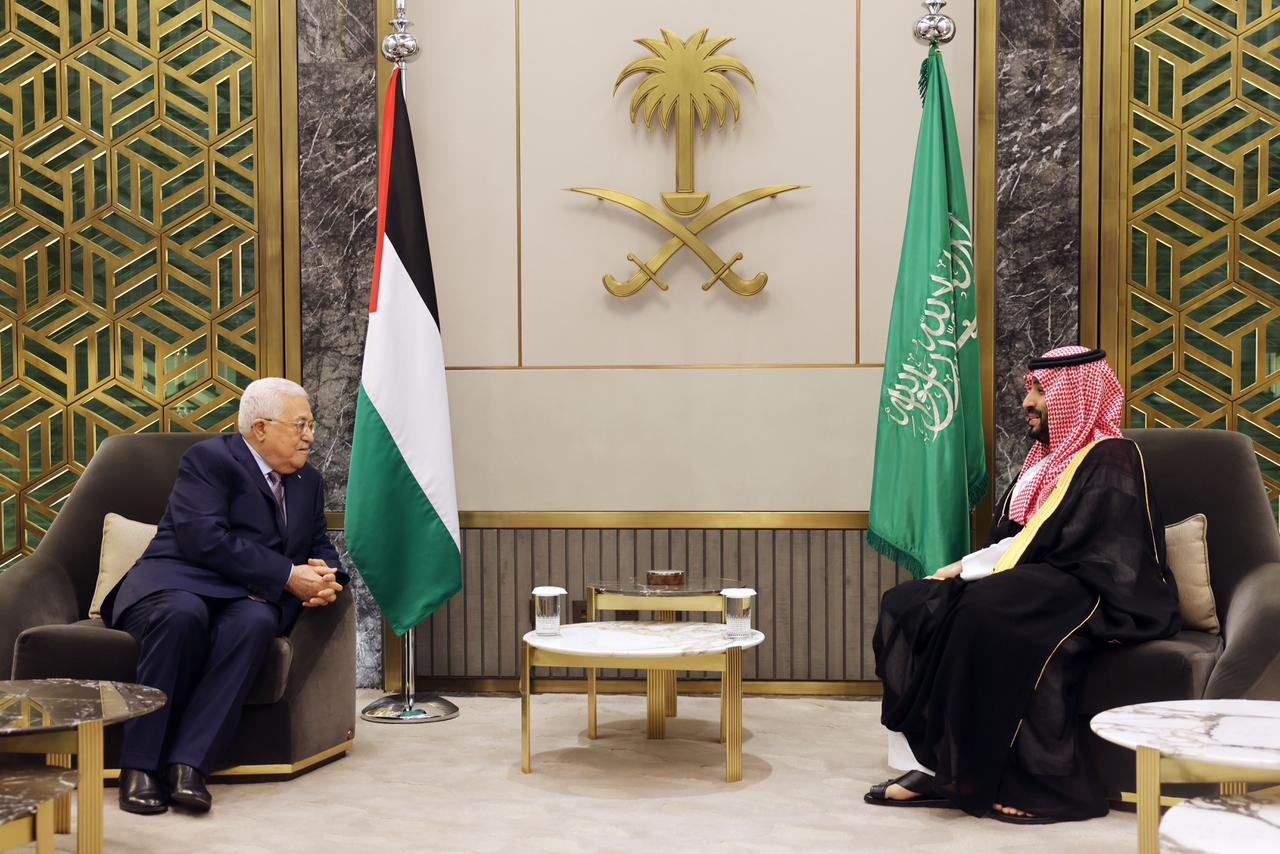
Palestinian Authority President Mahmoud Abbas, left, meeting with Saudi Arabia’s Crown Prince Mohammed bin Salman in the Saudi port city of Jeddah, April 19, 2023. (Wafa)

The message was passed along in multiple meetings between the Palestinian Authority delegation and senior Saudi officials, including Foreign Minister Faisal bin Farhan, the US and the Arab official said.

Last month, Saudi Arabia’s ambassador to Jordan began serving as Riyadh’s first-ever nonresident ambassador to the Palestinians as well as its first-ever nonresident consul general to Jerusalem.

The Arab official explained that Riyadh has made clear to Ramallah that it is prepared to depart from its long-held public stance against normalizing ties with Israel absent an actualized two-state solution to the Israeli-Palestinian conflict, and that the PA has come to terms with this development and accordingly is asking for measures that fall short of immediate statehood.

Jacob Magid contributed to this report


Israel Intercepts Rocket-Making Material En Route to Gaza From Turkey

Latest Developments

September 15, 2023 | Flash Brief


Israeli customs authorities revealed on September 14 that their agents intercepted 16 tons of explosive material on its way from Turkey to the Gaza Strip in July. According to the Israeli Tax Authority spokesperson, the customs agents in Ashdod inspected two containers that were supposed to contain 54 tons of gypsum — the key ingredient in plaster. After testing the material in a lab, authorities concluded that some of the bags contained ammonium chloride — a dual-use chemical used in making rockets.

Despite normalizing relations with Israel in recent years, Turkey has supported the terrorist organization Hamas, funneling funds to Hamas through its banks, hosting meetings with Hamas leaders, and issuing Turkish passports to Hamas leaders.

Expert Analysis

“The origin of this shipment cannot be ignored. Turkey has become a major sponsor of Hamas in recent years and a major hub of Hamas operations. Did the government in Ankara know about this effort to arm the terrorist group with 16 tons of explosive material? This is a crucial question to answer for Israel but also for the United States and many of Turkey’s other NATO allies.” — Jonathan Schanzer, FDD Senior Vice President for Research

“The seizure of 16 tons of raw materials, intended to be used by Hamas for the construction of rockets, once again underscores Turkey’s insincere commitment to antiterrorism. On the one hand, Ankara declares its desire to ‘normalize’ ties with Israel, while on the other, it continues to support a major terrorist entity that is focused on undermining the very existence of Israel. Erdogan’s government remains a primary source of support for Hamas and other jihadist entities throughout the region.” — Sinan Ciddi, FDD Non-Resident Senior Fellow

Haven for Hamas

The relationship between Turkey and Israel, once allies, chilled after the 2008-2009 Operation Cast Lead by the Israel Defense Forces (IDF) in Gaza. Ankara formally broke diplomatic ties in September 2011 after Turkish President Recep Tayyip Erdogan, Turkey’s then prime minister, personally greenlit a flotilla of ships to breach the Israeli blockade of Gaza, leading to a deadly incident with Israeli forces in May 2010. Turkey has been a haven for Hamas since it established a headquarters in Istanbul in 2014. Hamas leader Ismail Haniyeh lives part-time in Turkey, and he and his son hold Turkish passports. Saleh al-Arouri, Hamas’ West Bank chief, is also based in Istanbul. Al-Arouri is a U.S.-designated terrorist with a $5 million U.S. bounty on his head.

Hamas Smuggling is a Major Problem

Jerusalem’s interception of rocket-making material comes after Israel reopened the Kerem Shalom border crossing between Israel and Gaza on September 10. Israel closed the crossing — the sole entry point for goods between Gaza and Israel — on September 4, after IDF soldiers discovered high-quality explosive material concealed inside clothes in three trucks. Hamas is known to redirect dual-use goods intended for its civilian population for military purposes, such as commandeering cement intended for civilian construction projects to build its terror tunnels.