Move likely to anger Israel, which withdrew from UNESCO in 2019 over previous steps that Jerusalem said were done to diminish the Jewish connection to the Holy Land

Tell es-Sultan in Jericho on September 29, 2011 (Diego Delso via Wikimedia Commons, CC BY-SA)

Tell es-Sultan in Jericho on September 29, 2011 (Diego Delso via Wikimedia Commons, CC BY-SA)

RIYADH, Saudi Arabia — A UN conference voted Sunday to list the ruins of the ancient West Bank city of Jericho as a World Heritage Site in Palestine, a decision likely to anger Israel, which controls the territory and does not recognize a Palestinian state.

Jericho is one of the oldest continually inhabited cities on earth, and is in a part of the West Bank that is administered by the Palestinian Authority. The listing refers to the Tel es-Sultan archaeological site nearby, which contains ruins dating back to the 9th millennium B.C.

The decision was taken at a meeting of the UN World Heritage Committee in Riyadh, Saudi Arabia, under the auspices of the UN Educational, Scientific and Cultural Organization, UNESCO.

Israel quit UNESCO in 2019, accusing it of being biased against it and of diminishing its connection to the Holy Land. Israel also objected to UNESCO’s acceptance of Palestine as a member state in 2011. But Israel remains a party to the World Heritage Convention, and it sent a delegation to the meeting in Riyadh.

Israel captured the West Bank, along with Gaza and East Jerusalem, in the 1967 Mideast war. The Palestinians want all three territories for their future state. Israel views the West Bank as the biblical and cultural heartland of the Jewish people.

There have been no serious or substantive peace negotiations in over a decade, and Israel is currently led by the most nationalist and religious government in its history, making any move toward Palestinian statehood nearly unimaginable.

The modern city of Jericho is a major draw for tourism to the Palestinian territories, both because of its historical sites and proximity to the Dead Sea. In 2021, the Palestinian Authority unveiled major renovations to one of the largest mosaics in the Middle East, in a Jericho palace dating back to the 8th century.

Palestinians visit Hisham’s Palace, where one of the largest mosaic panels in the world has been unveiled following a multi-year restoration project, in the West Bank city of Jericho on October 28, 2021. (Photo by ABBAS MOMANI / AFP)

Ahead of the vote, Likud MK Dan Illouz wrote on X, the site formerly known as Twitter, that he had written to UNESCO head Audrey Azoulay.

“Jericho is first and foremost a city of Biblical significance,” Illouz said.

“Blurring this fact is an insult to the millions of Jews and Christians all over the world,” he said in a statement.

“Such a decision would constitute a blatant interference by UNESCO in a conflict in which it is not its role to intervene,” Illouz charged. “It is our duty to stop the Palestinian Authority’s subversion, and insist on our right to our land.”


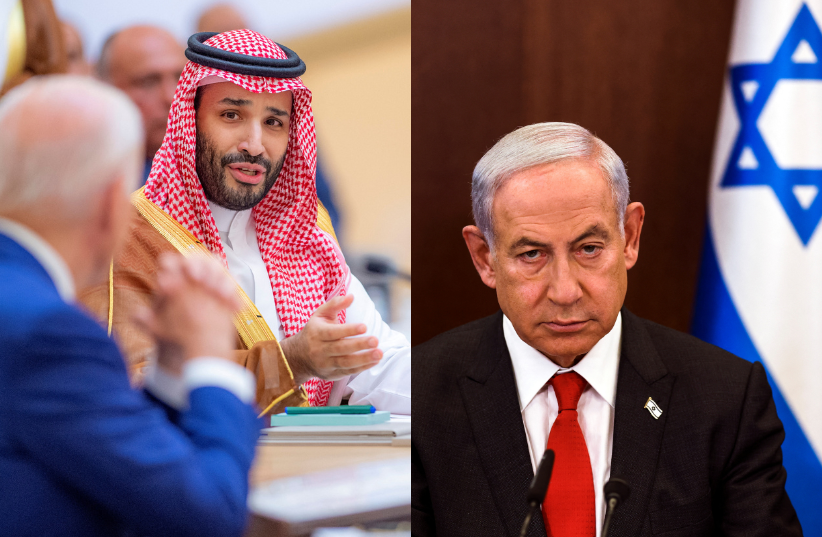
Saudi Arabia withdrew from normalization talks due to Benjamin Netanyahu’s “extremist” government, as per the unconfirmed Elaph report.

 (L-R) US President Joe Biden, Saudi Crown Prince Mohammed Bin Salman and Prime Minister Benjamin Netanyahu (photo credit: VIA REUTERS)
(L-R) US President Joe Biden, Saudi Crown Prince Mohammed Bin Salman and Prime Minister Benjamin Netanyahu
(photo credit: VIA REUTERS)
Saudi Arabia has informed the Biden administration of its decision to halt all talks of normalizing ties with Israel on Sunday, the Arab news outlet Elaph cited an Israeli official in the Prime Minister’s Office as saying.

According to the unconfirmed report, Riyadh issued a message through the US, explaining that the “extremist” nature of Israel’s right-wing government led by Prime Minister Benjamin Netanyahu is “torpedoing any possibility of rapprochement with the Palestinians, and thus with the Saudis,” as per Aleph.

Furthermore, the report specified that Saudi Arabia was put off from a potential peace deal due to Netanyahu’s “acceptance” of demands made by the likes of National Security Minister Itamar Ben-Gvir and Finance Minister Bezalel Smotrich, who the Saudis see as “extreme right.”

Antony Blinken: Palestinian issue is critical for peace deal

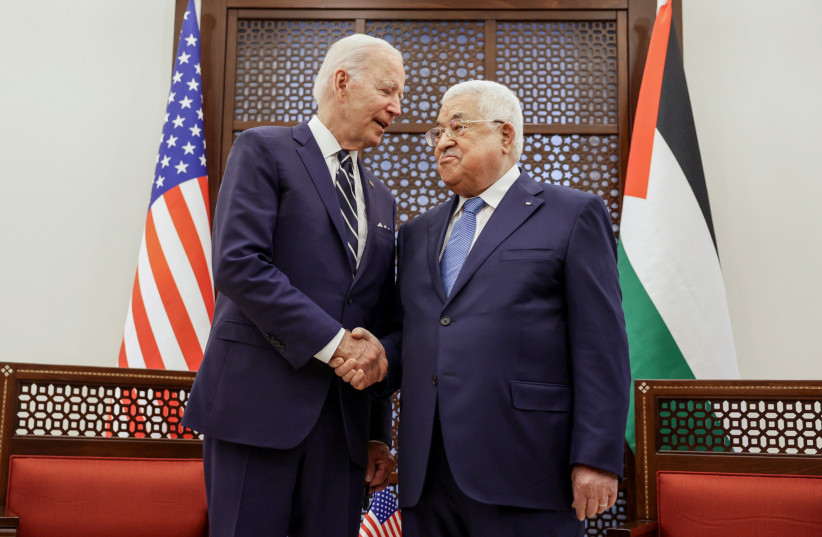
Last week, US Secretary of State Antony Blinken said that Saudi Arabia has let the Biden administration know that resolving Palestinian issues is critical for any normalization deal with Israel.

“It is also clear from what we hear from the Saudis that if this process is to move forward, the Palestinian piece is going to be very important too,” he said on Wednesday in an interview with the podcast Pod Save the World.

 US President Joe Biden shakes hands with Palestinian President Mahmoud Abbas at the Presidential Compound, in Bethlehem, in the West Bank July 15, 2022 (credit: REUTERS/EVELYN HOCKSTEIN)
US President Joe Biden shakes hands with Palestinian President Mahmoud Abbas at the Presidential Compound, in Bethlehem, in the West Bank July 15, 2022 (credit: REUTERS/EVELYN HOCKSTEIN)

Israeli normalization with the Arab world and “any of the efforts that are going on to improve relations between Israel and its neighbors can not be a substitute for Israel and the Palestinians resolving their differences and having a much better future for Palestinians,” Blinken said.

“In our judgment that needs to involve a two-state solution” to the Israeli-Palestinian conflict, he explained.

Last month, Foreign Minister Eli Cohen stressed in an interview with Elaph that the “Palestinian issue is not an obstacle to peace.”


IAEA chief slams ‘profoundly regrettable’ Iranian decision, warns it will harm agency’s capacity to monitor nuclear program; Tehran claims ‘political’ use of watchdog by West

An unidentified International Atomic Energy Agency (IAEA) inspector disconnects the connections between the twin cascades for 20 percent uranium production at the nuclear research centre of Natanz, some 300 kilometers south of Tehran, Iran, on January 20, 2014. (KAZEM GHANE/IRNA/AFP)

An unidentified International Atomic Energy Agency (IAEA) inspector disconnects the connections between the twin cascades for 20 percent uranium production at the nuclear research centre of Natanz, some 300 kilometers south of Tehran, Iran, on January 20, 2014. (KAZEM GHANE/IRNA/AFP)

Iran has barred around a third of the International Atomic Energy Agency’s most experienced inspectors from overseeing nuclear sites in the country, the UN watchdog group said Saturday. The IAEA’s chief slammed the move as unprecedented and said it would complicate inspection of Iran’s nuclear program.

Rafael Grossi, director-general of the IAEA, said in a statement that he was informed by Iran of the move earlier Saturday. The lack of cooperation will damage the organization’s ability to “provide credible assurances that nuclear material and activities in Iran are for peaceful purposes,” said Grossi, urging Iran to reconsider the move.

“I strongly condemn this disproportionate and unprecedented unilateral measure which affects the normal planning and conduct of agency verification activities in Iran and openly contradicts the cooperation that should exist between the agency and Iran,” Grossi stated.

“This profoundly regrettable decision by Iran is another step in the wrong direction and constitutes an unnecessary blow to an already strained relationship between the IAEA and Iran in the implementation of the NPT Safeguards Agreement,” he added.

Grossi said the inspectors in question “have conducted essential verification work at the enrichment facilities in Iran which are under Agency safeguards.”

“Israel is not surprised from Iran’s moves, which prove it is violating all its commitments to the international community and intends to arm itself with nuclear weapons,” the Prime Minister’s Office said in a statement.

“The prime minister reiterates that Israel will do everything needed to defend itself against this threat,” the statement added.
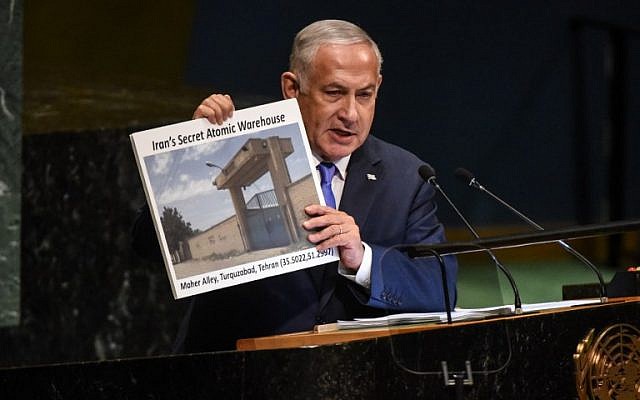
Prime Minister Benjamin Netanyahu holds up a placard showing a suspected Iranian atomic site while delivering a speech at the United Nations during the United Nations General Assembly on September 27, 2018 in New York City. (Stephanie Keith/Getty Images/AFP)

Responding to the IAEA, Iran’s foreign ministry linked the move to what it said was an attempt by the United States and three European countries to misuse the body “for their own political purposes.” He appeared to be referring to Britain, France and Germany, which said Thursday they would maintain sanctions on Iran related to its nuclear and ballistic missile programs.

“Iran had previously warned about the consequences of such political abuses, including the attempt to politicize the atmosphere of the agency,” foreign ministry spokesman Nasser Kanaani said.
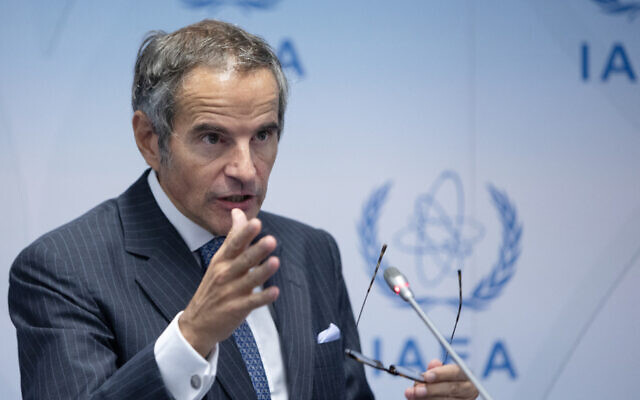
Rafael Grossi, director-general of the International Atomic Energy Agency, speaks during the IAEA’s Board of Governors meeting at the agency’s headquarters in Vienna, September 11, 2023. (Alex Halada/AFP)

Last week, the UN nuclear watchdog said in confidential reports seen by AFP that Iran had made “no progress” on several outstanding nuclear issues, including installing more cameras to monitor their nuclear program.

Tehran in March vowed to reactivate surveillance devices that were disconnected in June 2022 amid deteriorating relations with the West.

In a separate report, also seen by AFP, the IAEA said Iran’s total stockpile of enriched uranium was lower than in May but still more than 18 times the limit set in a 2015 accord between Tehran and world powers.

Iran’s total enriched uranium stockpile was estimated at 3,795.5 kilograms (8,367.7 pounds) as of August 19, down by 949 kilograms from May, the agency said.

The limit in the 2015 deal was set at 202.8 kilograms.

The stockpile of uranium enriched up to 60 percent is now at 121.6 kilos, up from 114.1 kilos in May.

Iran also has 535.8 kilos of uranium enriched up to 20 percent, up from 470.9 kilos in the last May report.

Britain, the United States, France and Germany on Wednesday told the IAEA that Iran must clarify questions over its nuclear program, including concerns over the monitoring cameras, and the presence of uranium particles enriched to near weapons-grade level.

On Monday, Grossi expressed concern that the international community was losing interest in holding Iran to account over its advancing nuclear program, without naming the countries.
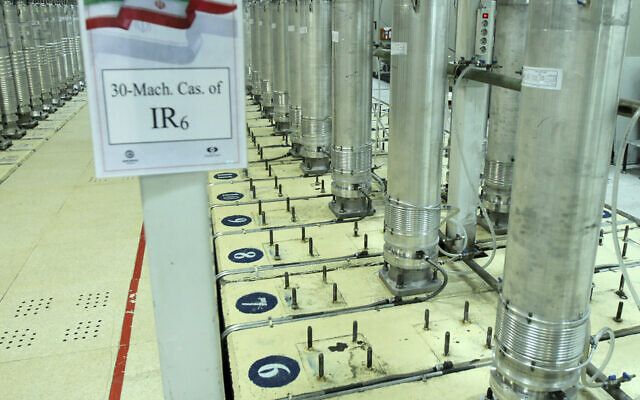
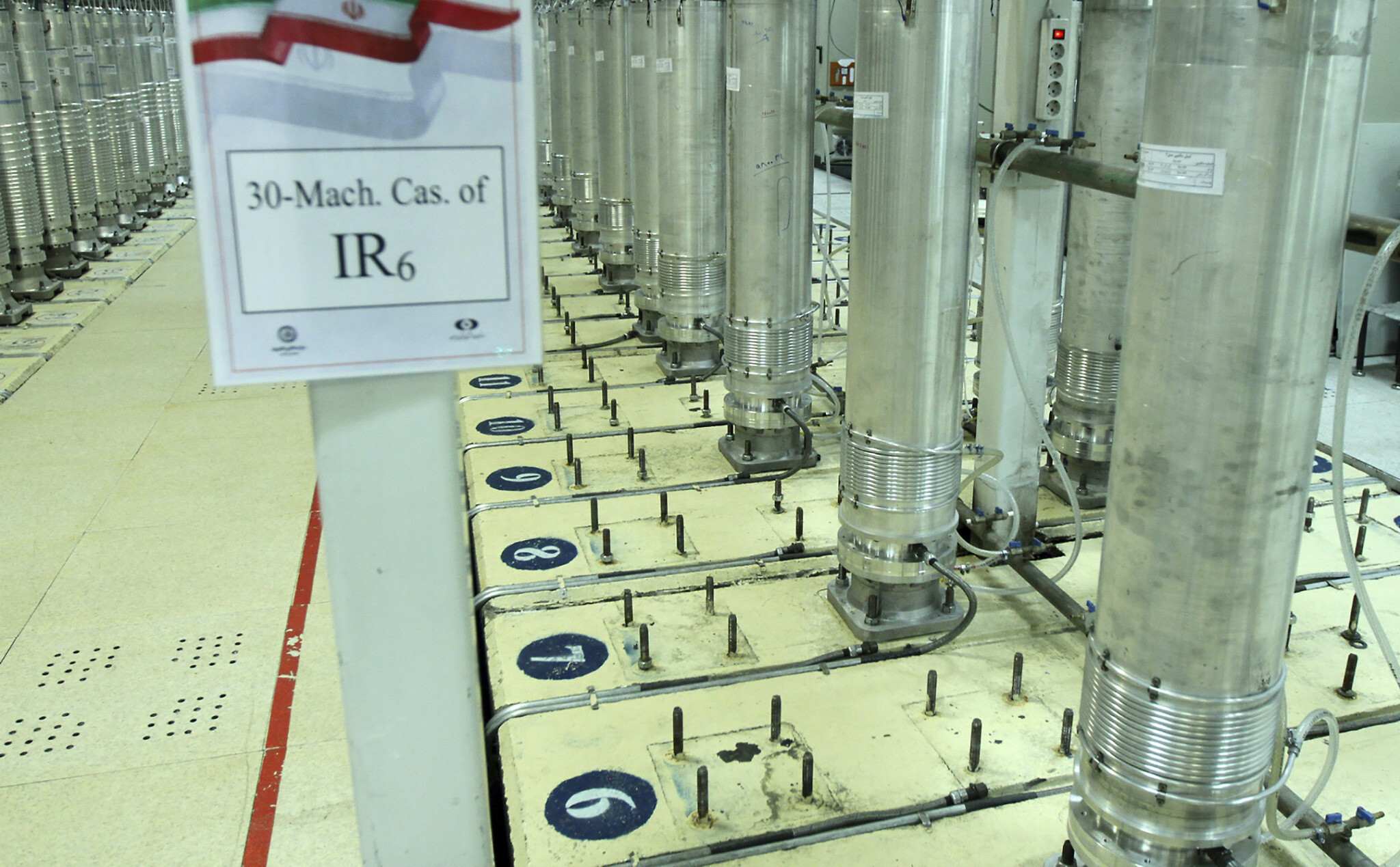
File: This photo released November 5, 2019, by the Atomic Energy Organization of Iran shows centrifuge machines in Natanz uranium enrichment facility near Natanz, Iran (Atomic Energy Organization of Iran via AP)

The comments follow an easing of tensions between Tehran and Washington, which announced a prisoner swap last month.

“We are aware that there is a bilateral process of sorts. We have been informed by the United States about this. But when it comes to the nuclear part, [it is] not clear what is being discussed,” Grossi stressed at the time.

In 2015, major world powers reached a deal with Iran, under which Tehran would curb its nuclear program in exchange for relief from crippling economic sanctions.

That started to unravel in 2018 when then-US president Donald Trump unilaterally withdrew from the pact and reimposed sanctions. Tehran in turn stepped up its nuclear program.

Efforts to revive the deal have been fruitless so far.

Iran has always denied any ambition to develop a nuclear weapons capability, insisting its activities are entirely peaceful.