The restoration of ties between Iran and Saudi Arabia has injected a sense of “controlled calm” in some regional settings where the two powers have clashed in the past. Pointing to the lowering of tensions, a Gulf diplomatic source told Amwaj.media, “Both countries need de-escalation even if it comes at the expense of [their stances in] some arenas and dossiers.”
In the new interest-driven regional context, there are indications that Egypt and Jordan may soon follow the Kingdom in entering new chapters with Iran. As with the Iranian-Saudi dialogue, Iraq and Oman are facilitating the expanded Arab-Iranian engagement—but with different roles.
Egypt-Iran dialogue
In the spring of 2021, Iraq began hosting a series of dialogues between Arab states and Iran. The Iranian-Saudi engagement has gotten most attention. But in the shadow, talks between Egypt and Iran were also facilitated by Baghdad. Iraq’s then-prime minister Mustafa Al-Kadhimi (2020-22) kicked off the effort by acting as a preliminary liaison. This was followed by a first session to break the ice between Egyptians and Iranians. The atmosphere was defined by two main features: a clear security orientation and the tying of progress to the Iranian-Saudi dialogue, particularly considering the joint Arab approach to ties with the Islamic Republic at the time.
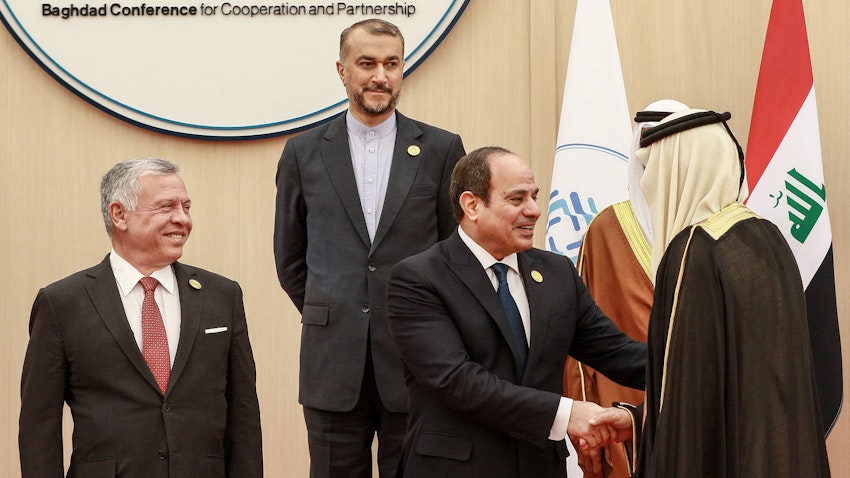
The inaugural Baghdad Conference for Cooperation and Partnership in the autumn of 2021 added further impetus to Iraq’s effort to advance Arab-Iranian diplomacy. The gathering of regional officials was current Iranian Foreign Minister Hossein Amir-Abdollahian’s first foreign trip after taking office, and notably produced an image in which Kadhimi was seen flanked by Egyptian President Abdel Fattah El-Sisi and Amir-Abdollahian on either side.
Iran’s openness to relations with Egypt under Sisi, an ally of Saudi Arabia and the US who rose to power after a coup which ended Muslim Brotherhood rule, may come as a surprise to some observers. After the 1979 Islamic Revolution, Iran’s relations with Egypt went through a decades-long freeze with few exceptions. When longtime leader Hosni Mubarak stepped down in 2011 amid Arab Spring protests and Egypt came to be ruled by the Brotherhood, many in Iran were ecstatic.
But the Brotherhood did not turn out to be the natural Islamist partner of the Islamic Republic that some may have anticipated. When then-Egyptian president Mohamed Morsi (2012-13) visited Tehran for a summit of the Non-Aligned Movement, he made clear that differences over regional issues were stark—thundering against Iran’s Syrian ally Bashar Al-Assad. The following year, Mahmoud Ahmadinejad became the first Iranian president to visit Egypt as part of an Organisation of Islamic Cooperation (OIC) gathering. However, the Egyptian foreign minister at the time, Mohamed Kamel Amr, noted that “the security of Gulf countries is a red line for Egypt,” indicating that ties with Tehran would not be pursued to balance relations with Riyadh.
Perhaps ironically, Sisi—a bitter foe of Islamist groups—shares key interests with Iran. Shortly after the fall of Morsi, who had cut relations with Syria and shut embassies in June 2013, Cairo and Damascus agreed to keep consulates open. In 2016, Sisi explicitly stated that he stood with the Syrian military. As the Iranian-Saudi rapprochement picked up steam earlier this year, the foreign ministers of Egypt and Syria exchanged visits as part of “advanced talks” to restore full diplomatic relations. During the Arab League summit hosted by Saudi Arabia in May, Assad—welcomed back to the Arab fold after years of isolation amid the Iranian-Saudi normalization—met with Sisi on the sidelines.
In other words, Egypt has similar to Saudi Arabia pursued engagement with Iran and Syria in a parallel and yet interconnected manner. However, Cairo has intentionally trailed the Kingdom on particularly the Iranian track.
Enter Oman
One key element of Kadhimi’s diplomatic endeavors was his personal networks in the Gulf Arab states and ties with the leaders of Egypt as well as Jordan. Under Muhammad Shia’ Al-Sudani as prime minister, Iraq is seemingly no longer the main interlocutor for Arab-Iranian dialogue, a Gulf Arab diplomatic source suggested to Amwaj.media.
Rather than Baghdad, it was Beijing which in Mar. 2023 mediated an Iranian-Saudi normalization deal. Moreover, while Sudani has asserted that “Iraq is mediating between Iran and a number of Arab states,” and that this is going on “in complete confidentiality…until [tangible] results are achieved,” there are indications that Oman is emerging as the top facilitator of Egyptian-Iranian dialogue.
After Sudani entered office in Oct. 2022 with the support of the Shiite Coordination Framework—a constellation of Iran-backed parties—foreign players have sensed greater influence of armed groups over state institutions and the decision-making process in Iraq. Instead of continuing in the path of its predecessor, the Sudani administration has from the outset been put in a tough position. The influence of actors such as Asa’ib Ahl Al-Haq and other Shiite Coordination Framework players have limited Baghdad’s diplomatic efforts, partly by reducing the margins in which Sudani can engage with his regional and international counterparts.
The Iranian-Saudi dialogue facilitated by Kadhimi was accompanied by a parallel expert-level track in Muscat. According to an Omani diplomatic source, Sultan Haitham bin Tareq Al Said has in past months increasingly been playing a significant role in bringing together Egyptian and Iranian viewpoints.
During his visit to Tehran in May—the first since ascending the throne in 2020—the Sultan relayed a number of messages to the Iranian leadership from Egypt. Of note, his trip to Iran was immediately preceded by his first visit to Egypt as ruler of Oman. The messages, according to the Omani diplomatic source—whose statements were confirmed by an Iranian political source—expressed a readiness for dialogue, negotiations and to reach common understandings on some regional dossiers.
The endeavor to improve relations with Egypt appears to be endorsed by the upper echelons of the Iranian state. In July, Ali Akbar Velayati—a former foreign minister and foreign policy advisor to Iran’s supreme leader—described the resumption of relations with Cairo as important for both countries as well as the region and the Muslim world.
Informed sources have indicated to Amwaj.media that the dialogue between Cairo and Tehran is halfway on the road to resulting in an agreement to restore relations. So far, according to an Arab diplomatic source, the talks have revolved around bilateral ties in addition to “the Palestinian cause and the border region between the Gaza Strip and the Sinai Peninsula, as well as the Syrian and Yemeni dossiers.” Speaking on condition of anonymity, an Egyptian diplomat further said that “an announcement that the two sides have reached a comprehensive and joint vision may be made in the coming months.”
The Iran-Jordan track
While Oman is playing a leading role in facilitating Egypt-Iran dialogue, the engagement between Iran and Jordan is still progressing via Iraq. However, it is currently on hold and is marred by caution. As of writing, the two sides have yet to be fully mutually reassured about intentions and aims. Therefore, the talks have not reached the political level. Similar to the initial stages of the Iranian-Saudi engagement, the dialogue remains security-oriented and is in need of positive gestures. The latter could include Baghdad moving forward with the implementation of the Basra-Aqaba pipeline, which Amman perceives as holding major economic and political significance.
The Sudani administration is implicitly in favor of the pipeline project. But Iran-backed armed groups which hold sway over the Iraqi government oppose the endeavor—characterizing it as akin to normalization with Israel. Yet, the root of their rejection of the pipeline can be traced back to Tehran, experts say. The implementation of the project would allow Iraq to rely less on the Gulf as a conduit for its oil exports—reducing Iran’s leverage over international energy markets—and would also enable Baghdad to more easily reach new customers.
The dialogue between Iran and Jordan notably began under Kadhimi as well. The talks started with a preliminary session and were followed by two rounds of “fruitful and serious talks” in 2022, according to an informed official at a regional Arab intelligence organization. The atmosphere is said to have been “positive,” with “all sides sensing a keenness to cooperate and reach fruitful outcomes.” The Iranian side was led by a senior official from the Ministry of Intelligence, who met with his Jordanian counterpart from the General Intelligence Directorate. Arab sources told Amwaj.media that the two sessions were lengthy and concluded with both sides asserting the importance of enhancing bilateral ties and upping the level of diplomatic representation.
The key outcomes of the talks can be divided into three categories. First, there was mutual understanding of the need for enhancement of economic and political cooperation. Second, the two sides agreed on enhancing security cooperation, including halting support for subversive groups operating in the respective countries. Third, Arab sources noted, the two sides agreed to establish a joint trilateral cooperation cell with Baghdad, working towards countering drug trafficking to Jordan from Iraq and Syria. Notably, the Jordanian security delegation accused some Iranian “proxies” of involvement in the narcotics trade, Amwaj.media has learned. Looking ahead, Arab sources said, the future of the dialogue is said to be dependent on coming political circumstances as well as guarantees.
The success of any diplomatic initiative lies in the guarantees that are attained. But the latter is what Baghdad cannot provide, and what Muscat will not pursue. If the Chinese-mediated Iranian-Saudi rapprochement is a model, the characterization of a third-party actor as a guarantor—however flimsy or theoretical such a role may be—could be the way forward.