U.S. Secretary of State Antony Blinken said on Wednesday that a normalization agreement between Israel and Saudi Arabia could not come at the expense of a two-state solution to the Israeli-Palestinian conflict.

Speaking on the “Pod Save the World” podcast, Blinken said, “Normalization—any of the efforts that are going on to improve relations between Israel and its neighbors—are not, cannot be a substitute for Israel and the Palestinians resolving their differences and having a much better future for Palestinians. And in our judgment, of course, that must… needs to involve a two-state solution.”

He went on to say that progress with regard to the Palestinians was important to the Saudis, too.

“It’s also clear from what we hear from the Saudis that if this process is to move forward, the Palestinian piece is going to be very important,” he said.


In response to a question from the show’s hosts as to the advisability of “rewarding” the current leadership of Israel and Saudi Arabia, the top U.S. diplomat emphasized the issue transcended individual leaders and governments.

“If you have the leading Muslim country in the world, Islamic country in the world, making peace with Israel, that’s going to have benefits that travel well beyond the region,” he said.

“This and most things that we do are not about individual leaders or individual governments; they’re about the substance of the issue and whether we can, in whatever we’re doing, advance a world that’s a little bit more peaceful, a little bit more prosperous, a little bit more full of opportunity,” he said. “And there’s no question in my mind that if we could help achieve normalization between Israel and Saudi Arabia, it would move the world in that direction,” he added.

“We’ve had extraordinary turmoil in that part of the world going back to at least 1979—decades of turmoil. Moving away from that, having more moderating and integrating dynamics carry things forward, I think would be a profound change and a profound change for the good—and a change that would, again, not be tied to any specific government but to the fundamental interests of the countries involved,” he said.

Last month, Israeli Foreign Minister Eli Cohen told the Arabic-language Elaph online newspaper that the Palestinian issue would not be an obstacle to normalizing relations with Saudi Arabia.

“The current Israeli government will take steps to improve the Palestinian economy,” he said.

In exchange for supporting a normalization agreement, the Palestinian Authority reportedly wants more control over areas of Judea and Samaria, the reopening of the U.S. consulate in Jerusalem and the resumption of Saudi financial support.

“Senior [P.A. chief Mahmoud] Abbas adviser Hussein al-Sheikh, who is leading the consultations on the issue with Riyadh, gave Saudi National Security Adviser Musaed bin Mohammed al-Aiban the list of possible deliverables three months ago,” Axios reported in August.

Riyadh has already proposed resuming financial assistance to the P.A., according to Saudi officials and former Palestinian officials.

Recently, Riyadh appointed its first-ever non-resident envoy to the P.A., who will double as consul general to Jerusalem.

The list of demands suggests Palestinian leaders are taking a more practical approach to Saudi-Israel normalization than they did in 2020 to the Abraham Accords. It described that deal between Israel, the United Arab Emirates and Bahrain as “a stab in the back of the Palestinian cause and the Palestinian people.”

Netanyahu last month downplayed claims that the Palestinian issue has played a significant role in the Israel-Saudi deal negotiations. “Is that what’s being said in corridors? Is that what’s being said in discreet negotiations? The answer is a lot less than you think,” he said.

Syria: The Israeli interest

Israeli air power alone may not be sufficient to tackle the full dimensions of Iranian ambitions in Syria.

The recent unrest in Suweida province in Syria has shown that the situation in the country remains far from resolved. While Syria has dropped from the headlines, the events in Suweida and beyond indicate that significant parts of the population in the regime-controlled parts of Syria are far from reconciled to the prospect of continuing to live under the rule of the Assad family. The country remains divided into areas of control, and with none of the issues that triggered the civil war in 2011 resolved.

Follow Israel Hayom on Facebook, Twitter, and Instagram

What is the current Israeli interest in Syria, and what should Israel be seeking from allies and partners in terms of the diplomacy on Syria? Israel’s primary goal in Syria is the halting of the advance of Iranian influence and capacity in the country.

From an Israeli point of view, the current diplomatic situation in Syria – in which the regime remains isolated by the West, and without major reconstruction efforts underway from Western companies or states – is the ideal background for the continued prosecution of the Israeli military efforts against Iranian entrenchment and consolidation on Syrian soil.

Thus, Israel should use all available diplomatic channels to encourage the West to maintain its firm stance on Resolution 2254 and the continued isolation of the Assad regime. If Assad succeeds in ending his isolation and normalizing relations with the West, it is a near inevitability that at a certain point, US pressure on Israel would begin to induce it to cease its military campaign on Syrian soil, on the grounds that the conflict has finished, Syria is now a normal actor on the international stage, etc.

Similarly, the continued de facto partition of Syria is a clear Israeli interest. The control by the US and its Kurdish allies in the Syrian Democratic Forces constitutes an incomplete but significant barrier to Iranian freedom of movement and action between Iraq and Syria. Because of the presence of this entity, which controls around 30% of Syria’s territory, the Iranians have only one route between Iraq and Syria, namely the al-Qaim/Albukamal border crossing at Syria’s southeastern tip. In the event of war, the limited maneuverability of Iranian forces and their proxies would offer an advantage to Israel, which could swiftly disable the border crossing and the roads leading westwards from it. Thus, Israel should use its diplomatic representations and capacities to seek to induce the US and its allies to remain in Syria.

Even the Sunni Islamist, Turkish-dominated enclave in the northwest of the country offers an advantage to Israel in that its presence keeps the regime weakened, prevents it from focusing on the reconquest of the southeast and prevents the regime from extending its rule across the country and thus normalizing its situation. Thus, Israel should encourage Turkey in the direction of continued opposition to the Assad regime, and maintenance of its area of control in Syria.

At the same time, there is currently no realistic prospect for the fall of the regime or a process of political transition. Nor is there an obvious alternative to the regime. Extensive contacts and representations to the Syrian opposition are thus without purpose.

Regarding the “war between wars,” while there have certainly been achievements, the available evidence suggests that the tactics employed have been insufficient to deal with the reality of the penetration of the Syrian state by Iran, and the extent to which large parts of the machinery and organs of the Syrian regime state are now either working in close cooperation with or are under the control of the Iranians.

The Iranians are closely involved in the vital drug production sector, in arms procurement, and even as recently revealed in the area of chemical weapons production, as well as in myriad other areas. To adequately develop responses, Israel must first internalize this reality.

Following this, the choice may well lie between an escalation and broadening of the target base for the air campaign, to include targets unambiguously associated with the Assad regime, or acceptance of a situation in which a large part of the Iranian project remains ‘out of bounds’ to Israel, enabling the Iranians to continue to consolidate and entrench themselves in Syria, as long as they do so while sheltering behind a regime flag of convenience.

It may also, unfortunately, be the case that Israeli air power alone will not be sufficient to address the issue of the full dimensions of Iranian ambitions in Syria. Cooperation with other forces in the country, most centrally the US and its local clients the SDF (possibly even elements within regime-controlled areas such as the clients with whom Israel worked in the pre-2018 period), will prove necessary.

So, Syria, in 2023, remains a crucial and central arena in the contest between Israel and the Iran-led regional project. A renewed focus, and probably a broadening and deepening of the scope of Israeli activity in the country, are required to adequately address this reality. The preservation of the current diplomatic situation with regard to the country, and increased boldness and flexibility regarding the tactics to be adopted, are prerequisites for success.


By: Tal Beeri and Boaz Shapira

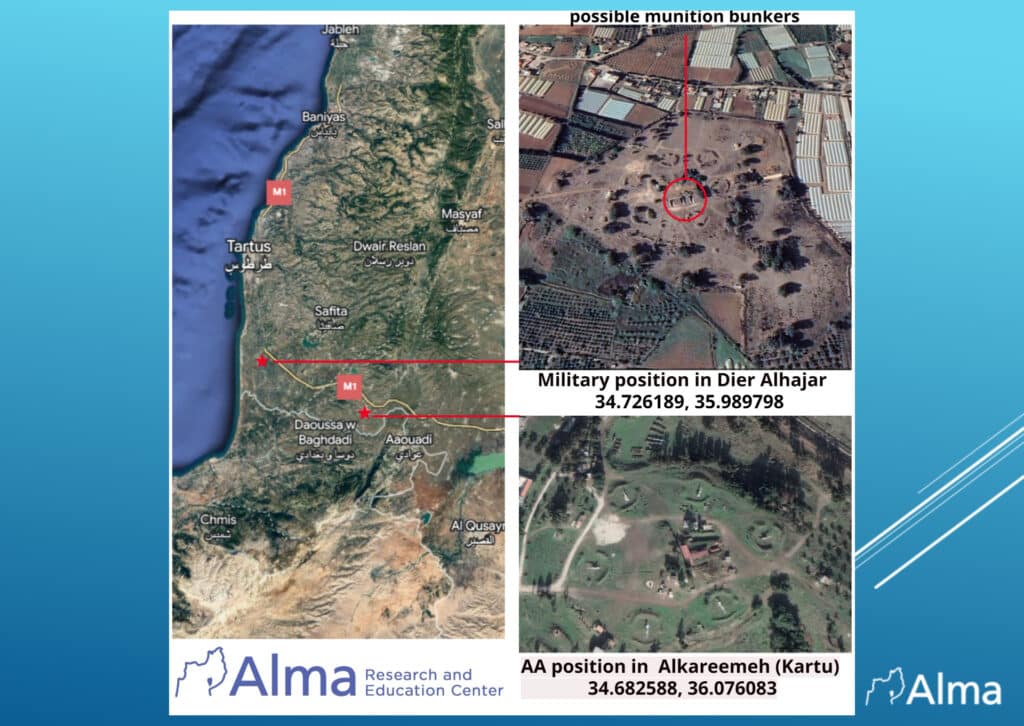
Two significant airstrikes were carried out in northwestern Syria on Wednesday (September 13), during the afternoon and night. The initial and preliminary strike appears to have been launched south of Tartus against the Syrian air defense system equipped with modern radar. The second and most significant attack was launched apparently against Project 99 at the CERS Center south of Hama.

See the special report on the CERS Center was published by us in August 2023

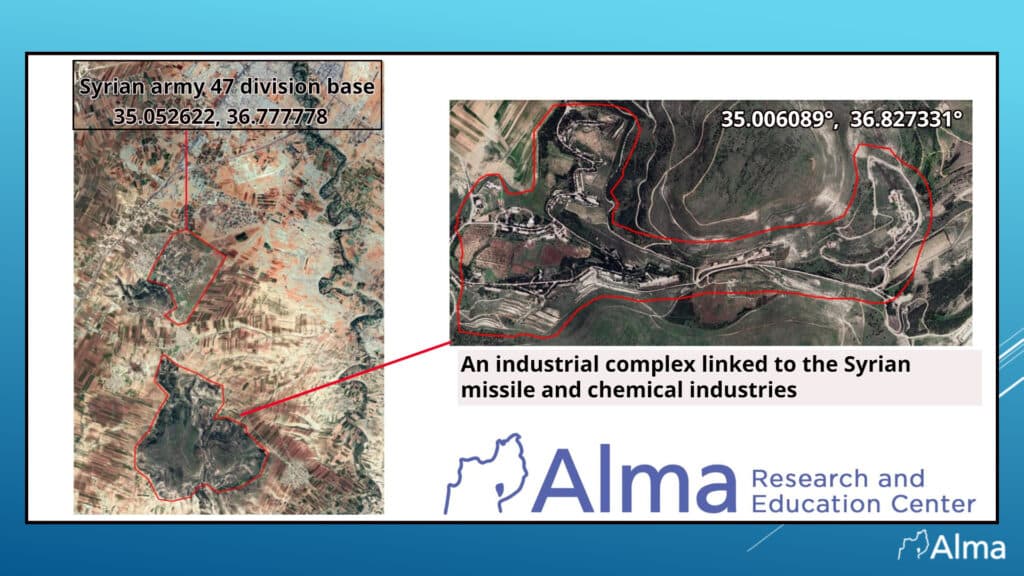
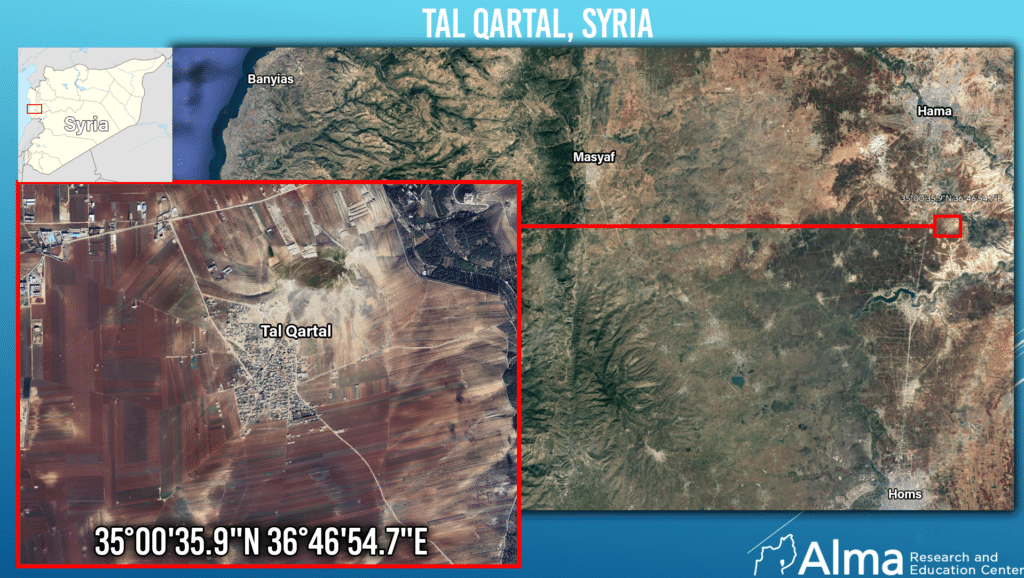
The main attack, which was the second attack, occurred at 22:40. We believe it was directed at the CERS Center, which houses Project 99, which manufactures precision ballistic missiles. As far as we know, Iranian, North Korean, and, of course, Hezbollah scientists participate in this project.

Project 99 is administered by the 4000 Institute (“Sector 4”) of CERS. The project site is situated near Tal Qartal, approximately 35 kilometers north of Homs and 18 kilometers south of Hama. The attack zone is located south of the base of the 47th Brigade of the Syrian Army, which is located near Jabal Ma’arin.

Dr. Mahmoud Ibrahim (originally from Rif Damascus) was the founder and first director of Project 99. He holds a doctorate in mechanical engineering and is known as the progenitor of Syrian ballistic missiles. He later served as the CERS Center’s director of planning until his elimination in 2015. Nidal al-Atassi is one of the project’s prominent figures (though, as of this writing, it is unknown whether he is still in his position).

The initial preliminary airstrike occurred at approximately 17:20, south of the city of Tartus, in the vicinity of Route M1, which connects Homs in the east to the Syrian coast in the west. According to our understanding, this airstrike targeted two elements of the Syrian air defense system. The first was in Deir al-Hajar, and the second was in al-Karima. According to Syrian media reports, in the airstrike, two air defense officers were killed.

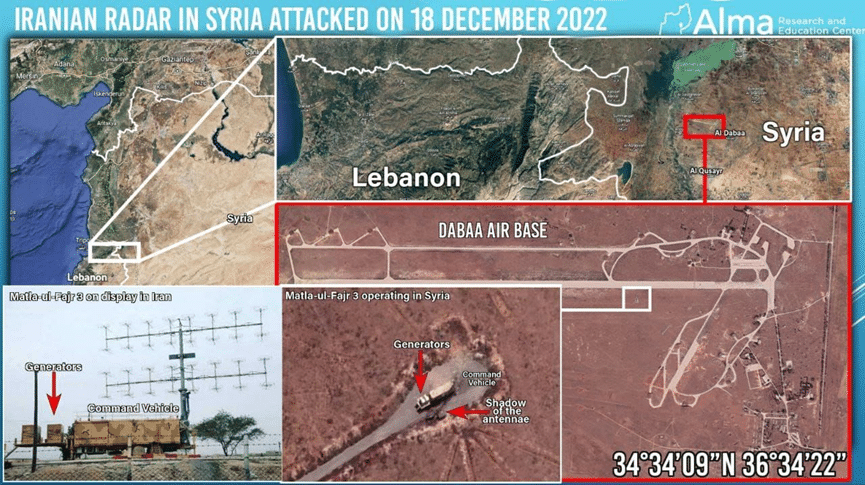
According to local reports and consistent with our assessment, the early attack was intended to destroy advanced air defense systems. In March 2023, we published an article about the Iranian “Matla Al-Fajar” (“Morning Rising”) Series 3 radar system, a sophisticated radar with a claimed detection range of hundreds of kilometers, as described by the Iranians. A similar radar array was attacked in December 2022 at Al-Dabaa Airport, 10 kilometers north of Qusayr (see image below), and a similar system was likely destroyed in an attack attributed to Israel in the vicinity of Aleppo Airport in March 2023.

There is a high probability that additional systems of this type have been deployed at multiple other locations in Syria. It is conceivable that these or similar systems were attacked in the initial phase of the current offensive, which began south of Tartus on September 13.

The first preliminary attack conducted south of Tartus was carried out in broad daylight, which is relatively uncommon. The fact that it was conducted in this particular manner and that a preliminary attack was carried out at all attests to the significance of the second attack launched south of the city of Hama.