Iran behind surge in Hamas drone activity

Hamas deploying growing number of drone aircraft similar to Iranian-designed unmanned aircraft used by Hezbollah.

By Yaakov Lappin, TPS

Aerial activity over the Gaza Strip in recent weeks has rekindled concerns in Israel regarding Hamas’s capabilities with regard to unmanned aerial vehicles.

On Aug. 21, the Israel Defense Forces monitored and attempted to intercept a UAV over Gaza near (but which had not penetrated) Israeli airspace. The IDF said at the time that it was unclear whether the drone had been downed.

While the UAV did not pose an immediate threat to Israeli civilians and triggered no alerts, the incident served as a reminder that Hamas’s engineers are working around the clock, with Iranian assistance, to bolster the terror faction’s capabilities in this field.

Tal Inbar, a senior research fellow at the Missile Defense Advocacy Alliance, a nonprofit organization that promotes public support for missile defense systems, noted that this was not the first time Hamas has fielded UAVs.

“Hamas has a number of models that have a very similar appearance to UAVs in the possession of Hezbollah, and in principle one can say that the inspiration for them is Iran,” he told the Tazpit Press Service.

  WARRING PALESTINIANS ARE KILLING EACH OTHER IN REFUGEE CAMPS

While it remains uncertain which elements of Hamas’s drone program are smuggled in from Iran and which are assembled in Gaza, it is beyond doubt that Iranian know-how is fueling Hamas’s UAV fleet build-up, he said.

“We saw in the past an armed UAV in Gazan skies, armed with what looked like small missiles,” said Inbar, adding that it is unknown whether Hamas is using such systems operationally.

Hamas also has a UAV “very similar” in design to an Israel Aerospace Industries model no longer in use, he noted, adding, “The similarity is likely not coincidental.”

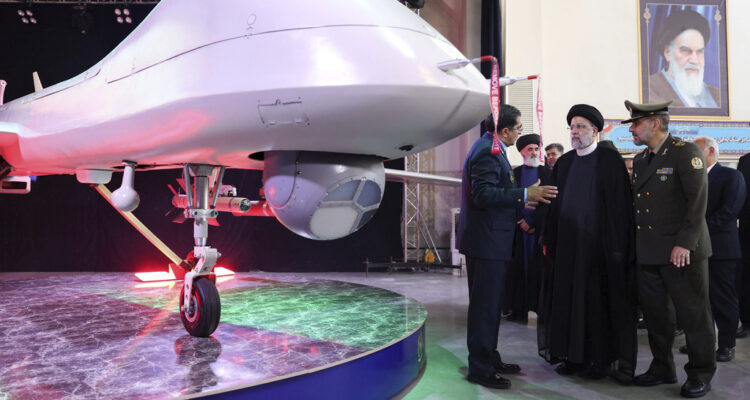
Further corroborating the Iranian link, Uzi Rubin, founder and first director of the Israel Missile Defense Organization, noted that during Israel’s May 2021 conflict with Gaza, Hamas deployed a UAV known as the “Ababil,” known to also be in the possession of Hezbollah in Lebanon.

The same UAV, with some minor adjustments, is also present in Yemen, where the Houthis who possess it call it the “Qasef,” according to Rubin. The Ababil is launched from a mobile catapult.

“The model that Hamas fired during [the May 2021 conflict] is called ‘Shahab’ by them,” said Rubin. He noted that the terror group has deployed various other types of drones “from ‘Operation Protective Edge’ [in 2014] onwards.”

  WATCH: JENIN TERROR GROUP SAYS IT FIRED ROCKETS AT JEWISH COMMUNITIES

According to Rubin, Iranian knowledge transfers enable local UAV production in Gaza.

It is possible that Iran is able to transfer not just knowledge but also material and parts directly to Gaza, he said, without needing to involve Hezbollah.

“They somehow manage to also smuggle in the engines—these are piston engines with two cylinders, based on an unknown plan,” he said, adding, “Hamas has no problem producing and assembling all of the rest on its own.”

That Israel has thus far failed to stop the smuggling of these engines into Gaza is “worrying,” he said.

Iranian assistance to terror groups in Israel goes beyond UAVs. In recent months, Iran has stepped up efforts to smuggle improvised explosive devices (IEDs) into Judea and Samaria so that its allies and proxies like Palestinian Islamic Jihad can reverse engineer them.

Hamas’s Iranian-assisted UAV fleet is thus a manifestation of a larger Iranian program to arm terror factions in both Gaza and Judea and Samaria, whether directly via smuggling or indirectly by teaching Palestinian terror factions how to build them.

Defense minister claims runway, 20 km from Israel, to be used by Iranians to attack Israel; IDF chief: We must be ‘more prepared than ever’ for ‘extensive military conflict’

Defense Minister Yoav Gallant speaks at a conference at Reichman University in Herzliya, September 11, 2023. (Ariel Hermoni/ Defense Ministry)

Defense Minister Yoav Gallant speaks at a conference at Reichman University in Herzliya, September 11, 2023. (Ariel Hermoni/ Defense Ministry)

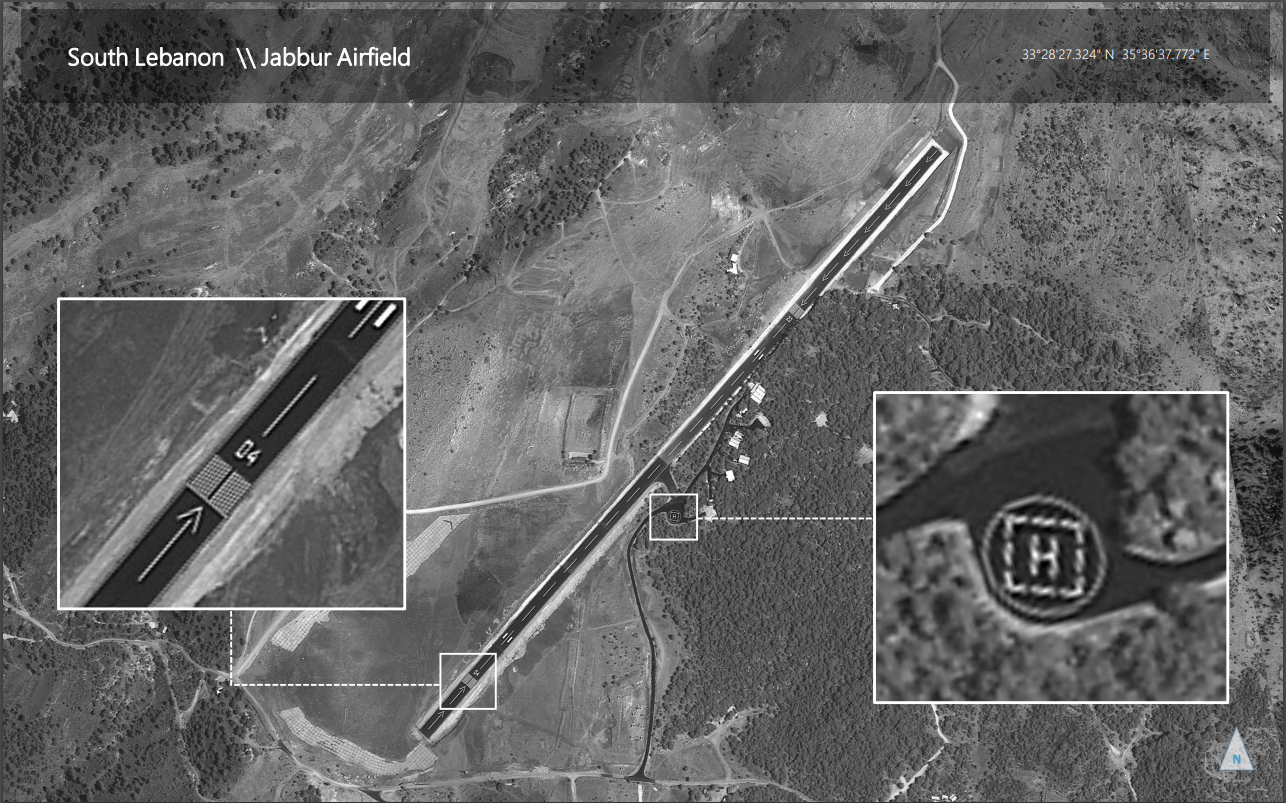
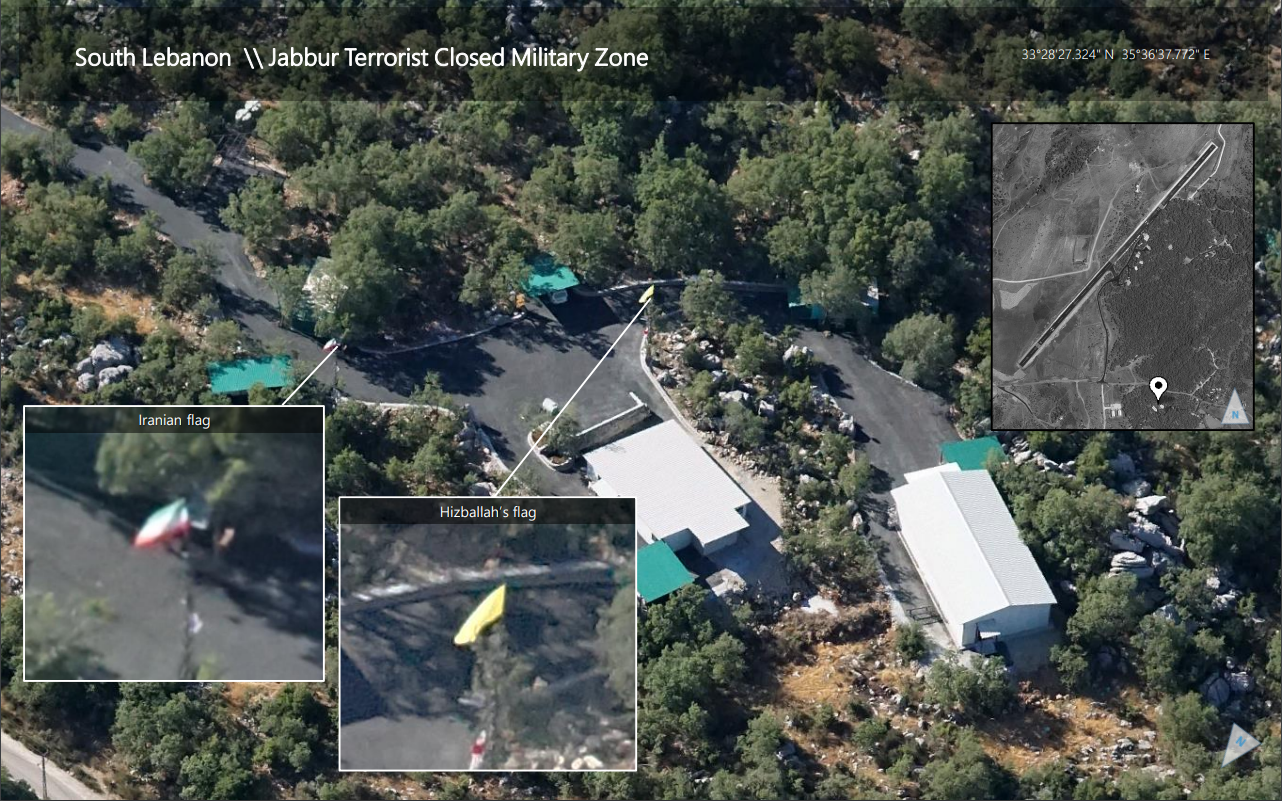
Defense Minister Yoav Gallant on Monday accused Iran of setting up an airport in southern Lebanon, 20 kilometers (12 miles) from the Israeli border, which he said was being used “for terror purposes” against Israelis.

Speaking at an annual conference of the Institute for Counter-Terrorism Policy (ICT) at Reichman University in Herzliya, Gallant presented pictures of the airport, being built in the Qalaat Jabbour mountain region, which he said bore the fingerprints of Iran and its proxy terror group Hezbollah.

“In the pictures, you can see the Iranian flag flying over the runways, from which the ayatollah regime plans to operate against the citizens of Israel,” Gallant said.

“In other words: the land is Lebanese, the control is Iranian, and the target is Israel,” he added.

The claim could potentially re-inflame tensions heightened following provocations by the Iran-backed Hezbollah in recent months that include the terror group’s establishment of two tents in territory claimed by Israel — one of which was later removed — and camouflaged operatives patrolling the border in violation of a UN resolution, among other acts.

“If it comes to a conflict, we will not hesitate to activate the lethal force of the IDF. Hezbollah and Lebanon will pay heavy and painful prices,” Gallant warned.

This image presented by Defense Minister Yoav Gallant during a speech at a conference at Reichman University in Herzliya, September 11, 2023, shows a runway allegedly built by Iran in southern Lebanon. (Defense Ministry)

He also accused Iran of being behind terror operations in the West Bank and  increasingly controlling Gazan terror groups Hamas and Islamic Jihad.

“Iran is the provider of money, knowledge, and guidance to Gazan terrorism,” he said.

Speaking at a 50-year commemoration of the Yom Kippur War, Israel Defense Forces Chief of Staff Lt. Gen. Herzi Halevi echoed Gallant’s warning.

“Our enemies may be tempted to see an advantage in the multi-front threat to us. It is better for them to know that when Israel is threatened, it knows how to mobilize all its resources, put the differences aside — and attack,” he said, referring to recent societal strife over proposed changes to the judiciary.

According to Reuters, citing a non-Israeli source, the airfield exposed by Gallant can be used by large drones, including armed unnamed aerial vehicles that were developed from Iranian plans. The source said drones that take off from the airstrip could carry out operations both domestically and beyond Lebanon’s border, though the former was more likely.

The source also said Hezbollah has devoted considerable resources to drone technology.

This image presented by Defense Minister Yoav Gallant during a speech at a conference at Reichman University in Herzliya, September 11, 2023, shows an airport allegedly built by Iran in southern Lebanon. (Defense Ministry)

Gallant said Iran was continuing efforts to establish militia groups on Israel’s northern border, in addition to its arming of the Hezbollah terror group in Lebanon.

“The State of Israel, through the defense establishment, will not allow the establishment of a second Hezbollah in the Syrian Golan Heights, and the use of Syrian soil as a springboard for the transfer of [advanced] weapons to Hezbollah,” Gallant said.

Israel has admitted to conducting hundreds of sorties against Iran-backed groups attempting to gain a foothold in Syria, over the last decade, as well as attacking arms shipments believed to be bound for those groups, chief among them Hezbollah.

Gallant also said Iran was working to destabilize the Iraq-Jordan border with militia groups, to potentially open up another front against Israel on its eastern border with Jordan.

IDF Chief of Staff Lt. Gen. Herzi Halevi speaks at a ceremony marking the 50th anniversary of the Yom Kippur War, on September 11, 2023 at the Glilot military base. (Israel Defense Forces)

Speaking at the Glilot military base near Herzliya, Halevi cautioned against Israel underestimating its enemies, as it is thought to have done five decades ago.

“We must be more prepared than ever for a multi-front and extensive military conflict, which will include maneuvering in close contact and with high friction with the enemy, will involve losses and casualties, and where the home front is also a front,” Halevi said.

Gallant urges ‘broad agreement’ for judicial changes

In his remarks, Gallant also addressed the government’s controversial plans to overhaul the judicial system, saying “major changes must made by broad agreement” a day before the High Court of Justice hears petitions against the first and so far only piece of legislation approved as part of the judicial shakeup.

“The continuation of the internal struggle between hawkish currents in the State of Israel seeps into the IDF and into the other security organizations and exacts a price that the IDF and the defense establishment cannot bear,” Gallant said.

“I am not concerned with the question of who started it or who is right. I repeat, the continuation of the internal struggle endangers national resilience, the IDF, and our ability to provide security for the State of Israel and protection for its citizens,” he added.

Halevi also appeared to refer to national tensions over the judicial overhaul, which top IDF officials have warned is harming military readiness amid protests against the proposed changes by reserve soldiers who have stopped showing up for volunteer duty or threatened to do so.

“One cannot but wonder, can such cohesion only exist under a great threat?” Halevi asked.

“The State of Israel has one IDF that protects it from many enemies. It is the responsibility of all of us to protect [the IDF], because it is the basis of our safe existence here, and because our security is above all else,” he added.


Barnea hinted that he and his allies had a hand in blocking Russian-Iranian arms deals which could have led to Iran getting nuclear weapons.

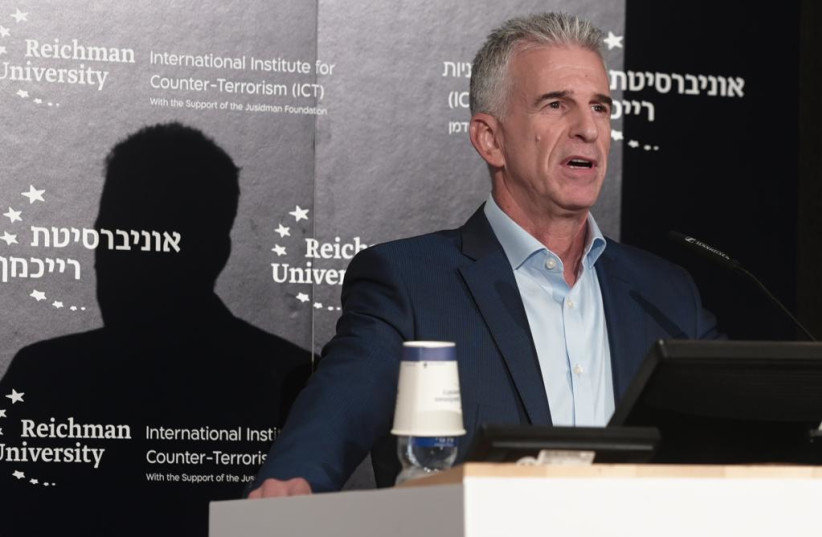
 Mossad Director David Barnea giving a speech to the anti-terrorism institute at Reichman University, September 10, 2023. (photo credit: AVSHALOM SASSONI/MAARIV)
Mossad Director David Barnea giving a speech to the anti-terrorism institute at Reichman University, September 10, 2023.
(photo credit: AVSHALOM SASSONI/MAARIV)
The Mossad and other intelligence bodies have thwarted 27 Iranian terrorist plots against Israelis on almost every continent so far this year, Mossad Director David Barnea said Sunday.

He and his allies had a hand in blocking Russian-Iranian arms deals, which could have led to Iran getting more advanced weapons, Barnea hinted during a speech at Reichman University’s International Counter-Terrorism Conference.

“The first factor feeding Iran’s overinflated ego is the assistance it has been giving Russia through the sale of UAVs,” he said. “We know that the Iranians were planning to sell Russia short-range and long-range missiles too, but this deal has been interdicted.

“I have a feeling that more deals will be interdicted soon. We are concerned that the Russians will meet Iran’s demands to supply it with weapons and raw materials that will put Israel at risk.”

Israel is ready to “exact a price from the highest officials in the heart of Iran,” if necessary, to defend Israel from Iran’s attacks and threats,” Barnea said.

Proxies are Iran’s way to hide its terrorist face, but Tehran is behind practically everything: terrorist acts, logistics, money, and support – all under orders from the very top, he said.

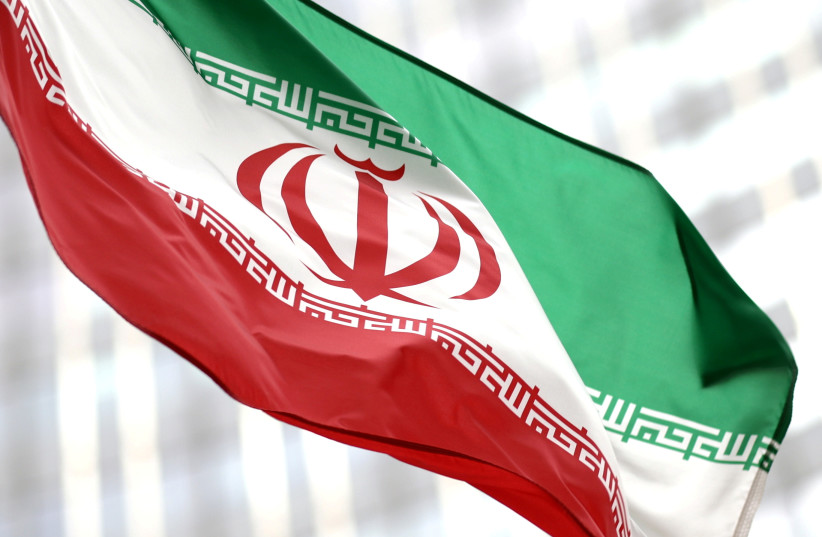
Iranian flag flies in front of the UN office building, housing IAEA headquarters, amid the coronavirus disease (COVID-19) pandemic, in Vienna, Austria, May 24, 2021. (credit: LISI NIESNER/ REUTERS)

Proxies are Iran’s way to hide its terrorist face, but Tehran is behind practically everything: terrorist acts, logistics, money, and support – all under orders from the very top, he said.

Barnea presented videos from the capture and interrogation by Mossad agents of Iranian terrorists in Tanzania and Cyprus. The list of countries in which terrorist agents were caught also included Georgia, Greece, and Germany, he said.

Yousef Shahbazi Abbasalilo was an Iranian operative in Cyprus, and Hamidreza Abraheh was an Iranian operative in Tanzania, he added.

The danger of a terror state becoming a nuclear state

The world needs to understand the danger of a terrorist state that also becomes a nuclear state, Barnea said, adding that “Iran will never get a nuclear weapon.”

“Next month, the UN weapons embargo expires” – from the 2015 Joint Comprehensive Plan of Action (Iran nuclear deal) – something Iran will use to gain cheaper access to weapons, he said, adding: “We will not let Iran remain at its current nuclear levels. Even if there is full return to the nuclear deal, this will not undo Iran’s new nuclear knowledge. Everything is Iran’s cynical move to get money back without giving up its nuclear progress.”

Barnea also blasted the US deal with Iran, allowing the return of billions of dollars that had been frozen as part of nuclear sanctions, to secure the release of five American hostages. Iran still has not answered International Atomic Energy Agency surveillance demands or answered probe questions into Tehran’s illicit nuclear violations, he said.“I can’t show our methods in a video, but you know we are not sitting passively” regarding Iran’s nuclear weapons development, Barnea said.

Iran’s deal with the Saudis was extremely temporary, and they eventually would return to their traditional adversarial relationship, he said.