The PLO in Jerusalem announced a “Night of Rage” on Wednesday this week that will take place all over “occupied Jerusalem”.
In a published message, the organization called on Muslims to come and stay at the Al-Aqsa Mosque and hold prayers there on the night when the Jews mark Tisha B’Av, which marks the mourning for the destruction of the Temple.
The Muslims who will come to Al-Aqsa Mosque were also called to oppose the expected “invasion” of Jews visiting the Temple Mount on Thursday, during the fast.
The organization emphasized that Israel’s attempt to damage the sanctity of Jerusalem will bring nothing but disaster and humiliation in calling for Palestinian youth to confront the “occupation” in every street and square.
At half past nine on the evening of Tisha B’Av there will be a reading of the scroll of Lamentations in front of the Western Wall, and the following morning a visit by many Jews to the Temple Mount is expected.
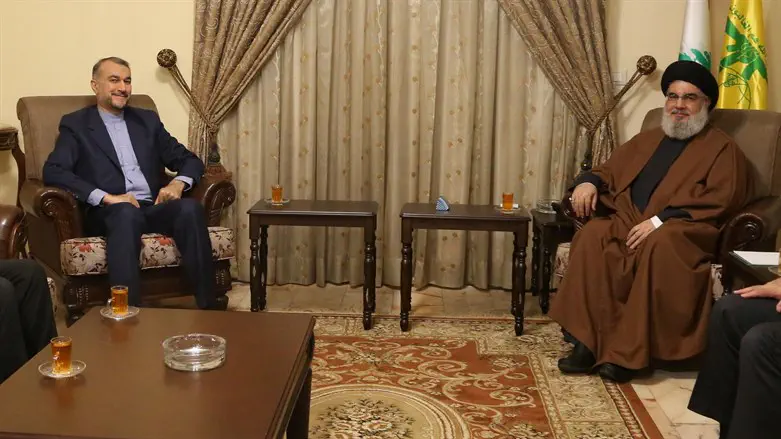
Hassan Nasrallah meets Iranian Foreign Minister Hossein Amir-AbdollahianHezbollah Media Office/Handout via REUTERS
Listen to article3 minutes
Hamas, Iran and Hezbollah decided not to get involved in the crisis that is brewing in Israel in wake of the government’s proposed judicial reform, so as not to help Prime Minister Benjamin Netanyahu, Reuters reported on Tuesday.
According to the report, the crisis sweeping Israel has become a focal point for its enemies across the Middle East who have convened top-level meetings to weigh the turmoil and how they might capitalize on it.
The subject was discussed at a three-hour meeting last week involving a senior commander from Iran’s Quds Force, the arm of its Revolutionary Guards that funnels military support to Tehran’s allies, two Iranian security officials and officials from Hamas, an Iranian diplomat told Reuters.
After concluding that the crisis had already weakened Israel, they agreed they should refrain from any “direct interference”, believing this could give Netanyahu the chance to shift blame to foreign adversaries.
A Hamas source declined to comment, saying there are ongoing discussions between Hamas, Iran and the Quds Force “over the whole situation and to discuss ways to upgrade the work of resistance”.
Iran’s foreign ministry and the Guards’ public relations office could not be immediately reached for comment.
The report comes a day after the Knesset passed the second and third readings of the law that would reduce the use of the reasonableness standard.
Hezbollah leader Hassan Nasrallah took pleasure in the protests which started in Israel following the approval of the law.
“Today in particular is the darkest day in the history of the entity (Israel),” Nasrallah said. “As some of its people say: This day puts Israel on a path to collapse and disappearance, God willing.”
Hezbollah has been provoking Israel lately. The latest incident occurred on Tuesday, when Hezbollah terrorists, wearing full uniform and armed, toured the Israeli border in the Upper Galilee.
IDF soldiers used non-lethal means to force the terrorists away from the fence.
In addition, Hezbollah terrorists caused a fire on the Lebanese side of the border across from the Israeli town of Metula. The fire caused several mines to explode on the Lebanese side of the border.
Before that, Hezbollah terrorists illegally erected tents on sovereign Israeli territory. The tents were placed about 30 meters inside Israeli territory, and generators were placed there to allow Hezbollah terrorists to stay in the compound.
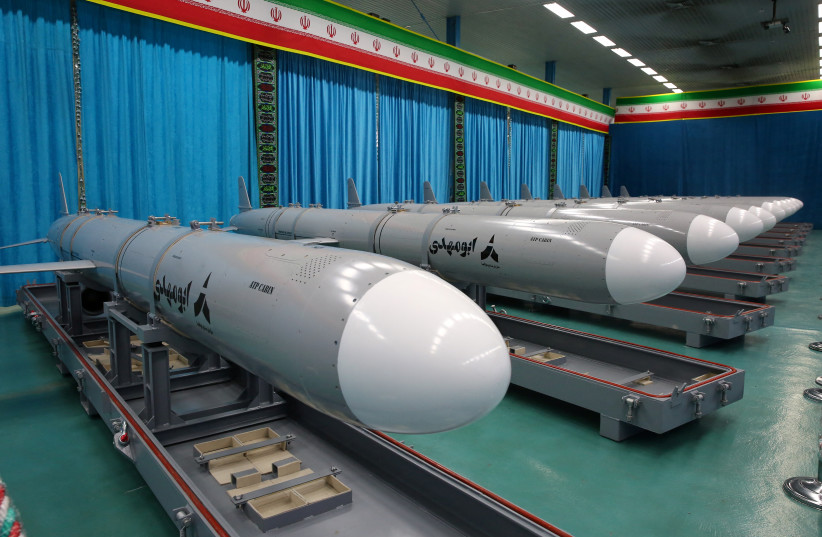
Iranian missiles called Abu Mahdi are displayed during the ceremony of joining the IRGC Navy and the Army, in Tehran, Iran, in this picture obtained on July 25, 2023.
(photo credit: Iran’s Defense Ministry/WANA (West Asia News Agency)/Handout via REUTERS)
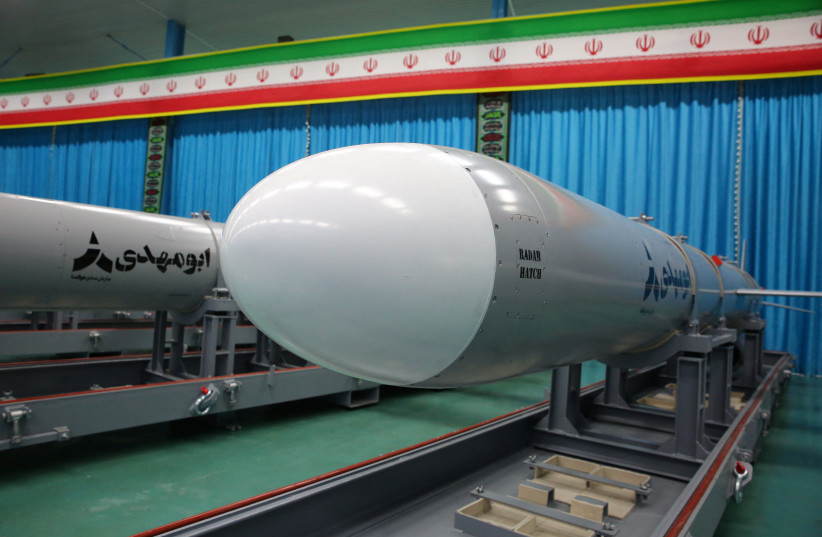
The Iranian Navy and the Islamic Revolution Guards Corp (IRGC)’s Navy both received a cruise missile that is supposed to extend their ability to strike at ships in the region. The missile is called the Abu Mahdi and is said to be a “high-precision naval cruise missile.”
This would give them a cruise missile with a claimed range of 1,000 km, Iranian state media claimed on Tuesday. The announcement comes amid rising naval tensions as the US has sent more warplanes and ships to the Persian Gulf. Iran doesn’t have a very large navy or air force, and therefore using missiles and drones is the main way Iran can threaten ships and other naval forces.
The announcement is important to Iran and was widely reported by Iran’s media. “Iran’s Defense Minister Brigadier General Mohammad Reza Ashtiani said during the ceremony that the Abu Mahdi cruise missile is capable of confronting electronic warfare and evading radar systems and has utilized artificial intelligence to chart its optimal flight path,” Iran’s pro-regime Fars News said.
How will the missile impact Iran’s naval defense capability?
It claimed that the locally made missile can expand the naval defenses of Iran and expand the zone Iran can threaten and also broaden the operational range of Iran. The reports point out that since August 2020 Iran has two missiles named after the late General Qassem Soleimani.
Soleimani was killed by a US drone-fired missile in 2020. Previous reports had indicated earlier this year that Iran was outfitting naval units with cruise missiles. We have reported previously in January 2023 on how Iran has conducted drills in the Persian Gulf and Gulf of Oman to showcase its cruise missile and drone capabilities.
An Iranian missile called Abu Mahdi is displayed during the ceremony of joining the IRGC Navy and the Army, in Tehran, Iran, in this picture obtained on July 25, 2023. (credit: Iran’s Defense Ministry/WANA (West Asia News Agency)/Handout via REUTERS)
According to Iranian state media, the missile can be used against ships such as destroyers and frigates. The US recently sent a guided-missile destroyer, the USS Thomas Hudner, through the Suez to join the US Bahrain-based 5th fleet. Iran claims the new Abu Madhi missile is improved from previous versions and has artificial intelligence that can help it navigate its flight path. It can “pass over natural and artificial obstacles as well as the enemy’s radar and defense systems,” Irna says.
“In line with the defense doctrine of the Islamic Republic of Iran and the improvement of its missile and defense power, we are witnessing today the joining ceremony of the long-range Abu Mahdi cruise [missile], which is a strategic system that we can call unparalleled,” Defense Minister Brigadier General Mohammad Reza Ashtiani said. Rear Admiral Alireza Tangsiri, the commander of the IRGC Navy, also addressed the ceremony: “One of the things that this missile can do is to repel the enemy, and it can drive the enemy away from our coasts,” he said.
A response to US activity in the region
The announcement of the missile is seen as a response to US moves in the region. Iran’s missiles like this have never been tested in combat and it is unclear how they will perform. It is unclear if they have the ranges and capabilities that Iran claims. The story of new command and control systems and how it uses AI for guidance has not been proven. Neither had its ability to evade radar.
Cruise missiles can sometimes skim the water and therefore it is hard for radar to detect them. They are also supposed to be able to maneuver. Iran usually boasts about new systems and makes all sorts of claims that are hard to verify. For instance, Iran claims this missile can be prepared for launch quickly. It can also be used with other missiles for the simultaneous firing of several missiles at the same target.
Iran’s media also noted that it recently unveiled the Khyber ballistic missile with a range of 2,000 km that carries a warhead weighing 1,500 kg. Iran claims its new hypersonic missile can also reach throughout the region, threatening Israel and Europe.
Pro-Iran media in the region highlighted the new naval missile. Al-Mayadeen, for instance, posted a story on it and Iran has also received social media coverage of its missile, even if the missile is not actually new and its capabilities are not proven.