
The United States has said the world faces the gravest nuclear danger since the 1962 Cuban Missile Crisis because of remarks by President Vladimir Putin during the Ukraine conflict.
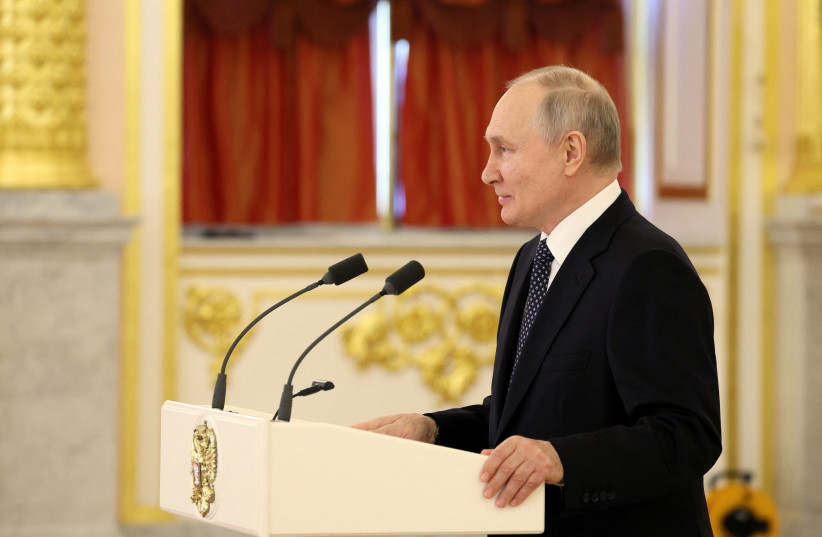
Russian President Vladimir Putin delivers a speech during a ceremony to receive diplomatic credentials from newly appointed foreign ambassadors at the Alexander Hall of the Grand Kremlin Palace in Moscow, Russia, April 5, 2023.  (photo credit: SPUTNIK/GAVRIIL GRIGOROV/KREMLIN VIA REUTERS)
Russian President Vladimir Putin delivers a speech during a ceremony to receive diplomatic credentials from newly appointed foreign ambassadors at the Alexander Hall of the Grand Kremlin Palace in Moscow, Russia, April 5, 2023.
(photo credit: SPUTNIK/GAVRIIL GRIGOROV/KREMLIN VIA REUTERS)

Russia on Saturday dismissed criticism from US President Joe Biden over Moscow’s plan to deploy tactical nuclear weapons in Belarus, saying Washington had for decades deployed just such nuclear weapons in Europe.

Russia said on Thursday it was pushing ahead with the first deployment of such weapons outside its borders since the 1991 fall of the Soviet Union and Belarusian President Alexander Lukashenko said the weapons were already on the move.

Biden said on Friday he had an “extremely negative” reaction to reports that Russia has moved ahead with a plan to deploy tactical nuclear weapons in Belarus. The US State Department denounced the Russian nuclear deployment plan.

“It is the sovereign right of Russia and Belarus to ensure their security by means we deem necessary amidst of a large-scale hybrid war unleashed by Washington against us,” Russia’s embassy in the United States said in a statement.

“The measures we undertake are fully consistent with our international legal obligations.”
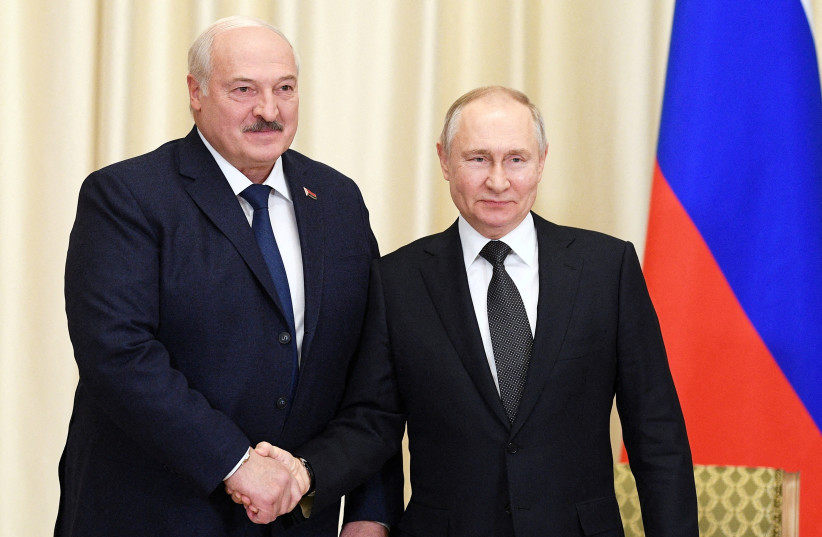
Russian President Vladimir Putin shakes hands with Belarusian President Alexander Lukashenko during a meeting at the Novo-Ogaryovo state residence outside Moscow, Russia, February 17, 2023. (credit: SPUTNIK/VLADIMIR ASTAPKOVICH/KREMLIN VIA REUTERS)Russian President Vladimir Putin shakes hands with Belarusian President Alexander Lukashenko during a meeting at the Novo-Ogaryovo state residence outside Moscow, Russia, February 17, 2023. (credit: SPUTNIK/VLADIMIR ASTAPKOVICH/KREMLIN VIA REUTERS)

Russia portrays the issue as a fight for survival

The United States has said the world faces the gravest nuclear danger since the 1962 Cuban Missile Crisis because of remarks by President Vladimir Putin during the Ukraine conflict, but Moscow says its position has been misinterpreted.

Putin, who has cast the Ukraine war as a battle for the survival of Russia against an aggressive West, has repeatedly warned that Russia, which has more nuclear weapons than any other country, will use all means to defend itself.

Tactical nuclear weapons are used for tactical gains on the battlefield, and are usually smaller in yield than the strategic nuclear weapons designed to destroy US, European or Russian cities.

The Russian Embassy called the US criticism of Moscow’s planned deployment hypocritical, saying that “before blaming others, Washington could use some introspection.”

“The United States has been for decades maintaining a large arsenal of its nuclear weapons in Europe. Together with its NATO allies it participates in nuclear sharing arrangements and trains for scenarios of nuclear weapons use against our country.”

The United States has deployed nuclear weapons in Western Europe since US President Dwight D Eisenhower authorized their deployment in the Cold War as a counter to the perceived threat from the Soviet Union. The first US nuclear weapons in Europe were deployed in Britain in 1954.

Much of the detail about the current US deployment is classified, though the Federation of American Scientists says that the US has 100 B61 tactical nuclear weapons deployed in Europe – in Italy, Germany, Turkey, Belgium and the Netherlands.

VP of oil company tells Nicosia he wants to hear views of other energy firms attending gathering next week where Cypriot gov’t will formally pitch plan to secure investor backing

Illustrative: People on the beach take photos of the 'Tungsten Explored' drilling ship, in the southern coastal city of Larnaca, Cyprus, on November 3, 2021. (AP Photo/Petros Karadjias, File)

Illustrative: People on the beach take photos of the ‘Tungsten Explored’ drilling ship, in the southern coastal city of Larnaca, Cyprus, on November 3, 2021. (AP Photo/Petros Karadjias, File)

NICOSIA, Cyprus — Oil and gas company Chevron is “positive” about an Israeli-Cypriot plan for a pipeline that would convey offshore natural gas from both countries to Cyprus where it would be liquefied for export by ship to Europe and elsewhere, an official said Friday.

Cypriot Energy Minister Giorgos Papanastasiou said after talks with visiting Chevron Vice President for Exploration and Production Frank Cassulo that the company also wants to hear the views of other energy firms attending a gathering next week where the Cypriot government will formally pitch the plan in order to secure investor backing.

Chevron has presented the Cypriot government with a plan to develop its Aphrodite deposit in waters south of the island, first discovered in 2011 and estimated to contain 4.2 trillion cubic feet of the hydrocarbon.

Sponsored by Sheba: The Stem Cell Revolution at Sheba Medical Center

Loaded: 61.04%

Papanastasiou also pointed to recent statements by a senior ExxonMobil executive who said the oil and gas company is interested in Israeli-Cypriot plans. ExxonMobil holds exploration licenses for two of Cyprus’ 13 areas — or blocks — that comprise its exclusive economic zone. The company has already discovered one sizeable gas deposit and prospects for more discoveries look “promising.”

Papanastasiou told The Associated Press last week that at least two major oil and gas companies — apart from Chevron — have expressed interest in the plan that aims to spur additional prospecting, expedite the deposits’ development and ensure adequate gas quantities for Cyprus to wean itself off imported oil and slash energy generation costs.

France’s Total and Italy’s Eni are also partners in a consortium holding exploration licenses for seven blocks.

Next week’s workshop will bring together all companies involved in hydrocarbon exploration off Cyprus, as well as pipeline and liquefaction plant manufacturers, investors and other high-tech firms, including Israeli companies.

The pipeline-liquefaction plant project’s key drawing card is its low cost relative to other exporting methods, enabling companies to recover their initial investment and turn a profit much quicker.

The roughly 320-kilometer (200-mile) pipeline is estimated at 450 million euros ($489 million) and the liquefaction plant at 1 billion euros ($1.1 billion).


Why are Iran’s missiles a growing threat? – analysis

Iran has been developing missiles since the 1980s, and today the country continues to increase the range and precision of its missiles.

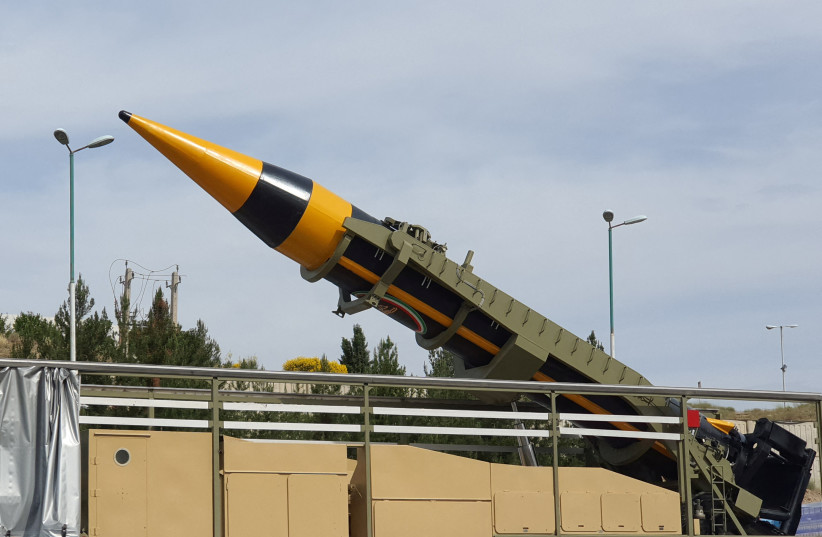
A new surface-to-surface ballistic missile called Khaibar with a range of 2,000 km, unveiled by Iran, is seen in Tehran, Iran, May 25, 2023
(photo credit: WANA (WEST ASIA NEWS AGENCY) VIA REUTERS)

An announcement by Iran that it tested a new long-range ballistic missile on Friday reveals the growing threat that Iran’s missiles pose to the region.

To understand the threat, we need to understand Iran’s complex missile program. There is a bit of complexity here because Iran keeps coming up with new names for its missiles, even if they are part of an existing group of missiles. It also has a variety of types of missiles, in terms of range and fuel used and even which part of Iran’s defense and space industries produces the systems.

Iran has been developing missiles since the 1980s, and today the country continues to increase the range and precision of its missiles. It also continues to work with both liquid and solid fueled missiles. Iran also continues to work on missiles that can launch satellites and it is working on cruise missiles and precision guided munitions. What this essentially means is that Iran has a plethora of options when it comes to fielding weapons that can threaten Israel, the US and also countries in the region and in Europe and Asia.

Iran’s missile and rocket program has origins not only in the 1980s but also in copying, reverse engineering and modelling new missiles on those that Iran was able to acquire from what were once Soviet, Chinese or North Korean models. For instance, the Iranian Shahab class of missiles are likely derived from the North Korean Nodong-A, and the Iranian Tondar short-range missile is modeled on a Chinese missile.

What are the abilities of Iran’s missiles?

Iran’s missiles are often in the spotlight and there is a lot of knowledge about them. The Center for Strategic and International Studies based in Washington has a report on Iran’s program that lists most of Iran’s major missiles. Their list includes the medium-range ballistic missiles Emad, Ghadr-1 (Shabab 3 variants), Khorramshahr, Sejjil and Shahab 3 as well as short-range ballistic missiles Zolfaghar, TOndar-69, Shahab-2, Shahab-1, Qiam-1, Fateh-110 and Fateh-313. Satellite launch vehicles include the Safir and Simorgh.

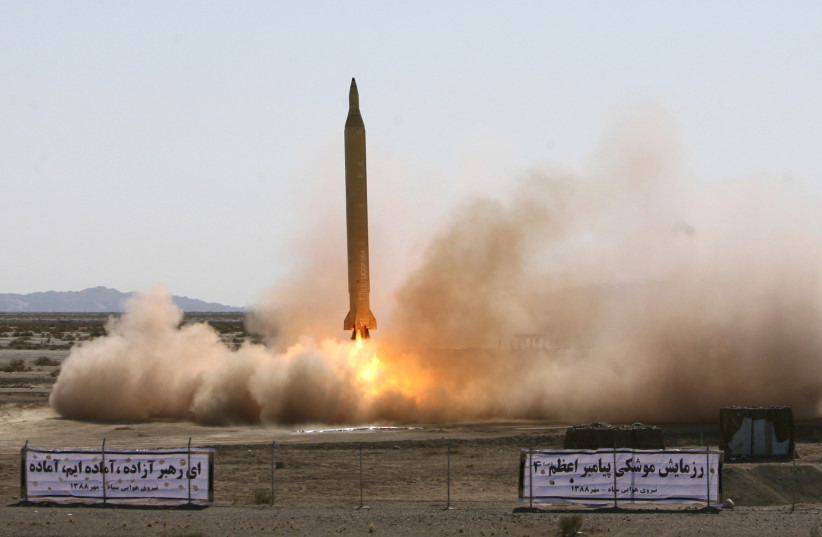
A Ghadr 1 class Shahab 3 long range missile is prepared for launch during a test from an unknown location in central Iran (credit: REUTERS)A Ghadr 1 class Shahab 3 long range missile is prepared for launch during a test from an unknown location in central Iran (credit: REUTERS)

To understand the ranges here, the Khorramshahr, which is the class of missile Iran recently tested, may have a range beyond 2,000 k.m. while the Shahab-3 variants Emad and Ghadr both have ranges between 1,700 and 1,950 k.m.. Shahab 3 itself has a range of around 1,300 k.m.. Similarly to Khorramshahr, the Sejjil may have a range of 2,000 k.m.. Iran also makes the Soumar cruise missile which it claims can reach up to 3,000 k.m.. In addition, the SLVs are measured in how high they can place a satellite and most have a range up to 500 k.m.. Many of the missiles that have the longest range are still considered in development, such as the Simorgh, Emad, Ghadr and Khorramshahr.

The missiles can also be divided into different types of fuels used in their propulsion. For instance, the Shahab missiles, Emad, Ghadr, KhorramShahr and Qiam are all liquid fueled. The Sejjil, Fateh, Dezful, Raad, Zulfiqar, and Tondar are solid fueled. There is no range distinction on these fuels, both solid and liquid are used for short- and medium-range missiles. Solid fueled missiles may have advantages in terms of speed of deployment, so that Iran could use its missiles quickly even if under some kind of attack.

The Foundation for Defense of Democracies put out an extensive look at Iran’s missiles in February 2023. It notes that since 2015, when Iran agreed to the Iran Deal, it has launched some 228 ballistic missiles.

“Iran, despite limitations on their missile testing laid down in the Iranian nuclear deal, has continued to test ballistic missile technology. The deal prohibits Iran from testing any missile designed to carry a nuclear warhead for a period of eight years but not from testing other missiles. Iran has pushed this framework on multiple occasions, most recently on June 18th, 2017, when Iran tested the Khorramshahr missile. The specifications of the missile are unknown, and therefore it is as yet unclear if the test violated this agreement,” the article notes.

An article at the Missile Defense Advocacy Alliance further argues that “Iran’s missile strikes against targets in Syria and Iraq (June 18, 2017, and September 08, 2018, respectively) suggest a pattern to Iran’s missile attacks. In both strikes, an unmanned aerial vehicle (UAV) was sent over the target area to conduct a battle damage assessment, one liquid-fueled ballistic missile and around six solid-propellant ballistic missiles. Current conflicts in the Middle East have served as proving grounds for new missiles and practice for Iranian missile forces.”

Iran’s missile are thus a multi-layered threat. First of all, Iran continues to develop its missile program through a variety of efforts, including via the IRGC and the Iranian space program. Second, Iran continues to export the missiles to countries in the region, usually to allied proxies and militias, such as the Houthis, Hezbollah, militias in Iraq and Syria and also via transferring information to Palestinian terror groups.

Iran also seeks to build more complex missiles, either using different types of fuel or investing in cruise missiles, maneuvering munitions and also greater precision. Iran also seeks to use missiles and drones in concert in its attacks. Clearly Iran’s attempt to develop a missile that has a long range and which could include a nuclear warhead is the height of the missile threat. If Iran has a missile capable of carrying that kind of warhead, then Iran’s attempt at weaponizing its nuclear program would be even more dangerous for the world.
