
Tehran said planning drone hits after Revolutionary Guards members killed in strikes blamed on Israel; US announces it sent nuclear-powered submarine to region amid tensions
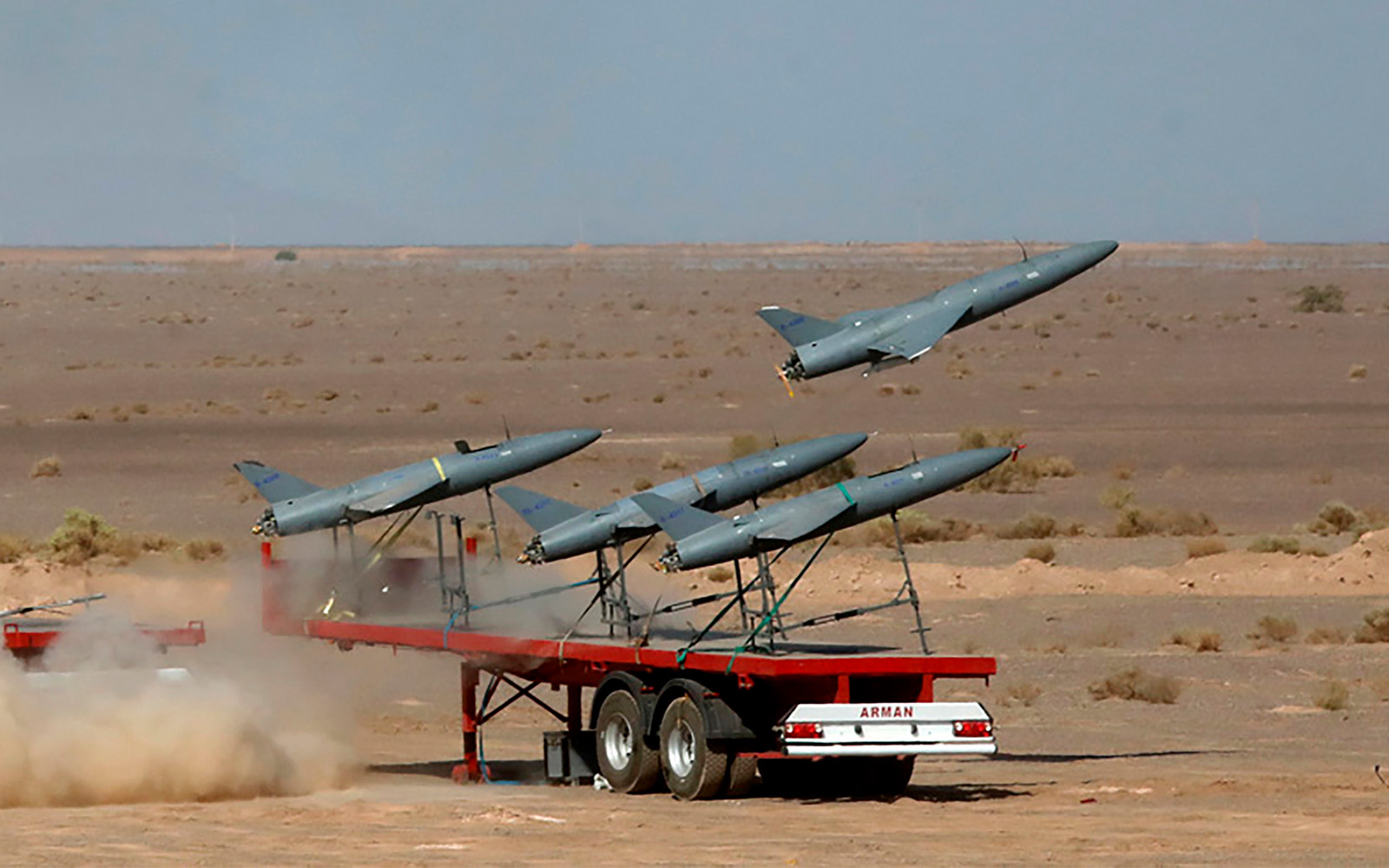
Illustrative: In this photo released by the Iranian Army on August 25, 2022, a drone is launched in a military drone drill in Iran. (Iranian Army via AP)

Illustrative: In this photo released by the Iranian Army on August 25, 2022, a drone is launched in a military drone drill in Iran. (Iranian Army via AP)

Iran is preparing to attack Israeli-owned trading vessels to avenge two Revolutionary Guards advisors killed in alleged Israeli airstrikes in Syria last month, The New York Times reported on Saturday.

The IRGC’s Aerospace Force is gearing up to launch drone attacks on ships sailing through the Persian Gulf and the Arabian Sea, according to the report, which cited two anonymous senior Western intelligence officials.

An Iranian political strategist linked to the IRGC told the newspaper the planned attacks were in retaliation for the strikes in Syria.

The report came as the US military announced it had dispatched the USS Florida, a nuclear-powered guided-missile submarine to the Middle East to “help ensure regional maritime security and stability.” The show of force comes amid heightened tensions with Iran, which continues to harass shipping and attack oil tankers in the area, including several owned by Israelis.

Washington usually does not disclose the locations of its submarines while they are at sea.

“It is capable of carrying up to 154 Tomahawk land-attack cruise missiles and is deployed to US 5th Fleet to help ensure regional maritime security and stability,” fleet spokesperson Commander Timothy Hawkins said in a statement.

Tomahawk cruise missiles launched from ships or submarines can hit targets up to 2,500 kilometers (1,500 miles away).

This photo released by the US Navy shows the USS Florida, a guided-missile submarine capable of carrying up to 154 Tomahawk missiles. The Navy said a nuclear-powered submarine, based out of Kings Bay, Georgia, passed through the Suez Canal on Friday, April 7, 2023. (US Navy via AP)

Hawkins said the submarine entered the region Thursday and began crossing the canal on Friday.

The move also comes with heightened tensions between Israel and Iran amid a general spike in violence in Israel, Lebanon, the West Bank and Gaza.

Israel has allegedly launched a series of airstrikes in Syria in recent weeks, including the strike that killed the Iranian military advisers, prompting vows of revenge from Tehran.

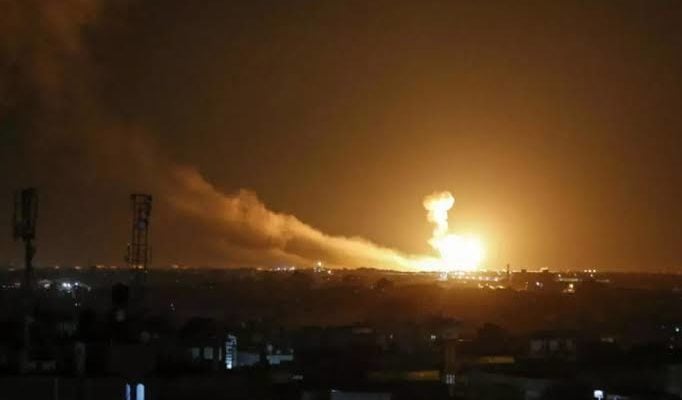
Six rockets were launched from southern Syria at the Golan Heights on Saturday night and early Sunday in two separate barrages hours apart, with three landing in Israeli territory, the military said.

After the second barrage, the Israel Defense Forces said it carried out artillery and drone strikes in southern Syria, targeting the launchers that had been used to fire the rockets. Later, Israeli fighter jets carried out additional airstrikes near the capital Damascus.

A local Palestinian militia called Liwa al-Quds, or the Jerusalem Brigade, claimed responsibility for the rocket launches, according to the Hezbollah-affiliated Lebanese Al Mayadeen network.

As a general rule, Israel’s military does not comment on specific strikes in Syria, but it has acknowledged conducting hundreds of sorties against Iran-backed groups attempting to gain a foothold in the country over the last decade.

Mourners attend the funeral procession for two of Iran’s Revolutionary Guard forces killed in Syria strikes blamed on Israel, held in Tehran on April 4, 2023. (Atta Kenare/AFP)

The IDF says it also attacks arms shipments believed to be bound for those groups, chief among them Hezbollah. Additionally, airstrikes attributed to Israel have repeatedly targeted Syrian air defense systems.

Iran, a key ally of Syrian President Bashar Assad, claims it only deploys military advisers in the conflict-ravaged country.

Iran’s Foreign Ministry spokesman, Nasser Kanani, accused Israel of bringing “war and insecurity” to the Middle East and of “creating discord in the region.”

Last week, the Israeli Air Force said a drone downed in Israeli airspace was suspected to be Iranian.

The escalation of attacks comes after what appears to be a rare bombing in Megiddo by an armed terrorist who infiltrated from Lebanon into Israel.

While many details of the investigation into the Megiddo bombing are barred from publication, the Haaretz news site cited speculation that the series of airstrikes on Iranian targets in Syria could indicate that the IRGC was involved in the latest security incidents.
IAF pounds Syria after 6 rockets fired on Golan Heights

“The IDF considers the Syrian state responsible for everything that happens on its territory and will not allow attempts to violate Israel’s sovereignty,” said a military spokesman shortly after the strikes were carried out.

By World Israel News Staff

The Israeli Air Force launched retaliatory airstrikes on targets in Syria, after six rockets were fired from the country towards Israel’s northern Golan Heights region.

In two separate barrages several hours apart, rockets were launched towards communities in the Lower Galilee, causing air raid sirens to wail and residents to seek shelter.

There were no casualties or property damage reported to be caused by the rockets.

At least one of the rockets exploded in an open area near the communities of Avnei Eitan and Natur at around 3 a.m. early Sunday morning.

One rocket was intercepted by the Iron Dome missile defense system, while several others fell short in Syria. At least one rocket ended up landing in an open area near an unpopulated area in Jordan.

Shortly after the second salvo of rockets, the IAF attacked the sites in southern Syria from which the rockets had been launched in Syria.

The Jerusalem Brigade, a relatively unknown Palestinian terror group, took responsibility for firing the rockets, according to Hezbollah-affiliated Lebanese news outlet Al-Mayadeen.

Both Israeli and Syrian officials noted that the IAF also struck targets near Damascus.

  ISRAEL ELIMINATES ISLAMIC JIHAD COMMANDER IN SYRIA, TERROR GROUP CLAIMS

“The IDF considers the Syrian state responsible for everything that happens on its territory and will not allow attempts to violate Israel’s sovereignty,” read a statement from the IDF Spokesperson’s Unit shortly after the strikes were carried out.

The rocket launches from Syria on Saturday marked the third front from which Israel had been attacked in as many days.

On Thursday – the day of the Passover holiday – Israel faced an unprecedented barrage of rockets fired on northern towns from Lebanon. It was the largest salvo of rockets originating from Lebanon since the 2006 war.

That same day, Gazan terror groups bombarded southern Israel communities with rockets launched from the coastal enclave.


The Islamic Republic’s proxies and allies appear to have begun a multi-front conflict with Israel over the past week.

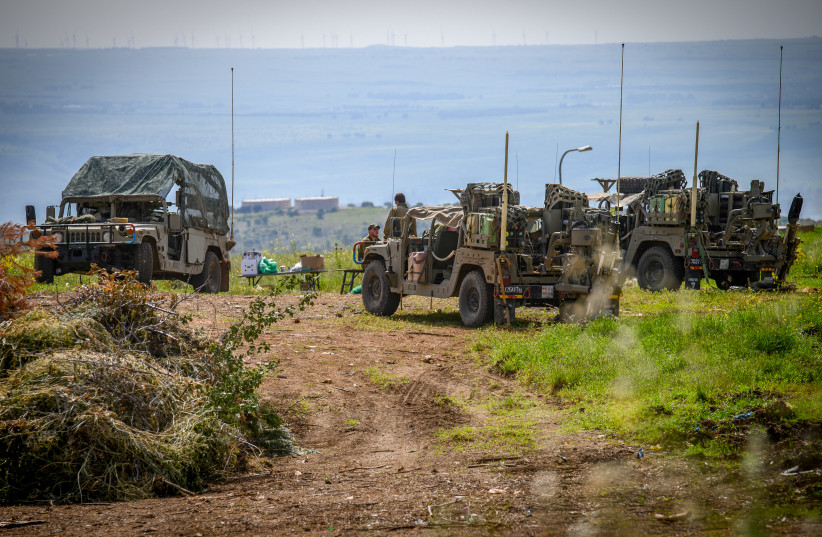
Israeli soldiers near the border with Lebanon, in northern Israel, April 7, 2023 (photo credit: AYAL MARGOLIN/FLASH90)
Israeli soldiers near the border with Lebanon, in northern Israel, April 7, 2023
(photo credit: AYAL MARGOLIN/FLASH90)

A week of attacks on Israel, including rockets fired from Lebanon, Gaza and Syria, represent the manifestation of an Iranian strategy to confront Israel with multiple threats on different fronts.

Although different groups may be behind the attacks in Gaza, Lebanon and Syria, these groups are likely all linked to Iran. The groups involved include Hamas, Hezbollah, Palestinian Islamic Jihad and other groups that may go by different or new names, but which are proxies of Tehran.

Iran has long sought to bring its conflict with Israel to Israel’s borders. Its backing of Hezbollah and Hamas was key to that strategy over the decades. For instance, Iran supplies Hamas with financial support and also helped it develop a larger rocket arsenal with longer ranges for its rockets. Whereas Hamas rockets once could only travel a few kilometers, now they can reach most parts of Israel.

Iran also supported Palestinian Islamic Jihad, which is even more of an Iranian proxy than Hamas. The group not only has a rocket arsenal thought to include thousands of rockets, but it has gunmen in the West Bank and its leadership often resides in Damascus.

Hezbollah: Iran’s key ally in the multi-front war

Hezbollah is the largest of Iran’s key allies in the region.

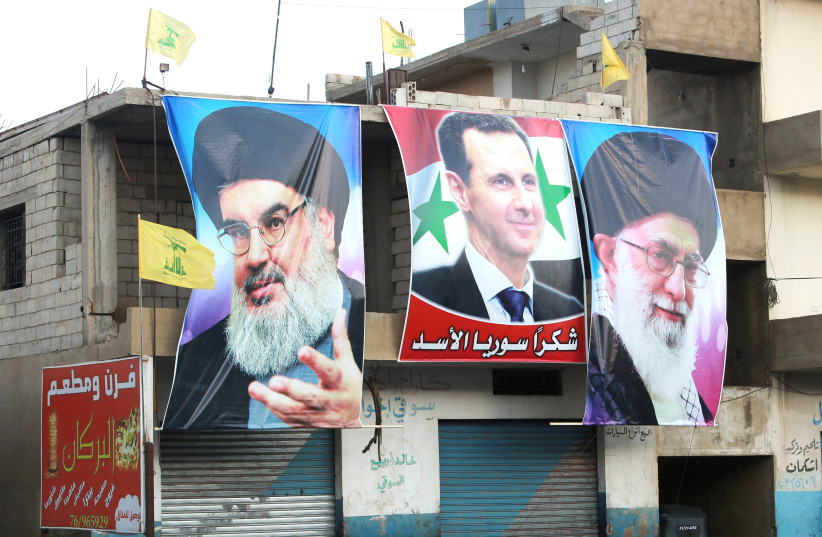
 A man rides a motorbike past posters depicting Lebanon's Hezbollah leader Sayyed Hassan Nasrallah, Syria's President Bashar al-Assad, and Iran's Supreme Leader Ayatollah Ali Khamenei near the Lebanese-Syrian border, in al-Ain village, Lebanon September 16, 2021 (credit: AZIZ TAHER/REUTERS)A man rides a motorbike past posters depicting Lebanon’s Hezbollah leader Sayyed Hassan Nasrallah, Syria’s President Bashar al-Assad, and Iran’s Supreme Leader Ayatollah Ali Khamenei near the Lebanese-Syrian border, in al-Ain village, Lebanon September 16, 2021 (credit: AZIZ TAHER/REUTERS)

An organization with origins in the 1980s it was backed by the new Islamic Revolutionary regime of Tehran back in the 1980s, so that it was able to build up a presence in Southern Lebanon. Hezbollah has also grown exponentially in its power since then. It not only has a rocket arsenal of more than 100,000 rockets, but it has developed more sophisticated systems, such as precision guided munitions. Along with Hamas, it also has drones that it has used to target Israel and to threaten energy exploration off the coast.

While Hamas has been mostly penned into Gaza since Israel’s withdrawal from Gaza and the Hamas victory in Palestinian elections, it now appears to be increasingly able to operate from Lebanon. The Hamas operations in Lebanon come with Hezbollah’s approval. The fact that Hamas leader Ismael Haniyeh flew to Lebanon on April 5, a day before 34 rockets were fired at Israel from Lebanon, shows how Hamas has increased its presence. Hamas cannot fire rockets or operate from southern Lebanon without coordination with Hezbollah. The rockets that were fired at Israel on April 6 were fired in broad daylight near Tyre. This is an area Hezbollah has presence. Last year Hezbollah killed a UN Irish peacekeeper in Al-Aqbieh in Lebanon north of Tyre. In May 2021 rockets were also fired at Israel from near the village of Seddiqine, also in Tyre district.

Hezbollah has increased its operations abroad in recent years. This includes Hezbollah networks that stretch to West Africa and South America. The most important development is Hezbollah’s operations in Syria, which began in 2012 in support of the Syrian regime. Hezbollah has moved forces to areas near the Golan, an area known as Hezbollah’s “Golan file” according to reports from the Alma Research and Education Center which covers threats in the north of Israel. In 2019, Hezbollah even brought drones to this area to threaten Israel. The threat was neutralized.

Other elements of Iran’s threats to Israel include militias in Syria and Iraq. These include the Iraqi-based Popular Mobilization Units and their factions such as Kataib Hezbollah and Asaib Ahl al-Haq. Iran flew a drone into Israeli airspace from Iraq in May 2021. Iran also recently launched a drone at Israel on April 1, last week, from Syria.

Iran’s idea for a multi-front war is not new. It has been boasting in recent months about how Israel is internally collapsing and it has signaled that it wants to increase its threats. Iran’s IRGC said on Sunday that this year its power will grow compared to Israel. Israel also carried out drills in May 2022 in preparation for the threat of a multi-front war. At the time estimates said Israel’s adversaries could fire 1,500 rockets a day at Israel.

Iran’s entrenchment in Syria

The multi-front war is made possible by Iran’s entrenchment in Syria. In the past Iran could threaten Israel using Hezbollah in Lebanon or PIJ in the West Bank and Gaza, and Hamas in Gaza. Israel has launched operations to neutralize the PIJ and Hamas threats in the past. Since last year Israel has also been battling PIJ gunmen in Jenin and other Palestinian factions that are emboldened against Israel. Israel has generally tried to isolate these threats, or manage these conflicts. Overall Israel has concentrated more heavily on the Iranian threat and containing Iranian entrenchment in Syria. This operation has been called the Campaign Between the Wars and it has gone on for many years, involving many airstrikes on sites in Syria. This has also involved larger operations such as Operation House of Cards in Syria in 2018. Islamic Jihad was also targeted in Syria in November 2019.

Nevertheless, the Iranian threat has not gone away and its proxies and allies appear to have begun a multi-front conflict with Israel over the past week. This involved the Iranian drone operation on April 1, Gaza rocket fire from April 5 to 7 and 34 rockets fired at Israel from Lebanon on Passover, April 6. In addition there was rocket fire from Syria on April 8 and 9. There were also shooting attacks in the West Bank and a drone launched from Gaza on April 3. When one looks at the larger picture the Iranian octopus of partners and groups is seeking to threaten Israel from multiple areas. This is also unprecedented in terms of the rocket fire from Lebanon and Syria over such a small period of time. In general peace has prevailed along the Lebanese border since 2006. Now Iran is showing it can heat up any border whenever it wants using various groups.
