Closed meeting will take place Thursday at request of UAE, the Arab League’s representative on the top UN panel; US expresses ‘extreme concern’ over Israeli-Palestinian tensions
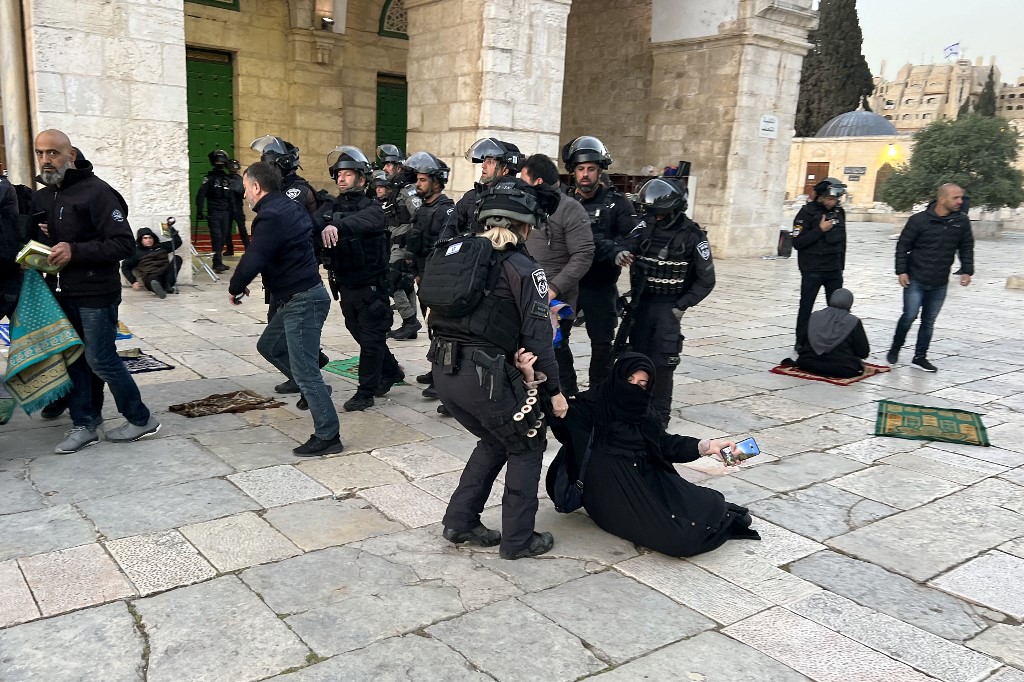
Israeli security forces remove Palestinian Muslim worshipers sitting on the grounds of the Al-Aqsa Mosque compound in Jerusalem, early on April 5, 2023. (Ahmad Gharabli/AFP)

Israeli security forces remove Palestinian Muslim worshipers sitting on the grounds of the Al-Aqsa Mosque compound in Jerusalem, early on April 5, 2023. (Ahmad Gharabli/AFP)

The United Nations Security Council will convene an emergency session on Thursday to discuss recent violence in Jerusalem where Israeli police clashed with Muslim worshipers at the Temple Mount, fighting that was followed by rocket fire from Gaza into Israel and IDF counterstrikes.

Thursday’s session will take place behind closed doors and was called by the United Arab Emirates — the Arab League’s representative on the council — and China, two UN diplomats for countries on the panel told The Times of Israel on Wednesday.

It will be the fourth emergency session held by the Security Council on Israeli-Palestinian tensions since the establishment of Prime Minister Benjamin Netanyahu’s hardline government just over three months ago.

Similar urgent meetings were convened after far-right National Security Minister Itamar Ben Gvir visited the flashpoint Temple Mount and after deadly IDF raids in Nablus and Jenin. The Security Council has also held three of its mandated monthly meetings on the Israeli-Palestinian during that same time span as well.

The emergency meeting will take place less than two days after the clashes in Jerusalem ended a relatively calm first two weeks of Ramadan.

Palestinians say that it is a traditional custom to remain in mosques overnight during Ramadan.

Footage released by Israel showed Palestinians inside the mosque shooting off fireworks at police in an intense clash.

Clips uploaded to social media showed troops beating already apprehended Palestinians inside the mosque.

The Temple Mount is the holiest site in Judaism and is revered as the location of both ancient Jewish temples. The compound is Islam’s third holiest site and is managed by Jordan, as part of a delicate arrangement with Israel.

Police said they tried to convince rioters inside the mosque to leave but that the group refused to comply, leaving security forces no option but to enter the building.

Some 350 suspects were detained by police. All but 57 were released by Wednesday afternoon, police said.

The clashes led to some 16 rockets being fired at Israel from Gaza early Wednesday. The Sderot Municipality said one of the rockets struck a factory in the industrial area, causing damage. No one was hurt.

In response Israel carried out airstrikes in the Strip, hitting several Hamas facilities.

The fighting raised fears of a wider conflagration. Similar clashes two years ago erupted into a bloody 11-day war between Israel and Hamas.

The UN’s Special Coordinator for the Middle East Peace Process Tor Wennesland, who will be briefing Security Council members on the latest developments at Thursday’s session, said in a Wednesday statement that he was “appalled by the images of violence inside the al-Qibli mosque” on the Temple Mount compound known to Muslims as the Noble Sanctuary.

“I am disturbed by the apparent beating of Palestinians by Israeli security forces and the large number of arrests. I also strongly reject the stockpiling and use of fireworks and rocks by Palestinians inside the mosque,” Wennesland said, pointedly criticizing both sides for their conduct in the clashes that took place overnight Tuesday-Wednesday.

“This holy period and places of worship should be for safe and peaceful religious reflection, noting that nearly 600,000 people have visited the Holy Sites in Jerusalem since the beginning of Ramadan. I call on political, religious and community leaders on all sides to reject incitement, inflammatory rhetoric, and provocative actions,” Wennesland said.
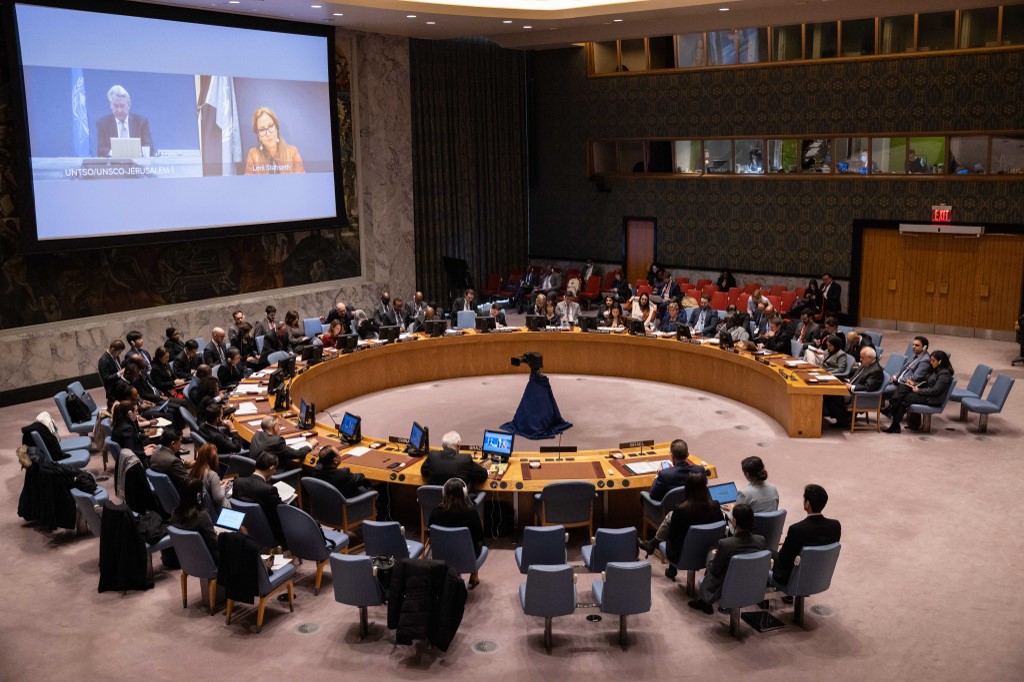
A United Nations Security Council meeting on the situation in the Middle East, at the United Nations headquarters in New York City on February 20, 2023. (Yuki IWAMURA / AFP)

“The historic status quo of the Holy Sites must be upheld, in line with the special role of the Hashemite Kingdom of Jordan. The role of the [Jordan-backed Islamic] Waqf is vital and it must be empowered to fulfill its crucial duties,” he said. “Leaders on all sides must act responsibly and refrain from steps that could escalate tensions.”

“The indiscriminate firing of rockets from Gaza is unacceptable and must stop,” Wennesland added. “The UN remains in close contact with all concerned parties to de-escalate the situation.”

UN Secretary-General Antonio Guterres was “shocked and appalled” by images he saw of Israeli security forces beating people at the Al-Aqsa Mosque, his spokesman said Wednesday.

Spokesman Stephane Dujarric said Guterres viewed images of the “violence and beating” within the holy site, and found it more distressing because it came “at a time of a calendar which is holy to Jews, Christians and Muslims that should be a time for peace and nonviolence.”
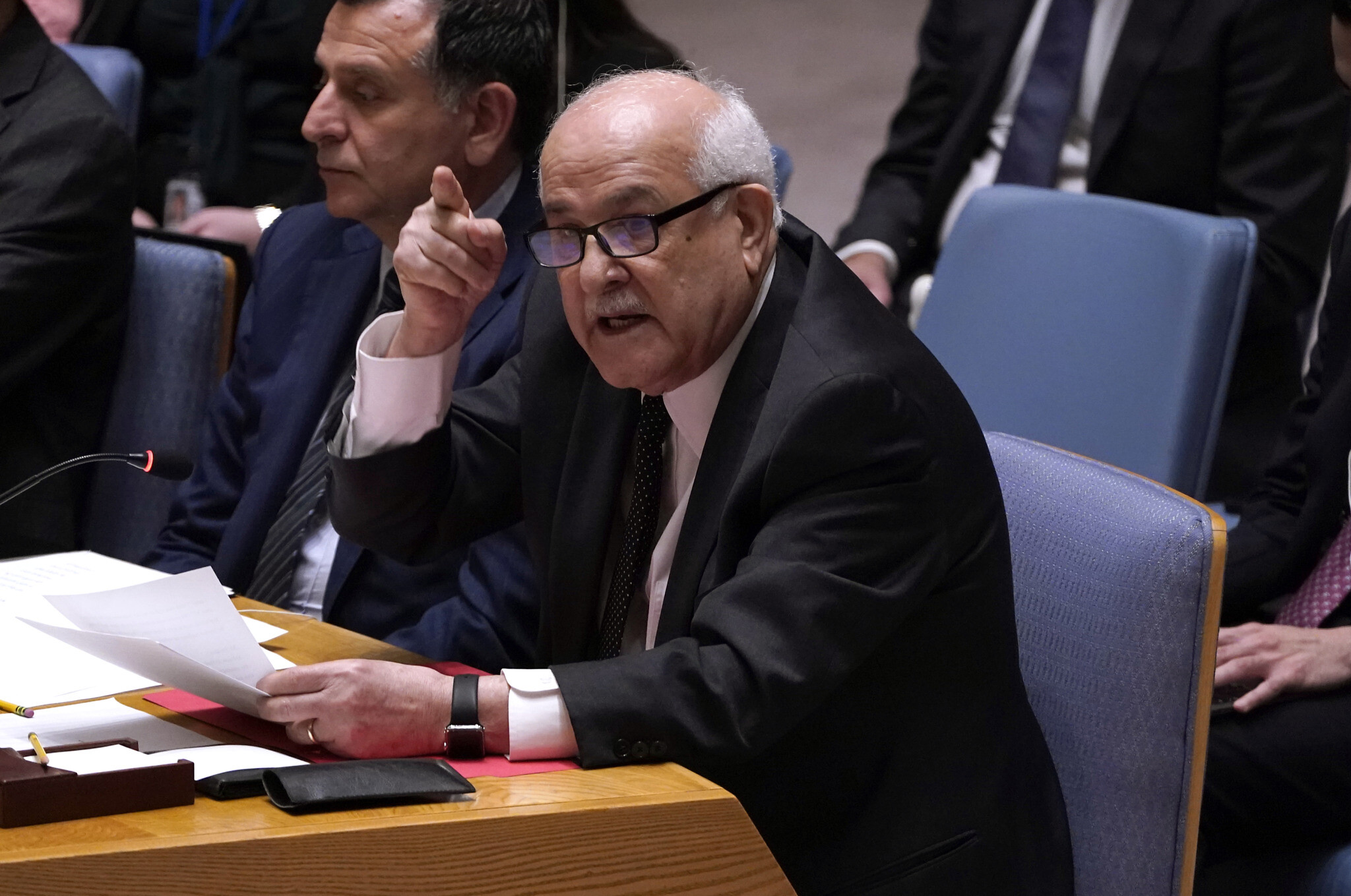
Ambassador Riyad Mansour, Permanent Observer of the State of Palestine to the United Nations, speaks during an emergency meeting of the UN security council regarding the situation in Palestine, at UN headquarters in New York City on January 5, 2023. (TIMOTHY A. CLARY/AFP)

White House National Security Council spokesman John Kirby said the US is “extremely concerned” about the violence at the Al-Aqsa Mosque in Jerusalem and “urges all parties to avoid further escalation.”

“More than ever, Israelis and Palestinians need to work together to reduce these tensions and restore calm,” said Kirby.

The US Office of Palestinian Affairs also weighed in, saying that “violence has no place in a holy site and during a holy season.

[We’re] alarmed by the shocking scenes in Al-Aqsa Mosque and rockets launched from Gaza toward Israel,” its statement said, appearing to criticize both Israeli and Palestinian-instigated violence. “We call for restraint and de-escalation to allow peaceful worship and to protect the sanctity of the holy sites.”

The Arab League was set to meet for its own emergency session Wednesday on the Jerusalem violence.

Turkey on Wednesday denounced the clashes at the mosque, with President Recep Tayyip Erdogan saying Israel had crossed a “red line.”

“Turkey cannot stay silent in the face of these attacks. Trampling on the Al-Aqsa Mosque is our red line,” Erdogan said during a dinner for those breaking daytime fasting, a practice for the Muslim holy month of Ramadan.

Erdogan’s comments followed earlier criticism made by his Foreign Minister Mevlut Cavusoglu.

“We condemn these attacks,” Cavusoglu said on the margins of a NATO gathering in Brussels. “Normalization with Israel has begun, but our commitment cannot be at the expense of the Palestinian cause and our principles.”

AFP contributed to this report.
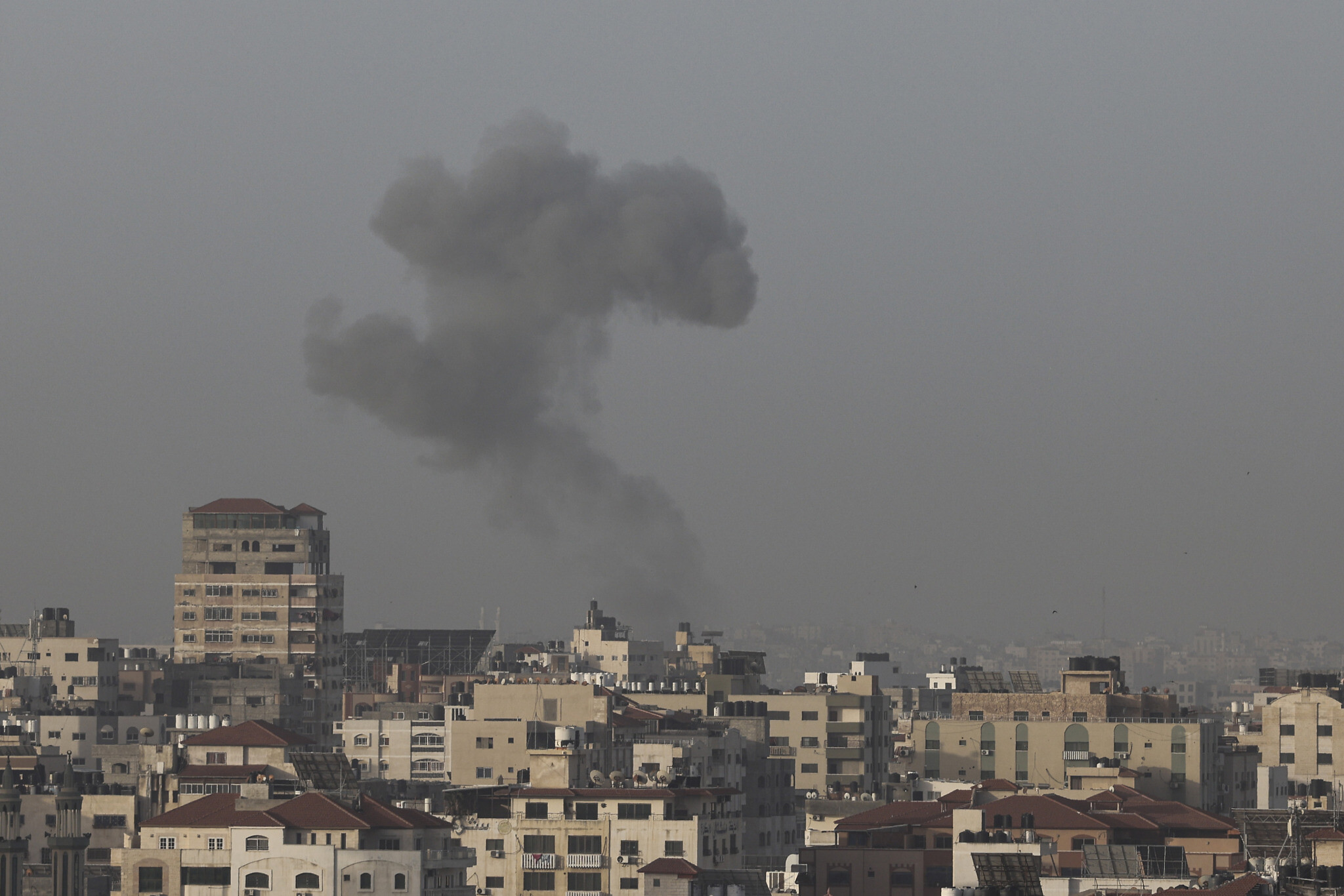

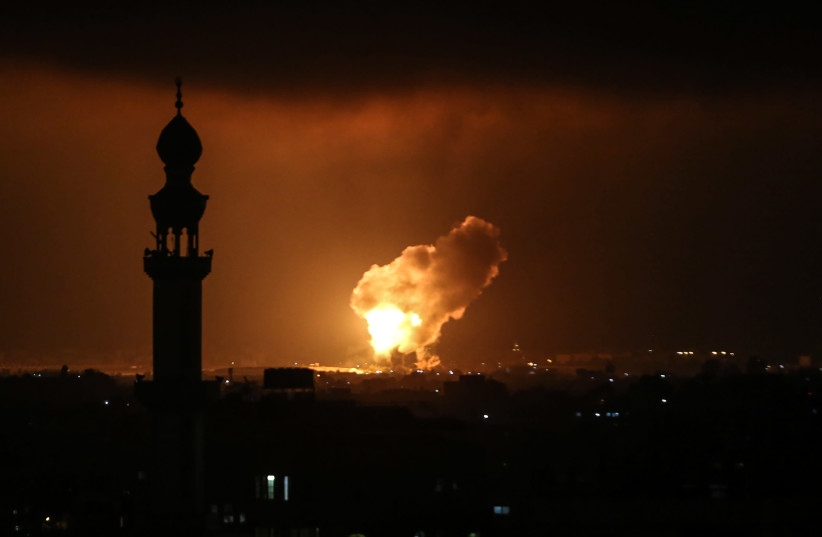
Smoke rises above buildings in Gaza City after the IDF struck the Palestinian enclave following rocket fire towards Israeli towns, April 5, 2023. (Mohammed Abed/AFP)

Smoke rises above buildings in Gaza City after the IDF struck the Palestinian enclave following rocket fire towards Israeli towns, April 5, 2023. (Mohammed Abed/AFP)

The Israeli Air Force struck Hamas targets in the Gaza Strip Wednesday morning after a barrage of rockets was launched at nearby Israeli towns from the enclave throughout the early hours of the day, amid a spike in violence at Jerusalem’s Temple Mount as Ramadan coincided with the arrival of the Passover holiday.

A weapons factory and a weapons storage facility belonging to the terror group were targeted in the strikes, the Israel Defense Forces said. Media reports indicated that the rockets were fired by the Palestinian Islamic Jihad terror group, but the Israeli military holds Hamas responsible for all attacks emanating from the territory it rules.

The rocket fire came after clashes erupted between the Israel Police and Palestinians inside the Al-Aqsa Mosque in Jerusalem overnight. Police said they had entered to dislodge “agitators” who had barricaded themselves inside with fireworks, clubs and stones. On Wednesday morning, authorities said 350 people had been detained in the unrest.

State of Jerusalem: The ‘Secular’ Struggle

Loaded: 18.32%

After the IAF struck targets in the Gaza Strip, another salvo of rockets were launched at Israeli border towns shortly before 7 a.m., triggering alert sirens. The Magen David Adom ambulance service said a 30-year-old man was lightly injured after he fell while running to a bomb shelter.

In total, 16 rockets were fired from the strip, eight of which were shot down by the Iron Dome anti-missile system.

Clashes at Al-Aqsa

On Tuesday night, dozens of masked youths barricaded themselves inside the Al-Aqsa Mosque atop the Temple Mount with fireworks, clubs and rocks following evening prayers, while locking the doors and placing barricades at the entrances, police said.

This was an apparent preparation for Jewish visits to the Mount on Wednesday, which is Passover Eve, amid a push by religious fringe groups to carry out an animal sacrifice at the holy site, forbidden by authorities. While Jews are allowed to visit the site of the ancient Jewish temples, under the status quo maintained there, they are not able to hold rituals.

The force said in a statement that officers tried to convince those inside to leave but were ultimately forced to enter the mosque, where they were attacked with rocks and fireworks.

Police released video footage showing what appear to be fireworks explosions inside the mosque and figures throwing rocks. Another police video showed riot police with shields advancing through the mosque under a barrage of fireworks explosions. The footage then showed a barricaded door and boxes of fireworks on the floor, as well as police escorting at least five people outside with their hands cuffed behind their backs.

Palestinian-filmed video showed security forces beating people inside the mosque.

Hamas denounced the raid on the mosque as an “unprecedented crime” and called on Palestinians in the West Bank “to go en masse to the Al-Aqsa mosque to defend it.”

Hours later, an Israeli soldier was wounded in a suspected shooting near the West Bank city of Hebron.

The Islamic holy month of Ramadan, which this year once again coincides with the Jewish festival of Passover, is known to be a period of higher tension between Israeli forces and Palestinians. Tens of thousands of worshipers visit Al-Aqsa, Islam’s third holiest site, throughout the month, regularly leading to a spike in tensions with Israel and violence.

Police said they were forced to enter the mosque after “several law-breaking youths and masked agitators” barricaded themselves inside.

“These instigators fortified [the mosque], hours after the [last evening] Taraweeh prayer in order to disrupt public order and desecrate the mosque,” the police said in a statement. “After many and prolonged attempts to get them out by talking to no avail, police forces were forced to enter the compound in order to get them out with the intentions to allow the Fajr [dawn] prayer and to prevent a violent disturbance,” they added.

“When the police entered, stones were thrown at them and fireworks were fired from inside the mosque by a large group of agitators,” they continued, adding that one officer was injured in the leg by a stone.

As unrest grows, lack of clarity on defense minister

Prime Minister Benjamin Netanyahu last week fired Defense Minister Yoav Gallant after the latter warned publicly of the need to halt the government’s judicial overhaul legislation — which the premier indeed halted a day later. The dismissal led to mass protests and Netanyahu has appeared to walk back the move without actually canceling it — with his office never submitting a formal letter of dismissal and Netanyahu returning to holding meetings with Gallant, saying he had delayed a decision on the matter.

On Twitter Wednesday morning, opposition leader Yair Lapid said “Israel’s security is not on hold. Our enemies will not be delayed.”

“This very morning Netanyahu needs to remove the cloud over Gallant’s dismissal. The State of Israel needs a full-time defense minister, not one on probation. Netanyahu, come to your senses,” wrote Lapid.

National Unity party head Benny Gantz, himself a defense minister in the previous government, also called on Netanyahu to announce Gallant would not be sacked, “no ifs or buts,” adding that Wednesday’s escalation in the Gaza Strip was a “reminder that in the Middle East, you don’t mix politics with security.”

Closures for Passover

Last week, The IDF announced it would impose a closure on the West Bank, set to take effect at 5 p.m. Wednesday, with crossing points closed to Palestinians on the first and last days of the Passover holiday. Gaza border crossings will also close.

Such closures are standard practice during festivals and holidays. The military says they are a preventative measure against attacks in periods of increased tension.

The closure will last until Saturday, April 8. A second closure will begin on April 11 and last until April 12.

On Friday, April 7, some border crossings are set to reopen to allow Palestinian worshipers from the West Bank to enter Jerusalem to pray at Al-Aqsa for Ramadan.


Several airstrikes attributed to Israel by foreign reports have struck Syria throughout the week. Some reportedly killed IRGC members in the country.

Illustrative image of an airstrike. (photo credit: ABED RAHIM KHATIB/FLASH90)
Illustrative image of an airstrike.
(photo credit: ABED RAHIM KHATIB/FLASH90)

Explosions due to alleged Israeli airstrikes were reported in the vicinity of the Syrian capital city of Damascus early Tuesday morning, according to local media reports cited by Army Radio.

Syrian state media outlets reported that multiple explosions were heard near the capital and that Syrian air defenses were activated to intercept what are alleged to be Israeli missiles.

Previous alleged Israeli airstrikes in Syria throughout the week

This airstrike is the fourth to have struck Syria this week. Previous airstrikes reportedly killed IRGC members in the country.

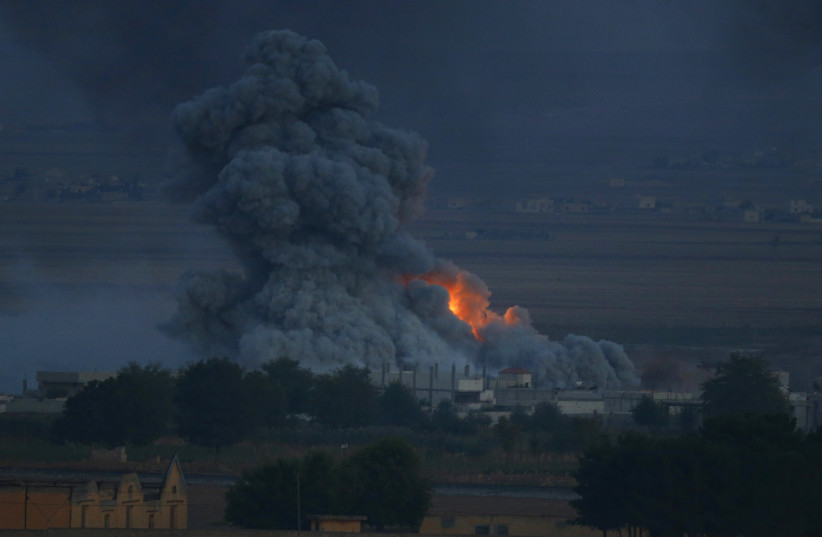
 Smoke rises over the Syrian town of Kobani after an airstrike, as seen from the Mursitpinar crossing on the Turkish-Syrian border in the southeastern town of Suruc in Sanliurfa province October 24, 2014. (credit: REUTERS/KAI PFAFFENBACH)Smoke rises over the Syrian town of Kobani after an airstrike, as seen from the Mursitpinar crossing on the Turkish-Syrian border in the southeastern town of Suruc in Sanliurfa province October 24, 2014. (credit: REUTERS/KAI PFAFFENBACH)

On Thursday, an IRGC adviser to Syria named Milad Heydari was killed in an airstrike, which Iran blamed on Israel.

Another airstrike killed IRGC member Meqdad Meqdani, according to Iranian media reports.

This also comes a day after a drone believed by the IDF to be of Iranian origin invaded Israeli airspace from Syria.

This is a developing story.

Tzvi Joffre and Reuters contributed to this report.