
William Burns says US doesn’t believe Iranian supreme leader has made decision to pursue weaponization, after Tehran found to have enriched uranium to 84% purity
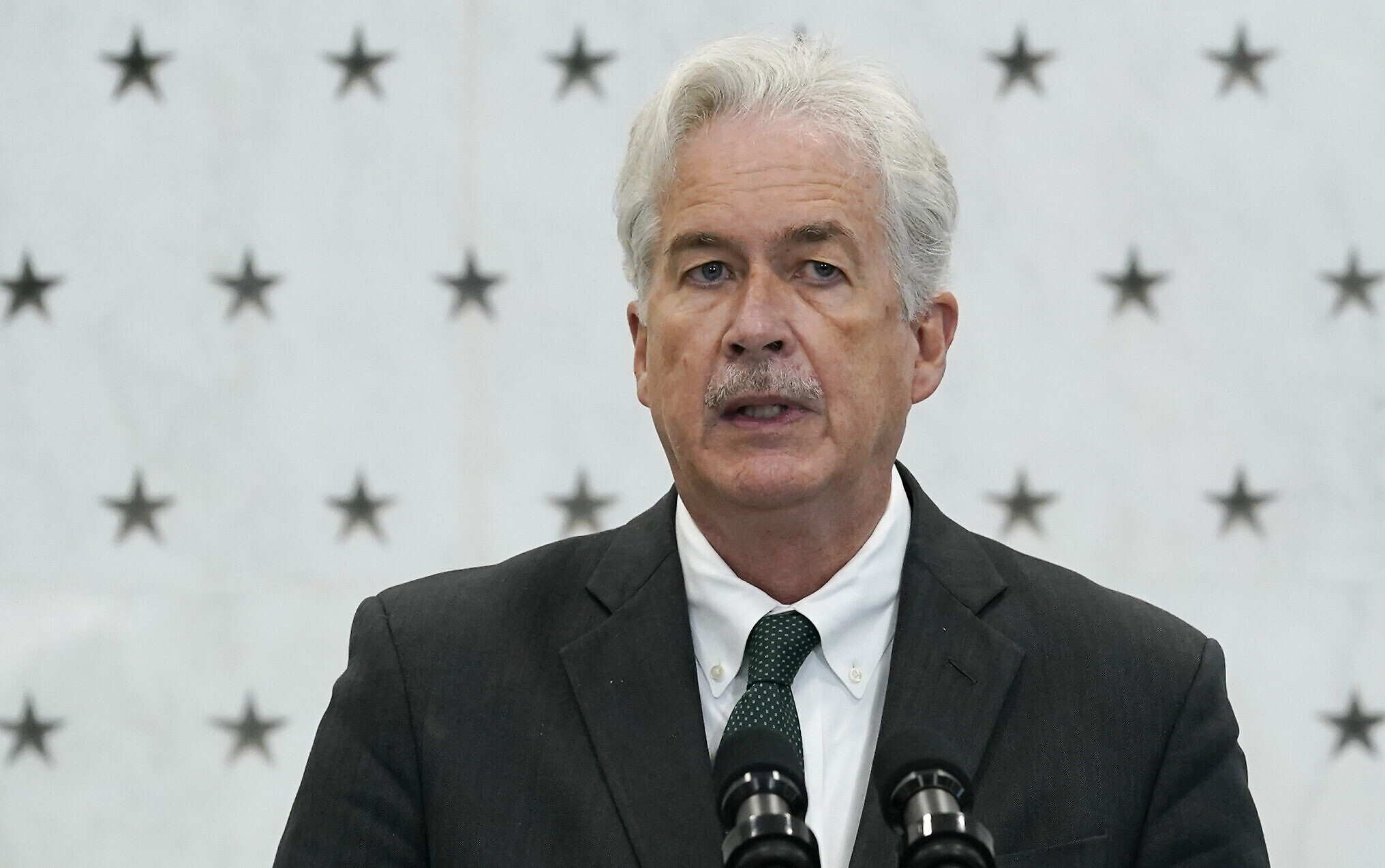
FILE - US Central Intelligence Agency Director William Burns speaks at the Central Intelligence Agency headquarters in Langley, Virginia, July 8, 2022. (AP Photo/Susan Walsh, File)

FILE – US Central Intelligence Agency Director William Burns speaks at the Central Intelligence Agency headquarters in Langley, Virginia, July 8, 2022. (AP Photo/Susan Walsh, File)

The head of the Central Intelligence Agency has warned that Iran could enrich uranium to weapons-grade within weeks, but said the United States does not believe Iranian leaders have yet decided to do so.

The comment by William Burns, made during an interview with CBS News aired Saturday, came after inspectors from the UN atomic agency found uranium in Iran enriched to 84 percent purity, the closest its been to the 90% purity needed for nuclear weapons.

A news website linked to the highest reaches of Iran’s theocracy on Thursday acknowledged the accusation.

“To the best of our knowledge, we don’t believe that the supreme leader in Iran has yet made a decision to resume the weaponization program that we judge they suspended or stopped at the end of 2003,” Burns said.

“But the other two legs of the stool, meaning enrichment programs, have obviously advanced very far,” he added.

The interviewer then noted the International Atomic Energy Organization’s recent finding that Iran has enriched uranium to 84%.

“They’ve advanced very far to the point where it would only be a matter of weeks before they could enrich to 90%, if they chose to cross that line, and also in terms of their missile systems, their ability to deliver a nuclear weapon once they’ve developed it has also been advancing as well,” the CIA chief warned.

“We don’t see evidence that they’ve made a decision to resume that weaponization program,” he stressed again, “but the other dimensions of this challenge I think are growing at a worrisome pace to.”

The latest revelations about Iran’s nuclear capabilities renew pressure on the West to address Tehran’s program, which had been publicly contained by the 2015 nuclear deal with world powers that the US unilaterally withdrew from in 2018.

It wasn’t immediately clear where the 84% enrichment allegedly took place, though the IAEA has said it found two cascades of advanced IR-6 centrifuges at Iran’s underground Fordo facility “interconnected in a way that was substantially different from the mode of operation declared by Iran to the agency in November last year.” Iran is known to have been enriching uranium at Fordo up to 60% purity — a level that nonproliferation experts already say has no civilian use for Tehran.

Iran also enriches uranium at its Natanz nuclear site.

Weapons-grade uranium is enriched up to 90%. While the IAEA’s director-general has warned Iran now has enough uranium to produce “several” nuclear bombs if it chooses, it likely would take months more to build a weapon and potentially miniaturize it to put on a missile.

In this image made from April 17, 2021, video released by the Islamic Republic Iran Broadcasting, IRIB, state-run TV, various centrifuge machines line the hall damaged on April 11, 2021, at the Natanz Uranium Enrichment Facility, some 200 miles (322 km) south of the capital Tehran. (IRIB via AP)

The new tensions over Iran’s program also take place against the backdrop of a shadow war between Iran and Israel that has spilled out across the wider Middle East. Prime Minister Benjamin Netanyahu, who long has advocated military action against Iran, mentioned it again in a talk last week.

“How do you stop a rogue nation from acquiring nuclear weapons?” Netanyahu rhetorically asked. “You had one that’s called Saddam Hussein’s Iraq. It was stopped by military force, ours. You had a second one that is called Syria that tried to develop nuclear weapons. And it was stopped by military action, ours.”

He added: “A necessary condition, and an often sufficient condition, is credible military action. The longer you wait, the harder that becomes. We’ve waited very long.”


Iran unveils new ‘Paveh’ cruise missile that can reach Israel

Top general says Tehran still wants to kill former US president Donald Trump, Mike Pompeo to avenge the assassination of Qassem Soleimani

Iran releases a video of the new Paveh cruise missile, with a reported range of 1,650 km on Friday February 24, 2023 (IRNA Screencapture/used in accordance with Clause 27a of the Copyright Law)

Iran releases a video of the new Paveh cruise missile, with a reported range of 1,650 km on Friday February 24, 2023 (IRNA Screencapture/used in accordance with Clause 27a of the Copyright Law)

A senior Iranian general unveiled a new cruise missile with a range of 1,650 km (1,025 miles) that could potentially reach Israel in an interview with state television on Friday, in which he also reiterated Tehran’s desire to kill former US president Donald Trump.

“Our cruise missile with a range of 1,650 km has been added to the missile arsenal of the Islamic Republic of Iran,” said Amirali Hajizadeh, the head of the Islamic Revolutionary Guards Corps aerospace force according to the Reuters news agency.

The television broadcast what it said was the first footage showing the new Paveh cruise missile, showing the missile launch, then flying low over terrain before hitting a target.

Beyond the range, Hajizadeh gave no further details of the missile.

The Guard in the past has said it has cruise missiles with ranges of 1,000 kilometers (620 miles). It also has missiles that range up to 2,000 kilometers (1,250 miles), more than enough to reach archenemy Israel and US military bases in the region.

Iran, which has developed a long list of homegrown weaponry, including drones, naval vessels, aircraft and electronic systems, has sparked mounting concern around the world with its supply of suicide drones to Russia for use in Ukraine and fears it could send other weapons systems to Moscow.

Israel has long warned against Tehran’s missile program saying it poses a threat to Israel, the region and Europe, not just for its conventional capabilities, but also because they could eventually be used to launch nuclear weapons should Iran acquire them.

In 2018, then-US president Donald Trump pulled the United States out of the Iran nuclear deal, claiming it was too weak and didn’t address Iran’s missile development.

He also re-imposed crushing sanctions on Iran. Tehran has since started enriching uranium up to 60% purity — a short technical step from the 90% needed to make an atomic bomb.

Speaking to State TV on Friday, Hajizadeh also reiterated Iran’s desire to kill Trump and former secretary of state Mike Pompeo for their role in the January 3, 2020, killing of Iran’s Quds Force commander Qassem Soleimani in an American drone strike in Baghdad.

“God willing, we are looking to kill Trump. Pompeo … and military commanders who issued the order (to kill Soleimani) should be killed,” Hajizadeh said in the television interview.

A girl holds a poster of Iranian commander Qassem Soleimani as she takes part in a anti-US protest against the killing of top Iranian commander Qasem Soleimani in Iraq, in Lahore on January 12, 2020. (ARIF ALI / AFP)

The report on the new cruise missile came hours after Iran said it will likely send air defense systems to Syria, a move apparently meant to protect against Israeli airstrikes.

“Syria needs to rebuild its air defense network and requires precision bombs for its fighter planes,” the Iranian state broadcaster said, according to Reuters.

“It is very likely that we will witness the supply by Iran of radars and defense missiles, such as the 15 Khordad system, to reinforce Syria’s air defenses,” it added.

The state TV report follows an airstrike in Damascus last weekend that was attributed to Israel, which the news agency on Wednesday said targeted a meeting of Syrian and Iranian officials involved with the manufacture of drones, as well as members of the Lebanese terror group Hezbollah.

Syria has said five people were killed and 15 wounded in the attack on Saturday night. The Israeli military has not commented on the strike, per its policy of not generally commenting on air raids in Syria, though it has acknowledged conducting hundreds of sorties against Iran-backed groups attempting to gain a foothold in the country over the last decade. Israeli officials have previously said the IDF does not target civilians and seeks to avoid damage to residential areas as much as possible.

A large hole is seen in the Kafar Sousah neighborhood of Damascus, after an alleged Israeli airstrike on Syria, February 19, 2023. (SANA)

Iran’s foreign ministry condemned the strike on Sunday, but did not mention any Iranian casualties.

It was also denounced by Russia, which like Iran is a key backer of the Syrian regime in the over decade-long civil war, as a “flagrant violation” of international law.

Israel’s need to coordinate with Russia — which largely controls Syrian airspace — to carry out strikes has been cited as a chief reason for Jerusalem’s reluctance to supply Kyiv with weaponry amid the Russian invasion of Ukraine. Israel has found itself at odds with Russia as it increasingly supported Ukraine while seeking to maintain freedom of movement in Syria’s skies.

Also Friday, the White House said Russia is considering sending fighter jets to Iran as part of an expanding military cooperation that has seen Tehran ship growing quantities of weaponry to Moscow for use in the invasion of Ukraine.

“We believe that Russia might provide Iran unprecedented defense cooperation, including on missiles, electronics and air defense. We believe that Russia might provide Iran with fighter jets,” National Security Council spokesman John Kirby told reporters.

Illustrative: Russian President Vladimir Putin meets with Iranian President Ebrahim Raisi on the sidelines of the Shanghai Cooperation Organisation (SCO) summit in Samarkand, Uzbekistan, September 15, 2022. (Alexandr Demyanchuk, Sputnik, Kremlin Pool Photo via AP)

Kirby said Iran, which is deeply isolated by Western sanctions aimed at halting its disputed nuclear program, was seeking to bolster its military with Russian help in exchange for sending armaments used in the year-long onslaught against Ukraine.

“Iran is also seeking to purchase additional military equipment from Russia, including attack helicopters, radars and combat training aircraft. In total, Iran is seeking billions of dollars’ worth of military equipment,” Kirby said.

“We were concerned it was going to go both ways, and those concerns are certainly being realized,” he said.

According to Kirby, Iran has already sent hundreds of drones, as well as artillery and tank ammunition, to Russia, saying that “Iran’s support for Russia’s war has expanded.”


Iran says it has developed long-range cruise missile

Iran has expanded its missile program, particularly its ballistic missiles, in defiance of opposition from the United States and expressions of concern by European countries.

 AIR DEFENSE capabilities are tested as part of the drill, simulating what could happen in the event of an Iranian missile or drone attack. (photo credit: IDF SPOKESPERSON'S UNIT)
AIR DEFENSE capabilities are tested as part of the drill, simulating what could happen in the event of an Iranian missile or drone attack.
(photo credit: IDF SPOKESPERSON’S UNIT)

Iran has developed a cruise missile with a range of 1,650 km (1,025 miles) a top Revolutionary Guards commander said on Friday, in a move likely to raise Western concerns after Russia’s use of Iranian drones in the Ukraine war.

“Our cruise missile with a range of 1,650 km has been added to the missile arsenal of the Islamic Republic of Iran,” Amirali Hajizadeh, the head of the Revolutionary Guards Aerospace Force, told state TV.

The television broadcast what it said was the first footage showing the new Paveh cruise missile.

Pushback against missile program

Iran has expanded its missile program, particularly its ballistic missiles, in defiance of opposition from the United States and expressions of concern by European countries. Tehran says the program is purely defensive and of a deterrent nature.

Iran has said it had supplied Moscow with drones before the war in Ukraine. Russia has used the drones to target power stations and civilian infrastructure.

In November, the Pentagon said the United States was skeptical of reports quoting Hajizadeh as saying Iran had developed a hypersonic ballistic missile.