
Mossad carried out Iran defense facility strike for Israel’s

US officials tell NYT drone attack not aimed at stopping weapons exports to Russia; ex-PM Bennett says he intensified Iran strikes after plot to kill Israelis in Turkey, Cyprus
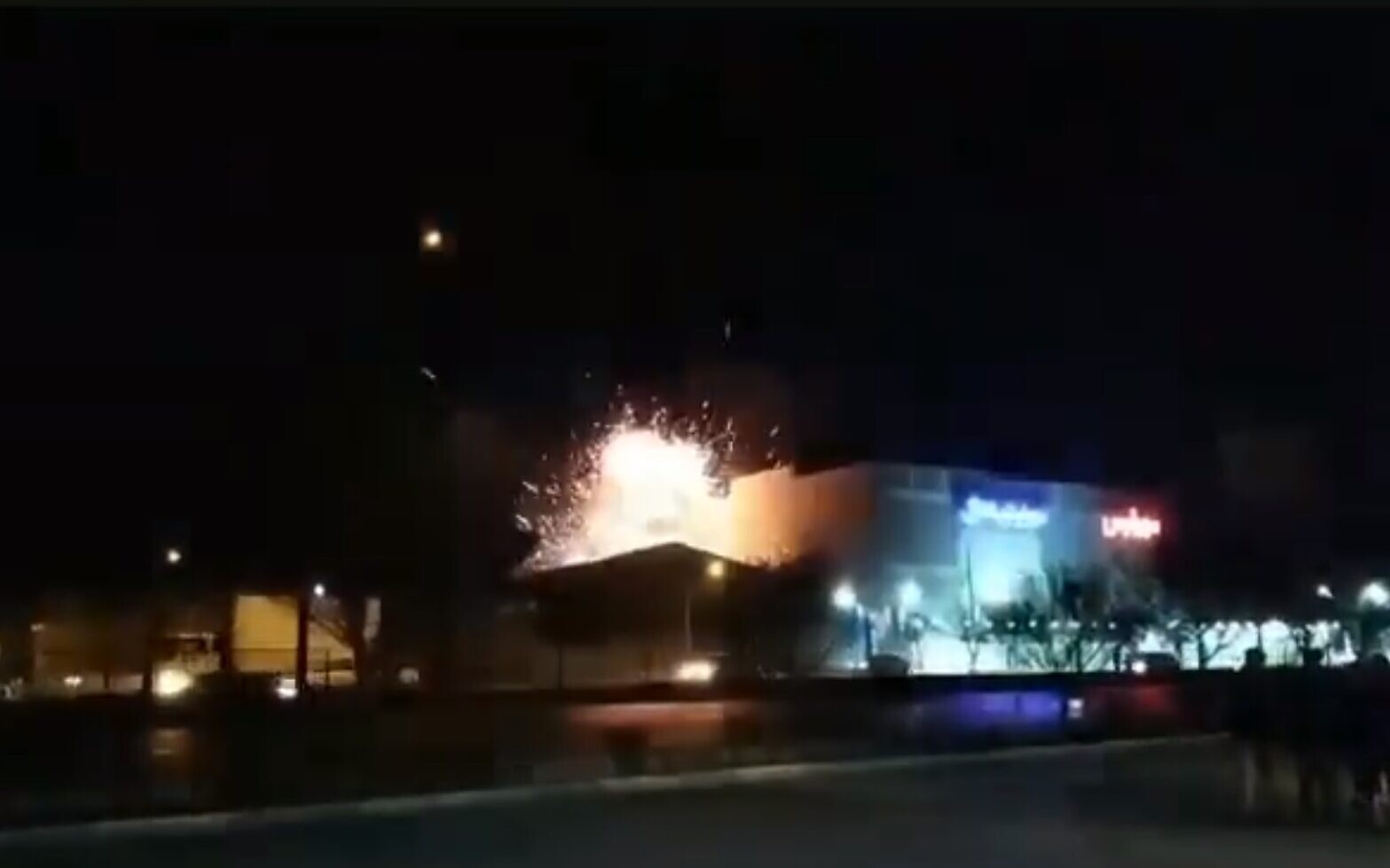
 

Screen grab from an unverified video circulating on social media said to show explosion at a defense facility in Iran's Isfahan after an alleged drone strike, January 28, 2023. (Used in accordance with Clause 27a of the Copyright Law)

Screen grab from an unverified video circulating on social media said to show explosion at a defense facility in Iran’s Isfahan after an alleged drone strike, January 28, 2023. (Used in accordance with Clause 27a of the Copyright Law)

The drone attack on a defense facility in the Iranian city of Isfahan was carried out by Israel to protect its own security interests, and not to prevent weapons exports to Russia, according to a New York Times report on Sunday.

The Saturday strike was carried out by the Mossad intelligence agency, according to the newspaper, which cited senior United States intelligence officials.

The report noted that Isfahan is a hub for Tehran’s missile industry, and is where the Shahab medium-range missile — which has a range capable of hitting Israel — is assembled.

Iran has yet to deliver missiles to Russia despite reports since October that it plans to do so, but Tehran has been supplying Shahed-136 suicide drones for the Kremlin’s use in the nearly year-long invasion of Ukraine.

The “kamikaze” drones have been deployed to attack Ukrainian civilian sites and critical infrastructure facilities since September. Some reports have said that the alleged Israeli strike targeted Iran’s drone program.

An Iranian Defense Ministry statement described three drones being launched at the facility on Saturday, with two of them successfully shot down. A third apparently made it through to strike the building, causing “minor damage” to its roof and wounding no one, the ministry said.

A drone is seen in the sky seconds before it fired on buildings in Kyiv, Ukraine, on October 17, 2022. (AP Photo/Efrem Lukatsky)

London-based opposition Iranian news outlet Iran International cited eyewitnesses as saying that they saw three or four explosions.

The state-run IRNA news agency later described the drones as “quadcopters equipped with bomblets.” Quadcopters, which get their name from having four rotors, typically operate from short ranges by remote control. Iranian state television later aired footage of debris from the drones, which resembled commercially available quadcopters.

The drones have been used in past attacks inside Iran, such as a June 2021 attack on a centrifuge manufacturing center in Karaj, and a February 2022 attack on a military drone storage and manufacturing facility in Kermanshah — attacks which were also attributed to Israel by several media outlets.

US officials said on Sunday that Washington was not behind the strike.

It was the first alleged Israeli strike inside Iran since Prime Minister Benjamin Netanyahu returned to office, and may mark his continuation of the previous government’s policy, which intensified Jerusalem’s attacks inside the Islamic Republic.

Former prime minister Naftali Bennett said in an upcoming YouTube video shared with The New York Times that he decided to “create a price tag” and increase activities inside Iran following Tehran’s attempts “to murder Israelis in Cyprus, in Turkey” in 2022.

Former prime minister Naftali Bennett arrives at a cabinet meeting at the Prime Minister’s Office in Jerusalem on October 23, 2022. (Alex Kolomoisky/Pool)

Bennett said that in the wake of the plot, the Revolutionary Guard Corps commander behind the attempted attacks was “eliminated” — a reference to the killing of Col. Hassan Sayyad Khodaei last May.

Bennett said he refused US President Joe Biden’s request for Jerusalem to notify Washington before such strikes took place.

“There are things you do not want to know about in advance,” Bennett recalled telling Biden.

A Wall Street Journal report which also pointed the finger at Israel for the Isfahan strike noted the timing of the attack came at the same time that talks between Jerusalem and Washington are aimed at finding new ways to counter Tehran’s nuclear program. US Secretary of State Antony Blinken is set to arrive in Israel on Monday.

Iran condemned the attack, calling it “cowardly,” and accused Iran’s enemies of trying to sow insecurity in the Islamic Republic.

“This cowardly act was carried out today as part of the efforts made by enemies of the Iranian nation in recent months to make the Islamic Republic insecure,” Foreign Minister Hossein Amir-Abdollahian said Sunday at a press conference.

Iran’s Foreign Minister Hossein Amir-Abdollahian meets with his Qatari counterpart in the capital Tehran, on January 29, 2023. (Atta Kenare/AFP)

The US recently indicated that it would be taking a more aggressive approach toward Tehran, including on its drone supply program to Russia.

The Biden administration has also signaled that it had abandoned the possibility of reviving a deal with Iran over its nuclear program, known as the Joint Comprehensive Plan of Action, which then-US president Donald Trump withdrew from in 2018. Trump then instituted a “maximum pressure” sanctions regime, targeting various Iranian sectors, leading Tehran to respond by expanding its nuclear program in violation of the JCPOA.

Iran’s cooperation with Russia in the latter’s invasion of Ukraine, as well as the violent crackdown on anti-regime protests that have swept Iran since mid-September, have also played a role in Washington’s more assertive approach.

Last week, Israel and the US kicked off a large-scale joint exercise in Israel and over the eastern Mediterranean Sea, reportedly aimed at showing adversaries, such as Iran, that Washington is not too distracted by Russia’s invasion of Ukraine and threats from China to mobilize a large military force.

Netanyahu, who during his last term as premier ordered numerous strikes on Iranian targets in Syria and operations on Iranian soil, has been open about his intention to oppose Tehran’s nuclear aspirations at any cost.

In November, a longtime ally of Netanyahu said in an interview that he believed the prime minister would order a strike on Iran’s nuclear facilities if the US does not secure a new nuclear deal with Tehran and fails to take action itself in the near future.

own interests — report

Mossad carried out Iran defense facility strike for Israel’s own interests — report

Mossad carried out Iran defense facility strike for Israel’s own interests — report


Iran’s pro-IRGC Fars News reports Iran is ready for “any threat.” This would appear to contradict reports at Iran’s other pro-government Tasnim news that says the attack was a failure.

Picture shows general view of Isfahan (UCF) nuclear power plant (UCF) 295 km from Tehran, March 2005 (photo credit: HENGHAMEH FAHIMI / AFP)
Picture shows general view of Isfahan (UCF) nuclear power plant (UCF) 295 km from Tehran, March 2005
(photo credit: HENGHAMEH FAHIMI / AFP)

Iran’s regime is pushing several narratives about a drone attack on a military facility in Isfahan. According to Iran’s air defense force commander Alireza Sabahifard, they are ready for “any threat,” as quoted in Iran’s pro-IRGC Fars News on Monday. In addition, Iran’s Mehr news says that Russian “intel services” are analyzing the recent attack on an Iranian “military site.” This would appear to contradict reports at Iran’s other pro-government Tasnim news that says the attack was a failure.

If it was a failure why is Iran seeking out the Russians?

“In any case, we only need to condemn any such actions that are directed against a sovereign state, ” the Kremlin said in a statement on Monday, Russia’s pro-government Sputnik reported. Iran’s Mehr News says that Russia has condemned the attack.

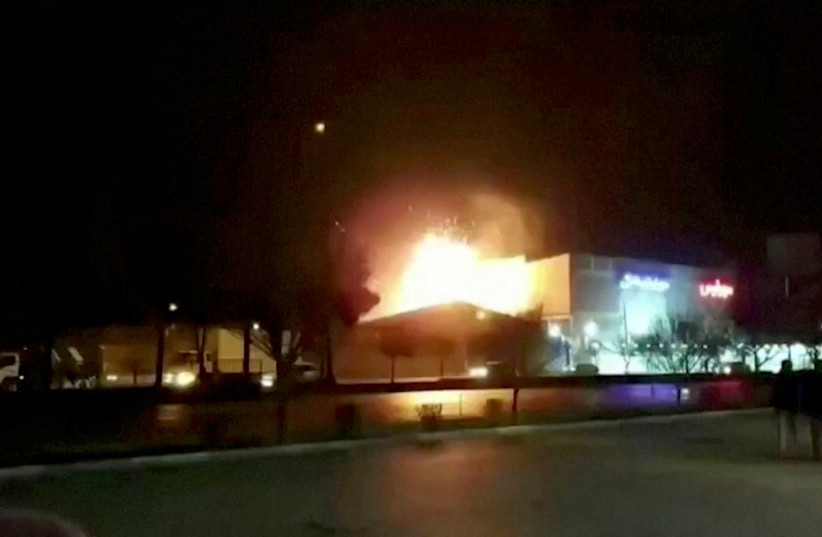
 Eyewitness footage shows what is said to be the moment of an explosion at a military industry factory in Isfahan, Iran, January 29, 2023 (credit: POOL/WANA (WEST ASIA NEWS AGENCY) VIA REUTERS)Eyewitness footage shows what is said to be the moment of an explosion at a military industry factory in Isfahan, Iran, January 29, 2023 (credit: POOL/WANA (WEST ASIA NEWS AGENCY) VIA REUTERS)

“In any case, we only need to condemn any such actions that are directed against a sovereign state.”

The Kremlin

Russia has also condemned the attack. “We strongly condemn any provocative actions that could potentially provoke an uncontrolled escalation of tension in an already far from calm region. Such destructive actions can have unpredictable consequences for peace and stability in the Middle East,” Foreign Ministry spokeswoman Maria Zakharova said in a statement.

Meanwhile Iran has summoned Ukraine’s envoy over comments made by a Ukraine government advisor that seemed to say Iran had been “warned” about providing drones to Russia. Russia has used Iranian-supplied Shahed drones to attack Ukraine.

The Iranian reports now seem to indicate that Tehran wants to cement the Russia-Iran partnership potentially, at least in terms of these issues relating to drones. Russia has hinted at “unpredictable consequences.”

Iran’s Mehr news then says a source at Sputnik’s Persian service said that “the unmanned aerial vehicles involved in Saturday’s attack were ordinary off-the-shelf drones, not ‘strike UAVs,’ as initially reported in some quarters.”

This hints at commercially available drones and also means they are harder to trace because “off-the-shelf” means they are generic. “The Iranian Defense Ministry announced that its air defense units have repelled a drone attack on a military workshop in the central city of Isfahan,” Mehr notes.

Did Iran succeed or is Russia interested? It can’t be both

If Iran had repelled the attack then why does the same media say Russia is so outraged and interested? Press TV in Iran meanwhile says that the explosion that occurred due to the drone attack happened at a defense industry complex.

Iran’s Foreign Minister meanwhile was meeting with his Qatari counterpart, the Iranian media said. “This cowardly act was carried out today as part of efforts made by the enemies of the Iranian nation in recent months to make the Islamic Republic insecure,” Iranian Foreign Minister Amir-Abdollahian said in a presser.

Meanwhile, another Iranian website IRNA reported about Russia’s condemnation of the attack as well “earlier on Sunday, Iran’s Ministry of Defense announced that a quadcopter drone attack on a defense industrial complex in the central Iranian province of Isfahan has failed.” The use of the term “quadcopter” is interesting here because it also hints at small drones and quadcopters tend to be commercially available recreational drones. However, quadcopter-style drones, don’t usually have a long range.

While Mehr News had said that Russian intel was interested in the attack, but didn’t elaborate further. Russia’s TASS state media said, “Moscow condemns the drone attack on Iran and Russian intelligence is trying their best to get a full picture of what happened.”

This report says that Russia has said the following: “Naturally, our services are analyzing information in order to get the more or less full picture of the incident,” the Kremlin official said, “replying to a question as to whether Russia has any intel as to who may have been behind the drone attack on Iran.”

This comment by Russia doesn’t seem to go as far as the Iranians would like it to. It only suggests Russia is “analyzing” the information and that Russia is interested and perhaps concerned. The overall narrative by the plethora of Iranian state and semi-state media leaves many questions about what Iran is trying to say and which narrative it wants the region to accept; and also what might come next.

Clearly, Iran wants Russia to be interested in the drone attack and it wants to condemn Ukraine for appearing to make light of the attack. This is part of Tehran’s desire for a stronger alliance with Russia. Iran is selling drones to Russia and Russia has used those drones to attack Ukraine. However, it is unclear if Russia has acquired more drones or if it is running low on stocks.


The most important outcome: the US has lost patience with the Islamic Republic and is willing to in one way or another flex its muscles.

 Eyewitness footage shows what is said to be the moment of an explosion at a military industry factory in Isfahan, Iran, January 29, 2023 (photo credit: POOL/WANA (WEST ASIA NEWS AGENCY) VIA REUTERS)
Eyewitness footage shows what is said to be the moment of an explosion at a military industry factory in Isfahan, Iran, January 29, 2023
(photo credit: POOL/WANA (WEST ASIA NEWS AGENCY) VIA REUTERS)

It will probably be years before anyone will take public credit for the weekend drone attack on Iran’s facilities at Isfahan, but already in a matter of days, the attack may have reshuffled the entire picture regarding Iran.

The most important outcome: The US has lost patience with the Islamic Republic and is willing in one way or another to flex its muscles and, according to foreign sources, give more support to Israel to do so.

Until this past week, there had been a number of US and Israeli joint drills which could have been veiled threats to Tehran to at least freeze the progress of its nuclear program. However, these drills took place often at the same time as Washington was sounding hopeful messages about a return to diplomacy, or at least not messages that diplomacy was dead.

In May 2022, the US provided refueling platforms for the Israel Air Force to hold one of its largest-ever drills for carrying out “deep” attacks far away from Israel’s borders – often a metaphor for Iran.

In July 2022, the US and Israel held a joint exercise to help protect Israel from Iranian ballistic-missile threats. There were also assorted US-Israel naval and other drills.

Israel Air Force holding large-scale drill simulating multi-front war (credit: IDF SPOKESPERSON'S UNIT)Israel Air Force holding large-scale drill simulating multi-front war (credit: IDF SPOKESPERSON’S UNIT)

However, by August 2022, the US and the world powers were talking about Iran as if a return to the nuclear deal was all but signed.

So it is hard to say that the pre-August 2022 drills sent much of a message about US seriousness to support a viable military option against the ayatollahs’ nuclear program.

US-Israel joint drill

By the time the US and Israel held a joint air force drill in November 2022, the deal had fallen apart, but America had not closed the door on negotiations.

Fast forward to mid-January, when US Secretary of State Antony Blinken said, “With regard to the JCPOA, the Iranians killed the opportunity to come back to that agreement swiftly many months ago.”

The Joint Comprehensive Plan of Action had not been on Washington’s agenda as a “practical matter for many months now,” he added. “It’s not our focus. We’re focused on what’s happening in Iran. We’re focused on what Iran is doing in terms of the provision of weapons to Russia to use against innocent people and the entire energy grid in Ukraine.”

“All options are available on the table to prevent Iran from obtaining a nuclear weapon.”

US Secretary of State Antony Blinken

US State Department representatives had said similar things before, but now it was coming from the top.

From January 22-25, the US and Israel held what was called at the time their largest-ever joint drill for attacking “deep” targets, just as US National Security Advisor Jake Sullivan was visiting Israel.

In the middle of those drills, on January 25, International Atomic Energy Agency Director-General Rafael Grossi described the JCPOA as “an empty shell,” saying diplomatic activity linked to reviving the 2015 nuclear deal was close to nonexistent.

“Nobody has declared it dead, but no obligation is being pursued, and … every limit that existed in the JCPOA has been violated several times,” Grossi said.

Overnight between January 28-29 this past weekend, the drone attack on Isfahan took place.

Hours after the attack, Blinken told Al Arabiya that Washington still preferred a diplomatic option to prevent a nuclear Iran and ending its aggression but that “all options are available on the table to prevent Iran from obtaining a nuclear weapon.”

“Nobody has declared it dead, but no obligation is being pursued, and… every limit that existed in the JCPOA has been violated several times,” he said.

Overnight between Saturday and Sunday this past weekend, the drone attack on Isfahan took place.

Hours after the attack, Blinken said Washington still preferred a diplomatic option to prevent a nuclear Iran and ending its aggression. But “all options are available on the table to prevent Iran from obtaining a nuclear weapon,” he told Al Arabiya.

At the same time that the drone attack occurred, while Blinken was taking an ever-tougher line on Iran, and only days after the giant US-Israeli joint drill, CIA Director William Burns was holding meetings in Israel.

Of course, these could all be coincidences. Prime Minister Benjamin Netanyahu just regained power one month ago, so it is not strange that many US officials would be coming through.

But when you add together the kind of officials coming through, their much tougher tone about the deal being dead, the joint drills and the drone strike, it seems very unlikely that the drone strike did not have US support.

There are all sorts of ways to parse the Pentagon statement that the US had no military involvement in the drone strike.

Might it have had intelligence or cyber involvement? Even if the US really did nothing, the cumulative impact of the strike along with the converging vectors makes it clear that Iran is now far more threatened than it might have been only a few months ago.

The Biden administration was patient with nuclear negotiations with Tehran for nearly two years, and it did very little besides wave its finger in disapproval and add symbolic new sanctions when the ayatollahs continued to move closer to the nuclear threshold.

It is not patient anymore. Whether that is because of Iran supplying drones to Russia with which to attack Ukraine or Tehran’s mass killings of its own people – the gloves are off.

The question now is whether Iran will take the hint and adjust its behavior in some way, as it did in 2012, or remain intransigent and leave whoever hit Isfahan this weekend – the Mossad, according to foreign sources – with increasing American support to do even greater damage.
