Iran has equipped 51 of its cities and towns with civil defense systems to thwart any possible foreign attack, as tensions rise with Israel and Mossad Chief David Barnea heads to Washington early this week in an attempt to thwart the nuclear deal with Tehran.
The civil defense equipment enables Iran’s armed forces to “identify and monitor threats by using round-the-clock software according to the type of the threat and risk,” Deputy Defense Minister General Mehdi Farahi was quoted as saying by Iranian media on Saturday.
Although he did not name the countries that could threaten Iran, the move comes just after Israel announced the purchase of refueling tankers that will help it attack the Islamic Republic’s nuclear sites.
Iran has accused Israel and the United States of cyberattacks in recent years that have impaired the country’s infrastructure. Iran has also accused Israel, which has neither confirmed nor denied responsibility, of sabotaging its nuclear facilities.
The four new planes are only likely to arrive in 2025, but news of their purchase comes as the Jewish state has intensified its aerial strike against Iranian targets in Syria and has spoken repeatedly of maintaining its right to act militarily against Iran even if US President Joe Biden succeeds in reviving the 2015 nuclear deal.
All eyes are now on the European Union, now that its foreign policy chief Josep Borrell has received a response from Tehran over a text that has been described as a final offer to revive the deal.
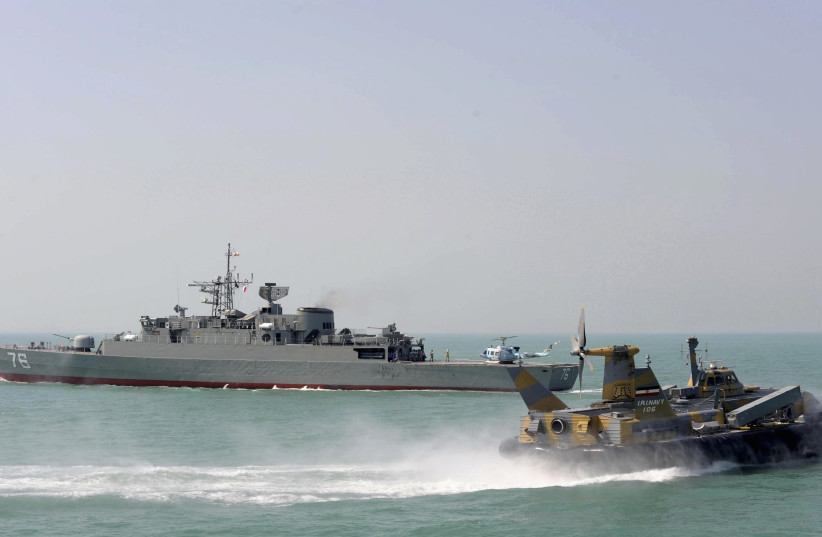
A hovercraft passes by Iran’s first domestically made destroyer Jamaran on the southern shores of Iran in the Persian Gulf during inauguration maneuvers, February 21, 2010. (credit: REUTERS/EBRAHIM NOROOZI)
“Right now everybody, is studying this response,” Borrell’s spokesman Peter Stano said on Friday.
“The way ahead will be – as always – discussed with all participants and the US.”
In 2018, then-US president Donald Trump pulled out of the agreement and reimposed harsh sanctions on Iran, prompting Tehran to violate undertakings it had made under the pact by rebuilding stockpiles of enriched uranium and installing advanced centrifuges to speed up output.
Biden has sought to revive the deal since taking office in 2021 – and Borrell is coordinating the talks putting the agreement back in place.
In March, the nuclear deal appeared near revival.
But then EU-brokered indirect talks between Tehran and Washington broke down over several issues, including Tehran’s insistence that the International Atomic Energy Agency (IAEA) close its probes into uranium traces found at three undeclared sites before the nuclear pact is revived.
Now the deal’s revival again seems imminent
Iran’s Foreign Ministry spokesperson Nasser Kanaani said on Friday that Tehran’s response was constructive.
The text that w“as sent [by Iran] has a constructive approach aimed at finalizing the negotiations,” Kanaani was quoted as saying by state broadcaster IRIB on Friday.
The US State Department has already cast doubt on the possibility of progress.
“We can confirm that we have received Iran’s response through the EU,” a spokesperson said. “We are studying it and will respond through the EU, but unfortunately [the response] is not constructive.”
White House National Security Council spokesperson Adrienne Watson said that “some gaps have closed in recent weeks but others remain.”
Tehran needs stronger guarantees from Washington for the revival of a 2015 nuclear deal, its foreign minister said on Wednesday, adding that the UN International Atomic Energy Agency should drop its “politically motivated probes” of Iran’s nuclear work.
The White House on Friday rejected linking the deal’s revival with the closure of the IAEA investigation.
“There should not be any conditionality between re-implementation of the JCPOA and investigations related to Iran’s legal obligations under the Non-proliferation Treaty,” White House press secretary Karine Jean-Pierre said, referring to the deal formally known as the Joint Comprehensive Plan of Action.
“There should not be any conditionality between re-implementation of the JCPOA and investigations related to Iran’s legal obligations under the Non-proliferation Treaty.”
Karine Jean-Pierre
Jean-Pierre was alluding to IAEA investigation into uranium traces found at the three undeclared Iranian sites.
Resolution of the so-called safeguards investigations is critical to the UN agency, which seeks to ensure that parties to the Nuclear Non-Proliferation Treaty are not secretly diverting nuclear material which they could use to make a weapon.
“We have taken a deliberate and principled approach to these negotiations from the start. And, you know, if Iran is prepared to comply with this – with its commitments under the 2015 deal – then we are prepared to do the same,” Jean-Pierre said.
When it comes to the “IAEA investigations, the safeguards, our position is crystal clear. Iran needs to answer” the IAEA given that “it’s crystal clear the investigations are not political. They are not leverage or bargaining chips,” she said.
“Once the IAEA director general reports to the Board of Governors that the outstanding issues have been clarified and resolved, we expect them to come off the board’s agenda, and not before,” she explained.
“It would be preferable to return to the JCPOA without any open safeguard issues. The power to achieve that is fully in Iran’s hands.”
Israel opposed the 2015 deal and has opposed attempts to revive it, explaining that it strengthens rather than weakens Iran’s aggression. Barnea’s trip follows one by Defense Minister Benny Gantz and National Security Advisor Eyal Hulata last month. Prime Minister Yair Lapid also spoke with Biden last week. While in Washington, Barnea is expected to meet with members of Congress.
Meanwhile, military tensions have also been rising between the US and Iran, with Washington compelling Tehran for a second time this week to release US military sail drones that it tried to seize at sea, American officials said on Friday.
Iran has been building up its naval presence in the Red Sea, near the coast of Yemen where Tehran backs the Houthi movement.
Iran’s state television earlier on Friday acknowledged that the Iranian Navy released two US maritime drones in the Red Sea but accused the American unmanned vessels of jeopardizing maritime safety, without providing evidence.
“The (Iranian navy) frigate Jamaran seized the two vessels on Thursday to prevent any possible accident after issuing warnings to the US fleet. After international shipping lanes were secured, the two vessels were released in a safe area,” the station said.
The US Navy, in a statement, challenged that account, saying the drones were in an assigned patrol area at least four nautical miles from the nearest maritime traffic lane.
“The vessels posed no risk to naval traffic and had been operating in the general vicinity of the Southern Red Sea for more than 200 consecutive days without incident,” the Navy statement said.