
Washington sees negotiated agreement as only solution to Iran’s nuclear program, as Jerusalem presses White House to prepare a military option, report says

Iran's Foreign Minister Hossein Amir-Abdollahian (R) attends a press conference with Josep Borell, the High Representative of the European Union for Foreign Affairs and Security Policy (L), at the foreign ministry headquarters in Iran's capital Tehran on June 25, 2022. (ATTA KENARE / AFP)

Iran’s Foreign Minister Hossein Amir-Abdollahian (R) attends a press conference with Josep Borell, the High Representative of the European Union for Foreign Affairs and Security Policy (L), at the foreign ministry headquarters in Iran’s capital Tehran on June 25, 2022. (ATTA KENARE / AFP)

Israel reportedly believes the US and Iran are still within weeks of reviving a nuclear deal, despite Washington saying Tehran’s latest response in negotiations was “not constructive.”

The Israeli assessment is contained in a non-public report compiled by the Foreign Ministry’s political research department, Channel 12 said on Friday.

“The American administration continues to see the agreement as the only way to deal with the Iranian nuclear program,” the report said, according to Channel 12.

The Foreign Ministry report said the US and Iran are more realistic about one another’s positions than before and are both working to boost political support for a deal ahead of a final agreement, according to Channel 12.

The US calling Iran’s response to a draft agreement “not constructive” on Thursday was the latest in a back and forth between the adversaries via mediators from the European Union.

The EU foreign policy chief Josep Borrell on Wednesday said he hoped for a resolution within days to revive the 2015 nuclear accord known as the Joint Comprehensive Plan of Action (JCPOA).
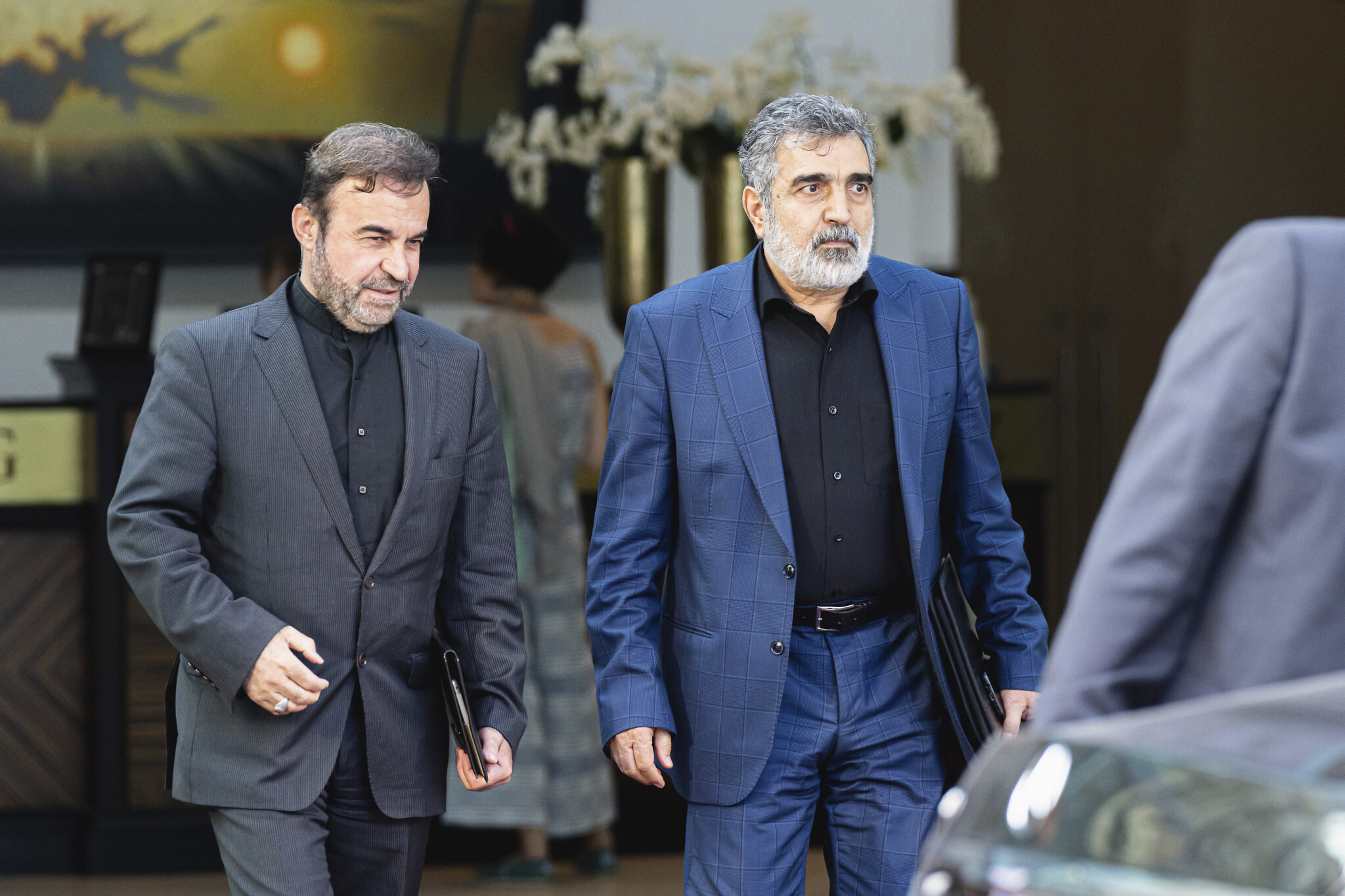
Iranian deputy foreign minister Reza Najafi, left, and Iranian AEOI spokesperson Behrouz Kamalvandi, seen leaving the Palais Coburg where closed-door nuclear talks took place in Vienna, Austria, August 5, 2022. (AP/Florian Schroetter)

On August 8 the EU put forward what it called a final text. Iran proposed changes to it — largely accepted by the Europeans — to which the US issued a response through the mediators.

Iranian foreign ministry spokesperson Nasser Kanaani said Friday that Tehran sent another response, according to Iranian state news agency IRNA. Kanaani called the Iranian proposal “constructive” and expressed hopes that a deal would be finalized.

Later in the day, White House National Security Council spokesperson Adrienne Watson said in a statement that the US was still “studying the [Iranian] response and coordinating with our E3 allies.”

“Some gaps have closed in recent weeks but others remain,” she said in a statement to The Times of Israel. “The President will only conclude a deal that he determines is in the national security interest of the United States.”

Channel 13 on Friday quoted an unnamed Israeli official who said Iran’s response had dragged the sides backward and further away from an agreement. The official said Jerusalem will continue its efforts to influence the talks in any way possible.

Supreme Leader Ayatollah Ali Khamenei speaks on the anniversary of the death of the late founder of the Islamic Republic, Ayatollah Ruhollah Khomeini, shown in the poster at top center June 4, 2022. (Office of the Iranian Supreme Leader via AP)

Also on Friday, a senior European official directly involved in nuclear talks told the Walla news site that Iran had sought to reopen talks on the International Atomic Energy Agency (IAEA) investigations into Iranian nuclear activity. The US and the IAEA, the UN’s nuclear watchdog, both oppose restarting negotiations on the issue.

White House press secretary Karine Jean-Pierre said during a Friday briefing that “there should not be any conditionality between the implementation of the JCPOA and [IAEA] investigations related to Iran’s legal obligations.”

She said the IAEA’s cases against Iran should only be closed if the UN agency finds its concerns have been addressed by Iran.

“The Iranian response was totally unreasonable. It reopens the EU coordinator’s text on nuclear safeguards, which was at the outer limits of our flexibility already, and which the Iranians implicitly accepted in their August 15 response,” the European official told Walla. “The Iranian response can only be read as them not wanting to close this deal when we were so close, for the first time in 18 months.”

“With this opportunity squandered, it is now hard to imagine that a deal can happen before the [US] midterms,” Ali Vaez, a top analyst with the International Crisis Group told POLITICO.

During their phone call earlier this week, Prime Minister Yair Lapid urged US President Joe Biden to prepare a military strike against Iran’s nuclear program, telling him that “only a credible US military plan will ensure the Iranians don’t try to cheat” if a nuclear deal is revived, Channel 12 reported.

Prime Minister Yair Lapid speaks via phone to US President Joe Biden on August 31, 2022. (Courtesy)

Israel has long pushed the US to prepare a military option, and Biden said in July that he would be prepared to use force if necessary to prevent Iran from obtaining a nuclear weapon. Iran’s nuclear program is believed to be too advanced to be taken out with one strike and it is unclear the extent of damage a military attack would be able to incur.

During the call with Lapid, Biden reiterated his commitment to keeping Israel in the loop regarding the nuclear talks and assured Lapid there would be no surprises as Jerusalem felt there were during the Obama administration.

Mossad chief David Barnea will be heading to Washington next week where he will be briefing the Senate Select Committee on Intelligence on Israel’s position and intelligence regarding Iran, Channel 12 said.


Diplomats, intel officials tell Reuters Iran is increasingly using civilian flights to transport arms, leading to increase in strategic attacks attributed to Israel

This satellite image taken September 1, 2022, shows damage caused in an airstrike attribued to Israel at the Aleppo International Airport in northern Syria. (Planet Labs PBC via Aurora Intel)

This satellite image taken September 1, 2022, shows damage caused in an airstrike attribued to Israel at the Aleppo International Airport in northern Syria. (Planet Labs PBC via Aurora Intel)

Israeli airstrikes on Iranian targets in Syria have increasingly targeted airports to counter Tehran’s growing use of commercial flights to bring military supplies into the country, Reuters reported Friday, citing intelligence and diplomatic sources.

A Western intelligence source and a Syrian military defector told the news agency that Tehran has taken to flying small weapons and other military supplies on regular civilian flights. Supplies transferred include precision-guided missiles, night vision equipment and UAVs, all of which are small enough to load onto civilian planes, they said.

Iran has increasingly relied on flights as its previous ground routes via Iraq have become unreliable amid local turf wars and internal conflicts, the report said.

Israel views Iran’s expansion throughout Syria as a continued threat to its national security, and has conducted strikes across a broad range of targets in an effort to curb Iran’s forces in the region.

A regional diplomatic source told Reuters that Israeli intelligence had noticed Iran’s growing use of civilian airports to bring in military equipment and that recent airstrikes targeting airports appeared to signal a shift in Israeli strategy in the region.

“They started to hit infrastructure used by the Iranians for ammunition supplies to Lebanon,” the source told Reuters. “In the past, it was only the supplies but not the airport. Now, they hit the runway.”

The Reuters report said recent strikes on airports in Aleppo and Damascus also appeared to have been conducted to prevent the arrival of specific planes carrying weaponry.

This satellite photo released by Planet Labs PBC shows the damage after an Israeli strike targeted the Aleppo International Airport, September 1, 2022. (Planet Labs PBC via AP)

While Israel has refused to comment on specific airstrikes, military officials have acknowledged conducting them throughout Syria’s eleven-year-long civil war.

Earlier this year, airstrikes attributed to Israel caused major damage to the Damascus International Airport, halting all air traffic for two weeks. The Syrian defector told Reuters that as a result, Iran diverted its shipments to the Aleppo airport, prompting Israel’s alleged strike there on Wednesday.

Nawar Shaaban, an analyst at the Omran Center for Strategic Studies, also told Reuters that the location of Israeli air strikes sheds light on the expansion of Iranian influence in Syria. While strikes previously targeted  Damascus and surrounding military zones, strikes in destinations farther away, such as Aleppo and the Syrian coast, show which regions Israel assesses as potential threats.

“The dangerous thing is that when we look at these areas that are being hit, it tells us that Iran has spread out more,” Shaban said.

“Every time we see a strike hit a new area, the reaction is, ‘Woah, Israel hit there’. But what we should be saying is, ‘Woah, Iran is there,’” he added.

A fire is reportedly seen at Aleppo International Airport in northern Syria following an airstrike attributed to Israel, August 31, 2022. (Social media)

While the IDF spokesperson has declined to comment on specific events, in line with Israeli policy, it has acknowledged numerous attacks in the region.

A satellite image taken Thursday showed damage at Aleppo International Airport in northern Syria. The image, taken by Planet Labs PBC and provided by Aurora Intel, appeared to show a scorched area near the end of the runway.

The strike tore a hole through the runway, as well as ignited a grassfire at the airfield. Still, planes continued to land at the airport throughout Thursday.

According to Aurora Intel, a sanctioned Iranian cargo plane had landed at the Aleppo airport several hours before the strike. It was not clear if the plane, or cargo it was carrying, had been hit in the attack.

Also Thursday, Syria’s Foreign Minister Faisal Mekdad issued a harsh warning to Israel over the airstrikes. He said Israel was “playing with fire” and risking a wider military conflict, according to Arabic media reports.

On Friday, an Arabic newspaper reported that Russia had demanded Iran and its militias withdraw from positions across Syria amid an apparent uptick in airstrikes attributed to Israel.

A-Sharq Al-Awsat, a Saudi-owned daily published in London, cited Syrian officials as saying Russian officers called on their Iranian counterparts during a Wednesday meeting at the Hama Military Airport in central Syria to leave several sites in the country.

The report said the calls came as Russia was seeking to maintain stability in Syria, and to deprive Israel of targets to bomb in areas Russia sees as important. An airstrike attributed to Israel last month hit several Iranian sites close to Russia’s main naval base in Syria, at the port city of Tartus.


The Middle East is changing, Israel must be ready – opinion

Deputy US Ambassador Richard Mills warned the United Nations Security Council on Wednesday that Iran’s Lebanese proxy, the Hezbollah terrorist organization, is amassing weapons on Israel’s northern border.

His testimony came after the UNSC voted to extend by one year the mandate of the UNIFIL peacekeeping force in southern Lebanon, demanding the relevant parties guarantee freedom of movement for the force and “cease any restrictions and hindrances to the movement of its personnel.”

Resolution 2650 (2022) also reiterates the UNSC position that the official Lebanese Army should be the country’s sole armed force. The Council condemned all violations of the Blue Line and called on all parties to respect the cessation of hostilities, prevent any such violations and cooperate fully with the United Nations and UNIFIL. The resolution also called on all States to fully support and respect the establishment — between the Blue Line and the Litani River — of an area free of any armed personnel, assets and weapons other than those of the Government or UNIFIL.

A new paragraph was added that states the UNSC “condemns the continued maintenance of arms outside the control of the Lebanese State by armed groups in violation of resolution 1701 (2006).” The resolution also “recalls paragraph 15 of resolution 1701 (2006) according to which all States shall take the necessary measures to prevent, by their nationals or from their territories or using flag vessels or aircraft, the sale or supply of arms and related materiel to any entity or individual in Lebanon other than those authorized by the Government of Lebanon or UNIFIL.”

While the UNSC was meeting on UNIFIL, however, Lebanon’s culture and energy ministers were filmed symbolically hurling rocks across the border at Israel.

“The US shares this Council’s significant concern about the state of affairs in southern Lebanon – in particular, Hezbollah’s threatening activities,” Mills said, noting that Resolution 2650 “reaffirms UNIFIL’s authority to operate independently and to conduct both announced and unannounced patrols.”

None of those words reflect the reality in southern Lebanon.

The Hezbollah terrorist group long ago infiltrated the weak Lebanese government, which has never dared suggest disarming the powerful Iranian proxy.

UNIFIL soldiers simply avoid areas in which they could easily find themselves in danger from the Hezbollah militia – a heavily armed force supplied, trained, and generously supported by Tehran.

“UNIFIL peacekeepers are blocked with increasing frequency from conducting their mandated tasks and accessing sites of concern,” Mills noted.

Hezbollah has also planted outpost structures all along the Blue Line – the international border between Israel and Lebanon – which they claim belong to the “Green Without Borders” environmental group. The Israeli military debunked that claim months ago with photos showing the so-called “environmental observation” structures manned by Hezbollah terrorists.

“The proliferation of prefabricated containers placed by Green Without Borders obstructs UNIFIL’s access to the Blue Line and is heightening tension in the area, further demonstrating that this so-called environmental group is acting on Hezbollah’s behalf,” Mills pointed out.

The resolution renewing the UNIFIL mandate, he added, “has made clear that Hezbollah’s continued amassing of weapons must stop.”
