Saudi Arabia seen as softening stance on normalization, but few expect public ties anytime soon
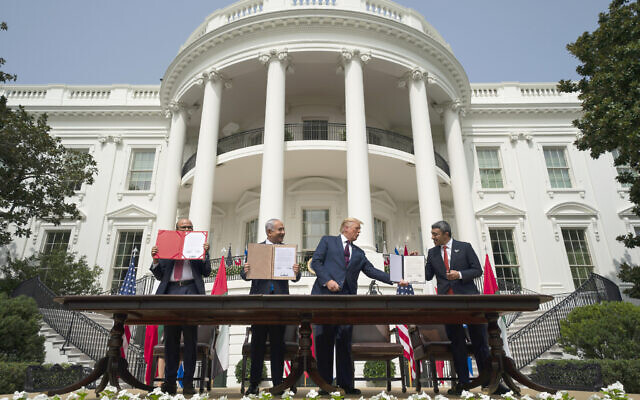
The dramatic agreements the United Arab Emirates, Bahrain and Israel signed this week raise a major question: Will the biggest and most powerful Arab Gulf state be next?
Saudi Arabia, the birthplace of Islam, does not recognize Israel and has no official diplomatic ties with it.
Saudi officials said recently that the kingdom remained committed to the Arab Peace Initiative introduced by Riyadh back in 2002, according to which Arab countries would normalize ties with Israel in return for a statehood deal with the Palestinians and full Israeli withdrawal from territory captured in 1967.
But on Tuesday, hours after the so-called Abraham Accord was signed by Israel, the UAE and Bahrain, US President Donald Trump said he believed Saudi Arabia would follow, telling reporters that after speaking with Saudi King Salman bin Abdulaziz Al Saud, he felt the kingdom would do so “at the right time.”
“We have many other countries going to be joining us, and they’re going to be joining us soon,” the president said.
The head of the Mossad, Israel’s spy agency, apparently agrees.
In an interview that Israel’s Channel 12 news aired late Wednesday, Yossi Cohen refused to either confirm or deny that he had met with Saudi Crown Prince Mohammed bin Salman, considered the power behind the throne, saying only with a smile: “I prefer not to comment.”
Cohen, who is close to Israeli Prime Minister Binyamin Netanyahu, is reported to be secretly shuttling back and forth to Gulf states. He was one of the few Israeli officials to accompany Netanyahu to the signing ceremony.
Cohen said Tuesday’s deals formalized relations after “many years of contacts that took place in a very precise manner.” He asserted that concerns in the region about Iran’s aspirations played a major role in the break the two Gulf states made from decades of non-recognition of Israel so long as its dispute with the Palestinians remains unresolved.
Asked whether Saudi Arabia would follow suit in the near future, Cohen said: “I think this can happen.”
Some speculate that a bombshell announcement could come as early as next month to help Trump in his reelection campaign. Others strongly disagree.
Dr. Hussein Ibish, senior resident scholar at the Arab Gulf States Institute in Washington, told The Media Line that there would be no “October surprise,” with Riyadh taking its role as a leader of the Arab and Muslim world very seriously.
“Saudi Arabia has complex considerations [that] other, smaller, Gulf Arab countries don’t have,” he said.
Saudi Arabia has complex considerations [that] other, smaller, Gulf Arab countries don’t have
“They [the Saudis] play a regional Arab leadership role that is fundamentally different from the UAE’s and which Bahrain does not do at all. Saudi Arabia also has pan-Islamic leadership considerations that will need to be taken into consideration, especially as they face a growing bloc of opposition from Turkey, Pakistan and Malaysia, sometimes backed up by Iran,” Ibish explained.
“Finally, Saudi politics are a lot more complicated than their smaller neighbors’, with a large geographical country and over 30 million people in multiple regions, and with many different identity sub-groupings. They will have to be very careful about the domestic politics, arguably even more than Bahrain,” he said, referring to the fact that the Sunni rulers in Manama preside over a Shi’ite majority.
Peace with Saudi Arabia would be a tremendous diplomatic prize for Israel. Its king is the custodian of the Holy Mosques in Mecca and Medina. He presides over the world’s largest oil exporting country and the Arab world’s biggest economy. He also has a strong military.
Elana DeLozier, a research fellow at the Washington Institute for Near East Policy, believes the kingdom is not on the list of states ready to follow in the UAE’s footsteps, saying that Abu Dhabi merely put its own interests before those of anyone else.
“I think that for the UAE, it’s really about prioritization of their interests,” she told The Media Line. “They long had sympathy for the Palestinian cause, but they also have an interest in a relationship with Israel.”
It is no secret that the UAE and other Gulf states have been inching closer to ties with Israel. Many Israeli officials, businesspeople and athletes have visited Gulf states. Their security and intelligence sectors have seen steady cooperation, where several Israeli firms have sold Gulf states advanced cyberweapons.
“Saudi Arabia is in a much different position than the UAE and Bahrain, particularly given that its official leader − King Salman − has long stood firmly behind a two-state solution in exchange for Arab normalization,” DeLozier noted.
Saudi Arabia is in a much different position than the UAE and Bahrain, particularly given that its official leader − King Salman − has long stood firmly behind a two-state solution in exchange for Arab normalization
“We must not forget that it was the Saudis, after all, who introduced the Arab [Peace] Initiative of 2002. Certain constituencies that are firmly against normalization could also call into question Riyadh’s claim to Islamic leadership as custodian of the holy sites in Mecca and Medina if it were to take this step,” she explained.
Ghassan Khatib, a lecturer in political science at Birzeit University in the West Bank, concurs, saying that despite Israeli wishes and Trump’s assurances, Riyadh cannot risk its standing in the Arab and Muslim worlds.
“First, in Saudi Arabia, there is public opinion that the government would have to take into consideration, which is not the case in some other Arab Gulf states,” Khatib told The Media Line.
“Second, Saudi Arabia is facing competition against its leadership in the Islamic world and will not gamble by selling out on Jerusalem,” he stated, adding that this “would play into the hands of the Iranians and the Turks, who are competing with Saudi Arabia for leadership of the Islamic world.”
Saudi Arabia is facing competition against its leadership in the Islamic world and will not gamble by selling out on Jerusalem
Prof. Eytan Gilboa, a senior research associate at the Begin-Sadat Center for Strategic Studies at Bar-Ilan University near Tel Aviv, told The Media Line that although things are moving slowly, more Arab states are expected to normalize relations with Israel – although Saudi Arabia is not one of them.
“Saudi Arabia is a different case – they will be the last to do so,” he asserted.
“Saudi Arabia is going through huge domestic reforms, and MbS is facing a lot of opposition to this. So I guess he doesn’t need another controversial issue to deal with now,” Gilboa said, using the Saudi crown prince’s popular appellation.
Saudi Arabia is going through huge domestic reforms, and MbS is facing a lot of opposition to this. So I guess he doesn’t need another controversial issue to deal with now
When Egypt signed the first peace treaty with Israel more than four decades ago, it was kicked out of the Arab League, which moved its headquarters from Cairo to Tunis. Ten years later, in 1989, Egypt was readmitted to the umbrella body, which subsequently returned to Cairo.
“All Arab states considering peace deals with Israel have to make cost-benefit analyses. The costs entail risks in the form of blowback,” Giorgio Cafiero, the CEO and founder of Gulf State Analytics, a geopolitical risk consultancy based in Washington, told The Media Line.
No Arab leader can “forget the fate of Anwar Sadat, who paid the ultimate price for formalizing Egypt’s relationship with Israel,” he said.
Cafiero argues that Riyadh is calculating its steps carefully.
“From the Saudi government’s perspective, there are… certain risks that are not in the picture for the other five Gulf Cooperation Council states,” he said.
From the Saudi government’s perspective, there are… certain risks that are not in the picture for the other five Gulf Cooperation Council states
Some analysts argue that while it is unlikely that Saudi Arabia will formalize ties with Israel, there are many signs that Riyadh is softening its stance. For example, one of the most influential clerics in the kingdom and the entire Muslim world used a recent sermon to call on Muslims to avoid “passionate emotions and fiery enthusiasm” toward Jews.
Hasan Awwad, an expert on Middle East politics, told The Media Line that the cleric, Abdulrahman al-Sudais, imam of the Grand Mosque in Mecca, was appointed by the king and does not speak on a sensitive issue like this without authorization.
“It is no doubt that Sudais reflects the Royal Court’s wishes. This was an attempt by the Saudis to test the Saudi public pulse regarding normalizing relations with Israel,” Awwad said.
Sudais is closely watched by millions of Muslims. He has delivered passionate sermons about Palestine and the Palestinians, often with tears streaming down his plump cheeks.
In previous sermons, he prayed for a Palestinian victory over the “invader and aggressor,” meaning the Jews. But in his September 5 sermon, the imam toned down the rhetoric.
He told the story of how the Prophet Muhammad was good to his Jewish neighbor, arguing that the best way to persuade Jews to convert to Islam was to “treat them well.” He faced widespread criticism on social media for invoking Islam to indirectly justify normalization with Israel.
Saudi Arabia has already taken other symbolic steps, such as allowing Israeli passenger planes to transit its airspace.
Awwad says that regional conflicts would play a direct role in moving Saudi Arabia closer to Israel, saying that “economic and domestic and regional political factors” will come into play.
“First, Saudi Arabia needs economic stability and strength to face the future challenges, since the world is shifting from oil to new energy. This shift will jeopardize the Saudis’ political power in the face of the rise of Turkish economic and political regional and international power, which threatens to replace Riyadh as the leader of the Sunni bloc,” he explained.
Saudi Arabia needs economic stability and strength to face the future challenges, since the world is shifting from oil to new energy. This shift will jeopardize the Saudis’ political power in the face of the rise of Turkish economic and political regional and international power, which threatens to replace Riyadh as the leader of the Sunni bloc
“Second, Riyadh wants to strengthen itself through entering into alliances with Washington’s only loyal and most trusted and powerful ally, Israel, to face Iran,” he stated.
For Saudi Arabia, the debate over normalization with Israel reflects a deep divide between the old guard, who view the Palestinian cause as an important issue, and the young guard led by the powerful crown prince, who, according to Cafiero, views the economy and containing Tehran’s influence in the region as top priorities.
“Having said all the above, Crown Prince Mohammed bin Salman appears far more open to normalizing the Saudi kingdom’s relationship with Israel than his father, King Salman. Thus, if Riyadh formalizes its ties with Tel Aviv at some point down the road, it is a safe bet that this would probably only happen after MbS becomes the king of Saudi Arabia,” he theorized.
Crown Prince Mohammed bin Salman appears far more open to normalizing the Saudi kingdom’s relationship with Israel than his father, King Salman
Cafiero notes that the Saudi monarchy is cautious about its public image and how it is perceived in the Arab and Muslim worlds.
“Religious and ideational variables are also in the equation. The Saudi king is officially the Custodian of the two Holy Mosques, and Saudi Arabia leads the Organization of Islamic Cooperation, giving the kingdom a special role in the wider Islamic world,” he said.
“With both Iran and Turkey challenging Saudi Arabia’s religious legitimacy − underscored by the Kuala Lumpur Summit of 2019 – any peace deal between Riyadh and Tel Aviv could aid the Iranian and Turkish governments’ efforts to convince more Muslims worldwide that Saudi Arabia lacks the religious legitimacy to lead the Islamic world,” he added.
Jason Brodsky, policy director for United Against Nuclear Iran, told The Media Line: “I don’t think normalization in relations between Israel and Saudi Arabia is imminent, but they are inching toward that goal. King Salman publicly stated − only days ago − that the Arab Peace Initiative is a precondition to normalization. However, that calculus could change after succession.”
Ibish feels it is difficult to imagine normalization taking place while Salman is still in power.
“King Salman remains very committed to the Arab Peace Initiative and supportive of the Palestinian cause,” he noted.
On the other hand, he continued, when MbS takes the throne and assumes full control of the kingdom, there could be more room for negotiations, especially if Trump wins a second term.
The king is 84 years old.
MbS’s good friend Kushner is the force behind the UAE and Bahrain normalizing relations with Israel. The crown prince told the CBS News program 60 Minutes that Israelis are entitled to live peacefully on their own land on condition of a peace agreement that assures stability for all sides.
Ibish says Riyadh will closely watch whether and how the agreements signed this week will benefit the two Gulf nations, adding that if things go extremely well, this could at some point entice the Saudis to follow suit.
“Especially if [the accords] appear to have a positive impact for the Palestinians, it is possible that Salman might come around. But I do not think that is likely,” he noted.
“More probably, it would fall to his successor, presumably MbS, to consider whether the complex factors above are offset by possible strategic and national gains. It will depend a great deal on the domestic and regional circumstances at the time,” Ibish said.
The agreements with the UAE and Bahrain have dealt a huge blow to Palestinian efforts to regionally isolate Israel. The outrage was swift, with people calling the deals “a stab in the back of the Palestinian cause” as well as the Palestinian people.
“There’s no doubt that the leadership is concerned,” Khatib said. “The Palestinian Authority needs to reform its strategy and find new ways to convince more Arab states to refrain from normalizing ties with Israel.”
The Palestinian Authority needs to reform its strategy and find new ways to convince more Arab states to refrain from normalizing ties with Israel
While the Palestinian cause was a top priority for the Arabs over the decades, support appears to be fading as other conflicts brought about by the so-called Arab Spring supersede the Israeli-Palestinian conflict. This was evident when the Arab League failed to pass a resolution proposed by the Palestinian Authority that would have condemned the Israel-UAE normalization deal.
“There have been all kinds of problems in the Arab world − disputes, revolutions, civil wars, tensions between different Arab countries,” Khatib stated. “Palestinians are now paying the price for the deterioration in Arab unity.”
Saudi Arabia, too, shares with Israel a fear of Iran, which could play a major factor in persuading Riyadh to establish ties. In fact, Phillip Smyth, an expert on Iranian politics and the 2018-2019 Soref Fellow at the Washington Institute for Near East Policy, told The Media Line that if an announcement is made about Saudi Arabia and Israel establishing formal relations, “it wouldn’t shock me.”
Regional tensions will affect any Saudi decision on the issue, he explains, adding that growing Iranian influence in the area represents a threat to Riyadh’s national interests.
“When we look at Bahrain and the Emirates, both countries are dealing in some way with the security framework of actually dealing with the Iranians and in terms of moving into a realpolitik-style vision of the region,” he noted.
He cites unrest in Bahrain and “Iranian interference, bombings… and different forms of attacks from Iranian-sponsored and -directed militant groups” as pushing the tiny Gulf monarchy closer to Israel.
Gilboa believes the normalization accords are more about a shared desire to counter and contain Iran’s influence in the region and less about the Palestinian cause.
“The answer to this is a counter-alliance, a new strategic alliance… [for] the Gulf states and including Saudi Arabia, Egypt, Jordan and Israel,” he said.
Israel and the Gulf states, Gilboa explains, all see Iran as an existential threat.
“Iran is trying to build a Shi’ite alliance in the shape of crescent, starting in Tehran [and] going to Iraq, Yemen, Syria [and] Lebanon. There are two other players: Islamic Jihad and Hamas in Gaza,” he noted, adding that a possible counter-grouping could be called a “Sunni alliance.”
Gilboa does not expect Riyadh to go public with its relationship with Israel in the immediate future.
“Not in the next two years at least,” he believes. “They will watch what is happening with the Gulf states, Morocco, Sudan…. They will not be among the first; they will be among the last.”
Riyadh’s Possibilities are Many in Wake of Israel-Gulf Accords