As IAEA reports show Iran’s nuclear efforts advancing, the US and its allies have few viable options to respond.
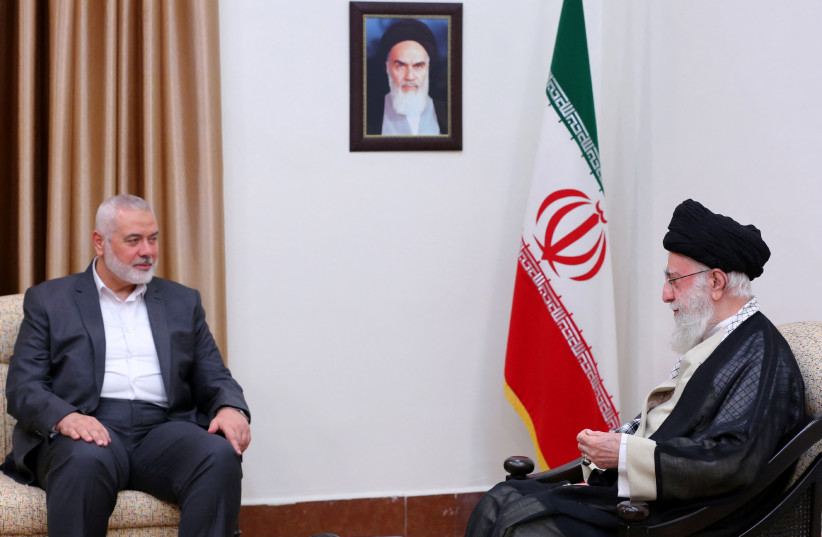
 Iran's Supreme Leader Ayatollah Ali Khamenei meets with Palestinian group Hamas' top leader, Ismail Haniyeh, in Tehran, Iran June 21, 2023. (photo credit: Office of the Iranian Supreme Leader/WANA (West Asia News Agency) via REUTERS)
Iran’s Supreme Leader Ayatollah Ali Khamenei meets with Palestinian group Hamas’ top leader, Ismail Haniyeh, in Tehran, Iran June 21, 2023.
(photo credit: Office of the Iranian Supreme Leader/WANA (West Asia News Agency) via REUTERS)
The United States and its allies have few routes left to rein in Iran’s nuclear work with prospects for talks long buried and tougher actions against Tehran running the risk of stoking tensions in a region already enflamed by the Gaza war.

With a U.S. election next year limiting Washington’s room for manoeuvre, four serving and three former diplomats painted a bleak picture of efforts to curb Iran’s nuclear programme, which according to U.N. nuclear watchdog reports continues to advance.

The diplomats spoke to Reuters on condition of anonymity.

According to one of the two confidential reports by the International Atomic Energy Agency and seen by Reuters, Iran now has enough uranium enriched up to 60% purity – close to weapons-grade and a level Western powers say has no civilian use – to make three bombs.

The stockpile continues to grow, the reports say, even though Iran has consistently denied wanting nuclear arms.
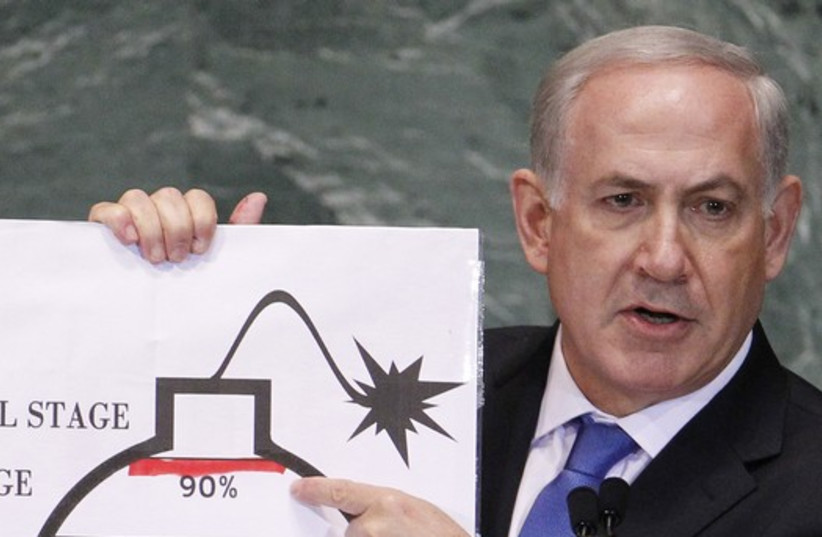
Netanyahu warns against nuclear Iran at 2012 UN General Assembly (credit: REUTERS)

Having failed to revive a nuclear deal between Iran and world powers that was abandoned by former U.S. President Donald Trump in 2018, President Joe Biden has no room for now even to consider a more informal “understanding” to curb Iran’s nuclear work with a regional conflict raging and tension spiralling.

“There is a sort of paralysis, especially among the Americans … because they don’t want to add fuel to the fire,” said a senior European diplomat.

Any negotiations to reach an “understanding” with Iran would have entailed Washington offering concessions – such as easing its tough sanctions regime on Tehran – in return for Iranian constraint.

Such a move now looks inconceivable after Iran-backed Palestinian group Hamas launched its devastating attack on Oct. 7 on U.S. ally Israel. Since then, Iran’s regional proxy militias have launched dozens of attacks on U.S. and coalition troops in Iraq and Syria, according to the Pentagon.

At home, the Biden administration is constrained by U.S. presidential elections now just a year away. Trump, who at the moment looks most likely to be Biden’s opponent, could seize on any engagement with Tehran and portray it as weakness.

“In the current environment, it is simply not politically feasible to seek an accommodation with Iran on the nuclear issue,” said Robert Einhorn, a former U.S. State Department official.

“The political debate is really not going to be about negotiating with Iran, it’s going to be about confronting Iran,” he said.

Iran stonewalling IAEA

Washington has deployed two aircraft carriers to the region and warplanes to the eastern Mediterranean, partly as a warning to Tehran. But U.S. officials have also made clear they do not want an escalation, urging Iran-backed militias to stand down.

Washington and its French, British and German allies – which were among the parties to the 2015 nuclear deal – will now focus on next week’s IAEA Board of Governors meeting.

This week’s IAEA reports showed Iran was making steady nuclear progress and indicated that Tehran continued to stonewall the agency in monitoring its work.

A deal in March to re-install monitoring equipment including surveillance cameras, which were removed last year at Iran’s behest, has only partially been honoured.

Tehran’s “de-designation” in September of some of the agency’s most experienced inspectors – a move that effectively bars them from working in Iran – has also exasperated the IAEA.

Western powers in September had threatened to pass a binding resolution ordering Iran to reverse course – one of the strongest sanctions in the IAEA board’s armoury.

Four diplomats said a resolution was now unlikely because it was imperative to avoid a diplomatic and nuclear escalation with Iran while attention is focused on Israel’s conflict with Hamas.

They said a less inflammatory move, such as a firm non-binding statement, that would threaten tougher action at the next board meeting in March was more likely for now.

“We can’t have a resolution,” said the senior European diplomat. “If we were to pass a resolution … it risks pushing them (the Iranians) over the edge … to 90% enrichment.”

Weapons-grade uranium is around 90% purity.

Two diplomats said all that could be done in coming months was to support IAEA chief Rafael Grossi’s efforts to strengthen oversight of Iran’s nuclear programme. He has been seeking to re-designate his inspectors before the end of the year.

“It’s way too early to say whether Iran will become a nuclear state or whether it will stay a threshold state like now,” one diplomat said. “But for now it will keep enriching.”


(Reporting by John Irish in Paris, Francois Murphy in Vienna and Arshad Mohammed in Washington; Editing by Edmund Blair)
Jordan ramps up diplomatic pressure on Israel over Palestinian issue

Prime Minister Bisher Khaswaneh, reflecting growing regional tensions, says any Israeli attempt to relocate Palestinians is as an act of war.

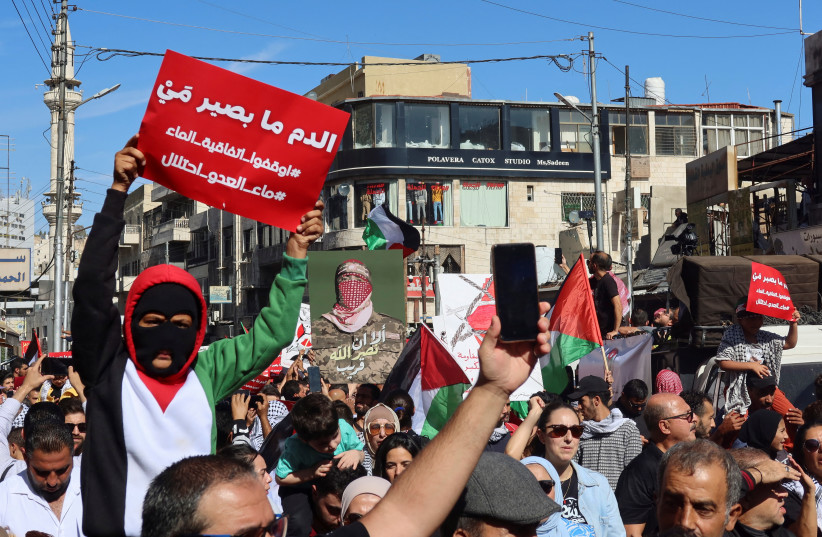
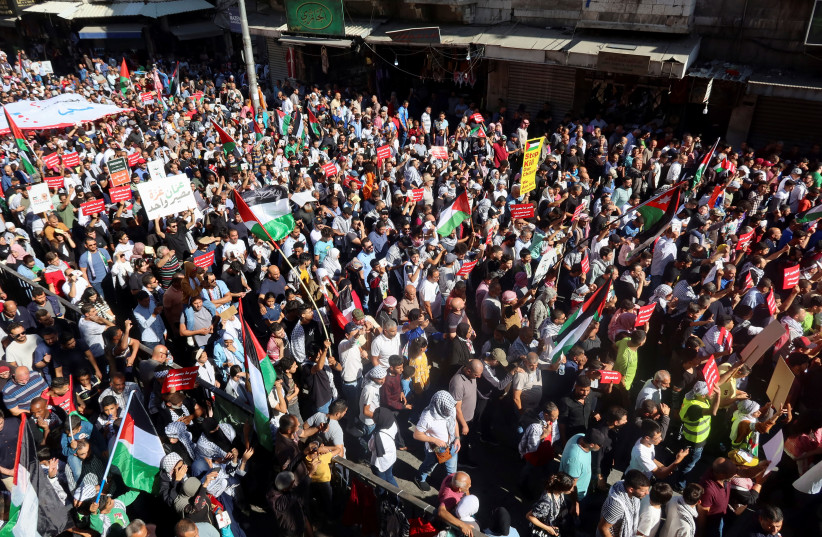
 Demonstrators carry flags and banners during a protest in support of Palestinians in Gaza, amid the ongoing conflict between Israel and the Palestinian Islamist group Hamas, in Amman, Jordan November 10, 2023.  (photo credit: REUTERS/JEHAD SHELBAK)
Demonstrators carry flags and banners during a protest in support of Palestinians in Gaza, amid the ongoing conflict between Israel and the Palestinian Islamist group Hamas, in Amman, Jordan November 10, 2023.
(photo credit: REUTERS/JEHAD SHELBAK)
Jordanian public officials have increased their rhetoric in terms of the kingdom’s relations with its neighboring state, Israel.

The prime minister of Jordan, Bisher Khasawneh, has broken his silence to deliver a blistering message to the Israelis. Khaswaneh said that any Israeli effort to physically attempt to relocate Palestinians from the West Bank, in any form, would be considered an act of war. Addressing members of the parliament, Khaswaneh said that there might be further diplomatic moves to the decision to withdraw the Jordanian ambassador and to deny the reentry of the Israeli ambassador if the war doesn’t end.

Muath Momani, executive director of the Law & Society Institute, told The Media Line that Jordan’s position in support of the Palestinian cause was and remains consistent and clear: “It is certain that Jordan, through its positions in support of the Palestinian cause, has some fears of the forced displacement of Palestinians from their lands. The Jordanian prime minister recently stated that if that happens, then it is war. Jordan will not hesitate to protect the Palestinian people from practices that affect their existence and identity.”

Samar Muhareb, director of the Arab Renaissance Democracy and Development organization, believes that Jordanian officials have been reflecting public sentiment. “The statements of the prime minister and the foreign minister are aimed at breaking the deadlock that has been going on for a month,” she told the Media Line.

Muhareb put the issue in terms of the national interests of Jordan. “The occupiers need to understand the interests of the region, and especially Jordan.” She argued convincingly for an immediate cease-fire and an eventual end to the Israeli occupation while also addressing the Palestinian refugee issue. Muhareb insists that this “is not only a form of solidarity—[but also] what happens in Palestine is an integral part of Jordanian national interest and a source of our country’s stability.”

 Demonstrators carry flags and banners during a protest in support of Palestinians in Gaza, amid the ongoing conflict between Israel and the Palestinian Islamist group Hamas, in Amman, Jordan November 10, 2023. (credit: REUTERS/JEHAD SHELBAK)
Demonstrators carry flags and banners during a protest in support of Palestinians in Gaza, amid the ongoing conflict between Israel and the Palestinian Islamist group Hamas, in Amman, Jordan November 10, 2023. (credit: REUTERS/JEHAD SHELBAK)

Jordan in Palestinians 

Ahmad Awad, director of the Amman-based Phenix Center for Economic and Informatics Studies, told The Media Line that the Jordanian position has been clear since the war on Gaza began. “Jordan is not only a neighboring country but is a country that has direct relations with Palestinians and is therefore affected socially [and] economically whenever changes take place in Palestine.”

Awad, who is also a member of the Himam coalition of civil society organizations in Jordan, warned of the danger of any effort at resettling Palestinians in Jordan. “This is a real threat because the far right-wing Israeli government has talked about this, and some Israeli decision-makers are even saying this is a chance to empty the West Bank and Gaza from Palestinians. Therefore, Jordan had to respond to this danger.” Awad says there are many options in dealing with this unprecedented Israeli crime in Gaza.

Advertisement

For Jordan, however, agreements with Israel provide badly needed water. The Jordanian monarch, King Abdullah, has succeeded in securing a €900 million grant mainly for the Jordan water carrier project. The project aims to carry water desalinated in the Red Sea to the urban areas in the center of the kingdom.

The war on Gaza is causing major political upheaval in Jordan as the country is witnessing daily demonstrations, protests, boycotts of various Western products, and an unprecedented unity of the society. Jordanians are united behind the need for an immediate cease-fire and Jordan officials have noted that they worry that with the war on Gaza continuing, radicalization is being felt at all levels.

Nevertheless, Tagreed Odeh, a political analyst, argued that Jordanian diplomacy is still taking balanced steps toward what is happening in Gaza. “What the prime minister said is nothing but a reminder to the Israeli side of the content of the peace treaty, which makes any forced displacement a break in the commitments of the peace treaty. Violating the treaty certainly means moving from the stage of peace to a declaration of war.”

Odeh said that Jordan is practicing politics in a wise way that ensures “the safety of Jordan in the first place, and then stability in its position toward the Palestinian issue.”

While there is no sign that we will soon see the cancellation of the Jordan-Israel peace agreement, there is no doubt that the pressure is building up on the government and the palace to do just that.

Jordan is reluctant to give up on its peace deal with Israel; it has both security and social implications, including the issue of water which Jordan badly needs.

Faisal Al Fayez, president of the Jordanian Senate, has said that the issue of the Jordanian-Israel peace agreement is an Arab decision. The Arab League convened an emergency summit in the Saudi capital Riyadh on November 11 but did not release a public statement on the matter due to a lack of consensus among Arab states on the nature of a joint response.


UN nuclear watchdog decries Tehran’s ongoing ban on its inspectors, says their ouster in September has seriously affected agency’s work

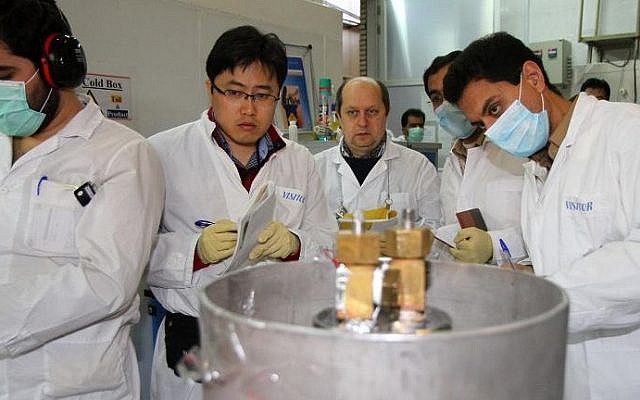
IAEA inspectors at Iran's nuclear power plant in Natanz on January 20, 2014. (IRNA/AFP Kazem Ghane/File)
File: IAEA inspectors at Iran’s nuclear power plant in Natanz on January 20, 2014. (IRNA/AFP Kazem Ghane)

The International Atomic Energy Agency (IAEA) has estimated that Iran’s stockpile of enriched uranium has reached 22 times the limit set out in the since-collapsed 2015 nuclear accord, according to a new report by the UN nuclear watchdog.

In a confidential quarterly report distributed to member states, the IAEA estimated that, as of October 28, Iran’s total enriched uranium stockpile was at 4,486.8 kilograms, an increase of 691.3 kilograms since the last quarterly report in September 2023.

The limit in the 2015 deal was set at 202.8 kilograms.

The IAEA report also said that according to the agency’s assessment, as of October 28, Iran has an estimated 128.3 kilograms (282.9 pounds) of uranium enriched up to 60% purity, which represents an increase of 6.7 kilograms since its September report.

Uranium enriched at 60% purity is just a short, technical step away from weapons-grade levels of 90%.

In its report, the IAEA also decried Iran’s decision to bar several inspectors as “extreme and unjustified,” saying it “directly and seriously affected” the agency’s work, marking a new low in relations. Iran in September withdrew the accreditation of several inspectors.

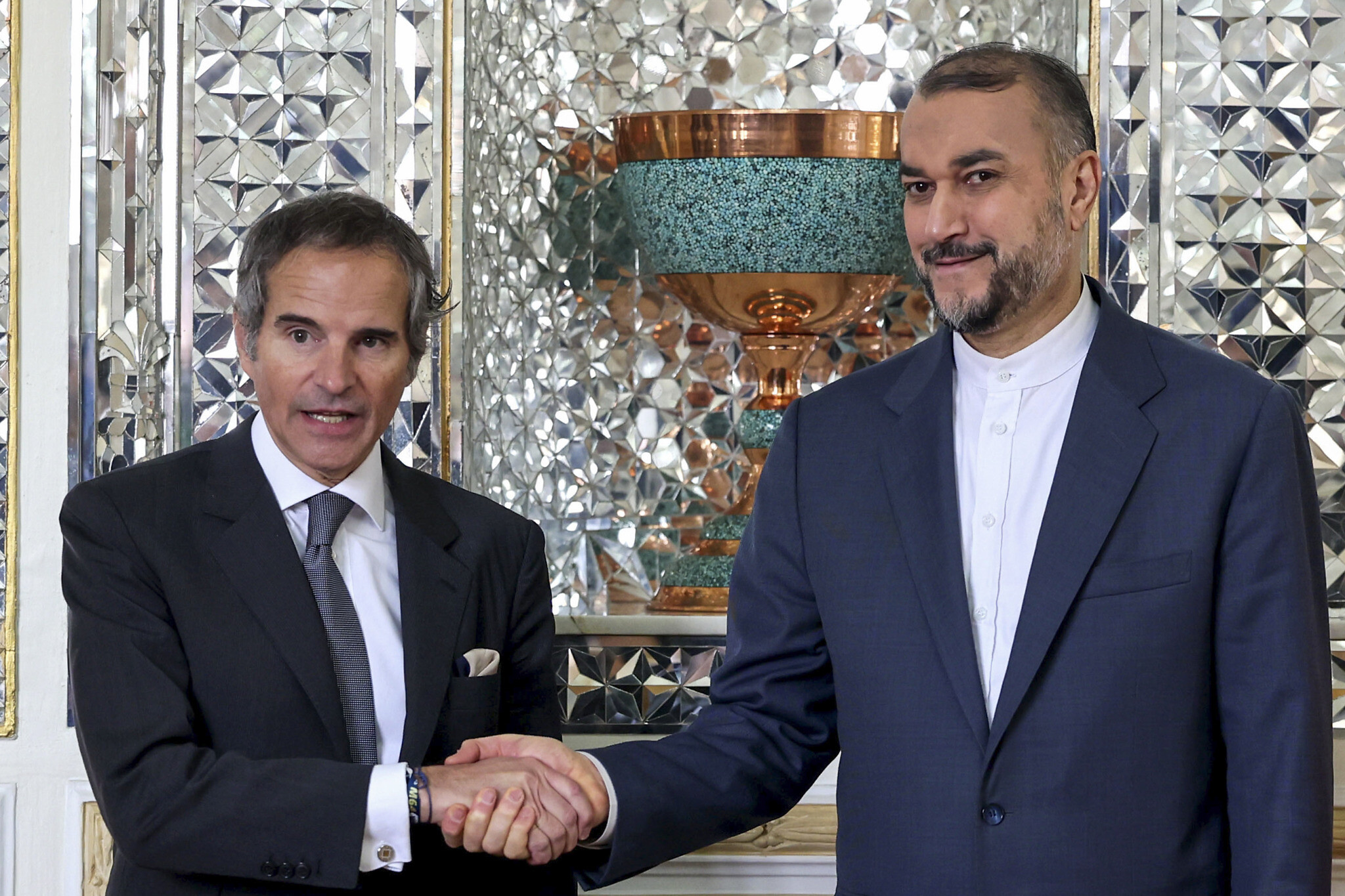
File: Iranian Foreign Minister Hossein Amir-Abdollahian (R) welcomes International Atomic Energy Agency (IAEA) chief Rafael Grossi ahead of a meeting in Tehran on March 4, 2023. (ATTA KENARE / AFP)

“Iran’s stance is not only unprecedented, but unambiguously contrary to the cooperation that is required,” the IAEA said in a confidential report seen by AFP.

The IAEA has condemned the move — which targets eight top inspectors, with French and German nationals among them, according to a diplomatic source.

The inspectors are crucial to the IAEA’s work in Iran as they have “rare expertise and knowledge of the locations,” another diplomatic source said.

Tehran has described its decision as retaliation for “political abuses” by the United States, France, Germany, and Britain.

In a second confidential report distributed to member states, the watchdog said that no progress has been made on its request that Iran explain the origin and current location of manmade uranium particles found at two locations that Tehran has failed to declare as potential nuclear sites, which the IAEA named as Varamin and Turquzabad.

The report also said that there is no progress thus far in getting more monitoring equipment, including cameras, reinstalled that had been removed by Iran in June 2022.

Iran responded to criticism by the US, Britain, France, and Germany on that issue by barring several of the IAEA’s most experienced inspectors from monitoring its nuclear program.

The move was the latest to raise tensions surrounding Iran’s nuclear program, as the 2015 deal curbing Tehran’s nuclear activities in exchange for sanction relief has long fallen apart.

World powers struck the nuclear deal with Tehran in 2015 in an effort to ensure Iran could not develop nuclear weapons. Under the terms of the deal, Iran agreed to limit enrichment of uranium to levels necessary for nuclear power in exchange for the lifting of economic sanctions.

UN inspectors were tasked with monitoring the program.

Then-president Donald Trump unilaterally pulled the US out of the accord in 2018, saying he would negotiate a stronger deal, but that did not happen. Iran began breaking the terms a year later. Those included provisions that Iran was allowed to enrich uranium only up to 3.67% purity and maintain a stockpile of uranium of 300 kilograms.

US President Joe Biden has said he would be willing to re-enter a nuclear deal with Iran, but formal talks to try to find a roadmap to restart the deal collapsed in August 2022.

‘No progress’

In the second report, the IAEA said it received a letter from Iran on Wednesday, reiterating its position to withdraw the inspectors’ accreditation.

Mohammad Eslami, the head of Iran’s civilian nuclear program, said in the letter received by the IAEA that it was “within its rights to de-designate the Agency inspectors” and stated that the watchdog’s “assertion” of the potential risks of impeding the conduct of inspections “is not compelling and lacks any legal basis.”

Eslami added, however, that he was “exploring possibilities to address the request” to reconsider the ban on the inspectors.

IAEA head Rafael Grossi expressed “his hope that this matter will be resolved promptly.”

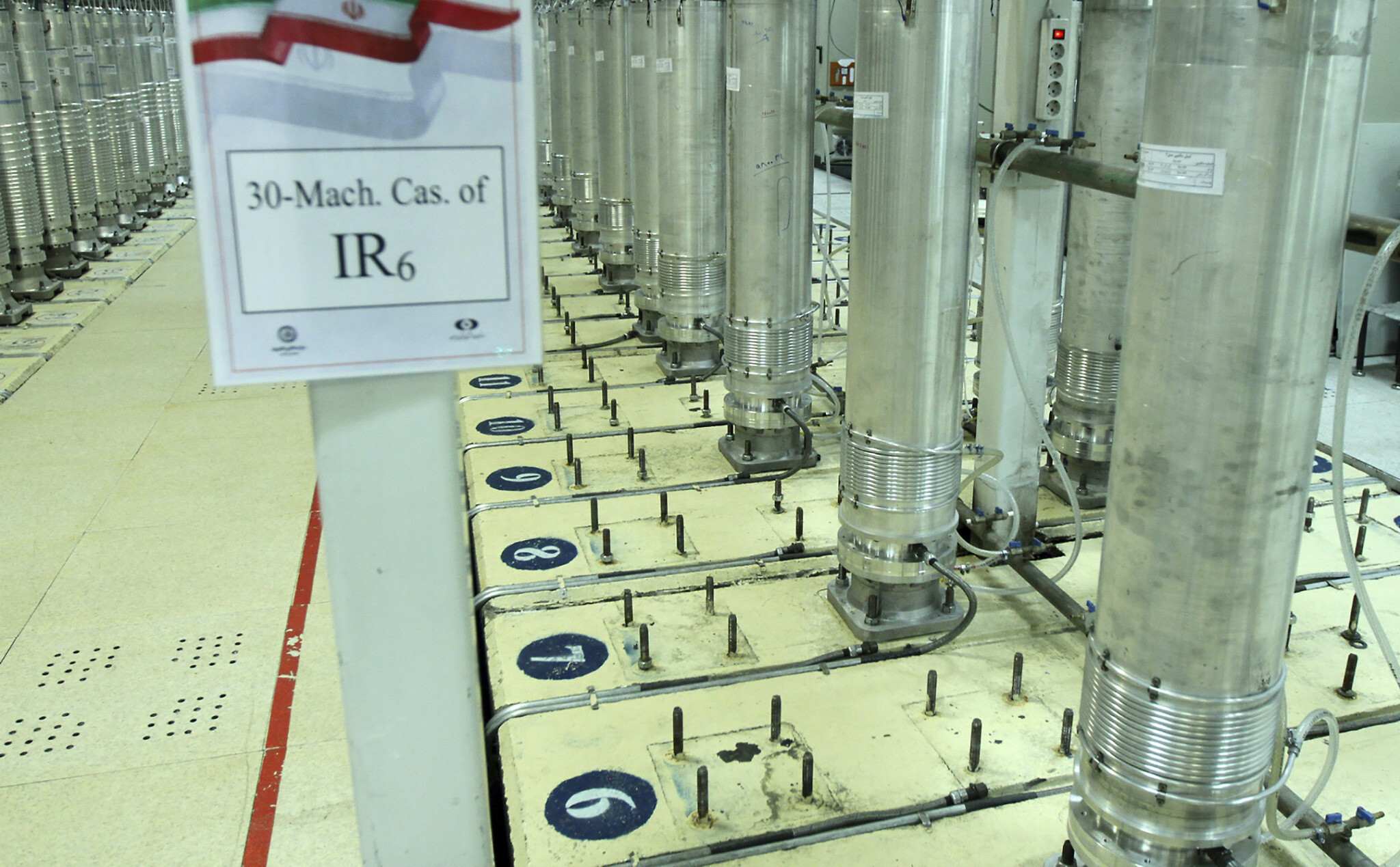
File: This photo released November 5, 2019, by the Atomic Energy Organization of Iran shows centrifuge machines in Natanz uranium enrichment facility near Natanz, Iran. (Atomic Energy Organization of Iran via AP)

Heightened tensions

In recent months, Biden’s administration had strived to keep a lid on Middle East troubles through quiet diplomacy with Tehran.

But that bet came crashing down with the October 7 massacre by Hamas-led terrorists against Israel.

Tensions between Iran and the United States have worsened since the devastating onslaught and Israel’s subsequent air and ground offensive in Gaza, which aims to eliminate Hamas in the Strip.

Washington and Tehran have mutually accused each other of aggravating the situation.

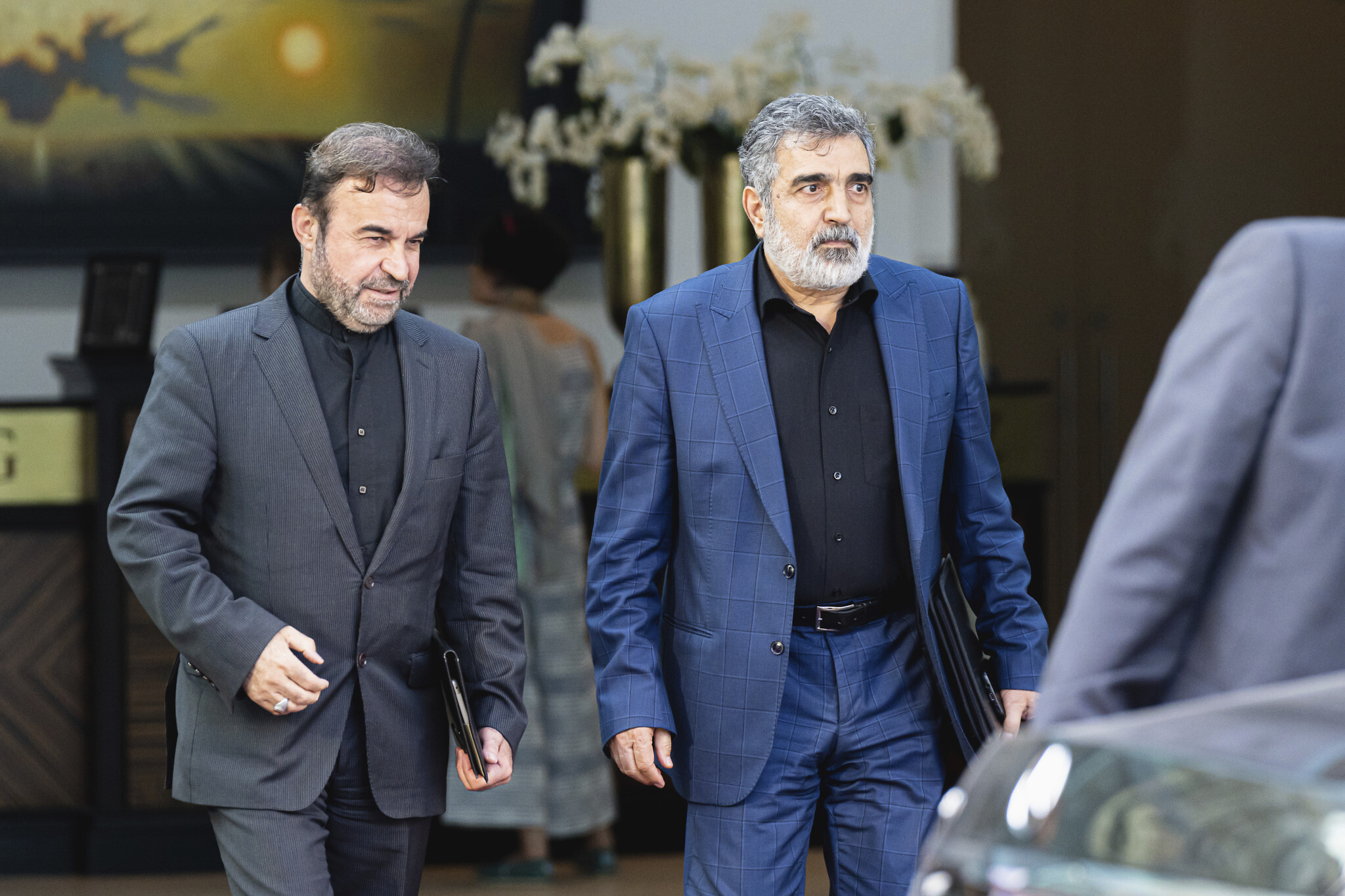
File Iranian deputy foreign minister Reza Najafi, left, and Iranian AEOI spokesperson Behrouz Kamalvandi, seen leaving the Palais Coburg where closed-door nuclear talks took place in Vienna, Austria, August 5, 2022. (AP/Florian Schroetter)

Since 2018, Iran has retaliated against the US’s pulling out of the agreement by stepping up its nuclear activities.

EU-mediated efforts to revive the deal — bringing the US back on board and Iran back into compliance — have so far been fruitless.

The EU announced formally last month that it would maintain sanctions “under the EU non-proliferation regime on Iran.”

The decision to keep the sanctions in place was originally announced by Britain, France, and Germany, all signatories to the pact, in September.

The sanctions remaining in place include blacklisting missile manufacturers and affiliates of Iran’s Revolutionary Guards.