
Among the suggestions is that the deal include provisions to preserve a two-state solution.
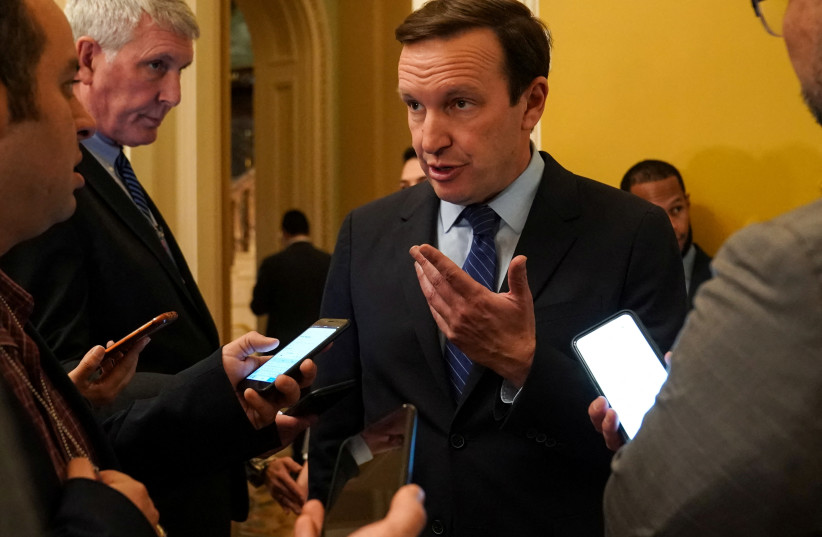
 U.S. Senator Chris Murphy (D-CT) speaks to reporters before attending the weekly Democratic caucus luncheon at the U.S. Capitol in Washington, D.C., U.S., November 29, 2022. (photo credit: REUTERS/SARAH SILBIGER)
U.S. Senator Chris Murphy (D-CT) speaks to reporters before attending the weekly Democratic caucus luncheon at the U.S. Capitol in Washington, D.C., U.S., November 29, 2022.
(photo credit: REUTERS/SARAH SILBIGER)
Twenty Democratic US senators on Wednesday expressed support for a potential Israeli-Saudi normalization deal but laid out concerns about any U.S. security guarantees or nuclear assistance to Riyadh.

In a letter to President Joe Biden, the senators underscored resistance the White House could face from Congress if the administration brokers a landmark agreement opening diplomatic ties between long-time foes Israel and Saudi Arabia in return for Washington meeting Riyadh’s demands.

Negotiations have been advancing, but US officials caution that much work remains.

Among the suggestions of Biden’s fellow Democrats is that any agreement include “meaningful” provisions to preserve the option of a two-state solution to the Israeli-Palestinian conflict. Israel’s far-right government is expected to resist any big concessions to the Palestinians.

“Peace between Israel and its neighbors has been a longstanding goal of US foreign policy, and we are maintaining an open mind about any agreement that would potentially deepen the political, cultural and economic ties between Saudi Arabia and Israel,” the senators wrote.
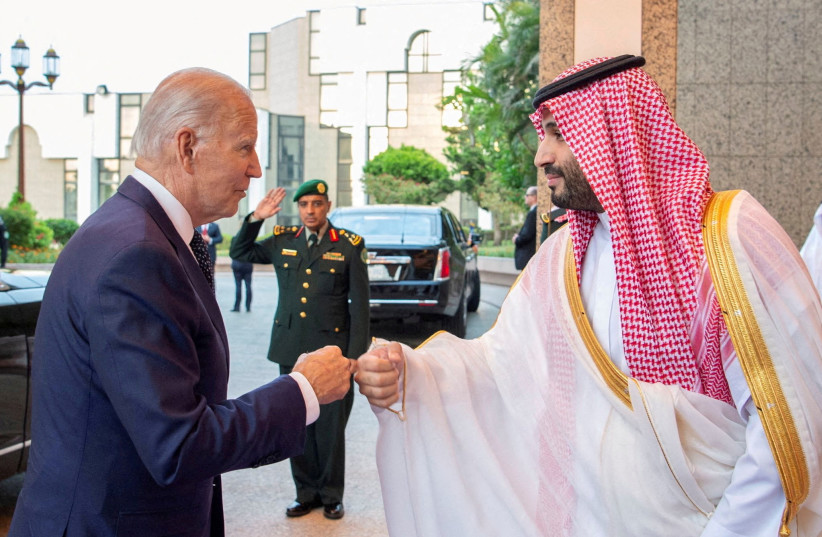
 FILE PHOTO: Saudi Crown Prince Mohammed bin Salman fist bumps U.S. President Joe Biden upon his arrival at Al Salman Palace, in Jeddah, Saudi Arabia, July 15, 2022. (credit: BANDAR ALGALOUD/COURTESY OF SAUDI ROYAL COURT/HANDOUT VIA REUTERS)
FILE PHOTO: Saudi Crown Prince Mohammed bin Salman fist bumps U.S. President Joe Biden upon his arrival at Al Salman Palace, in Jeddah, Saudi Arabia, July 15, 2022. (credit: BANDAR ALGALOUD/COURTESY OF SAUDI ROYAL COURT/HANDOUT VIA REUTERS)

Caution about a binding defense treaty

But they cited misgivings about what the Saudis want.

Saudi Arabia is determined to secure a military pact requiring the United States to defend the kingdom in return for opening ties with Israel and will not hold up a deal even if Israel does not offer major concessions to Palestinians in their bid for statehood, three regional sources familiar with the talks have told Reuters.

“A high degree of proof would be required to show that a binding defense treaty with Saudi Arabia – an authoritarian regime which regularly undermines US interests in the region, has a deeply concerning human rights record, and has pursued an aggressive and reckless foreign policy agenda – aligns with US interests,” the letter stated.

Both Democrats and Republicans have previously denounced Riyadh for intervention in Yemen, moves to prop up oil prices and its role in the 2018 killing of journalist Jamal Khashoggi.

Concern about Saudi nuclear ambitions

The letter also stated concerns about the Saudis’ request for civilian nuclear help and access to advanced weaponry.

It said the US must hold the Saudis to the “gold standard” of Section 123 of the U.S. Atomic Energy Act, establishing a framework for peaceful nuclear cooperation.

The White House did not immediately respond to a request for comment.

Senators leading the letter effort included Middle East subcommittee Chair Chris Murphy, No. 2 Democrat Dick Durbin, Chris Van Hollen and Peter Welch.


Jason Greenblatt: Deal between Israel and Saudi Arabia imminent

Trump’s Special Representative for International Negotiations describes the changes that Saudi Arabia has undergone in recent years.

Israel National News
Oct 4, 2023, 9:32 AM (GMT+3)

Jason Greenblatt

Jason Greenblatt, who served as former US President Donald Trump’s Special Representative for International Negotiations, predicted in an interview published on Wednesday in Israel Hayom that a deal to normalize relations between Israel and Saudi Arabia is imminent.

While Greenblatt was clear that it is difficult and that he does not place bets, he says that even if it would not happen immediately, the talks are on a good path.

According to him, if he were currently working in the same position for President Biden as he did for Trump, he would say that the best thing that the US could do, even if it is not realistic, is to encourage Crown Prince Bin Salman and Prime Minister Netanyahu to talk directly without US mediation. In his opinion, it would be better than a situation where the US is the mediator, or even worse if the US pressures Israel into giving things it doesn’t want to the Palestinians.

Greenblatt is highly involved in Saudi Arabia as a businessman who often visits the kingdom. Last week, he was even a guest of the Saudi Embassy in Washington for its national day celebrations. He recounts that he proudly wore his kipa and was warmly welcomed. He says this is a significant change from the past, and it fills him with hope for the future.

He also recalled how, in 2017, he traveled to Saudi Arabia ahead of President Trump’s visit to the country. He described the very lonely Shabbat he spent in Riyadh, eating the meager kosher food that he brought from home and received from a US military base, and how, on that trip, he did not wear his kipa. Back then, he says, the mere mention of Israel to the Saudis caused discomfort, and the US State Department suggested that President Trump refrain from doing so. Trump disagreed and mentioned the Jewish state several times.

In contrast, Greenblatt now wears his kipa when he walks the streets of Saudi Arabia, sits in its restaurants, and visits its malls, and so do his family members. According to him, the Saudis understand that they have similar religious needs, demands, and feelings, and they respect that. He adds that many Saudis even wish him ‘Shabbat Shalom’, and he received many greetings for the Jewish New Year, in English and even in Hebrew. He thinks they respect Jews even more than many Europeans he knows. The drastic changes caused Greenblatt to feel optimistic about the Saudis.

Greenblatt mentioned the Fox News interview with Bin Salman, in which the crown prince said that his nation is getting closer to normalization with Israel every day and outlined what he would do for the Palestinians. Greenblatt says that he believes that the Saudis have learned that it is possible to help the Palestinians in a way that puts their own needs first.

When asked if the Saudis would be ready within half a year to a year to accept thousands of Israeli tourists, Greenblatt answered that it would take time. He explained that for years, there was a specific kind of education in the kingdom about Israel and others, including Jews, and that now there is a transformation period.


The excavation efforts also led to the discovery of a coin from 67/68 CE, during the first Jewish revolt against the Roman occupying forces.

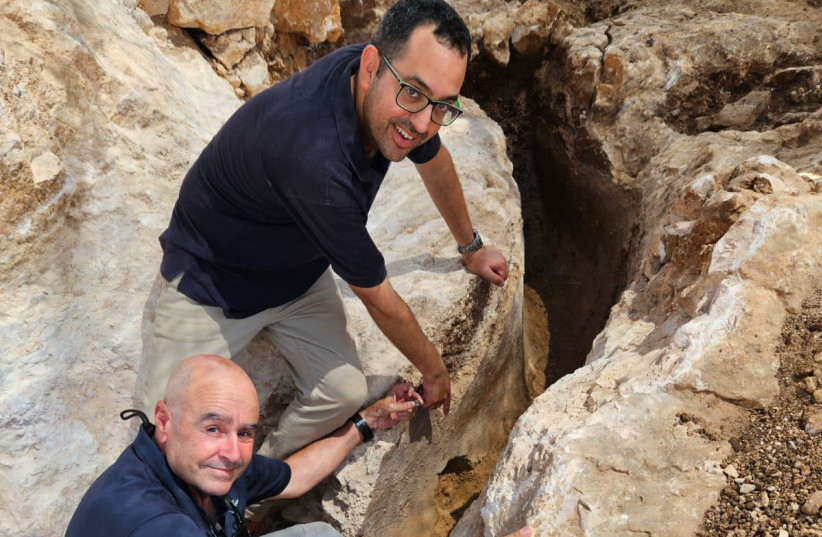
A long section of the Upper Aqueduct to Jerusalem was uncovered in archaeological excavations at Giv‘at HaMatos
(photo credit: EMIL ELJEM/ISRAEL ANTIQUITIES AUTHORITY)
Archaeological excavations in the Giv’at Hamatos neighborhood of Jerusalem uncovered an ancient Aqueduct that once carried water throughout Jerusalem’s upper city during the time of Rome’s occupation, the Israel Antiquities Authorities announced on October 2.

The tunnel once fed water to the homes of Jerusalem’s elite, including the homes of prominent figures like Roman emperor Herod’s palace, 2000 years ago. The duct also continued functioning throughout Jerusalem in 70 CE, after the Tenth Roman Legion destroyed the Second Temple.

“Towards the end of the Second Temple period, when Jerusalem underwent significant expansion, and Herod’s Temple was built, the water flowing in the springs and stored in the cisterns was no longer sufficient for the thousands of residents and pilgrims in the city. Water had to be transferred to the city from afar,” said Dr. Ofer Sion and Ruth Cohen, the excavation directors on behalf of the Israel Antiquities Authority.

“Due to this situation, the Hasmoneans and King Herod built two complex aqueducts to transport water to Jerusalem, constituting one of the grandest and most sophisticated water projects in the country, and indeed, in the ancient world. The aqueducts trapped water from springs in the Bethlehem region, and by the construction of large pools, and the implementation of hydraulic laws (the siphon principle of communicating vessels based on the force of gravity), topography, and an extraordinary level of engineering, the water flowed over many kilometers.”

A long section of the Upper Aqueduct to Jerusalem was uncovered in archaeological excavations at Giv‘at HaMatos. (credit: EMIL ELJEM/ISRAEL ANTIQUITIES AUTHORITY)

Other finds in the ancient Aqueduct

The excavation efforts, funded by Arim Urban Development Company, also led to the discovery of a coin from 67/68 CE. The coin dates back to the first Jewish revolt against the Romans, which was before the destruction of the Second Temple. It is believed that Roman occupiers had intentionally left the coin in the duct.

“Even with the establishment of the new pagan city Aelia Capitolina, the Tenth Legion continued to use and upkeep the sophisticated aqueduct,” explain Sion and Cohen. “We found about 25 coins in the aqueduct foundations, distributed at fairly equal distances. In our opinion, this is hardly coincidental, but just as is still common today, the Tenth Legion builders placed the coins there for good fortune.”

“The exposure of this section of the Upper Aqueduct and the discovery of the 25 coins may enable– possibly for the first time—an absolute dating of the different stages of the construction of Jerusalem’s water aqueducts. It may shed light on the question of who built the first aqueduct—whether it was the Hasmoneans, or King Herod,” the researchers say.

The route of the Upper Aqueduct followed a convenient and gentle topographical course. So far, three distinct parts have been identified: the lower two parts dating from the Late Second Temple period, and the upper part dating from the days of the Roman Legion stationed in the upper city.